Is the location of the Sanctified House in Makkah mentioned in the Torah?
David (PBUH) spoke of the new House of the Lord, as recorded in chapter 84 of the Book of Psalms:
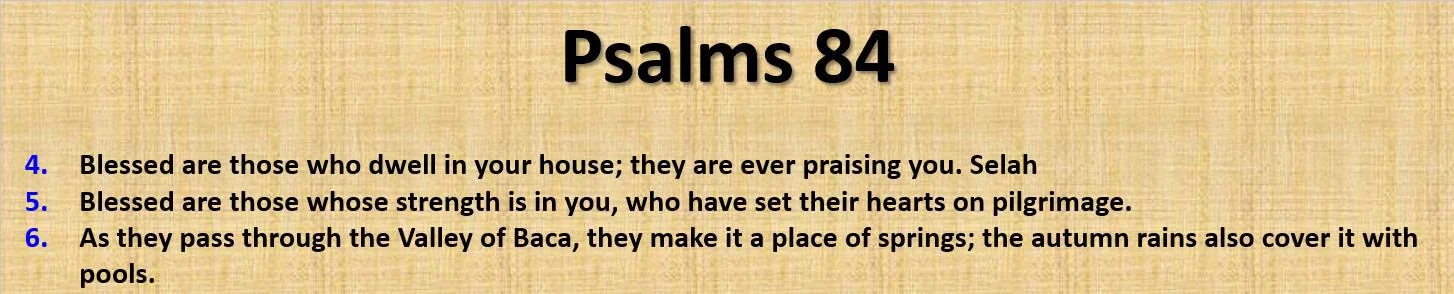
“Blessed are those who dwell in your house; they are ever praising you. Selah” (Psalms 84:4). That is, they pray to Allāh and praise Him continually in His House. Where is this House of the Lord located? Is it the Jewish Temple, which has been destroyed, or the churches, which are filled with idolatry? “Blessed are those whose strength is in you, who have set their hearts on pilgrimage” (Psalms 84:5). This verse is similar in meaning to the Qurʾānic verse: {Our Lord! I have made some of my offspring settle in a barren valley near Your Sacred House! Our Lord! I did so that they may establish Prayer. So make the hearts of ˹believing˺ people affectionately inclined toward them} (Qurʾān 14:37). Allāh granted this supplication of Prophet Abraham (PBUH). For this reason, people from across Arabia used to come to the Sacred House in Makkah for ḥajj and ʿumrah at the time this verse was revealed, and Muslims continue to gather there from all over the world for the same purpose to this day. “As they pass through the Valley of Baca, they make it a place of springs; the autumn rains also cover it with pools” (Psalms 84:6). The House of the Lord is located in the Valley of Baca. Notably, Bakkah—an ancient name for Makkah—is also mentioned in the Qurʾān: {Surely the first House ˹of worship˺ established for humanity is the one at Bakkah—a blessed sanctuary and a guide for ˹all˺ people} (Qurʾān 3:96). The text in the Book of Psalms (84:4–6) is, therefore, sufficient proof for truth-seekers among the People of the Book (i.e., the Jews and the Christians) to accept Islam without hesitation. It speaks of those whose hearts are set on pilgrimage to the House of the Lord, located in the Valley of Baca, and the Qurʾān confirms this location by referring to Bakkah, the ancient name of Makkah. This establishes that these verses in Psalm 84 prefigure the faithful who unceasingly praise Allāh in the Sanctified House in Makkah. Incidentally, the fact stated in the Qurʾān regarding the Sanctified House in Makkah—that it is the first House established on earth for all people to worship Allāh—cannot be challenged. It is established through numerous undisputed traditions that the Kaʿbah was constructed by Abraham (PBUH), who lived roughly eight or nine centuries before Moses (PBUH), who in turn lived many centuries before David (PBUH) and his son Solomon (PBUH). Hence, the fact that the Kaʿbah predates the Temple of Jerusalem is beyond dispute, since Abraham (PBUH) and his son Ishmael (PBUH) built the Kaʿbah in Makkah, whereas Solomon (PBUH) built the Temple in Jerusalem. The statement “they make it a place of springs” refers to the well of Zamzam. The phrase “they make it” indicates that there was originally neither water nor crop in that valley in Makkah, exactly as described in the Qurʾān: {Our Lord! I have made some of my offspring settle in a barren valley near Your Sacred House} (Qurʾān 14:37). Unfortunately, the phrase “the Valley of Baca” was inaccurately translated into Arabic as “Wādī al-Bukāʾ,” meaning “the Valley of Weeping,” instead of “Wādī Bakkah,” even though no such place exists anywhere on earth or on any world map. Additionally, the expression “the Valley of Weeping” does not appear in the Hebrew Bible or in any recognized version of it, including the two widely regarded English translations, the New International Version and the King James Version. Rather, these sources consistently use the expression “the Valley of Baka” or “the Valley of Baca.”
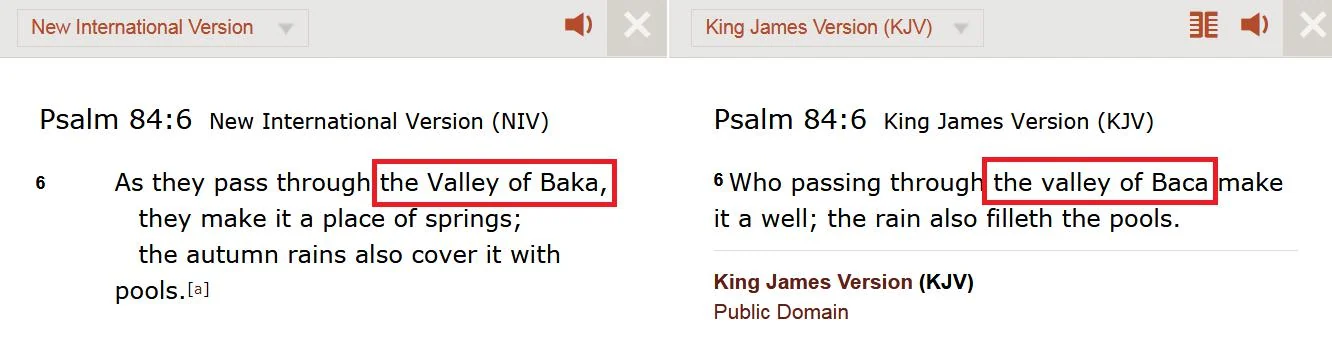
While one translation renders the term as “Baka” and the other as “Baca,” both capitalize it, demonstrating that “the Valley of Baka/Baca” is understood as a proper noun rather than a descriptive expression. The rendering “the Valley of Weeping” appears only in certain Middle Eastern translations of the Bible, particularly the Arabic and Aramaic translations, whereas widely recognized English translations consistently retain the expression “the Valley of Baca.”

Without a doubt, the Torah heralded that the House of the Lord would be in the Valley of Bakkah, yet the People of the Book, unfortunately, conceal this truth. They substituted “Wādī Bakkah” (the Valley of Bakkah) with “Wādī al-Bukāʾ” (“the Valley of Weeping”) for the simple reason that Muslims in the Middle East have access to their Scriptures and could therefore use this prophecy as evidence for the truth of Islam. Indeed, Jewish rabbis and Christian scholars have kept the revealed truth concealed throughout their history to the present day. The Qurʾān sternly warns those among the People of the Book who hide clear signs—such as the description of Prophet Muḥammad (PBUH)—after Allāh made them evident to His servants through the Books revealed to His Messengers. Allāh declares that all things curse such people for this grave act. Just as everything—even the fish in the sea and the birds in the air—seeks forgiveness for the scholar who teaches people what is good, in the same way, those who conceal knowledge are cursed by Allāh and by the cursers: the angels, humankind, and all who curse, including animals, each in its own distinct manner. Allāh says: {Those who conceal the clear Signs We have sent down, and the Guidance, after We made it clear for the people in the Book, on them shall be Allāh’s curse, and the curse of those entitled to curse} (Qurʾān 2:159). The warning is directed at the Jewish rabbis and Christian scholars who concealed the clear proofs in their Scriptures that attest to the truthfulness of Prophet Muḥammad (PBUH) and his message. They were duty-bound to do their utmost to convey true guidance, yet they kept it hidden. Indeed, the gravest shortcoming of the knowledgeable among the People of the Book was that they kept the teachings and signs revealed by Allāh confined to a limited class of individuals—namely the rabbis and monks—rather than disseminating them widely. They did not allow this knowledge to reach even the broader Jewish and Christian communities, let alone the non-Jewish and non-Christian peoples of the world. Later, when Prophet Muḥammad (PBUH) began his mission, they recognized him yet deliberately concealed the truth. Allāh says: {Indeed, those who hide Allāh’s revelations, trading them for a fleeting gain consume nothing but fire into their bellies. Allāh will neither speak to them on the Day of Judgment, nor will He purify them. And they will suffer a painful punishment. They are the ones who trade guidance for misguidance and forgiveness for punishment. How persistent are they in pursuit of the Fire!} (Qurʾān 2:174–175). That is, those who conceal the signs of the Truth in their Scriptures to gain leadership, status, or financial benefit will face a painful punishment. The scholars of the People of the Book subjected the Scriptures to distortions, tampering with the texts and twisting them in a manner that obscured their true meaning. They concealed the description of Prophet Muḥammad (PBUH) and replaced “the praised (Muḥammad) of all nations” with “the desired of all nations,” and “the Valley of Bakkah” with “the Valley of Weeping.” The Qurʾān relates that when they conferred among themselves, they instructed one another not to disclose the knowledge Allāh had revealed to them—that is, the prophecies concerning the Prophet (PBUH)—to the believers (i.e., the Muslims), fearing that they would use this scriptural evidence against them before Allāh: {Do you ˹believers still˺ expect them to be true to you, though a group of them would hear the word of Allāh then knowingly corrupt it after understanding it? (75) When they meet the believers they say, “We believe.” But in private they say ˹to each other˺, “Will you disclose to the believers the knowledge Allāh has revealed to you, so that they may use it against you before your Lord? Do you not understand?” (76)} (Qurʾān 2:75–76).
Let us return to the Book of the Psalms: “As they pass through the dry valley of Baca, it becomes a place of springs.”

Similar to the phrase “the dry Valley of Baca” mentioned in the Book of Psalms, Allāh says: {Our Lord! I have settled some of my offspring in a barren valley, near Your Sacred House} (Qurʾān 14:37). What, then, occurred after Abraham (PBUH) settled some of his offspring in this barren valley? The verse in the Book of Psalms states, “they make it a place of springs,” symbolizing the emergence of the well of Zamzam. Without a doubt, any atheist who ignores such fulfilled prophecies and denies the truth of what Allāh has revealed is no less culpable than the Jews and Christians who are fully aware of the truth yet conceal it. Allāh says: {Surely those who disbelieve and die as disbelievers are cursed by Allāh, the angels, and all of humanity} (Qurʾān 2:161).

That is, those who persist in disbelief and die without repenting are removed from Allāh’s mercy, and the angels, together with all righteous humanity, beseech Allāh to exclude them from His mercy. In short, the prophecy in the Book of Psalms applies to none other than Prophet Muḥammad (PBUH), his nation, and the Sanctified House of Allāh in Makkah. Hence, refusal to believe in Prophet Muḥammad (PBUH) constitutes a form of disbelief. Therefore, beware of Allāh’s punishment, and do not underestimate the consequences of refusing to believe in Prophet Muḥammad (PBUH) or to acknowledge the teachings he conveyed on Allāh’s behalf—encompassing beliefs, moral principles, and laws governing human life—for Allāh will not accept from anyone who rejects his Prophethood any obligatory or supererogatory act as recompense.
Let us recapitulate the principal prophecies discussed in the previous sections. Prophet Moses (PBUH) heralded the coming of Prophet Muḥammad (PBUH) when he said: “The LORD your God will raise up for you a prophet like me from among your brothers. You must listen to him” (Deuteronomy 18:15). As explained earlier, a Prophet like Moses would arise from among the brothers of the Israelites—that is, from the descendants of Ishmael (PBUH). “I myself will call to account anyone who does not listen to my words that the prophet speaks in my name” (Deuteronomy 18:19). Indeed, Allāh will call to account whoever refuses to follow the teachings of Prophet Muḥammad (PBUH). Prophet Habakkuk (PBUH) proclaimed that the light of Prophethood would shine forth from among the Children of Ishmael: “God came from Teman, the Holy One from Mount Paran” (Habakkuk 3:3). The wilderness of Paran was the dwelling place of Ishmael (PBUH). Prophet Isaiah (PBUH) foretold the coming of Prophet Muḥammad (PBUH) when he said: “Here is my servant, whom I uphold, my chosen one in whom I delight; I will put my Spirit on him, and he will bring justice to the nations” (Isaiah 42:1). Isaiah (PBUH) also foretold that the Prophet (PBUH) would raise the voice of glorification and the call to prayer in the dwellings of Kedar and in Sela—that is, in Makkah and al-Madīnah: “Let the wilderness and its towns raise their voices; let the settlements where Kedar lives rejoice. Let the people of Sela sing for joy; let them shout from the mountaintops” (Isaiah 42:11). Prophet Jesus (PBUH) foretold the coming of Prophet Muḥammad (PBUH) when he said to the Jews: “Have you never read in the Scriptures: The stone the builders rejected has become the capstone” (Matthew 21:42). Prophet Daniel (PBUH)’s visions likewise foretold the coming of Prophet Muḥammad (PBUH) and the rise of his nation, which would overcome the four pagan kingdoms of the earth and conquer the kingdom symbolized by the “eleventh horn” (i.e., Constantinople). Prophet Jacob (PBUH), on his deathbed, informed his sons of the coming of Prophet Muḥammad (PBUH): “The sceptre shall not depart from Judah, nor a lawgiver from between his feet, until Shiloh come; and unto him shall the gathering of the people be” (Genesis 49:10). Prophet Haggai (PBUH) prophesied the advent of Prophet Muḥammad (PBUH) who is the desired of all nations and to whom they shall submit: “I will shake all nations, and the desired of all nations will come” (Haggai 2:7). For the sake of brevity, we shall content ourselves with this selection of prophecies in the Scriptures of the People of the Book concerning Allāh’s final Prophet, Muḥammad (PBUH). It is worth noting that this attempt to shed light on the subject is but a humble one, for the Torah and the Bible contain many more prophecies than those mentioned here. In addition, numerous prophecies are found in the apocryphal (i.e., non-canonical) books of the Bible, as well as in the scriptures of certain East Asian religious traditions. It is to be hoped that more in-depth research will be undertaken in this field for the benefit of the Islamic nation. Indeed, any fair-minded person who considers the remarkable number of these prophecies and reflects upon their precision will be deeply impressed and will recognize them as compelling proofs of Muḥammad (PBUH)’s Prophethood. Allāh says: {Was it not sufficient proof for them that it has been recognized by the knowledgeable among the Children of Israel?} (Qurʾān 26:197). Allāh also says: {The disbelievers say, “You are no messenger.” Say, “Allāh is sufficient as a Witness between me and you, as is whoever has knowledge of the Scripture”} (Qurʾān 13:43). That is, those who possess knowledge of the divinely revealed Books bear witness that the teachings of Prophet Muḥammad (PBUH) are in harmony with those imparted by the earlier Prophets. Allāh says: {They demand, “If only he could bring us a sign from his Lord!” Have they not already received a confirmation of what is in the earlier Scriptures?} (Qurʾān 20:133). This indicates that the Qurʾān itself is a profound miracle: though presented by an unlettered man from among the Quraysh, it embodies the essence of the teachings and guidance contained in the previous Scriptures. Unquestionably, these Scriptures—which the Qurʾān affirms—serve as a sign attesting to the truthfulness of Muḥammad’s (PBUH) mission.1
Notes and References
- 1
Abū ʿAbd Allāh al-Qurṭubī, al-Jāmiʿ li-ʾAḥkām al-Qurʾān, (Bayrūt, Lebanon: Muʾassasat ar-Rissālah, 2006), vol. 16.