Several claimants to Prophethood emerged in the Arabian Peninsula after Prophet Muḥammad (PBUH). How can one distinguish between a true Prophet and such claimants?
The answer to this question is found in chapter 18 of the Book of Deuteronomy:
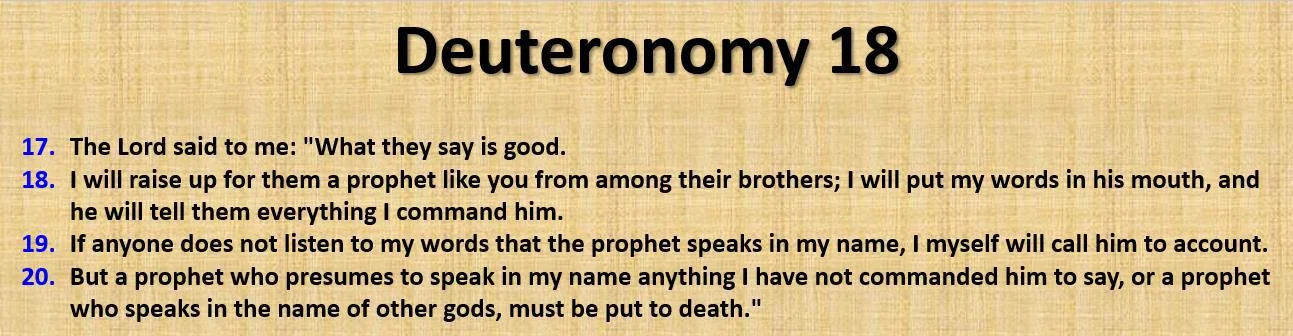
Allāh says: “But a prophet who presumes to speak in my name anything I have not commanded, or a prophet who speaks in the name of other gods, is to be put to death.” (Deuteronomy 18:20). In other words, whoever fabricates falsehoods and attributes them to Allāh is destined to perish. The Qurʾān makes a similar distinction between a true Prophet and a claimant. In one of the earliest chapters revealed in Makkah—responding to the accusations of the Makkan pagans who alleged that the Prophet (PBUH) had fabricated the Qurʾān—Allāh declares that had he (PBUH) fabricated even a small portion of it, He would have seized him and killed him immediately: {Had the Messenger made up something in Our Name, (44) We would have certainly seized him by his right hand, (45) then severed his aorta (46)} (Qurʾān 69:44–46). Now, the fact that this verse appears in one of the earliest Qurʾānic chapters to be revealed, and that Muḥammad (PBUH) is regarded—by impartial historians—as the most successful and influential figure in human history, speaks for itself. In other words, the Prophet (PBUH) did not pass away until Allāh had perfected the religion through him. Allāh says:{This day I have perfected for you your religion and completed My favor upon you and have approved for you Islam as religion} (Qurʾān 5:3). The message was conveyed, the Sharīʿah completed, and the Prophet (PBUH) passed away only a few days after this verse was revealed. In short, unlike a false prophet, a true Prophet completes his mission. There is a second criterion distinguishing a true Prophet from a false one, mentioned in chapter 18 of the Book of Deuteronomy: “18 21You may say to yourselves, “How can we know when a message has not been spoken by the Lord?” 22If what a prophet proclaims in the name of the Lord does not take place or come true, that is a message the Lord has not spoken. That Prophet has spoken presumptuously. Do not be afraid of him.” (Deuteronomy 18:21-22).
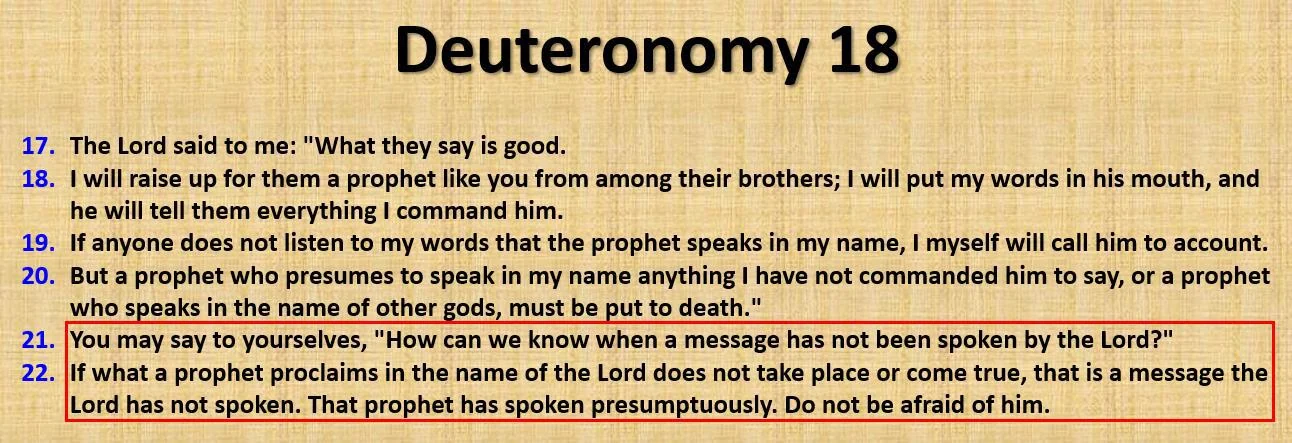
Allāh informs us that anyone who claims Prophethood and foretells things that do not come to pass is a false prophet. Undoubtedly, there is no other Prophet—whether in the Old Testament or the New Testament—with as many fulfilled prophecies as Prophet Muḥammad (PBUH). In fact, all the prophecies of Jesus Christ, Moses, and all the Prophets of the Old Testament put together would not amount to the number of Prophet Muḥammad’s fulfilled prophecies.