Did the Arabs anticipate their victories over the kingdoms of the earth?
Indeed, no nation in the history of the earth was more wretched, fewer in number, or more divided than the Arabs before Islam. They lived as primitive tribes on the margins of the civilized empires that dominated the earth—namely, the Persian, Greek, and Roman empires. At the time when Prophet Muḥammad (PBUH) received the revelation and began to preach it, the Arabs could not have imagined, even in their wildest dreams, seeing these great empires, let alone conquering them. Moreover, the Muslims were vastly outnumbered—consisting of only a few hundred Companions around the Prophet (PBUH)—and were oppressed, constantly fearing attacks from their enemies. Nevertheless, Allāh informed the Prophet (PBUH) of the sovereignty of His religion and its eventual spread across all these kingdoms. The Qurʾān conveyed the divine promise that those who act according to the teachings of Islam would be granted honour, glory, and superiority. Allāh says: {We have surely revealed to you a Book, in which there is glory for you. Will you not then understand?} (Qurʾān 21:10). Accordingly, Allāh urges the Prophet (PBUH) and his nation to understand that their honour lies in the Qurʾān, and that they will be held accountable on the Day of Judgment for following its guidance and calling others to it. He says: {Surely this ˹Qurʾān˺ is a glory for you and your people. And you will ˹all˺ be questioned ˹about it˺} (Qurʾān 43:44). In short, Islam came to spread and prevail, and the Prophet (PBUH) foretold the conquest of all the kingdoms of ancient times, including the Levant, Iraq, Persia, and Constantinople. Moreover, he (PBUH) foretold that the message of Islam would reach the farthest east and west of the earth.1
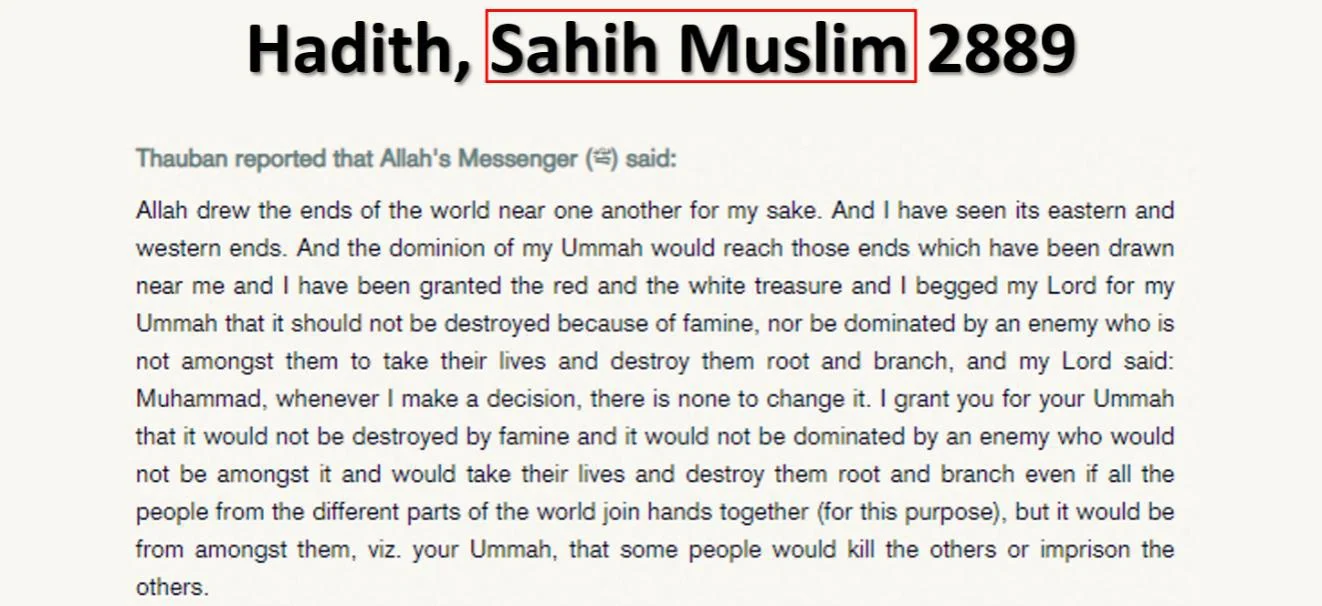
“Allāh drew the ends of the world near one another for my sake” means that Allāh brought distant lands together; “and I have seen its eastern and western ends” indicates that the Islamic conquests in the East and West would surpass those in the North and South; and “the dominion of my ummah (Muslim nation) would reach those ends which have been drawn near me” promises that all the lands shown to the Prophet (PBUH) would be conquered by the Muslims. In the expression “…and I have been granted the red and the white treasure,” the red treasure signifies gold, and the white treasure signifies silver. This means that the Prophet (PBUH) was granted the treasures of the kings of Iraq and the Levant, namely Khosrow and Caesar. Ironically, at the beginning of Islam, the Arabs feared for their seasonal trade journeys—their winter and summer trips to Yemen and the Levant. That is, they feared rejection by those kingdoms they visited for trade. Therefore, the Prophet (PBUH) informed them that a time would come when these kingdoms, to which they traveled for trade and which they feared, would fall under Islamic rule. He (PBUH) declared that he had been granted the red and white treasures, which would be spent in the cause of Allāh, as stated in an agreed-upon authentic Prophetic tradition. Jābir ibn Samurah [may Allāh be pleased with him] reported that the Messenger of Allāh (PBUH) said: “When Khosrow perishes, there will be no Khosrow after him; and when Caesar perishes, there will be no Caesar after him. By Him in Whose Hand my soul is, their treasures will surely be spent in the cause of Allāh.”2 The infidel kingdoms were conquered during the era of the Companions. Muslim rule spread from China in the east to Andalusia in the west, as the Prophet (PBUH) had prophesied, and the treasures of Khosrow and Caesar were indeed spent in the cause of Allāh in Iraq and the Levant. In short, with the advent of the Prophet (PBUH), the time had come for the Arabs to rise. They ruled the world for centuries and filled the earth with justice after it had long been filled with oppression and tyranny. Without a doubt, at that time, never in their wildest dreams did the Arabs imagine that they would one day conquer the greatest kingdoms of the earth. Nevertheless, the vision of Prophet Daniel (PBUH) was indeed fulfilled.
Notes and References
- 1
Muslim ibn al-Ḥajjāj, Ṣaḥīḥ Muslim, (Bayrūt, Lebanon: Dār al-Kutub al-ʿIlmiyyah, 2020), ḥadīth: 2889a, available at: https://sunnah.com/muslim:2889a.
- 2
Agreed upon ḥadīth, Muḥammad al-Bukhārī, Ṣaḥīḥ al-Bukhārī, (Cairo, Egypt: Dār as-Salām. 1999), ḥadīth: 3121, available at: https://sunnah.com/bukhari:3121; Muslim ibn al-Ḥajjāj, Ṣaḥīḥ Muslim, (Bayrūt, Lebanon: Dār al-Kutub al-ʿIlmiyyah, 2020), ḥadīth: 2919, available at: https://sunnah.com/muslim:2919a.