What are some of the mysterious matters in the Torah that the Holy Qurʾān clarifies?
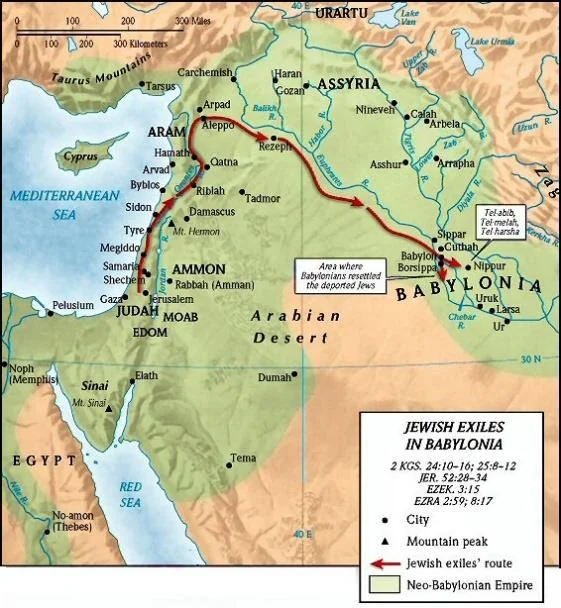
Without a doubt, the Noble Qurʾān resolves many mysteries found in the Torah. Perhaps the most striking of these, in my view, is the sudden disappearance of Prophet Ezra (PBUH) from the unfolding events of his time. Historically, the sovereignty of the Judean kingdom in the land of Israel came to an abrupt end with the destruction of Jerusalem by Nebuchadnezzar, who burned the Temple in 586 B.C. Following the destruction of the Temple, the Jews were taken into Babylonian captivity, where they remained for many years. Then, in the fifth century B.C., Prophet Ezra—known in Islamic tradition as ʿUzayr (PBUH)—emerged. He was well versed in the Scriptures that had been destroyed and began teaching the people. He resolved to undertake the task of restoring the Scriptures and of leading the believers from Babylon back to Jerusalem.
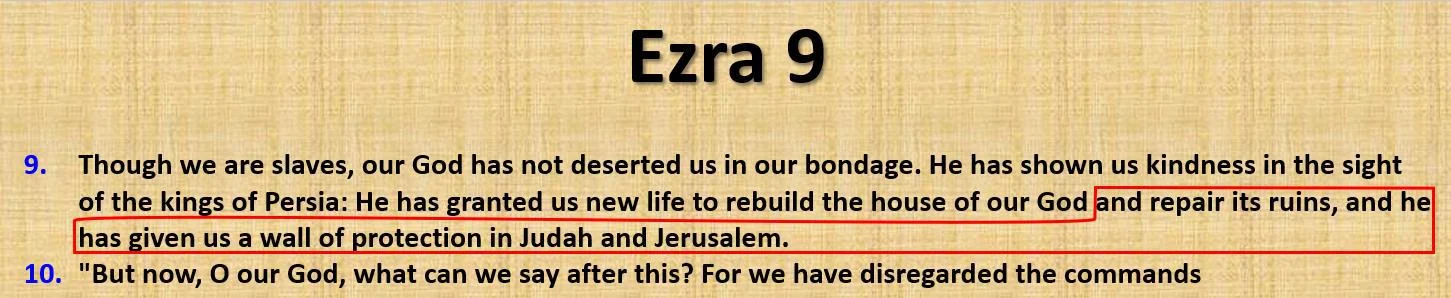
When Ezra passed by the city of Jerusalem, he found it in ruins. Moreover, although God had shown the Israelites kindness and granted them the means to rebuild the Temple, they had neglected His commands. As the Scripture recounts: “9 9Though we are slaves, our God has not deserted us in our bondage. He has shown us kindness in the sight of the kings of Persia: He has granted us new life to rebuild the house of our God and repair its ruins, and he has given us a wall of protection in Judah and Jerusalem. 10But now, O our God, what can we say after this? For we have disregarded the commands” (Ezra 9:9-10).
Here we reach the heart of the mystery that the Jews have yet to resolve. It is recorded that Ezra came from Babylon to Jerusalem, and thirteen years later, another figure named Nehemiah also arrived in the holy city:

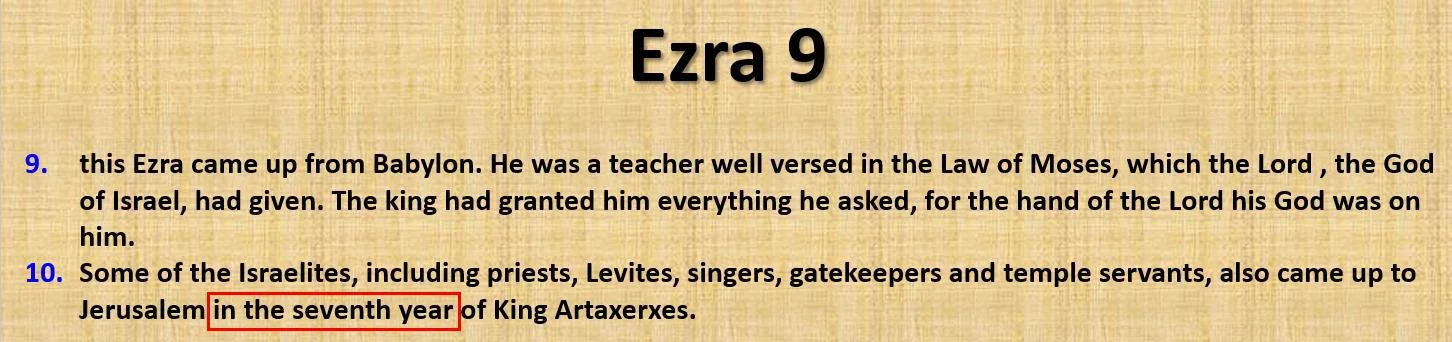
On the one hand, Ezra arrived in Jerusalem in the seventh year of King Artaxerxes’s reign:
On the other hand, Nehemiah arrived in Jerusalem in the twentieth year of King Artaxerxes’s reign: “1 1The words of Nehemiah son of Hacaliah: In the month of Kislev in the twentieth year, while I was in the citadel of Susa, 2Hanani, one of my brothers, came from Judah with some other men, and I questioned them about the Jewish remnant that survived the exile, and also about Jerusalem” (Nehemiah 1:1-2).

And here comes the surprise: Ezra completely disappears from the unfolding events, only to reappear in the generation of Nehemiah’s descendants. The Jews have never been able to understand or explain this mysterious incident, as the Bible provides no account for Ezra’s sudden disappearance and reappearance after such a long interval. Ezra had arrived in Jerusalem thirteen years before Nehemiah. At that time, as noted earlier, the holy city lay in ruins with very few believers remaining. Yet, after the lapse of many generations, Ezra suddenly reappears to find the city filled with believers: “10 1While Ezra was praying and confessing, weeping and throwing himself down before the house of God, a large crowd of Israelites—men, women and children—gathered around him. They too wept bitterly” (Ezra 10:1).

On the contrary, when Nehemiah arrived in Jerusalem after Ezra, he found only a small number of inhabitants in the holy city, which lay in ruins: “7 4Now the city was large and spacious, but there were few people in it, and the houses had not yet been rebuilt” (Nehemiah 7:4).

The most remarkable detail is that Nehemiah arrived in Jerusalem during the time of the high priest Eliashib: “3 1 Eliashib the high priest and his fellow priests went to work and rebuilt the Sheep Gate. They dedicated it and set its doors in place, building as far as the Tower of the Hundred, which they dedicated, and as far as the Tower of Hananel” (Nehemiah 3:1).

Ezra, on the other hand, arrived in Jerusalem during the time of Jehohanan (son of Joiada), grandson of Eliashib:1 “10 6Then Ezra withdrew from before the house of God and went to the room of Jehohanan son of Eliashib. While he was there, he ate no food and drank no water, because he continued to mourn over the unfaithfulness of the exiles” (Ezra 10:6).

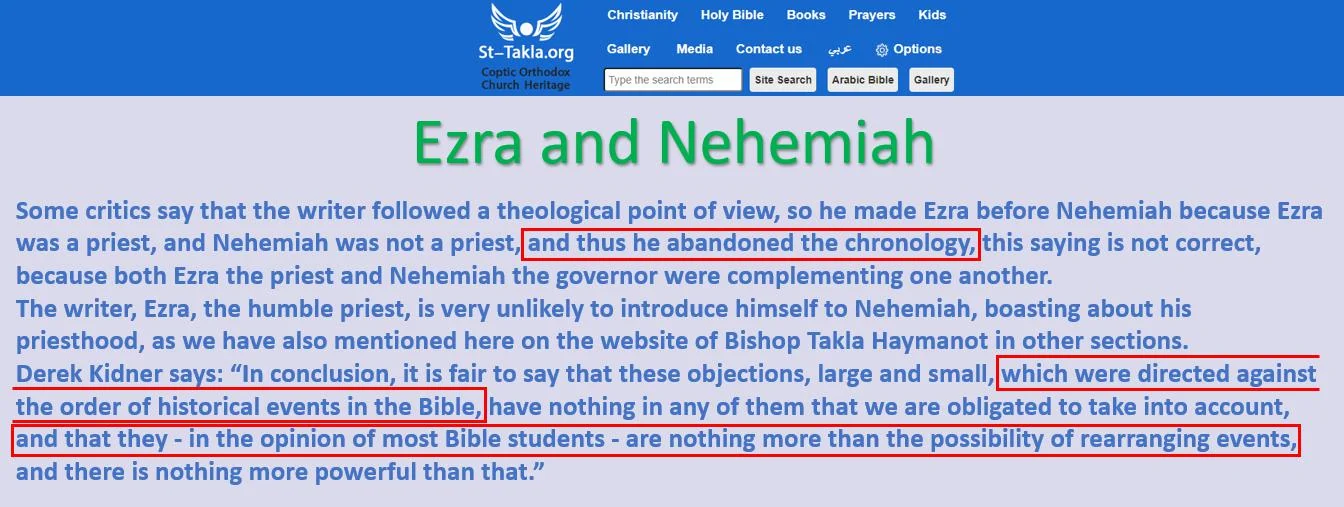
This unusual incident places the Jews in a historical dilemma that can accurately be described as a chronological problem in the post-exilic Books of Ezra and Nehemiah. As noted above, Ezra appears in Jerusalem, then disappears from the narrative for what seems to be three successive generations, only to reappear during the time of the high priest’s grandson. Strikingly, although Ezra arrived in Jerusalem thirteen years before Nehemiah, the narrative situates him within what appears to be the generation of Nehemiah’s descendants. Since a generation generally spans roughly thirty to forty years, Ezra’s apparent absence would amount to nearly a century. How, then, could he have arrived earlier, yet be associated with a later generation? This sequence presents a clear chronological difficulty—one for which Jewish scholars have not reached a resolution to this day. Attempts to solve this difficulty have not truly removed it. The Coptic Orthodox Church Heritage Website (St-Takla.org) relates that some critics suggested that the author arranged the material—the Books of Ezra—from a theological point of view rather than in strict chronological order. In other words, the events may not be presented in the exact order in which they happened. However, this explanation effectively requires a rearrangement of the sequence of events as presented in the text. Opponents have therefore argued that such theological approaches compromise the original chronology. This point is reinforced by Derek Kidner, a British Old Testament scholar, who stated that the objections against the order of historical events in the Bible amount to nothing more than the possibility of rearranging them. Although he intended this as a dismissal of the criticism, the statement is revealing in itself. If the solution is to rearrange events, then the narrative order itself is not strictly chronological. Therefore, the problem is not denied. Rather, it is managed by allowing the order of events to be adjusted, and the proposed solution effectively concedes that the sequence, as it stands, presents a genuine difficulty.
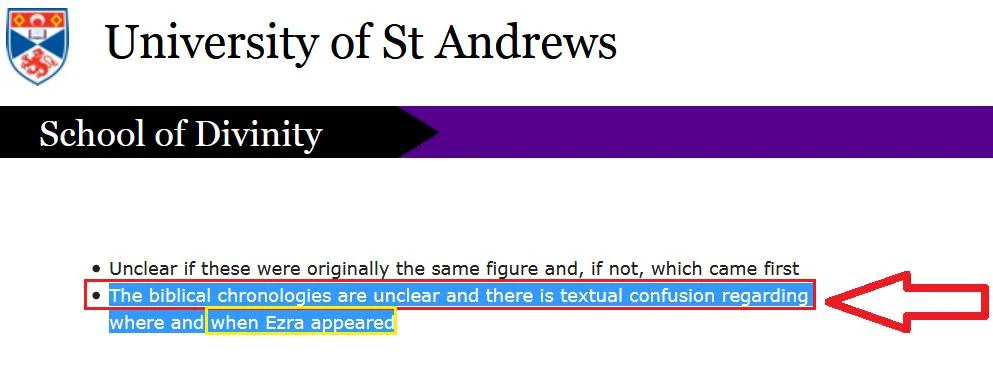
Similarly, the University of St Andrews published an article on its website stating that the biblical chronologies are unclear and that there is textual confusion concerning when and where Ezra appeared.2

Perhaps the answer to this dilemma is found in chapter al-Baqarah (The Cow) in the Qurʾān. It recounts that a man passed by a city lying in ruins whose inhabitants had died generations earlier. The man wondered how Allāh would resurrect the dead on the Day of Judgment. The Qurʾān relates that Allāh then caused him to die for one hundred years before restoring him to life. Allāh asked him how long he thought he had remained in that state, and he replied that it had been perhaps a day or part of a day, whereupon he was informed of the true duration. Clearly, the man was Prophet Ezra (PBUH), and the ruined city was Jerusalem. This opinion is held by the majority of the senior Companions and by the scholars and imāms (leading authorities) of Qurʾānic exegesis, including Ibn ʿAbbās, Qatādah, ʿIkrimah, Aḍ-Ḍaḥḥāk, and as-Suddī, as well as the majority of scholars. The Qurʾānic verse reads: {Or ˹are you not aware of˺ the one who passed by a city which was in ruins. He wondered, “How could Allāh bring this back to life after its destruction?” So Allāh caused him to die for a hundred years then brought him back to life. Allāh asked, “How long have you remained ˹in this state˺?” He replied, “Perhaps a day or part of a day.” Allāh said, “No! You have remained here for a hundred years! Just look at your food and drink—they have not spoiled. ˹But now˺ look at ˹the remains of˺ your donkey! And ˹so˺ We have made you into a sign for humanity. And look at the bones ˹of the donkey˺, how We bring them together then clothe them with flesh!” When this was made clear to him, he declared, “˹Now˺ I know that Allāh is Most Capable of everything”} (Qurʾān 2:259).
When Allāh restored Ezra (PBUH) to life, he entered the city of Jerusalem after a hundred years had passed. To his surprise, he found the city rebuilt and inhabited. Indeed, Jerusalem, including its walls, had been rebuilt by Nehemiah during the period in which Ezra had disappeared from the course of events. Nehemiah is the central figure of the Book of Nehemiah, which recounts his efforts to rebuild Jerusalem in the Second Temple period. Ezra reappeared in the generation of Nehemiah’s grandchildren, whereupon he began teaching the people their religion and recompiling the Books of the Scripture that had been lost. Thus, the Qurʾān resolves this dilemma in the Torah by explaining that Allāh caused Ezra (PBUH) to die for one hundred years and then restored him to life. Glory be to Allāh, who made the Qurʾān a supreme authority over the previous Scriptures and a guardian over them: {Indeed, this Qurʾān clarifies for the Children of Israel most of that over which they differ} (Qurʾān 27:76).
Notes and References
- 1
Ezra 10:6 refers to Jehohanan (Johanan) as the “son of Eliashib.” However, Nehemiah 12:10–11, 22 and the historian Josephus indicate that he was the son of Joiada and the grandson of Eliashib. This reflects a common biblical genealogical convention in which the term “son” may denote a grandson or later descendant, thereby distinguishing the high priest Johanan from his grandfather, the high priest Eliashib.
- 2
James R. Davila, “The Book of 6 Ezra (2 Esdras 15-16),” The School of Divinity/University of St Andrews, 20 Apr. 2007, https://otp.wp.st-andrews.ac.uk/abstracts-lectures/the-book-of-6-ezra-2-esdras-15-16/.