The Qurʾān is described as muhaymin over the previous Scriptures. What does this signify?
Allāh says: {We have revealed to you ˹O Prophet˺ this Book with the truth, as a confirmation of the Book that came before it and a supreme authority on it} (Qurʾān 5:48). It is important to note that the verse does not describe the Qurʾān as a confirmation of the previous “Books” (i.e., all those portions of them that remain in their original, unaltered form). Rather, it uses the singular term “the Book.” This choice highlights a point of paramount importance: the Qurʾān and all the Books revealed by Allāh to various Prophets at different times and in different languages ultimately constitute one and the same Book. These Books emanated from the same Author and sought to convey the same core teachings to mankind. Their differences lie only in language and the arrangement of commandments, as they were addressed to distinct audiences. Therefore, they do not contradict one another; on the contrary, they support one another as different editions of a single, unified Book. In this context, “the Book” in the verse refers to the original and fundamental teachings of religion. The Arabic phrase rendered in English as “a supreme authority on it,” “a guardian over it,” “a witness to it,” or “a judge (i.e., authoritative) over it” in translations of the above verse is muhayminan ʿalayhi. In Arabic, haymana, yuhayminu, and haymanah convey the meanings “to protect,” “to uphold,” and “to support.”1 It also means “to witness” and “to keep trust.” That the Qurʾān is muhaymin over the earlier Scriptures signifies that it preserves all their true teachings, safeguarding them from loss. Sufyān ath-Thawrī and others, reporting from Abū Isḥāq, from At-Tamīmī, from Ibn ʿAbbās, stated that Allāh’s saying “muhayminan ʿalayhi” means “entrusted over it [the Book i.e., the earlier Scriptures].”ʿAlī ibn abī Ṭalḥah reported from Ibn ʿAbbās that al-muhaymin means “the trustworthy,” and he said: “The Qurʾān is trustworthy over every Book that preceded it.” This interpretation is also reported from ʿIkrimah, Saʿīd ibn Jubayr, Mujāhid, Muḥammad ibn Kaʿb, ʿAṭiyyah, Al-Ḥasan, Qatādah, ʿAṭāʾ al-Khurasānī, as-Suddī, and Ibn Zayd. Ibn Jurayj said: “The Qurʾān is trustworthy over the Books that preceded it. Whatever of them agrees with it is true, and whatever disagrees with it is false.” Al-Wālibī reported from Ibn ʿAbbās that muhayminan means “a witness,” a view also held by Mujāhid, Qatādah, and As-Suddī. Al-ʿAwfī narrated from Ibn ʿAbbās that muhayminan means a judge (i.e., authoritative) over what preceded it of the Books. All of these statements are close in meaning, for the name al-muhaymin encompasses them all: it signifies that the Qurʾān is trustworthy, a witness, and authoritative over every Book that came before it. Allāh made this great Book, which He revealed as the last and final Scripture, the most comprehensive, greatest, and most perfect, gathering therein the best of the Scriptures that preceded it and adding perfections not found in any other. For this reason, He made it a witness, trustworthy, and authoritative over them all. And Allāh Himself guaranteed its preservation, as He says: {It is certainly We Who have revealed the Reminder, and it is certainly We Who will preserve it} (Qurʾān 15:9).2 Hence, the Qurʾān is a witness over the previous Scriptures in that it testifies to the truth of those portions of them that are indeed from Allāh. It is a judge over them because it distinguishes the elements that constitute true revelation from Allāh from the additions that have corrupted them. Thus, whatever in the previous Scriptures aligns with the Qurʾān is from Allāh, while whatever does not align originates from human beings. Moreover, the Qurʾān calls people to monotheism and reveals the prophecies that the People of the Book have concealed. It also clarifies numerous problematic matters in the Torah and the Bible and rectifies the distortions found within them. The following are a few examples:
•The Torah as it exists today states that in his old age, Prophet Solomon (PBUH) fell into disbelief. It asserts that he (PBUH) loved numerous women who inclined his heart toward the worship of other gods, rather than remaining wholly devoted to Allāh: “4As Solomon grew old, his wives turned his heart after other gods, and his heart was not fully devoted to the Lord his God, as the heart of David his father had been. 5He followed Ashtoreth the goddess of the Sidonians, and Molech the detestable god of the Ammonites” (1 Kings 11:4-5).

However, Allāh rectifies this misrepresentation in the Torah by affirming: “Never did Solomon disbelieve” (Qurʾān 2:102).
•The following dialogue between Jesus (PBUH) and his mother is recorded in the Bible as it exists today: “2 1On the third day a wedding took place at Cana in Galilee. Jesus’ mother was there, 2and Jesus and his disciples had also been invited to the wedding. 3When the wine was gone, Jesus’ mother said to him, “They have no more wine.” 4“Dear woman, why do you involve me?” Jesus replied. “My time has not yet come”” (John 2:2-4)

The general translation of the idiom “why do you involve me?” is “what business of mine is yours?”—which closely resembles the modern English expression “mind your own business!” The term “woman” in this context was disrespectful, not a term of endearment, and certainly not equivalent to “mother.” It is inconceivable that a Prophet would address his own mother in such a harsh and discourteous manner. Scholars of Biblical interpretation note that Jesus’ response to his mother has been difficult to comprehend.

On the contrary, the Qurʾān emphasizes that Jesus (PBUH) was commanded to show utmost kindness to his mother: {Jesus declared, “I am truly a servant of Allāh. He has destined me to be given the Scripture and to be a prophet. (30) He has made me a blessing wherever I go, and bid me to establish prayer and give alms-tax as long as I live, (31) and to be kind to my mother. He has not made me arrogant or defiant (32)”} (Qurʾān 19:30–32).
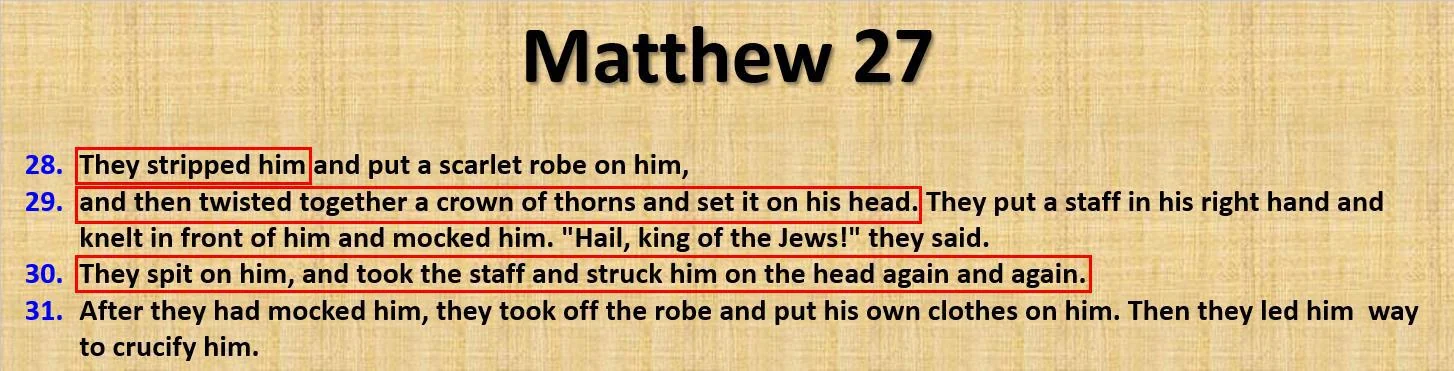
•The Bible, as it exists today, provides an account of how the Jews crowned Jesus’ head with thorns and spat on him during the alleged crucifixion incident: “27 28They stripped him and put a scarlet robe on him, 29and then twisted together a crown of thorns and set it on his head. They put a staff in his right hand. Then they knelt in front of him and mocked him. “Hail, king of the Jews!” they said. 30They spit on him, and took the staff and struck him on the head again and again. 31After they had mocked him, they took off the robe and put his own clothes on him. Then they led him away to crucify him” (Matthew 27:28–31).
The Qurʾān affirms that Jesus (PBUH) will hold a high rank both in this life and in the Hereafter: {˹Remember˺ when the angels proclaimed, “O Mary! Allāh gives you good news of a Word from Him, his name will be the Messiah, Jesus, son of Mary; honoured in this world and the Hereafter, and he will be one of those nearest ˹to Allāh˺} (Qurʾān 3:45). The truth about the crucifixion is clarified in the Qurʾān, which, unlike the Bible, states that the one who was harmed and humiliated was not Jesus (PBUH), the Messiah, and that it was only made to appear so because Allāh raised the real Messiah up to Himself before the crucifixion occurred. The Qurʾān explains that the Jews crucified someone else who, for one reason or another, was mistaken for Jesus (PBUH): {and for boasting, “We killed the Messiah, Jesus, son of Mary, the Messenger of Allāh.” But they neither killed nor crucified him—it was only made to appear so. Even those who argue for this ˹crucifixion˺ are in doubt. They have no knowledge whatsoever—only making assumptions. They certainly did not kill him. (157) Rather, Allāh raised him up to Himself. And Allāh is Almighty, All-Wise (158)} (Qurʾān 4:158–159). These verses categorically indicate that the Jews did not succeed in killing the Messiah (PBUH), for Allāh raised him unto Himself, and that the belief held by both the Jews and the Christians that Jesus (PBUH) died on the cross is founded on a misconception. Interestingly, after the Second World War, manuscripts dating back to the third century C.E. were discovered in the city of Najʿ Ḥammādī in Upper Egypt. Among these was The Second Treatise of the Great Seth, which records that it was Simon of Cyrene, not Jesus (PBUH), who bore the cross and was crucified, while Jesus (PBUH) himself stood on a height overlooking the scene, laughing at their folly. The manuscript narrates that Jesus (PBUH) said: “it was another, their father, who drank the gall of the vinegar, it was not I. They struck me with the reed; it was another, Simon, who bore the cross on his shoulder. It was another upon whom they placed the crown of thorns. But I was rejoicing in the height over all the wealth of the archons and the offspring of their error, of their empty glory. And I was laughing at their ignorance.”3

This account is corroborated by the Qurʾān.
•The Qurʾān subtly critiques both the Jews and the Christians, whose distorted Scriptures contain the fabricated story that Allāh created the heavens and the earth in six days and rested on the seventh: “31 17It will be a sign between me and the Israelites forever, for in six days the Lord made the heavens and the earth, and on the seventh day he abstained from work and rested” (Exodus 31:17).

The Qurʾān refutes this false claim, stating that Allāh created the heavens, the earth, and everything in between in six days, despite having the power to create them in an instant, and that He was not even touched by fatigue: {Indeed, We created the heavens and the earth and everything in between in six Days, and We were not ˹even˺ touched with fatigue} (Qurʾān 50:38).
Indeed, the Qurʾān establishes a permanent foundation of truth. It has provided the People of the Book with an excellent opportunity to unite and resolve the differences that arose from the superstitious creeds of their forefathers. Allāh says: {We have revealed to you the Book only to clarify for them what they differed about} (Qurʾān 16:64). Aṭ-Ṭabarī said: “He, Exalted is His remembrance, says to His Prophet Muḥammad (PBUH): ‘We did not send down Our Book to you, nor did We send you as a Messenger to Our creation, except that you might clarify for them that concerning which they differed regarding the religion of Allāh, make known to them what is correct therein and the truth as distinct from falsehood, and establish against them, through what is correct therein, the ḥujjah (incontestable proof) of Allāh Who sent you with it.’”4 Hence, the Qurʾān is a manifestation of the knowledge of the All-Knowing God, Who, through a gentile (i.e., non-Jew)—Prophet Muḥammad (PBUH)—clarified the reality of those events that form part of Israelite history and that are disputed by the learned among the Israelites themselves. Allāh says: {Indeed, this Qurʾān clarifies for the Children of Israel most of what they differ over} (Qurʾān 27:76).
Furthermore, there is a remarkable passage in the Torah stating that Abraham (PBUH) would be blessed, and that there would be a nation that would bless him and, in turn, would be blessed by Allāh Almighty: “12 1The Lord had said to Abram, “Leave your country, your people and your father’s household and go to the land I will show you. 2I will make you into a great nation and I will bless you; I will make your name great, and you will be a blessing. 3I will bless those who bless you, and whoever curses you I will curse; and all peoples on earth will be blessed through you” (Genesis 12:1-3).

Who, apart from Muslims, invokes blessings upon Abraham (PBUH)? Indeed, the most complete and excellent form of invoking blessings upon Prophet Muḥammad (PBUH) is known as aṣ-ṣalāt al-ibrāhīmiyyah (the Abrahamic prayer), which is typically recited in the prayer after the final tashahhud (the sitting recitation in the last unit of prayer). Muslims recite this prayer numerous times each day: “O Allāh! Send blessings upon Muḥammad and upon the family of Muḥammad as You sent blessings upon Abraham and upon the family of Abraham; indeed, You are Praiseworthy and Glorious. O Allāh! Bless Muḥammad and the family of Muḥammad as You blessed Abraham and the family of Abraham; indeed, You are Praiseworthy and Glorious.” By contrast, Christians hold that all people fell under the curse of the divine Law because no one could follow it without breaking it. According to this belief, Jesus Christ took upon Himself the curse of humanity and bore its penalty—death and separation from God—thus releasing people from the Law and opening the way for salvation through faith in Him. In other words, Christians believe that divine blessing comes through faith in Jesus, while the curse is tied to the Law; consequently, they do not consider adherence to the Law necessary for being justified before God: “3 9So those who have faith are blessed along with Abraham, the man of faith. 10All who rely on observing the law are under a curse, for it is written: “Cursed is everyone who does not continue to do everything written in the Book of the Law”” (Galatians 3:9-10).

Clearly, Abraham (PBUH) was a Prophet and fully observed the Law of Allāh. According to this Christian claim, he too would have been under the curse of the Law. Moreover, Christians maintain that Allāh’s blessing comes through faith in Jesus, while Allāh said to Abraham: “I will bless those who bless you, and whoever curses you I will curse; and all peoples on earth will be blessed through you” (Genesis 12:3). In short, it is evident who is truly blessing Abraham and who is cursing him.
Notes and References
- 1
The expression haymana ar-rajulu ash-shayʾ means that the man protected and guarded the thing. Similarly, haymana aṭ-ṭāʾir ʿalá firākhihi means that the bird took its young ones under the protection of its wings. Once ʿUmar said to the people: Innī dāʿin fa-hayminū, that is, I am going to pray so support me by saying amen.
- 2
ʿImād ad-Dīn abū al-Fidāʾ Ismāʿīl ibn ʿUmar ibn Kathīr, Tafsīr al-Qurʾān al-ʿAẓīm, (ar-Riyāḍ, Saudi Arabia: Dār Ṭaybah, 1997), interpretation of verse (Qurʾān 5:48), available at: https://quran.ksu.edu.sa/tafseer/katheer/sura5-aya48.html.
- 3
The Second Treatise of the Great Seth, trans. Roger A. Bullard and Joseph A. Gibbons, The Nag Hammadi Library, Gnostic Society Library, http://gnosis.org/naghamm/2seth.html.
- 4
Abū Jaʿfar Muḥammad ibn Jarīr aṭ-Ṭabarī, Tafsīr ibn Jarīr aṭ-Ṭabarī, (Bayrūt, Lebanon: Muʾassassat ar-Risālah, 2000), interpretation of verse (Qurʾān 16:64).