The king’s vision remains enigmatic, and additional details are necessary to confirm that it indeed foretold the rise and expansion of Islam, is it not?
Interestingly, years after Nebuchadnezzar’s dream, Prophet Daniel (PBUH) experienced a similar vision, this time with greater clarity and precision. Remarkably, the exact timing of the heralded Prophet’s mission was also revealed to Daniel (PBUH). The angels disclosed to Daniel (PBUH) the meaning of this vision, confirming that it was indeed a prophecy concerning the coming of Prophet Muḥammad (PBUH), whose nation will endure forever after triumphing over the four unbelieving kingdoms. The following is Daniel (PBUH)’s vision of the four beasts, as recounted in chapter 7 of the Book of Daniel:
“7 In the first year of Belshazzar king of Babylon, Daniel had a dream, and visions passed through his mind as he was lying in bed. He wrote down the substance of his dream. 2 Daniel said: “In my vision at night I looked, and there before me were the four winds of heaven churning up the great sea. 3 Four great beasts, each different from the others, came up out of the sea. 4 “The first was like a lion, and it had the wings of an eagle. I watched until its wings were torn off and it was lifted from the ground so that it stood on two feet like a man, and the heart of a man was given to it” (Daniel 7:1-4). Later, the angel who interpreted the dream informed Daniel (PBUH) that the four beasts represent four kingdoms that will arise from the earth. The first beast symbolizes Babylon—the “head” of the kingdoms referenced in the prophecy in chapter 2 of the Book of Daniel. Like a lion, it was powerful, and all people feared it. Its eagle-like wings signify the reach and swiftness of its command, allowing it to extend rapidly across the earth. The plucking of its wings represents its eventual destruction and the scattering of its armies. Its standing up signifies the loss of its former dominance, and the granting of a human heart indicates that it loses its inherent strength, becoming weak and fearful, like a frail human.
“5 And there before me was a second beast, which looked like a bear. It was raised up on one of its sides, and it had three ribs in its mouth between its teeth. It was told, ‘Get up and eat your fill of flesh!’” (Daniel 7:5). The second beast in Daniel’s vision represents the Medo-Persian Empire. The raising of one side of this beast signifies that one part of this kingdom—Persia—would hold predominance. The three ribs in its mouth symbolize three nations that were “devoured” (i.e., conquered) by the Medes and Persians: Babylon, Media, and Egypt. This beast appears in the form of a bear, which aptly symbolizes the kingdom because it was not as powerful as Babylon, its predecessor, just as the bear is inferior in strength to the lion, naturally less formidable and comparatively timid. The command to rise and eat much flesh refers to the kingdom’s plunder and absorption of the wealth of the three nations it conquered.
“6 After that, I looked, and there before me was another beast, one that looked like a leopard. And on its back it had four wings like those of a bird. This beast had four heads, and it was given authority to rule” (Daniel 7:6). The third of the four beasts is like a leopard, for it was stronger than the Medo-Persian kingdom, just as the leopard is stronger than the bear. It represents Greece, renowned for its rapid conquests, as Alexander the Great subdued multiple nations in a short period. The beast’s four heads symbolize the fourfold division of the Greek Empire following Alexander’s death. Its four wings and four heads signify the empire’s swift expansion and dominion over the four corners of the earth.
The fourth and final beast that Daniel (PBUH) saw rising from the sea is the most fearsome. It has large iron teeth and ten horns. This beast represents the mighty Roman Empire, which indeed crushed all its enemies. Its formidable teeth symbolize its armies, which subdued peoples, plundered their wealth, trampled their lands, and harvested their produce. Daniel (PBUH)’s attention was drawn in particular to this destructive fourth beast, and he reflected on the meaning of its ten horns. As he observed, a smaller horn began to emerge from among the ten, and in the process of its appearance, three of the original horns were uprooted. Daniel (PBUH) saw that this little horn had eyes like those of a human being and a mouth that spoke boastfully. Its arrogant words continued until the Ancient of Days (i.e., God) convened a day of judgment. At that time, the beast was slain, its body destroyed and cast into the blazing fire. This fate stood in contrast to that of the other three beasts, which lost their authority yet were not immediately destroyed.

Daniel (PBUH) was astonished by the vision and, seeking understanding, approached one of the angels standing nearby to ask the meaning of all that he had seen. The angel then explained to him the interpretation: that the four great beasts represent four kingdoms who will arise from the earth, but that the saints of the Most High will ultimately receive the kingdom and possess it forever:
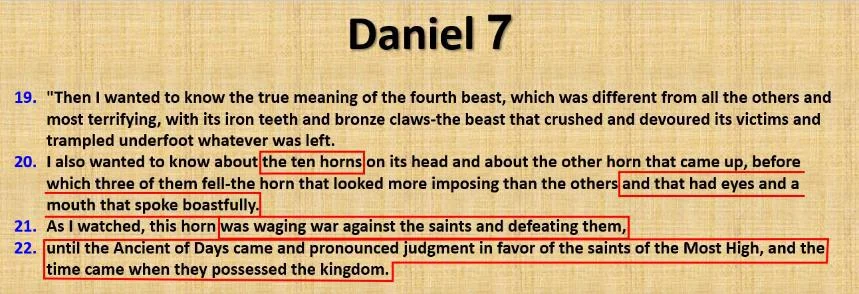
Daniel (PBUH)’s attention became increasingly fixed upon the fourth beast, particularly the mysterious ten horns upon its head and the emergence of another horn that rose among them, before which three of the original horns were uprooted. This horn appeared more imposing than the others, possessing eyes like those of a human being and a mouth that spoke boastfully, and it continued waging war against the saints of the Most High and prevailing over them until the Ancient of Days rendered judgment in their favor and the appointed time came for them to possess the kingdom.
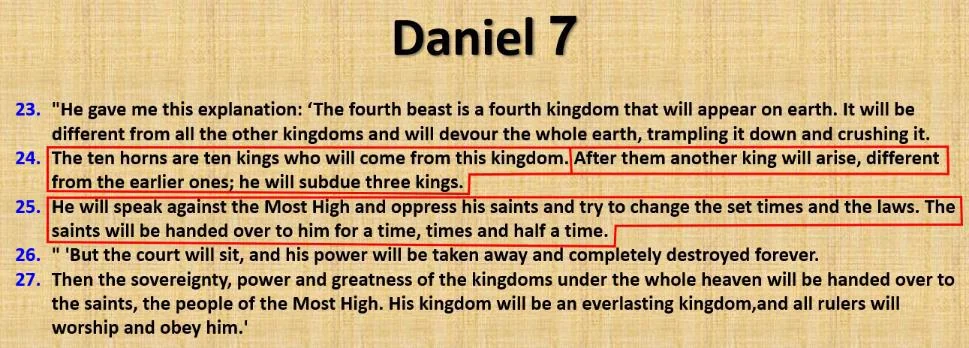
In response to Daniel (PBUH)’s inquiry, the angel provided a detailed interpretation of the vision. He explained that the fourth beast represents a fourth kingdom that will arise on earth, distinct from all the previous kingdoms in its destructive power, devouring the whole earth, trampling it down, and crushing it. The ten horns signify ten kings who will emerge from this kingdom. After them, another king will arise, different from the earlier ones, and he will subdue three kings. This king will speak against the Most High, oppress His saints, and attempt to change the set times and the laws. The saints of the Most High will be delivered into his hand for a time, times, and half a time. Yet the court will sit in judgment, his dominion will be taken away and completely destroyed, and the sovereignty and greatness of the kingdoms under heaven will be given to the saints of the Most High.
As the vision progressed, Daniel (PBUH) saw one like a son of man coming with the clouds of heaven, who approached the Ancient of Days and was led into His presence, where he was granted authority, glory, and sovereign power so that all peoples, nations, and men of every language worshiped him. This son of man’s dominion was declared an everlasting dominion that would not pass away, and his kingdom one that would never be destroyed. Daniel was left troubled in spirit, deeply disturbed by the visions that passed through his mind, compelling him to approach one of the angels standing nearby to seek the true meaning of all the things he had seen.

As the interpretation of the vision was revealed to Daniel (PBUH), he asked specifically about the fourth beast and its horns. The angel explained that the beast’s ten horns represent a succession of ten kings who will arise from that kingdom. The smaller imposing horn, with eyes and a mouth like those of a human, represents a later king before whom three of the original kings will be subdued (often interpreted as Seleucus, Ptolemy, and the king of Babylon). He is called the “little horn” because he was initially inferior to the others, yet his kingdom ultimately became greater than theirs. This evil king, the eleventh horn, will speak arrogantly against the Most High, seek to alter the times and the laws, and oppress His saints for “a time, times, and half a time”—about three hundred and fifty years.1 His human-like eyes symbolize his cunning, which he used to overpower and destroy many, along with their cities, while his boastful mouth signifies that he will be the most corrupt king, spreading disbelief and distorting religion. Above all, his defining characteristic is that he will fight against and defeat the monotheists.
After the fourth beast was slain and its body burned, a “son of man” came to heaven on the clouds. He approached God and was brought into His presence. He was endowed with “authority, glory, and sovereign power,” and all the nations of the earth worshiped him. The kingdom over which this “son of man” rules is declared to be indestructible and everlasting. That is, this prophesied Messenger will be granted the Prophethood, the Law, and authority. He will also be a mujāhid (a fighter in the cause of Allāh) before whom the kingdoms of the earth will surrender. Daniel (PBUH)’s prophecy refers to the same Prophet heralded by Jesus (PBUH) as the stone that will become the capstone at the end of times. Of particular significance is the verse, “…I looked, and there before me was one like a son of man, coming with the clouds of heaven,” which clearly points to Prophet Muḥammad (PBUH)’s miraculous journey known as al-isrāʾ wa-l-miʿrāj—the night journey and ascension into heaven—from Makkah to Jerusalem and then to heaven. As previously noted, the oppression of the saints of the Most High at the hands of the eleventh king is predicted to endure for about three hundred and fifty years, after which the everlasting kingdom of the saints will rise. They will triumph over the kingdoms of the earth, including that of the eleventh king himself, and their Law will remain until the Hour of Resurrection. That is, this new nation will fulfill the covenant entrusted to it by Allāh, fight for His cause, and reign until the end of times.
Hence, Daniel’s vision of the four beasts served to warn the Israelites that a succession of adversary kingdoms would hold authority over them. Yet ultimately, Allāh remains in control, and the last Prophet would come to overthrow the kingdoms of this world and establish His throne forever. The reign of the eleventh king, who oppressed the holy people of Allāh, was limited; Allāh judged him. The divine court convened, his power was taken away, and he was utterly destroyed, while the “son of man” would reign forever. From our perspective, looking back, we can see the future world events foretold in Daniel (PBUH)’s vision as the course of world history. Daniel (PBUH) accurately predicted the rise of successive empires, and we can easily trace the correlation between each beast and a historical empire. In short, history bears witness to the fulfillment of the remarkably precise prophetic statements contained in the Book of Daniel.
Notes and References
- 1
The biblical term “time” is interpreted as a hundred years. See: Apocalypse of Abraham, chapter 28.