What are the rational principles by which we infer the existence of Allāh, the Glorious and Exalted?
The laws of logic provide compelling evidence for the most reasonable inference: that Allāh exists and has created human beings and everything in the universe, and that these very laws are a reflection of His nature. The existence of the universe demands an explanation, for it could not have arisen from nothing. There must be a cause behind the universe, since nonexistence cannot produce existence; nothing cannot function as an origin, as an origin must itself exist. The philosophical axiom ex nihilo, nihil fit (“out of nothing, nothing comes”) forms a foundational basis for the laws of logic, including the law of non-contradiction. To claim that the universe was produced by nothing is to distort the meaning of nothingness, implying that nonexistence somehow has properties—which is both contradictory and absurd. True creation from absolute nothingness is a power unique to Allāh alone. When He wills something to exist, He simply says, “Be!” and it comes into being exactly as He intends, without dependence on causes or pre-existing materials. His Name al-Mubdiʾ (the Originator) signifies the One who brings creation into existence initially and originally—without prior model or matter—purely by His Will and command. That is, He originated creation from absolute nonexistence, without precedent or prototype. The Big Bang theory, the prevailing scientific explanation for the origin of the universe, states that the cosmos began from a state of extreme density and heat, and that a colossal cosmic event occurred approximately 13.7 billion years ago, causing the universe to expand and cool. Though theories vary regarding the exact conditions preceding the Big Bang, it is widely held that prior to this event, neither matter, energy, nor time existed. All were brought into existence in an instant. Remarkably, this truth—now confirmed by modern physics—was revealed in the Qurʾān over fourteen centuries ago.1 The demonstration that matter had a beginning deals a decisive blow not only to atheism but also to agnosticism, for once the hypothesis that matter was created and had a starting point is confirmed, the atheistic claim that “matter had no beginning” is invalidated, and the agnostic assertion that “we cannot know whether matter had a beginning or not” is shown to be unfounded.2
Thus, the Big Bang invalidates two viewpoints that claim to align with reason and science: agnosticism—the view that we cannot know whether God exists or whether the universe has existed from eternity—and atheism—the belief that matter has existed eternally. In contrast, the Big Bang supports monotheism: the belief in one God who created this vast and magnificent physical universe and everything within it, both living and nonliving. The universe must necessarily have a Creator, for it is inconceivable that it was brought into existence by nothing. There must be a Creator who initiated the force and energy necessary to set the universe into motion. Scientific evidence clearly points to the universe having a beginning and emerging from nothing. While science offers no explanation as to how this could have occurred, revelation provides the clear answer: it was a miracle of Allāh. The Big Bang is astonishing precisely because it marks the origin of the universe from absolute nothingness—when all matter, energy, space, and time came into being. Although some cosmologists have proposed alternative models to avoid the implications of an absolute beginning, none of these theories have gained widespread acceptance within the scientific community.
The second logical rule by which we infer the existence of Allāh is that “creatures indicate some of the attributes of their Creator.” In other words, another rational argument for the existence of the Creator is that the signs within nature reflect purposeful design, which in turn points to the Designer. Indeed, by observing the universe, we can clearly discern aspects of the One who created it. From the sun and the moon in the heavens, to the living beings on earth, to the innermost workings of the human body—all testify to the power and intentional design of the Creator. Human beings naturally and instinctively recognize these signs as evidence of divine purpose, for there can be no design without a Designer.3

Everything around us, both animate and inanimate, is far too marvelous and intricate to be likened to man-made objects or attributed to mere chance; rather, each is a clear example of intentional creation, reflecting supreme intelligence and flawless craftsmanship.4

To demonstrate just how implausible the claims of evolutionists are, let anyone who believes in the creative power of chance take a large barrel and fill it with whatever materials they believe are necessary to produce a living being. For instance, let them include all the essential elements—such as carbon, phosphorus, and calcium—along with organic compounds like amino acids, proteins, lipids, and carotene.5
When we observe the natural world, we see intricate and purposeful design everywhere—and design clearly implies a Designer. The universe functions with remarkable precision and complexity, making it irrational to attribute such perfection to mere chance. Elevating chance to the status of a creator is absurd, for the flawless order of creation can only point to Allāh as the true Creator of all that exists. As Ibn Kathīr said:6

The universe is undeniably fine-tuned, and our very existence serves as compelling evidence. Its structure is sustained by the fundamental constants and quantities—namely, gravity, the electromagnetic force, and the strong and weak nuclear forces—often referred to as the four fundamental forces. Each of these falls within an extremely narrow range that permits life and the universe itself to exist; even the slightest alteration in any of them would render the universe uninhabitable or cause it to collapse altogether. This remarkable fine-tuning stands as one of the most persuasive arguments for the existence of God. It is not merely a matter of a few broadly defined values arising by chance—rather, scientists have identified over 100 highly specific constants that strongly indicate the presence of an intelligent Designer.7 These fine-tuned characteristics of our universe are often referred to as anthropic constants, and their precise calibration provides strong evidence of intentional design—and where there is design, there must be a Designer.8
One example of fine-tuning is the precise balance required in the universe’s expansion rate; if it were even slightly faster, matter would disperse too quickly for stars and planets to form, and if it were slightly slower, the universe would collapse in on itself shortly after coming into existence. Either way, life would be impossible. Another striking example involves the delicate equilibrium between the strong and weak nuclear forces, which is essential for the formation of heavier elements necessary for life. In the following pages, we will highlight several of these anthropic constants that make our existence possible.
Anthropic Constant 1: Oxygen Level9

Anthropic Constant 2: Atmospheric Transparency10

Anthropic Constant 3: Moon-Earth Gravitational Interaction11

Anthropic Constant 4: Carbon Dioxide Level12

Anthropic Constant 5: Gravity13

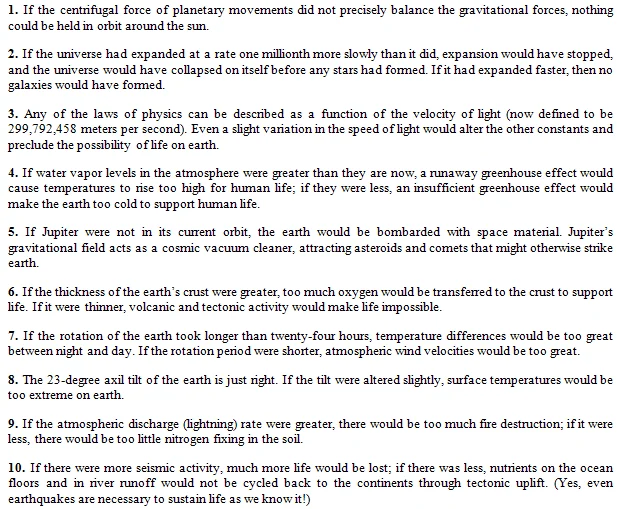
Here are ten additional anthropic constants that make our lives possible—each one finely tuned with extraordinary precision, and together they offer compelling evidence that the universe was designed with life in mind:14
Astrophysicist Hugh Ross has calculated the probability that these and other constants—122 in total—would all exist on any one planet by mere chance, without any intelligent design. Assuming there are 1022 planets in the universe (a staggering figure: 1 followed by 22 zeros), the probability he arrives at is an astonishing one in 10138—that is, a 1 followed by 138 zeros. To put this into perspective, the total number of atoms in the entire universe is estimated at only 1070. In essence, this means there is virtually zero chance that a planet would possess the precise life-supporting conditions we enjoy—unless an intelligent Designer is behind it all.15 Nobel Laureate Arno Penzias, the co-discoverer of the cosmic microwave background radiation—often referred to as the "afterglow" of the Big Bang—summed it up powerfully:16

British astronomer and cosmologist Edward R. Harrison uses the word “proof” when reflecting on the implications of the Anthropic Principle for the existence of God. He writes:17

Once again, this fine-tuning is essential for the universe to be life-permitting.18

Dr. William Lane Craig noted that the fine-tuning of the universe is not only astonishingly precise but also highly significant, as it points to the existence of a purposeful Designer:19
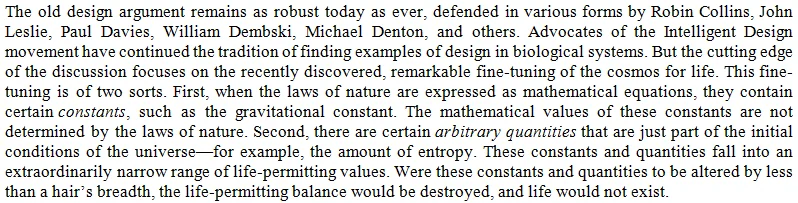
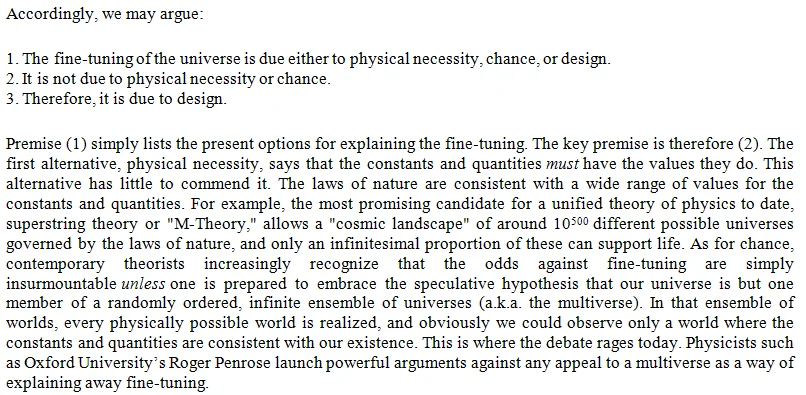
What accounts most reasonably for the remarkable fine-tuning of the universe? The possibilities generally fall into three main categories: that it had to be this way by physical necessity, that it occurred by random chance, or that it was the result of deliberate design. As Dr. William Lane Craig has explained:20
Scientists have discovered that life can only exist on a planet that is extraordinarily fine-tuned—like Earth. Not only our planet, but also our solar system, galaxy, and even the universe as a whole, exhibit characteristics that seem precisely calibrated to support intelligent life. The probability of such fine-tuning arising by pure chance is considered by many experts to be not just implausible, but virtually impossible. As growing evidence in the late 20th century began to reveal just how remarkably suited Earth is for life, many scientists found themselves reexamining the most straightforward conclusion: that an intelligent Designer lies behind it all. Physicist Paul Davies observes: “The conclusion must be that we live in a world of astronomical unlikelihood.”21 Donald Page of Princeton’s Institute for Advanced Study has estimated that the probability of our universe randomly assuming a configuration capable of supporting life is just one in 10¹²⁴—a figure so vast it defies comprehension.22 This observation, featured on the Y-Origins website, carries profound significance:23
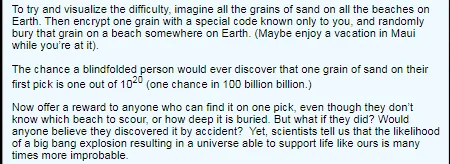
The likelihood of fine-tuning across our universe, galaxy, solar system, and planet is overwhelmingly improbable. Each one demands extraordinarily precise calibration—far beyond what chance can reasonably explain. Such exactness strongly points to intentional design. As Dr. Robin Collins observes: “Over the past thirty years or so, scientists have discovered that just about everything about the basic structure of the universe is balanced on a razor’s edge.”24 More than 35 distinct features of the universe and its physical laws must be exquisitely fine-tuned for physical life to exist.25 Here are six of those finely-tuned characteristics:26

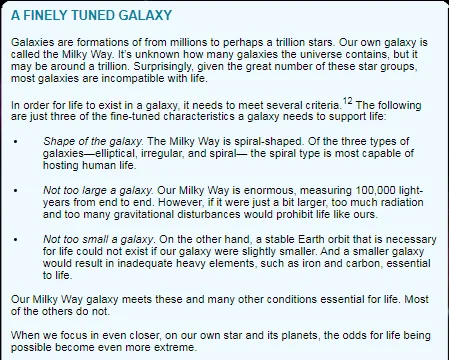
According to the Big Bang theory, all of this minute fine-tuning was embedded in the initial conditions of the universe’s first microsecond. In that instant, critical parameters—such as the rate of expansion, the ratios of mass and density, and the balance between matter and antimatter—were set precisely, ultimately resulting in a habitable planet called Earth. Beyond the 35 known characteristics of the universe that must be exactly right for life to exist, more than 100 additional features of our galaxy, solar system, and planet also required fine-tuning—without which human existence would be impossible.27 Scientists estimate that our universe contains around 100 billion galaxies, though the precise number remains uncertain. Galaxies are vast systems composed of dust, gas, dark matter, and between a million and a trillion stars, all bound together by gravity. Yet, despite their staggering abundance, most galaxies are not suitable for supporting life.28
Furthermore, for human life to be possible, Earth must orbit a sun of precisely the right size, position, and characteristics—just as ours does.29

When astronomers reflect on the extraordinary precision of our solar system, they recognize that even the slightest deviation would render advanced biological life impossible. Yet having the right universe, galaxy, and solar system is not sufficient on its own—Earth itself must also meet extraordinarily fine-tuned conditions, balanced to a razor’s edge, for human life to be possible.30
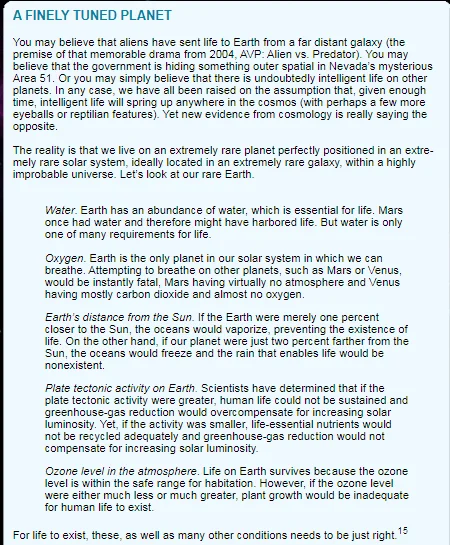
Professors Peter Ward and Donald Brownlee of the University of Washington conclude in their book Rare Earth that the conditions required for life are so uncommon in the universe that “not only intelligent life, but even the simplest of animal life is exceedingly rare in our galaxy and in the universe.”31 This has led many readers to echo the conclusion expressed by a reviewer from The New York Times: “Maybe we are alone in the universe, after all.”32 Agnostic Michael Denton, senior research fellow in human molecular genetics at the University of Otago in New Zealand, explains why the extraordinary fine-tuning of the universe has reignited the discussion on the significance of mankind in our lonely universe. Denton asserts that the evidence suggesting the universe exists for the sake of humanity is more compelling today than at any other time in the history of modern science.33

It may seem ludicrous to claim that life exists on only one tiny speck in a universe of ten billion trillion stars. Yet, incredibly, Earth appears to sit alone in a hostile universe devoid of life—a reality recently portrayed in National Geographic:34

The astonishingly precise numerical values required for life present scientists with profound implications. As Stephen Hawking observed: “The remarkable fact is that the values of these numbers seem to have been very finely adjusted to make possible the development of life.”35 With the advancement of scientific discovery—both in the vastness of space and the intricacies of the molecular world—science now finds itself addressing the deepest questions that have long stirred human reflection: Who are we, and why are we here? In short, the fine-tuning of the cosmos and the elaborate complexity of DNA not only point to the existence of a Designer but also offer insight into His nature. In light of recent discoveries, many prominent scientists have found their materialistic assumptions increasingly challenged. While several have acknowledged the compelling signs of design in the universe, many stop short of asking who designed it, or why. Stephen Hawking himself remarked on this hesitation among scientists to confront the deeper question of origins, stating: “There must be religious overtones. But I think most scientists prefer to shy away from the religious side of it.”36 However, some scientists are less reticent—openly acknowledging the appearance of design and daring to ask profound questions: Why is the universe so precisely fine-tuned for life? Has a Designer left His fingerprints upon creation? What is our purpose in this cosmos? Although Hawking typically avoided religious discourse, he nonetheless posed the question:37

Here Hawking opens new ground for scientific inquiry. Since the time of Copernicus—and more definitively after Darwin—materialism has dominated the scientific worldview. Any invocation of God was often dismissed as a “God of the Gaps” argument—another way of saying that God is merely a stopgap explanation for our lack of knowledge, and that He has no place in a purely material universe. Yet now, it is scientists themselves who are reigniting the conversation about the possibility of an intelligent Designer. Theoretical astrophysicist George Greenstein asks:38

Greenstein, a renowned professor of astronomy at Amherst College and recipient of the Phi Beta Kappa Award in Science, is among a number of distinguished scientists who, like him, are examining scientific evidence and contemplating the existence of God. This is not Forrest Gump scratching his head at the complexity of it all or attributing to God what he simply cannot grasp39 Rather, it is a serious inquiry grounded in observation. There are things that can be deduced about the Designer’s nature from the observation of the universe. That is, although scientific evidence only gives us a partial picture of what the Designer is like, the universe does reveal some insightful clues about His nature. Essentially, it reveals that the Designer is purposeful, powerful, and superintelligent. The discovery of the universe’s astonishing fine-tuning has led many scientists to conclude that such precision points to a purposeful design. As Paul Davies, one of the world’s foremost theoretical physicists, puts it: “If the universe has been designed by God, then it must have a purpose.”40 Mathematician Roger Penrose, who, together with Stephen Hawking, developed a proof for the beginning of time, offers the following insight:41

Penrose deduces that the fine-tuning of the physical constants necessary for the existence of Man is so improbable that it must have been intentionally planned, and it follows that whoever deliberately created the universe must have a purpose that includes us, as Paul Davies writes:42

If purpose is apparent from the fine-tuning of the universe, the immense power within the cosmos is revealed through startling new discoveries made possible by Hubble and other high-powered telescopes. Consider a few of the latest findings:43

Scientists are not only amazed by the power within the cosmos, but also deeply awed by the power required to create and govern it all, as well as by the astounding genius behind its design. Albert Einstein, one of the greatest and most influential physicists of all time, acknowledges that the mind behind the universe is a “superintelligence of such superiority that, compared with it, all the systematic thinking and acting of human beings is an utterly insignificant reflection.”44 Einstein acknowledged this intelligence without ever defining it in personal terms, but as he notes, human genius cannot be compared with the intelligence of the One who designed it—along with the universe, its laws of physics, quantum mechanics, and the intricate complexity of DNA. Astronomer Hugh Ross explains that it is impossible to impose any limit on either the power or the intelligence of a transcendent Creator.45 That is because the Creator would not be restricted by any of the constraints of our four-dimensional world—including time.46

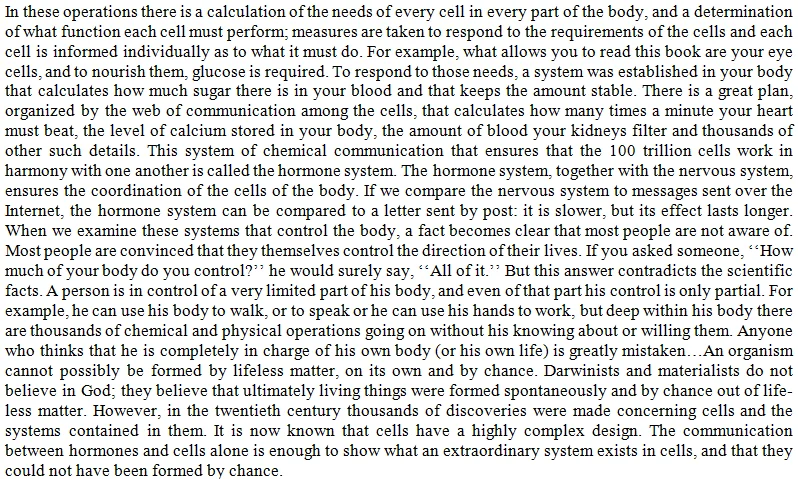
There is an obvious parallel between the Big Bang and the Islamic teaching of creation from nothing. The Qurʾān remarkably presents a God who is purposeful, powerful, and super-intelligent, describing Allāh as an infinite, eternal Creator who alone brought everything into existence from nothing. Many leading scientists studying the universe are convinced that human beings are a divine conception—the intentional work of a powerful, super-intelligent, and purposeful designer. As you read this, millions of operations are taking place within your body.47
When scientists analyze every single part of every single limb and organ of the human body, they discern the wondrous vistas of Divine wisdom unfolding. Nothing in the world has been created at random, but rather with purpose and destiny: {Indeed, We have created everything, perfectly preordained} (Qurʾān 54:49). That is, Allāh brings every single thing into being at an appointed time, gives it a particular form and shape, allows it to develop to its fullest extent, lets it survive for a certain period, and then causes it to decay and die at an appointed time. According to this universal principle, even this world has a destiny in accordance with which it is functioning and will come to an end at an appointed time. As Sayyid abū al-Aʿlá al-Mawdūdī puts it: “It will neither come to an end a moment earlier than its appointed time of end nor survive a moment longer; it has neither existed since eternity nor will exist till eternity, nor is it the plaything of a child which he may destroy as and when he likes.’’48 Finally, it is noteworthy that scientists, in fact, win prizes not for creating anything themselves, but for discovering aspects of Divine design and providence in the human body as well as in the universe as a whole.
The third rule by which we infer the existence of Allāh is the principle of nemo dat quod non habet, which means that no one gives what they do not have. It is not possible that an impersonal force lies behind everything in the cosmos. How could Nature—which has no consciousness, volition, or intelligent power—create Man, who possesses consciousness, volition, memory, intelligence, as well as attributes and virtues of which Nature is completely deprived and bereft? Man is higher and nobler by reason of the ideal and heavenly force latent and manifest within him. Thus, while the universe does have a cause, it could not have been an impersonal one—that is, a force without a mind. Let us suppose, for the sake of argument, that an impersonal force existed at the beginning and that everything else emerged from it. If that were the case, there would be only three factors to account for the complexity of the universe. Philosopher Francis Schaeffer identifies these factors: “Beginning with the impersonal, everything, including Man, must be explained in terms of the impersonal plus time plus chance. Do not let anyone divert your mind at this point. There are no other factors in the formula, because there are no other factors that exist...No one has ever demonstrated how time plus chance, beginning with an impersonal force, can produce the needed complexity of the universe, let alone the [personality] of Man.”49 Dr. William Lane Craig concurs, asserting that the beginning of the universe proves that its Creator is personal.50

As Craig explains, intelligence, volition (will), and power are all implied in the act of creating. For example, when we consider a painting such as the Mona Lisa, we see the same principles at work: Leonardo da Vinci needed intelligence, volition, and power to paint the image he wanted to portray. These attributes clearly point to Da Vinci being a person, not a mere force. Likewise, the universe could not have come from an impersonal force, whether matter, energy, or anything else devoid of mind. The First Cause must have had a mind to will the universe into existence—since it had a beginning—and must also have had sufficient power and intelligence to produce the specified complexity we observe in the universe. Only a personal, powerful, intelligent, eternal Cause adequately accounts for the existence of the universe. The materialist claim that the universe is a cold, uncaring, purposeless accident—originating from undirected forces blindly operating through eons of time—is utterly irrational. Sometimes atheists raise the question: “If everything needs a cause, then who caused God?” But this overlooks a key point: we are not claiming that everything that exists needs a cause—rather, that anything which begins to exist needs a cause. God did not begin to exist, and therefore does not need a cause. The question “Who caused God?” is nonsensical, because what it really asks is: “Who caused the uncaused Cause?” By definition, God is the uncaused, eternal, self-existent Cause of everything else. For anything at all to exist now, something must have always existed—that is, there must be an Eternal, Self-existent Being to account for the existence of anything else. In other words, without an eternal, uncaused Cause, nothing else could ever exist. Believers call that Cause God, because this Being must not only be eternal, but also intelligent and all-powerful to bring the universe into being. In short, a Creator must necessarily exist to account for the existence of creation. He is the necessary Existent, and this holds true for all times, places, and possible universes. The opposite of this attribute would be non-existence, which is a logical impossibility, as it would mean that nothing else could exist. All creation depends on Allāh for its existence; thus, He has always existed. Time itself is His creation, and so His existence preceded time. He is neither confined by it nor affected by it. Even if time were to end, His necessary existence would remain unchanged. He is Everlasting—there can never be a moment, before, during, or after the creation of time, in which Allāh does not exist. He is Self-Subsistent, meaning He depends on nothing else—not a creator, place, time, or anything—for His existence. In contrast, everything other than Allāh came into existence from non-existence due to dependence on Him. Allāh, however, exists on His own, possessing power, knowledge, and will. He is omnipotent, with infinite and irresistible power. His awe-inspiring power is evident from the vastness of the universe to the intricacies of the cell. He knows everything—past, present, future, and even what will never exist—down to the smallest and most minute detail. Creation itself is a testament to His limitless, perfect knowledge. From pre-eternity, He has willed what has been and what is to come. Whatever He wills must come to pass, and whatever He does not will can never occur. There is no one who can repel His will or defer His command; His will is absolute, and He cannot be compelled to do anything. Unquestionably, only Allāh could have designed the entire hormonal system that regulates the human body, created our cells, and programmed the language of DNA—the molecule of life found in all living organisms. The information density of DNA is astounding: just one gram can store 215 petabytes, or 215 million gigabytes, of data, whereas an average laptop hard drive contains only a millionth of that capacity. Clearly, human life is not the product of an evolutionary accident or random, undirected forces. It must have been designed by a perceptive power that exists beyond natural laws. In other words, since natural entities cannot account for life, a supernatural entity must. Atheists who deny God continue to explore possible ways that Nature could have generated a living cell; however, after nearly a century of effort—and even using intricately designed experimental setups—they have completely failed to produce even the most basic chemicals that form the building blocks of living cells. Without a doubt, these evolutionary efforts will continue to fail, because life is not the product of Nature—it was created by God.
The more scientists discover about our universe, the more we see the hand of design rather than randomness. Indeed, the ability to design is not merely a godly trait passed on to humans, but a proof of the very existence of God. The Creator of this wondrous universe is Allāh—the Master Designer, the All-Knowing, the All-Powerful, and the All-Wise. Everything in the universe has been tamed to serve the needs of Man, which indicates that Man’s Creator is a being of immense compassion. Even before a person is born, all their needs are already accounted for. For instance, babies do not breathe in the womb in the way we typically understand breathing; they do not use their lungs. Instead, the mother’s placenta enables the baby to “breathe” by allowing oxygen and carbon dioxide to pass through the blood. Yet by the grace of Allāh, lung development begins as early as three weeks into gestation and continues throughout the pregnancy. Had Allāh not equipped the fetus with lungs while still in the womb, the infant would be deprived of oxygen at birth, since babies typically take their first breath within about ten seconds of delivery. Brain damage can occur within just three to five minutes without oxygen, and after ten minutes, serious harm is likely, with an increasing risk of death. Similarly, even though the womb is dark and offers little or no light, a baby’s eyes begin to form only six weeks after conception—for Allāh prepares the child for life outside the womb. The creation of new human life is truly a miracle unfolding within the mother’s womb, entirely governed by Allāh, Who knows every intricate detail of the process, Who sets it in motion, and Who sustains it. Mother’s milk is another of Allāh’s extraordinary creations: an unmatched blend designed not only to meet all of a baby’s nutritional needs but also to protect it from infection. Most mothers are unaware that breast milk changes to meet their baby’s needs. In the first two weeks of life, breast milk transitions through three main stages: colostrum, transitional milk, and mature milk. Colostrum—the first milk produced in the two to four days following birth—is often called “liquid gold” due to its tremendous value. It contains high levels of antioxidants and antibodies that strengthen the baby’s immune system, line the stomach with beneficial bacteria, and contain compounds that nourish good bacteria while destroying harmful microbes. Its primary function is to protect against infection. Even though only small amounts are produced, every drop of colostrum carries lifelong benefits for the baby’s health. The balance of nutrients in breast milk is perfectly suited to the needs of the developing infant, and it is especially rich in compounds that support brain growth and the development of the nervous system. Despite the advances of modern science, manufactured baby formulas cannot compare to this miraculous nourishment created by Allāh—the Sublimely Subtle, the Infinitely Gentle, the Most Loving, the Generous, and the Intelligent Designer who has fashioned all things in due measure and perfect proportion.51

Furthermore, Allāh has placed within the hearts of all parents a natural instinct to love their children unconditionally and to make countless sacrifices for them—including time, sleep, money, freedom, social life, career aspirations, and personal desires. Although parenting is incredibly difficult, parents remain content to give their all for their children. In short, we will never be able to enumerate all of Allāh’s blessings upon us, for they are truly beyond counting. Take, for example, the human body alone: it is composed of one hundred trillion cells, and each individual cell is a blessing from Allāh. Undoubtedly, the creation of the heavens, the earth, and all that lies between them stems from Allāh’s power of creation and control alone, and He has no partner or associate in any of it: {This is Allāh’s creation. Now show Me what those ˹gods˺ other than Him have created} (Qurʾān 31:11). Atheists cannot point to anything in this universe as the creation of anyone other than Allāh, and their rejection of Him is nothing but sheer stupidity and obstinacy. Their foolish conduct defies explanation, for unless someone has entirely lost their senses, they cannot possibly believe that natural selection and favorable mutations alone fully account for the appearance of design in Nature. Anyone with even a small measure of common sense must ask: how can something that has no will, no consciousness, and no intelligent power create something that possesses will, consciousness, intelligence, and power? The same holds true for polytheists: how can they themselves acknowledge that their so-called deities are not creators, admit that Allāh alone is the Creator, and yet persist in assigning divinity to idols? How can they fail to understand that something with no power to create anything—something with no share whatsoever in the creation of anything in the heavens or the earth—cannot possibly be a deity? Why then do they bow before such things and worship them as gods? In short, chance does not govern the universe. Rather, everything that occurs does so under Divine Providence—the governance of Allāh, by which He, with wisdom and love, sustains and directs all that exists. A clear example of this providence is the sun, whose light and heat sustain all life on the only inhabited planet we know of in the universe. Scientists estimate that the sun is approximately 4.57 billion years old, but by the grace of Allāh, it did not burn out before the appearance of human beings just a few hundred thousand years ago, and it has not burned out yet. But how is it possible that the sun contains so much fuel? Why has it not been extinguished like a candle or a campfire? This is because the sun is not made of coal, but is composed primarily of hydrogen and helium atoms in a plasma state. It generates its energy through a process called nuclear fusion—not chemical combustion. If the sun were made of coal, it would have lasted only around 5,000 years at its current rate, and without the sun, life on Earth could not exist. Another astonishing sign of divine providence is the human skeleton. Our bones were created by the most intelligent architect. Just imagine what would happen if we had no bones; indeed, nearly every function in the human body would be thrown into chaos if the skeletal system were to vanish entirely.52 In a word, if we think of the human body as a house, then the skeleton serves as the foundation upon which the rest of the structure is built—and without bones, we would be nothing more than a puddle of skin and organs on the floor. Even if I, armed with all the knowledge granted to humankind, were to spend a thousand years presenting examples of Allāh’s marvelous creative works and the countless manifestations of His power and wisdom, I swear by Allāh, I would never be able to do them justice, for they are truly innumerable. They could not be recorded even if all the trees on earth were pens and the oceans ink. Someone might think I am exaggerating by saying this—but this is not my own claim. It is the statement of Allāh Himself—and who can be more truthful than Allāh? He says: {Say, ˹O Prophet,˺ “If the ocean were ink for ˹writing˺ the Words of my Lord, it would certainly run out before the Words of my Lord were finished, even if We refilled it with its equal”} (Qurʾān 18:109). Hence, those who reject Allāh are, in truth, denying the most established of all established facts. It is so firmly established that even if pens were made from all the trees on earth and ink supplied by all the oceans—replenished by seven more oceans—they would still be insufficient to record the entirety of Allāh’s creations in the universe and the countless manifestations of His power and wisdom: {If all the trees on earth were pens and the ocean ˹were ink˺, refilled by seven other oceans, the Words of Allāh would not be exhausted. Surely Allāh is Almighty, All-Wise} (Qurʾān 31:27). Anyone who reflects even briefly on this matter will realize that there is, in fact, no exaggeration in it whatsoever—for if it is impossible to count even all the creatures found on Earth alone, how could one possibly record in writing all the creations scattered throughout this boundless universe? Indeed, everything in this vast expanse is the handiwork of Allāh, Who has created all things with perfect wisdom: {˹That is˺ the design of Allāh, Who has perfected everything} (Qurʾān 27:88). Allāh has perfected the creation of everything He has brought into existence in this vast universe. That is, whatever He has created for a particular purpose, He has endowed with the most fitting structure and the most appropriate qualities to fulfill that purpose. Therefore, no one can point out any flaw or imperfection in the design of anything made by Allāh, nor can anyone propose an improvement or alteration to it: {…the Almighty, Most Merciful Who has perfected everything He created} (Qurʾān 32:6–7). Pondering over Allāh’s marvelous creations and reflecting on how He manifests His Beautiful Names throughout the universe and in every aspect of our daily lives—past and present—is among the most powerful ways to know Allāh and strengthen our faith in Him. Allāh is the Creator of the universe, Who governs all its affairs with His limitless power and resources. He is the All-Provider. He is the All-Knowing, from Whose knowledge nothing escapes. He is the Acquainted, whose knowledge encompasses all that is outward and hidden, and all that has occurred, is occurring, and will occur in the affairs of the entire creation. He is the All-Wise. He is the Generous. He is the Sublimely Subtle—Most Gentle and Gracious toward His servants, even when they are unaware of His care. He is the Bestower of Favours. He is the Possessor of Majesty and Honor. He is the Ever-Living, Who is not subject to death or illness and from Whom all life originates. He is the Self-Existing, completely free of any need or dependence, while all of creation depends entirely upon Him. Therefore, contemplate the flawless order of the universe and the beauty of Allāh’s countless blessings, and glorify Him. Say, “Glory be to my Lord and praise be to Him,” as Allāh says: {Glorify the Name of your Lord, the Most High, Who created and ˹perfectly˺ fashioned ˹all˺, and Who ordained precisely and inspired accordingly} (Qurʾān 87:1–3). Verily, contemplating the omnipotence, greatness, and majesty of Allāh is one of the most effective ways to attain pious submission to Him, for it protects the servant from heedlessness and strengthens faith by filling the heart with reverence and devotion. Returning to the question with which we began this section, there is ample evidence to support belief in God, including numerous rational grounds. Indeed, the very laws of logic offer us clear evidence for the existence of God.
Notes and References
- 1
Chapter al-Baqarah (2:17), Chapter al-ʾAnʿām (6:14) and (6:101), Chapter Yūsuf (12:101), Chapter Fāṭir (35:1), Chapter az-Zumar (39:46), and Chapter ash-Shūrá (42:11).
- 2
Admin, “We Are Created out of Nothing,” Quran Miracles, 21 March 2011, http://www.quranmiracles.com/2011/03/we-are-created-out-of-nothing-2/.
- 3
Admin and Editor of Science & Faith, “The Perfect Design in the Universe is Not by Chance,” Science & Faith, accessed 14 Feb. 2023, https://www.thesciencefaith.com/the-perfect-design-in-the-universe-is-not-by-chance/.
- 4
Ibid.
- 5
Ibid.
- 6
ʿImād ad-Dīn abū al-Fidāʾ Ismāʿīl ibn ʿUmar ibn Kathīr, Tafsīr Ibn Kathīr (Abridged), trans. and abr. by a group of scholars under the supervision of shaykh Ṣafiyy ar-Raḥmān al-Mubārakfūrī, (ar-Riyāḍ, Saudi Arabia: Darussalam Publications, 2003), interpretation of verse (Qurʾān 2:21), available at: https://quran.com/2:21/tafsirs/en-tafisr-ibn-kathir.
- 7
Norman L. Geisler and Frank Turek, I Don’t Have Enough Faith to Be an Atheist, (Wheaton, U.S.: Crossway, 2004), p. 105, available at: https://archive.org/details/norman-l.-geisler-frank-turek-david-limbaugh-i-dont-have-enough-faith-to-be-an-a/page/96/mode/2up.
- 8
Ibid., pp. 95–96.
- 9
Ibid., p. 98.
- 10
Ibid., p. 100.
- 11
Ibid.
- 12
Ibid., p. 101.
- 13
Ibid., p. 102.
- 14
Ibid., pp. 105–106.
- 15
Ibid., p. 106.
- 16
Ibid.
- 17
Ibid.
- 18
Admin, “We are created out of nothing,” The Quran: Unchallengeable Miracle, 21 March 2011, http://www.quranmiracles.com/2011/03/we-are-created-out-of-nothing-2/.
- 19
William Lane Craig, “God Is Not Dead Yet,” Christianity Today, 3 Jul. 2008, https://www.christianitytoday.com/ct/2008/july/13.22.html.
- 20
Ibid.
- 21
Paul Davies, Other Worlds, (London, U.K.: Penguin, 1990), p. 169.
- 22
Dietrick E. Thompsen, “The Quantum Universe: A Zero-Point Fluctuation?” Science News, 3 Aug. 1985, p. 73.
- 23
“They Don’t Call these Numbers Astronomical for Nothing,” Y-Origins, accessed 22 Feb. 2023, https://www.y-origins.com/index.php?p=life2.
- 24
Quoted in Lee Strobel, The Case for a Creator, (Grand Rapids, U.S.: Zondervan, 2004), p. 131.
- 25
Hugh Ross, The Creator and the Cosmos, (Colorado Springs, U.S.: NavPress, 2001), p. 224.
- 26
“A Finely Tuned Universe,” Y-Origins, accessed 22 Feb. 2023, https://www.y-origins.com/index.php?p=life3.
- 27
Hugh Ross, The Creator and the Cosmos, (Colorado Springs, U.S.: NavPress, 2001), pp. 187–193.
- 28
“A Finely Tuned Galaxy,” Y-Origins, accessed 22 Feb. 2023, https://www.y-origins.com/index.php?p=life4.
- 29
“A Finely Tuned Solar System,” Y-Origins, accessed 22 Feb. 2023, https://www.y-origins.com/index.php?p=life5.
- 30
“A Finely Tuned Planet,” Y-Origins, accessed 22 Feb. 2023, https://www.y-origins.com/index.php?p=life6
- 31
Peter D. Ward and Donald Brownlee, Rare Earth, (New York, U.S.: Copernicus, 2000).
- 32
William J. Broad, “Maybe We Are Alone in the Universe After All,” New York Times, 8 Feb. 2000, pp. 1–4, available at: https://www.nytimes.com/2000/02/08/science/maybe-we-are-alone-in-the-universe-after-all.html?smid=url-share.
- 33
Michael Denton, Nature’s Destiny: How the Laws of Biology Reveal Purpose in the Universe, (New York, U.S.: The Free Press, 1998), pp. 3–4.
- 34
Joel Achenbach, “Life Beyond Earth,” National Geographic: Special Millennium Issue,January 2000, p. 45.
- 35
Stephen Hawking, A Brief History of Time: From Big Bang to Black Holes, (New York, U.S.: Bantam, 1998), p. 124.
- 36
Quoted in John Boslough, Stephen Hawking’s Universe, (New York, U.S.: Avon, 1989), p. 109.
- 37
Stephen Hawking and Gene Stone, Stephen Hawking’s A Brief History of Time: A Reader’s Companion, (New York, U.S.: Bantam, 1992), p. 174.
- 38
George Greenstein, The Symbiotic Universe, (New York, U.S.: William Morrow, 1988), p. 27.
- 39
“Forrest Gump,” Longman Dictionary of Contemporary English, accessed 22 Feb. 2023, https://www.ldoceonline.com/dictionary/forrest-gump.
Forrest Gump: (1994) a humorous US film in which Tom Hanks appears as a man called Forrest Gump, who is nice but not very intelligent. As a result of good luck, he becomes successful and rich, and so achieves the things that many Americans think are important, though these things are not important to him. Gump is known for often repeating his mother’s saying that ‘Life is like a box of chocolates’, meaning that when you make a choice in life, you do not know whether it will be a good choice or not.
- 40
Paul Davies, God and the New Physics, (New York, U.S.: Touchstone/Simon & Schuster, 1984), p. 199.
- 41
Stephen Hawking and Gene Stone, Stephen Hawking’s A Brief History of Time: A Reader’s Companion, (New York, U.S.: Bantam, 1992), p. 142.
- 42
Paul Davies, Superforce, (New York, U.S.: Simon & Schuster, 1984), p. 243.
- 43
“What Kind of Designer?” Y-Origins, accessed 22 Feb. 2023, https://www.y-origins.com/index.php?p=designer_revealed4.
- 44
Albert Einstein, Ideas and Opinions—The World As I See It, (New York, U.S.: Bonanza, 1931), p. 40.
- 45
Hugh Ross, Beyond the Cosmos, (Colorado Springs, U.S.: NavPress, 1996), pp. 100–102.
- 46
“What Kind of Designer?” Y-Origins, accessed 22 Feb. 2023, https://www.y-origins.com/index.php?p=designer_revealed4.
- 47
Harun Yahya, The Miracle of Hormones, trans. Ron Evans, edit. Jerry Bergman, (New Delhi, India: Goodword Books, 2003), pp. 13-14, available at: https://www.academia.edu/35550018/The_Miracle_of_Hormones.
- 48
Sayyid abū al-Aʿlá al-Mawdūdī, Towards Understanding the Qurʾān (English version of Tafhīm al-Qurʾān), trans. and edit. Zafar Isḥāq ʾAnṣārī, (Markfield, U.K.: The Islamic foundation, 1988), Chapter al-Qamar (Qurʾān 54:49), footnotes 25, available at: https://www.islamicstudies.info/tafheem.php?sura=54&verse=42.
- 49
Francis A. Schaeffer, He Is There and He Is Not Silent, (Wheaton, U.S.: Tyndale House, 1976), p. 9.
- 50
William Lane Craig, The Kalam Cosmological Argument, (Eugene, U.S.: Wipf & Stock, 2000), p. 63.
- 51
“A Miracle of the Qur’an: Mother’s Milk,” IslamOnline, accessed 23 Feb. 2023, https://islamonline.net/en/a-miracle-of-the-quran-mothers-milk/.
- 52
Our bones serve many essential functions in the human body, including:
•Supporting the body and enabling movement: Bones literally hold the body upright and prevent it from collapsing. Posture depends on the skeletal system, and coordinated movement requires shifting weight around the bones.
•Protecting internal organs: Bones safeguard vital organs from impact, puncture, and injury. For example, the ribs protect the heart and lungs, while the skull protects the brain.
•Producing blood cells: Certain bones generate platelets, red blood cells, and white blood cells, which are formed within the bone marrow.
•Storing and releasing fat: Some bones store fat, which can later be released to provide energy when needed by the body.
•Storing and releasing minerals: Bones regulate mineral levels by storing them when they are abundant in the blood and releasing them when needed. Key minerals stored include calcium, phosphorus, and vitamin D.