Do the Homo fossils displayed in paleontological and biological museums represent the direct ancestor of modern humans?
To begin with, real fossils are stored in labeled metal cabinets for research purposes and are generally not displayed to the public. Instead, paleontological and biological museums exhibit casts rather than original fossils, for three main reasons. First, the demand for exhibits far exceeds the number of fossils that have been discovered, and thus casts allow incomplete specimens to be shared and studied worldwide. Second, original fossils are extremely fragile, and mounted bones are likely to sustain damage on display. Finally, using casts ensures that researchers can continue to study the original fossils. In short, casts preserve the irreplaceable and valuable originals while still allowing them to be appreciated by the public. In fact, very few fossil human remains exist to support an evolutionary explanation of human origins. Indeed, the discovered Homo fossils would not even fill a car trunk. As a result, these fossils are extremely valuable and considered a national treasure. A single Homo bone could fetch tens of millions of Egyptian pounds. This raises an important question: If Homo species were the dominant species on the planet for millions of years—as evolution advocates claim—why are Homo fossils not found everywhere? As mentioned earlier, fossils attributed to the genus Homo are exceedingly rare. Interestingly, of all the discovered Homo fossils, no direct ancestor of Homo sapiens (modern humans) has been found. In fact, these fossils are so scarce and incomplete that even many evolution advocates remain skeptical about the fossil record.
There are about 6,500 species of apes on Earth, most of which are now extinct, and fossils of many of these species have been discovered. Funnily enough, evolutionists let their imagination run wild about “the human journey from our ape ancestors” upon discovering what they thought were Homo fossils, only to later discover that they, in fact, were fossils of extinct ape species. Again, fossils attributed to the genus Homo, considered the direct ancestor of modern humans, are exceedingly rare. Upon closer examination, scientists often find that the fossils are either of extinct ape species or of Homo sapiens (our own species). A notable example is the fossilized remains discovered by paleoanthropologists Louis and Mary Leakey, and later their son Jonathan, at Olduvai Gorge in Tanzania, which they identified as belonging to the species Homo habilis. With the discovery of Homo habilis beginning in 1959, it was claimed that a new type of human ancestor had been found. The fossils were officially announced as a new species in 1964, but, as will be elaborated, their placement within the genus Homo was controversial. Additional fossils—including a partial skeleton discovered in 1986—suggested that this species was more ape-like than previously believed. The specimen known as OH 7, nicknamed “Johnny’s Child” and found by Jonathan Leakey, became the holotype for Homo habilis. As is often the case, however, this important fossil is incomplete, comprising a distorted lower jaw and bones from the hand and braincase.

Since then, many other fossil specimens have been discovered and assigned to Homo habilis, including KNM-ER 1813 and OH 8.

The Leakeys were convinced that the organism from which the skull and foot bones came had dexterous hands. They believed the hands were capable of making stone tools, that the foot skeleton indicated the creature was bipedal like us, and that, although the brain was much smaller than ours, it was on the path to evolving into the larger brain seen in later members of our genus. Based on these and other traits, they argued that Homo habilis was a better candidate for inclusion in our genus than Zinj, and concluded that it was the earliest member of the genus Homo. Hence, Louis Leakey, South African scientist Philip Tobias, and British scientist John Napier classified these fossils as a new species because this “early human” displayed a combination of features distinct from those observed in Australopithecus (Latin: “southern ape,” an alleged earlier group of small-brained, upright-walking human ancestors), and they named it Homo habilis (Latin: “handy man”), as they suspected that this slightly larger-brained, fully upright early human was responsible for the thousands of primitive stone tools also discovered at Olduvai Gorge. However, fossil finds from the mid-1980s revealed that Homo habilis, which had initially been regarded as a direct ancestor of modern humans, possessed rather ape-like limb proportions. This evidence prompted a reassessment of Homo habilis and its relationship to modern humans, leading many scientists to no longer consider this species one of our so-called direct ancestors. Bernard Wood, Professor of Human Origins and Evolutionary Anatomy at George Washington University, who has spent much of his career studying Homo habilis fossils, believes the species was not fully bipedal. Wood explained that he gradually came to realize that Homo habilis was generally not as modern human-like as it had been portrayed. In his view, although Homo habilis displayed some features seen in later members of the Homo genus, it lacked several key characteristics that researchers would expect in the earliest member of our genus. As a result, he and other like-minded researchers concluded that Homo habilis was probably not as strong a candidate for being the earliest member of our genus as originally claimed.1 Morphological analyses confirm that Homo habilis—often cited as a tool-using species and a transitional “link” between the australopithecines and Homo—is an unlikely intermediate between Australopithecus and Homo, and may not even belong in the genus Homo. Bernard Wood observed that Homo habilis differs from Homo in body size and shape, mode of locomotion, jaws and teeth, developmental patterns, and brain size. Wood noted that “a convincing hypothesis for the origin of Homo remains elusive” and argued that Homo habilis is too unlike Homo erectus to be its immediate ancestor, suggesting that it should be classified neither as Homo nor as Australopithecus, but in its own distinct genus.2 As previously mentioned, evolutionists considered Homo habilis to be the earliest member of our genus because stone tools were found near its fossil remains, leading them to assume that this species had developed the ability to modify stones into tools. Consequently, they argued that Homo habilis created and used the first stone tools in the archaeological record.

However, the long-standing hypothesis that Homo habilis was the first species to use stone tools, and that only our genus was capable of making and using them to butcher large animals, has been challenged by recent discoveries of stone tools at Lomekwi and butchered bones at Dikika, since the oldest Homo fossils are roughly half a million years younger than these tools and bones. This evidence indicates that stone tool–making behavior did not originate exclusively with our genus. In fact, chimpanzees also use stone tools to crack open nuts and even craft wooden spears to hunt smaller primates, such as bush babies.3 Indeed, the sophisticated use of stone tools by chimpanzees cannot be denied.4 It has thus become clear, based on accumulating evidence, that Homo habilis could not have been the earliest toolmaker and meat eater in “our family tree.” Indeed, Wood rightly observed that the announcement of “handy man” in April 1964 threw the field of hominin evolution into a turmoil that persists to this day, and that the Leakeys’ iconic discoveries at Olduvai Gorge should serve as a reminder of how much we do not know, rather than how much we do.5 On a side note, the news media is heavily biased toward evolution, and therefore, whenever a new hominin fossil is discovered, reporters often seize the opportunity to promote narratives of human evolution. It was thus no surprise when news outlets buzzed about the latest “human ancestor” following the unveiling of a new species, Homo naledi, in 2015. Yet the trajectory of Homo naledi resembles that of Homo habilis and other hominins, for which highly publicized claims of transitional or ancestral status have ultimately failed. Hence, when assessing media claims about the newest “human ancestor,” a measure of healthy skepticism is warranted.6
Nonetheless, what is particularly striking is the reconstructions of Homo habilis produced by evolutionists on the basis of incomplete fossil remains.

Artists have played a central role in paleontology, as paleontologists rely on them to visualize what once-living organisms may have looked like. However, the so-called reconstruction of a living being from fossil remains is largely driven by the paleontologists’ own preconceptions, which often serve their theoretical framework. In other words, the artist merely translates a paleontologist’s interpretations and assumptions into visual form. This is why evolutionary scientists are frequently accused of inventing details. Needless to say, this reconstruction process produces two victims: the “poor” bone fragments, which have nothing to do with the resulting drawings, and the minds of young people who place trust in these drawings. How can evolutionists produce illustrations of what is alleged to be the earliest representative of the human genus—an entire family—on the basis of partial fossil remains, such as an incomplete skull and a foot? Such illustrations amount to nothing less than deliberate deception, as they present interpretations of minimal evidence as unquestionable truth. That is, evolutionists’ preconceptions consistently determine how discovered fossils are interpreted as early human ancestors, even when contrary evidence is evident. Unfortunately, these preconceptions have so thoroughly colored the facts that they promote a fundamentally false picture of human origins, leading to the manipulation and distortion of evidence related to Homo habilis in order to support evolution as an explanatory framework. In essence, whenever small bone fragments are discovered, evolutionists allow their imagination to run wild, producing drawings that serve their theory. They typically depict an organism with a blend of humanlike and apelike traits, suggesting that this represents what the once-living organism—an alleged evolutionary species between humans and apes—looked like. However, as noted earlier, among the multiple alleged species within our genus, Homo habilis is the least humanlike in its anatomy and the most similar to apes. Yet again, how could evolutionists plausibly reconstruct the overall form of an organism, including its hair and bodily features, on the basis of nothing more than a partial skull and a few foot bones?More importantly, why did they portray Homo habilis with a white sclera, when it is well known that the sclerae of nonhuman great apes are typically darker than those of humans? In other words, compared to humans, chimpanzees and other great apes possess sclerae that are much darker in color, or at least not as uniformly white as human eyes.
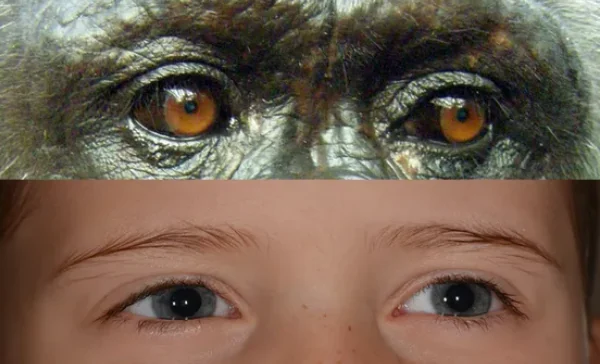
Again, there is no scientific basis for legitimately regarding Homo habilis as the earliest member of the genus Homo. The claims advanced by evolutionists rest largely on speculation and untested assumptions. Indeed, many proponents of evolution have gradually lost confidence in the theory as a result of what they perceive to be unscientific and intellectually dishonest methods employed by its advocates.
Notwithstanding, scientists who adhere to an evolutionary worldview are always seeking the so-called “missing link” to demonstrate that humans evolved from ape-like organisms, as the concept of a missing link is regarded as a crucial piece of evidence in human evolution. At times, however, this pursuit has led to excessive eagerness, resulting in some scientists producing outright fakes—such as deliberately combining human fossil fragments with those of apes to fabricate a supposed “missing link”—or engaging in premature claims and overinterpretations, drawing sweeping conclusions from fragmentary remains and extremely limited evidence. Some of these hoaxes were accepted for decades before being exposed. For example, in 1917, Harold Cook, a rancher and occasional paleontologist from Nebraska, discovered a small, well-worn tooth on his farm.
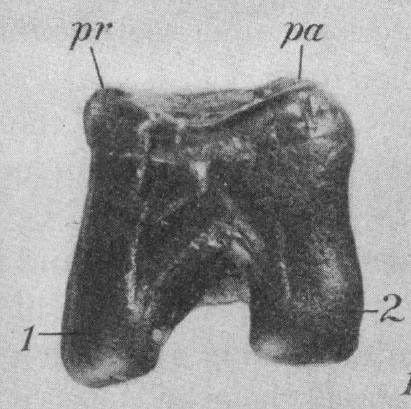
In 1922, Cook sent the tooth to his friend Henry Fairfield Osborn, a paleontologist and president of the American Museum of Natural History, who became highly excited at the prospect that it might belong to an ape-man—discovered right there in the United States. Osborn identified the tooth as belonging to an ape and quickly published a paper naming it as a new species, Hesperopithecus haroldcookii (honoring Harold Cook). The media and popular culture then referred to this so-called new species as “Nebraska Man.” An artist, relying heavily on imagination, then depicted Nebraska Man as a hairy ape-man. The infamous Nebraska Man illustration—depicting two humanlike yet extremely bestial beings—was created by Amedee Forestier for the Illustrated London News.
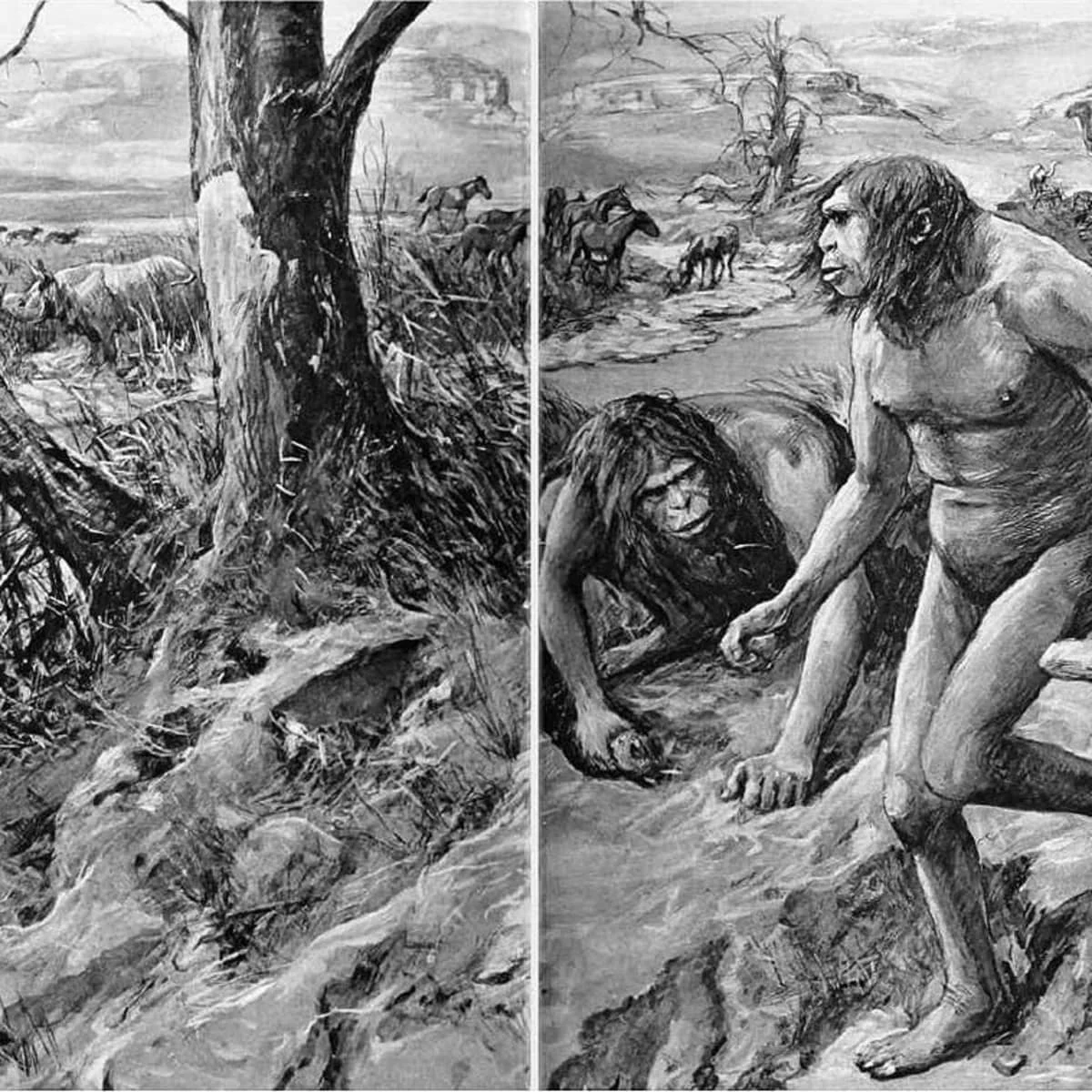
A “pedigree of the human family” was thus constructed on the basis of human remains consisting of nothing more than a single fossil molar tooth. However, several years later, it was discovered that the entire ape-man interpretation was a complete mistake. Remarkably, further excavations revealed that the tooth belonged neither to a human nor to an ape, but to an extinct species of peccary known as Prosthennops. The purported species was formally retracted roughly half a decade after Osborn’s original article had been published. Hence, the infamous Nebraska Man serves as a valuable lesson on the impact of presumptions in interpreting “evidence” within the field of human origins. In fact, there exists a long list of so-called “ape-men” that later proved to be deliberate hoaxes or cases in which the original classification was erroneous and subsequently withdrawn, such as Piltdown Man, Peking Man, Java Man, Ardi, Karabo, and some of their sisters and brothers. The point is that new discoveries will continue to be announced, but they should not be accepted uncritically; rather, one should wait, listen, and learn, for there is always the rest of the story.
Likewise, in 2008, a team of paleontologists discovered in Egypt a fossil that they described as belonging to a previously unknown amphibious, four-legged whale species. They named it Phiomicetus anubis—with “Anubis” taken from the jackal-headed Egyptian god. This illustration is the product of artists’ efforts to bring the imagination of these paleontologists to life.
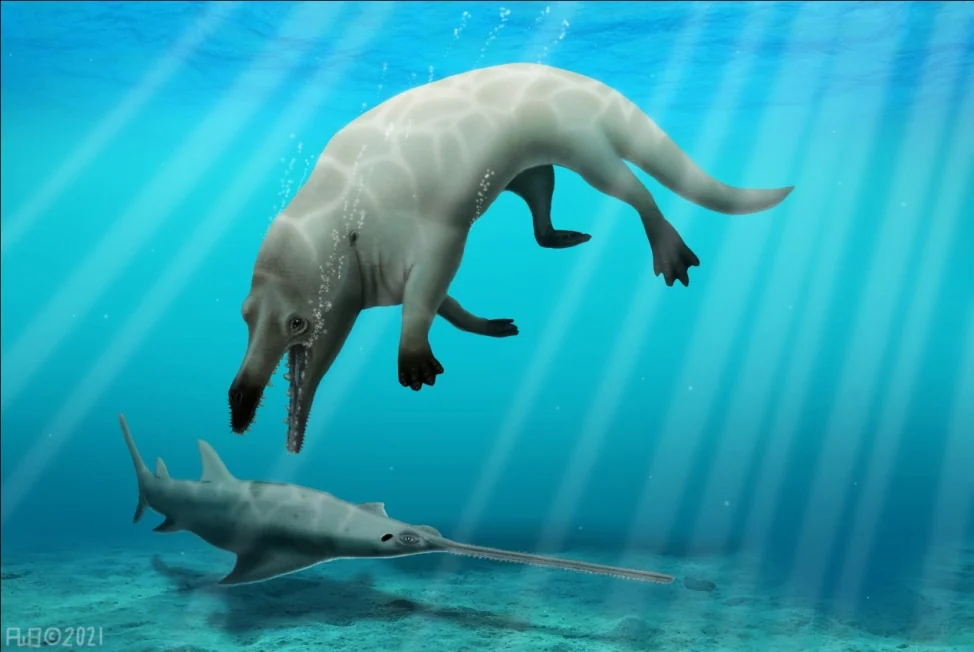
This is a drawing of the animal as envisioned by the scientists, with the recovered fossil pieces highlighted in red.7
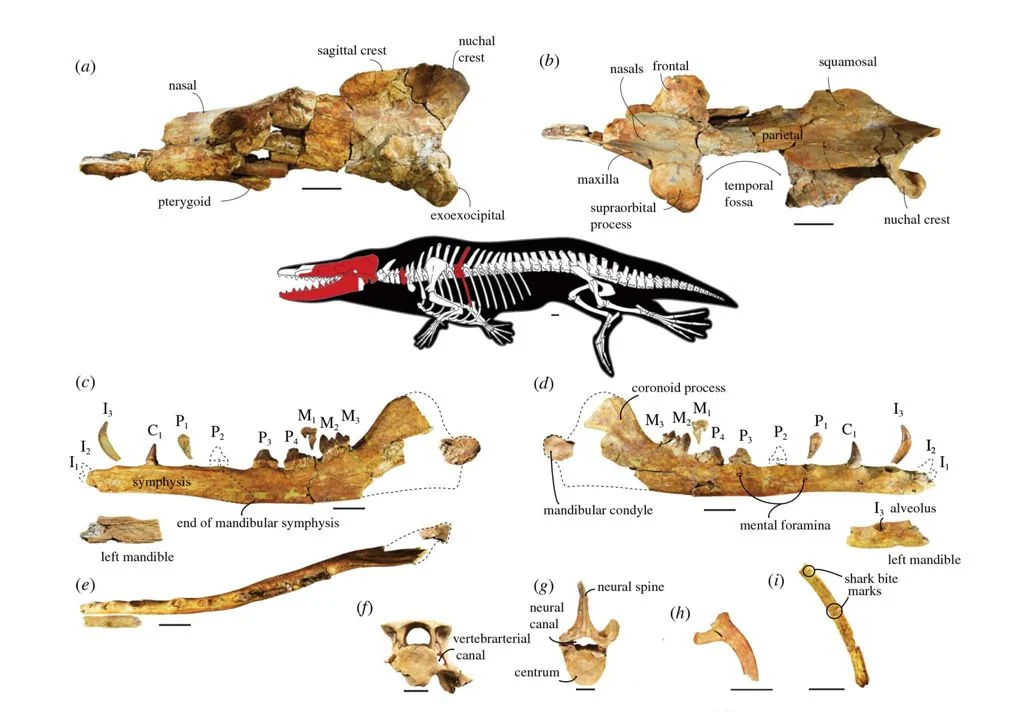
Strangely enough, these scientists transformed this fossil find into a fantastical four-legged whale, even though only a “partial skeleton,” believed to be from a whale, had been recovered. The pieces that were found consisted of a cranium, jawbones, a few neck and chest vertebrae, rib fragments, and some teeth. The irony is that no leg bones were found—none at all. Yet the depiction of the animal includes four fin-like legs. Why would a group of scientists claim to have discovered the remains of a whale and then depict it as a four-legged being when no legs were present? The answer lies in the assumptions embedded within evolutionary science. As the theory gained acceptance, it imposed a particular vision of life’s prior development onto all scientific analyses. One key tenet of the evolutionists’ narrative is that whales descended from land-dwelling, four-footed mammals. This colorful, detailed chart illustrates the assumed evolutionary pathway by which whales transitioned from terrestrial, footed ancestors to fully aquatic, finned organisms. 8
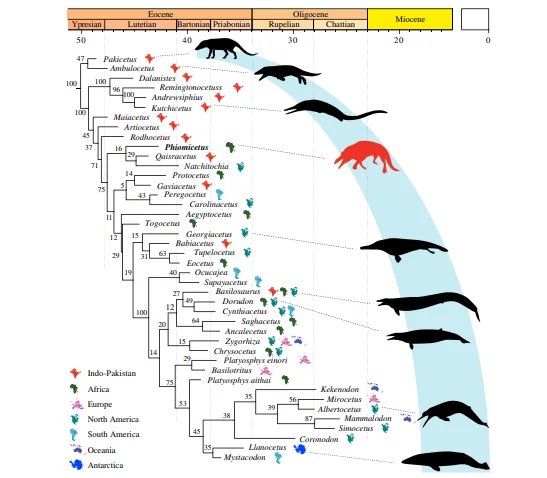
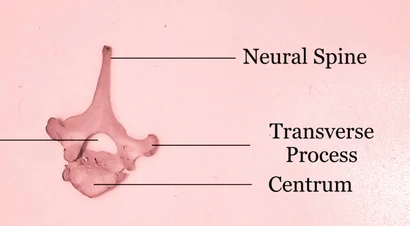
Remember, however, that evolutionists sketched this evolutionary “path” not because the fossil record provided evidence that it occurred in that manner, but because the evolutionary narrative dictated that it must have. As a result, it was the prior acceptance of this narrative that led to legs being added to Mr. Phiomicetus anubis, despite the absence of any evidence that he actually possessed them. Evolutionists contend that the long neural spines on its thoracic vertebrae indicate it may have been capable of supporting its own weight on land.
Unfortunately, evolutionists interpret everything as if the Darwinian paradigm were the absolute truth. Consequently, this fantastical four-legged whale is not the result of an unbiased examination of evidence, but rather a story spun by the advocates of the paradigm. Of course, there is no inherent problem with imagining the alleged whale as a four-legged amphibian—but where is the evidence? Even if we were to assume that this whale possessed four legs, does that justify claiming that one species of whale evolved into another? Clearly, it is far from sufficient to draw an arrow between two species and assert that one evolved from the other. To evolutionists, we say: provide the evidence first, and then believe; for reasonable belief must never exceed what the evidence actually supports. Indeed, the evolutionists’ theory of whale evolution is entirely implausible and hardly convincing, even to children. According to this evogram (a diagram showing the assumed evolutionary relationships among species), hippopotamuses are the closest living relatives of whales!9
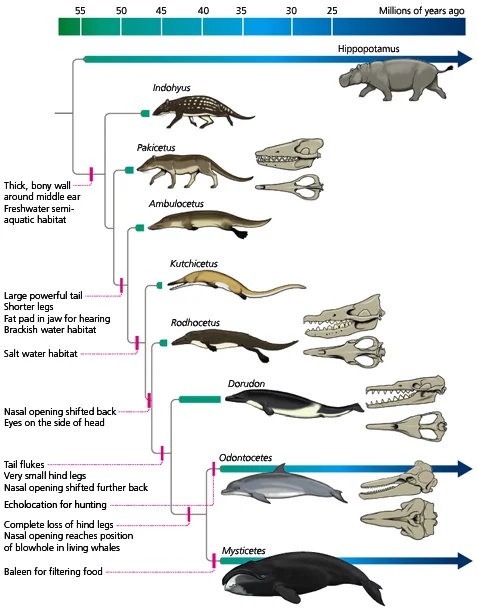
The idea that whales evolved from early four-legged land mammals—adapting to life in the oceans by losing their hind limbs, growing a flat tail, developing flippers, streamlining their bodies, and moving their nostrils from the tip of the nose, as in all land animals, to the top of the head to form blowholes—is scientifically impossible given the age of the universe. Such an evolutionary scenario would require what amounts to a supernatural miracle. Simply put, the process of whale evolution would have involved a vast number of physiological changes in the organisms involved—approximately 50,000. For instance, the cerebellum would have to change completely, as would the respiratory system, and there would need to be millions of mutant intermediate species at each stage to account for each change. Intermediate species are crucial evidence for evolution and the gradual transformation of one species into another, because without them, it cannot be demonstrated that species descended from others through small, successive changes. Yet we do not see innumerable transitional forms everywhere we look. In other words, millions of intermediate species should exist, representing the stages between ancestral organisms and their living descendants. The fact is, however, that there are no transitional fossils at all. Evolutionists assert that the fossil record is full of them, but in reality, it does not contain a single universally accepted transitional form. Every candidate fossil claimed as transitional has its doubters—not only among creationists, but even among evolutionary biologists and paleontologists themselves. Again, we have no objection to the concept of a four-legged amphibian whale, but it cannot be brought to life as part of the myth of evolution through so-called reconstructions based on imagination rather than scientific evidence. To reiterate, evolutionists create charts depicting the assumed evolutionary pathways by which one species supposedly transitioned from another, relying on little more than blind faith and lacking the slightest supporting evidence. Furthermore, the process of evolution would require hundreds of millions of years to achieve the diversity and complexity of life observed today. In other words, the maximum possible age of the universe is far shorter than the timescales required by evolutionary theory, as the expected evolutionary transition times exceed the lifetime of the Earth by many orders of magnitude. Geneticists have found that a few million years may suffice for a pair of necessary mutations to become fixed in Drosophila, yet their estimate for acquiring the same in humans is unrealistically long—exceeding 100 million years.10
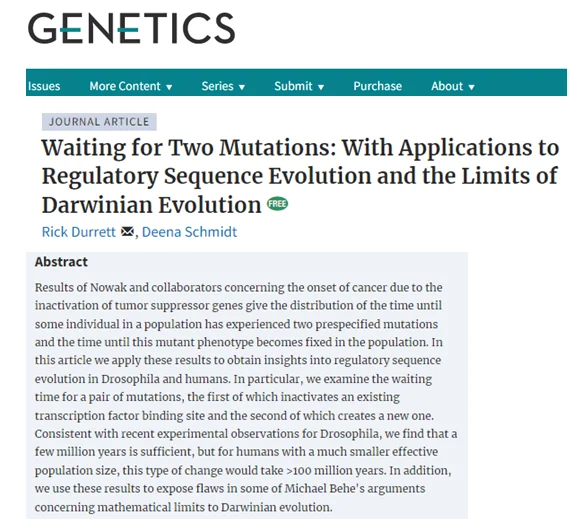
Keep in mind that even evolutionists acknowledge that beneficial mutations are extremely rare—at most, only one in a thousand mutations is beneficial. In practical terms, approximately sixty million mutations would be required for modern humans to evolve from the alleged common ancestor. If we multiply sixty million mutations by the hundred million years estimated for each pair of beneficial mutations to become fixed, the time needed for a single new species to arise would exceed the age of the universe by thousands of times. The point is that time is one of the three essential conditions for evolution to occur, yet there has simply not been enough of it. Science thus demonstrates that evolution is both impossible and mathematically unfeasible given the Earth’s age.
Unfortunately, it is difficult to discuss the problems of evolution without encountering intimidation in the form of the dreaded “C-word”: “What are you, some kind of creationist?” In reality, skepticism toward Darwinian evolution is not limited to religious believers. There are non-religious critics as well—atheists and agnostics who challenge materialistic accounts of origins. Nevertheless, such individuals are often subjected to ridicule and hostility, accused of “giving aid and comfort to creationists.” One prominent example is Evolution: A Theory in Crisis, a 1985 book by Michael Denton, an Australian agnostic biologist, in which he argued that the scientific theory of evolution by natural selection is, indeed, a “theory in crisis.”11 More than thirty years later, Denton revisited and reaffirmed this position in Evolution: Still a Theory in Crisis, where he maintained that there remains “an irresistible consilience of evidence for rejecting Darwinian cumulative selection as the major driving force of evolution.” He further asserted that “from the origin of life to the origin of human language, the great divisions in the natural order remain as profound as ever, and they are still unsupported by the series of adaptive transitional forms predicted by Darwin.”12 What Darwin Got Wrong is a book by Jerry Fodor and Massimo Piattelli-Palmerini in which the authors argue that the theory of natural selection should be rejected on two grounds: first, that it is empirically untenable, and second, that it is philosophically unsupportable. It is important to note that neither author is a creationist or even religious. Both are highly respected academics—Fodor was a philosopher, and Piattelli-Palmerini is a cognitive scientist. Particularly revealing is the publisher’s promotional description of the book, which highlights the strong cultural stigma still attached to dissent from Darwinism: “This is not a book about God, or about intelligent design. Rather, here is a remarkable book, one that dares to challenge natural selection–not in the name of religion but in the name of good science. Most scientists are so terrified of religious attacks on the theory of evolution that it is never examined critically. But there are major scientific and philosophical problems with the theory of natural selection.”13 Longtime evolutionary biologist Lynn Margulis—the wife of American astronomer Carl Sagan—stated: “Natural selection eliminates and maybe maintains, but it doesn’t create. … [N]eo-Darwinists say that new species emerge when mutations occur and modify an organism. I was taught over and over again that the accumulation of random mutations led to evolutionary change — led to new species. I believed it until I looked for evidence.”14 Likewise, Ernst Chain—a German-born British biochemist who shared the 1945 Nobel Prize for isolating and purifying penicillin—found Darwin’s theory of evolution to be “a very feeble attempt to explain the origin of species, based on assumptions so flimsy that it can hardly be called a theory.”15 Chain rejected evolution, stating: “To postulate that the development and survival of the fittest is entirely a consequence of chance mutations seems to me a hypothesis based on no evidence and irreconcilable with the facts. These classical evolutionary theories are a gross over-simplification of an immensely complex and intricate mass of facts, and it amazes me that they are swallowed so uncritically and readily, and for such a long time, by so many scientists without a murmur of protest.”16 Hence, although evolutionists frequently claim there is “overwhelming evidence” for evolution, to this day, no genuine proof exists, underscoring its fundamental weaknesses. In a word, evolution is not a scientific theory; rather, it rests on wild speculation and, for the most part, is not amenable to experimental testing.
In addition to the above, there is a serious moral problem with the pluralistic view of human species—that is, the idea that multiple human species once existed. As is well known, Darwin divided humanity into distinct races based on differences in skin, eye, or hair color, ranking them at higher and lower stages of evolution. In The Descent of Man, where he applied his theory of natural selection to humans and introduced the concept of sexual selection, Darwin’s text clearly reflects a racist and white supremacist ideology. Throughout the book, he described Australians, Mongolians, Africans, Indians, South Americans, Polynesians, and Eskimos as “savages,” considering every non-European population to be inferior while consistently elevating white Europeans. The notion that white people are inherently more intelligent and moral recurs throughout the work: for instance, “the highest races and the lowest savages” differ in “moral disposition … and in intellect.”17 For instance, Darwin wrote that Australians are incapable of complex thought and implied that they are akin to lower animals: “How little can the hard-worked wife of a degraded Australian savage, who uses hardly any abstract words and cannot count above four, exert her self-consciousness, or reflect on the nature of her own existence.”18 Undeniably, Darwin’s perspective on non-European races is both highly prejudiced and absurd. Modern evolutionists often ignore or omit this aspect of Darwin’s theory, but it has not gone entirely unnoticed. For example, Rutledge Dennis—Professor of Sociology and Anthropology at George Mason University—examined Darwin’s role in scientific racism for The Journal of Negro Education and found that, in Darwin’s worldview, “talent and virtue were features to be identified solely with Europeans.”19 Darwin drew a troubling connection between his belief in white supremacy and his theory of natural selection, using it to justify violent imperialism: “From the remotest times successful tribes have supplanted other tribes. … At the present day civilised nations are everywhere supplanting barbarous nations.”20 In other words, Darwin applied the concept of survival of the fittest to human races, implying that the extermination of non-white peoples is a natural consequence of white Europeans being a superior and more successful race. He thus justified violently overtaking other cultures on the grounds that such domination has occurred repeatedly throughout natural history, and he expressed no objection to continuing the vicious behavior of past generations. In fact, Darwin not only espoused white supremacy but also offered a biological rationale for it, asserting that white people are further evolved—more advanced than the rest of the world: “the western nations of Europe … now so immeasurably surpass their former savage progenitors and stand at the summit of civilization.”21 Again, this supposed superiority led Darwin to justify the domination of so-called inferior races by Europeans. He wrote that the gap between civilized Man and his closest evolutionary ancestor would widen as white Europeans “exterminate and replace” the world’s “savage races,” and as great apes go extinct, ultimately leaving the gap between civilized Man “and some ape as low as a baboon, instead of as at present between the negro or Australian and the gorilla.”22 It is clear that Darwin believed Africans and Australians are more closely related to apes than Europeans. In Darwin’s evolutionary framework, organisms form a hierarchy, with white Europeans at the top, apes at the bottom, and people of color somewhere in between. In other words, the designation “modern human” is essentially restricted to white Europeans, while all other races are implicitly regarded as sub-human. Darwin’s dark side is therefore a reality, not the product of critics’ ignorance or ulterior motives. His theories are undeniably racist, and the text of his books—particularly The Descent of Man—is revealing and conclusive. Indeed, the brutal racism and white supremacism in Darwin’s writings cannot be denied, and it is unsurprising that Social Darwinism later helped fuel genocides and world wars. Darwin’s notion that evolutionary progress results primarily from the elimination of the weak in the struggle for survival was a key factor that contributed to the ideological foundations of the Nazi Holocaust and World War II. It should be recalled that the development and implementation of policies aimed at protecting the so-called “superior race” were central to Hitler’s administration. This entailed, at the very least, preventing the “inferior races” from interbreeding with those deemed superior, in order to preserve the latter’s gene pool. Clearly, the belief in a “superior race” was grounded in the theory of group inequality within each species—a major assumption and requirement of Darwin’s original “survival of the fittest” concept. This evolutionary philosophy ultimately culminated in the “final solution”—the extermination of approximately six million Jews and four million other people whom German scientists operating under the Nazi regime judged to belong to “inferior races.” At the 1933 Nuremberg Party Rally, Hitler proclaimed that “the higher race subjects to itself a lower race …a right which we see in nature and which can be regarded as the sole conceivable right,” claiming that this hierarchy was founded on science.23 Simply put, Hitler believed that humans were animals to whom genetic laws, derived from livestock breeding, could be applied. Moreover, the Nazis believed that rather than allowing natural forces and chance to govern evolution, they must actively direct the process in order to advance the human race. The first step toward achieving this goal was the isolation of so-called “inferior races” to prevent them from further contaminating the “Aryan” gene pool. This belief—common among the educated classes—that certain races were genetically inferior and that this inferiority had been scientifically “proven” by Darwinism resulted in widespread public support for such policies. In other words, the Nazis believed they were merely applying facts, supposedly established by science, to engineer a superior human race as part of their vision for a better world: “The business of the corporate state was eugenics, or artificial selection—politics as applied biology.”24 Hence, Darwinism played a fundamental role in shaping the racist ideology of the Nazis, influencing their views on race and society. Essentially, they believed that different races had evolved to different levels and that, as a result, some races were superior while others were inferior. Moreover, they held that these allegedly unequal races were engaged in an inescapable struggle for existence. Consequently, they saw it as their mission to advance their own race within this universal racial struggle, even to the point of committing violence against those they regarded as racial enemies, since, in their view, someone had to perish in the Darwinian struggle for existence after all. Thus, the Holocaust emerged as the most infamous outcome of social Darwinism, as beliefs in German superiority drove the Nazis to exterminate those they deemed “undesirable.” Social Darwinism also exerted a major influence on the events leading up to the First and Second World Wars, as well as on many of the world’s worst crimes against humanity in the last century. No doubt, human rights, human dignity, and human values do not belong to the realm of nature. Atheists have no right to divide humankind into biologically distinct groups in order to justify racial discrimination, or even the killing of innocent souls, on the basis of nonsensical assumptions. Had the Nazi Party fully embraced and consistently acted upon the belief that all humans are descendants of Adam and Eve and equal before the Creator God, as taught in the Divine Scriptures, the Holocaust would never have occurred. However, according to evolutionists, humans are an evolutionary accident—animals that evolved through the same mechanisms as all other life forms rather than a special creation. Therefore, if religion is eliminated and materialistic, atheistic perceptions are implemented, all forms of ethnic cleansing will occur in the name of the survival of the fittest. This is because the annihilation of the “lower races,” which are seen as standing in the way of advanced culture and civilization, is presented as the key to human progress. This explains why many white nationalists today are so eager to honor both Hitler and Darwin, since the latter’s theory of natural selection provides ideological support for their white nationalist views. Indeed, Darwin’s theory contains a dangerous racial ideology, and the contemporary reverence for Darwin’s “gentlemanliness and the scientific brilliance of his theories” is an overly idealized illusion that collapses upon closer examination of his publications.
Finally, the problem remains unresolved, as no convincing explanation has yet been provided by any evolutionist, despite the enormous importance of the issue. If humans evolved from ape-like organisms, which species might have served as transitional forms between ape-like hominins and the fully human members of the genus Homo? So far, no satisfactory candidates have been identified. Moreover, since evolutionists assert that the genus Homo has existed and been the dominant species on the planet for at least 2.8 million years, it is reasonable to expect that Homo fossils would be found widely. Yet how many Homo fossils have paleontologists actually discovered? Not tens of thousands, not hundreds, not even just tens. Why are fossils attributed to Homo so exceedingly rare, and why have previous finds often been revealed as fraudulent, belonging instead to extinct ape species or to modern humans? Interestingly, there is not a single universally accepted fossil that can be definitively assigned to the genus Homo. Indeed, the so-called “missing-link” fossils sought since Darwin’s time will never be found, as they simply do not exist; in the absence of such fossils, the idea of evolution remains, at best, an entirely untenable and highly speculative hypothesis. The fact is that modern humans appeared in the world suddenly, already in a fully advanced state the very first time they appeared—without any evolutionary history. This is the truth that the failure of paleontology to provide evidence for evolution, together with findings from molecular biology, reveals to us every day. It may be easy for evolutionists to construct stories about how one species gave rise to another, but such accounts do not belong to science, as there is no way to test them. Evolutionists will never have access to any form of tree that can be considered factual. Ironically, the fossil record does not support evolution but instead provides positive evidence for creation, as it contains only discontinuities. All species are separated by bridgeless gaps, and intermediates between species are not observed. The fossil record shows fully formed new species that appear abruptly—not gradually—without evolutionary precursors or obvious connections to preceding species. Divine creation is the only explanation for this sudden appearance of new species. As has been elaborated, proponents of evolution make very bold statements based on the flimsiest of evidence. They promote their conclusions widely and vocally, going so far as to deliberately falsify evidence to ensure the popularity of their theory among the public. Unfortunately, evolution is often presented in a manner that creates the impression that it is a definitively settled scientific truth, and any objections to it are dismissed as ignorance or bigotry. It is worth noting, however, that the theory of evolution has changed dramatically since Darwin and continues to be modified with each new discovery, which serves as conclusive evidence that it lacks a valid scientific foundation and remains far from being scientifically proven. As we have noted, the fossil record has failed to support evolutionary claims, and findings from modern scientists have made the theory of evolution even less tenable. Indeed, today’s evolutionists uphold the theory with “faith.” But is faith not a belief that lacks proof? Evolutionists make overconfident and untested statements, yet their theory remains a mere conjecture or speculation, with their preconceptions playing a critical role in interpreting the limited evidence, often going beyond what the facts warrant. Doubtless, if all the evidence for the theory were presented to an unbiased philosopher of science, he would undoubtedly cry out at the top of his voice: “Stop this nonsense at once!”
Notes and References
- 1
“Bernard Wood: The Homo Habilis and the Origin of Modern Humans,” YouTube, uploaded by Stefano Di Criscio, 10 Apr. 2014, https://youtu.be/wmWqojkcJ_8, [4:47-5:25].
- 2
Bernard Wood, Human Evolution: Fifty Years after Homo habilis,” Nature, vol. 508, issue 7494, 3 Apr. 2014, pp. 31–33. DOI: https://doi.org/10.1038/508031a.
- 3
Briana Pobiner, “The First Butchers: Were there other Toolmakers and Meat Eaters in our Family Tree?” Sapiens, 23 Feb. 2016, https://www.sapiens.org/biology/homo-sapiens-and-tool-making/.
- 4
“Chimpanzees’ Sophisticated Use of Tools | BBC Studios,” YouTube, uploaded by BBC Studios, 4 Apr. 2008, https://youtu.be/5Cp7_In7f88.
- 5
Ibid.
- 6
Casey Luskin, “The Human Fossil Record Lacks Intermediaries,” Evolution News & Science Today, 27 Oct. 2022, https://evolutionnews.org/2022/10/the-human-fossil-record-lacks-intermediaries/.
- 7
Abdullah S. Gohar et al., “A New Protocetid Whale Offers Clues to Biogeography and Feeding Ecology in Early Cetacean Evolution,” Proceedings of the Royal Society B: Biological Sciences, vol. 288, issue 1957, 25 Aug. 2021. DOI: https://doi.org/10.1098/rspb.2021.1368.
- 8
Ibid.
- 9
Carl Zimmer, The Tangled Bank: An Introduction to Evolution, (Greenwood Village, U.S.: Roberts & Company, 2013).
- 10
Rick Durrett and Deena Schmidt, “Waiting for Two Mutations: With Applications to Regulatory Sequence Evolution and the Limits of Darwinian Evolution,” Genetics, vol. 180, issue 3, 1 Nov. 2008, pp. 1501–1509. DOI: https://doi.org/10.1534/genetics.107.082610.
- 11
Michael Denton, Evolution: A Theory in Crisis, (London, U.K.: Burnett Books, 1985).
- 12
---., Evolution: Still a Theory in Crisis, (Seattle, U.S.: Discovery Institute Press, 2016).
- 13
Jerry Fodor and Massimo Piattelli-Palmerini, What Darwin Got Wrong, (New York, U.S.: Farrar, Straus and Giroux, 2010).
- 14
Lynn Margulis and Dorion Sagan, Acquiring Genomes: A Theory of the Origins of Species, (New York, U.S.: Basic Books, 2003), p. 32.
- 15
Ronald William Clark, The Life of Ernst Chain: Penicillin and Beyond, (New York, U.S.: St. Martin’s Press, 1985), p. 147.
- 16
Ernst Chain, Social Responsibility and the Scientist in Modern Western Society, (London, U.K.: Council of Christians and Jews, 1970), p. 25.
- 17
Charles Darwin, The Descent of Man, (Amherst, U.S.: Prometheus Books, 1871), p. 36.
- 18
Ibid., p. 62.
- 19
Ibid., p. 243.
- 20
Ibid., p. 160.
- 21
Ibid., p. 178.
- 22
Ibid., p. 201.
- 23
Joseph Tenenbaum, Race and Reich, (New York, U.S.: Twayne Publisher, 1956), p. 211.
- 24
Léon Poliakov, The Aryan Myth, (New York, U.S.: Basic Books, 1974); George Stein, “Biological Science and the Roots of Nazism,” American Scientist, vol. 76, issue 1, 1988, pp. 50–58, [p. 56].