Is Ḏū al-Qarnayn the same figure as Alexander the Great?
Ḏū al-Qarnayn is the righteous king whose story is recounted in the Qurʾān:1
In fact, the expression “Ḏū al-Qarnayn” is not a personal name but a title, literally meaning “the one with two horns.” The characteristics of Ḏū al-Qarnayn, as presented in his Qurʾānic narrative, may be summarized as follows:
1.The title Ḏū al-Qarnayn (the two-horned one) must have been familiar to the Jews, since the disbelievers of Makkah asked Prophet Muḥammad (PBUH) about him at their instigation; consequently, one must turn to the Jewish Scriptures to identify which person or king was known as the two-horned one.
2.Ḏū al-Qarnayn must have been a great ruler and conqueror whose campaigns extended eastward, westward, and on a third front either northward or southward. Several such conquerors had appeared prior to the revelation of the Qurʾān, and thus the inquiry into his other characteristics must be confined to this class of conquerors.
3.The title Ḏū al-Qarnayn should be applicable to a ruler who constructed a strong wall across a mountain pass to protect a people from the incursions of Gog and Magog; accordingly, it is necessary to establish who Gog and Magog were, when such a barrier was built, by whom, and which territory it adjoined.
4.In addition to these attributes, he must also have been a worshiper of God and a just ruler, for the Qurʾān emphasizes these qualities above all others.
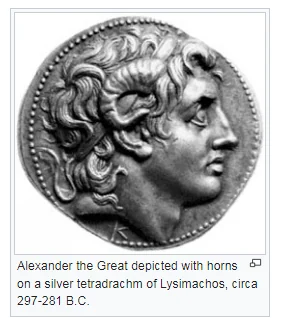
Some have identified Ḏū al-Qarnayn with Alexander the Great (also known as Alexander the Macedonian) without presenting convincing evidence, basing the claim merely on his extensive travels and his depiction with the horns of a ram.
However, the claim that Alexander was known as the two-horned one must be examined from two perspectives:
1.Was Alexander extensively depicted with two horns in pre-Islamic history, and was this attribution widely recognized?
2.Was Alexander the only figure in ancient history to be portrayed with two horns?
Unquestionably, the answer to both questions is no. It is true that coins and other artifacts depict Alexander with two horns—an image most likely adopted after his conquest of Egypt from the god Zeus-Ammon, itself a syncretic fusion of the Greek god Zeus and the Egyptian deities Ra and Hamun. However, the attribution of the ram’s horns to Alexander did not become widespread until well into the Middle Ages. There is no evidence in any of the pre-Islamic recensions (i.e., early versions or textual traditions) of the Alexander Romance that Alexander was referred to as “the one with two horns,” nor is there evidence that this attribution was widespread beyond his empire or that he was universally known by such an epithet. Those who argue otherwise disregard the historical record of other figures portrayed with horns. In fact, numerous ancient rulers were depicted with two horns, including the Elamites (predecessors of the Achaemenids in Persia, who ruled from roughly 2700 BCE until their conquest by the Achaemenids in 539 BCE), Egyptian pharaohs, Seleucids who succeeded Alexander, and even Achaemenids such as Cyrus the Great.2 Let us cite a few examples of ancient kings who were portrayed with two horns. Naram-Sin, ruler of the Akkadian Empire (c. 2254–2218 BC), was one such figure. A notable example is the Victory Stele of Naram-Sin, dating to around 2250 BC, which depicts him wearing a bull-horned helmet—a symbol of divine kingship in Mesopotamian iconography (i.e., he was the first Mesopotamian king to openly portray himself as a god).3

Ptolemy XII Auletes is depicted wearing the hemhem crown—an elaborate ancient Egyptian ceremonial headpiece consisting of a triple atef adorned with corkscrew-shaped ram’s horns and typically flanked by two uraei.4

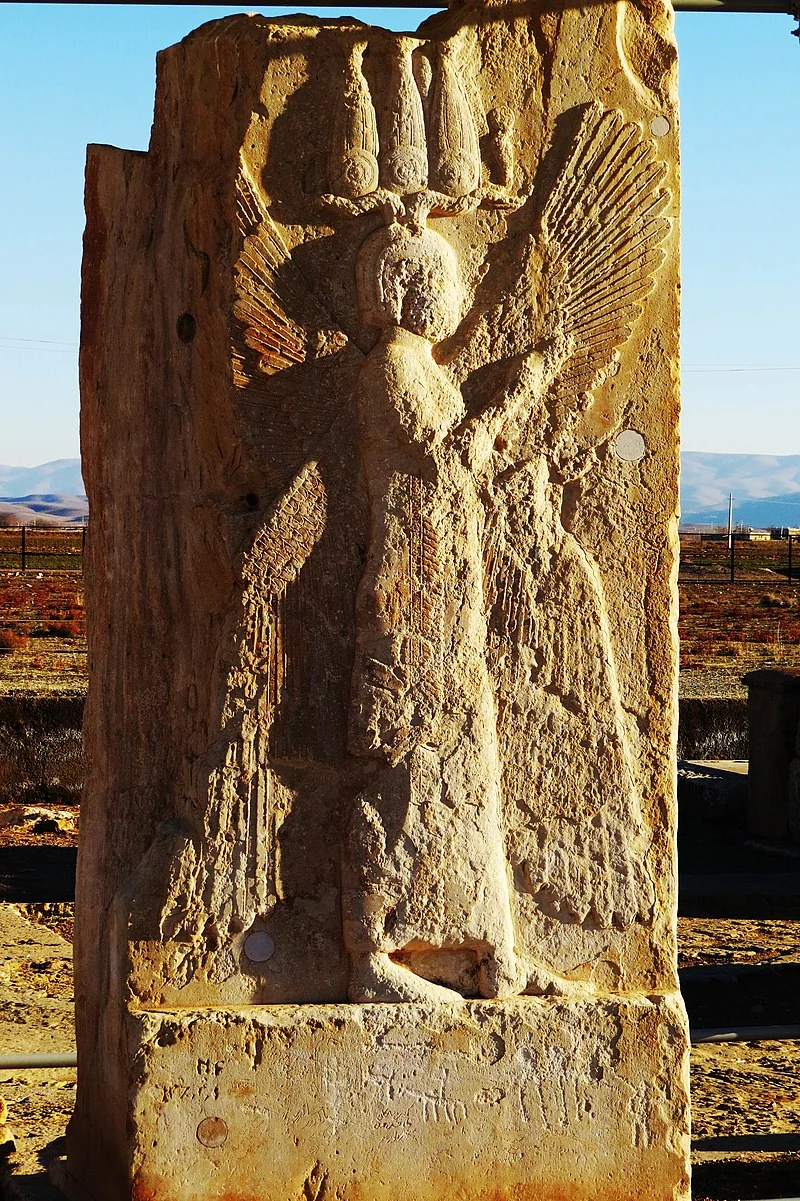
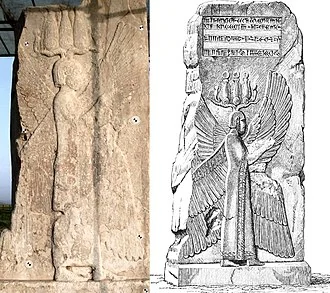
Cyrus the Great, too, is depicted wearing a hemhem crown.5

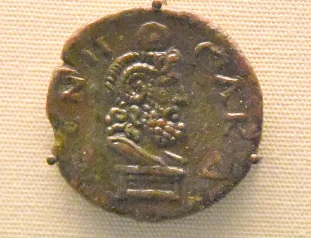
Hadrian’s silver drachms, dating to c. 134–135 CE, depict Zeus-Ammon on a plinth, wearing a ram’s horn.6
The evidence demonstrates that Alexander the Great was by no means the only ruler in antiquity portrayed with two horns; indeed, horns were a common emblem among kings, symbolizing power and sovereignty. Furthermore, a comparison between the Qurʾānic portrayal of Ḏū al-Qarnayn and the extant historical accounts of Alexander makes it evident that the two figures cannot be equated, and to assert otherwise reflects a profound misunderstanding of both history and Scripture. As will be shown, Alexander is disqualified on multiple grounds, whereas the Persian king Cyrus the Great emerges as the strongest candidate, supported by substantial and compelling evidence.
As noted in a previous section, it was the Jews of al-Madīnah who instructed the Makkan disbelievers to question Prophet Muḥammad (PBUH) about Ḏū al-Qarnayn (the two-horned one) in order to test his Prophethood: {They ask you ˹O Prophet˺ about Ḏū al-Qarnayn. Say, “I will relate to you something of his narrative”} (Qurʾān 18:83). Hence, the story was revealed in response to their inquiry. Considering the occasion of its revelation, it follows that the figure in question would be expected to appear in the Torah. Indeed, Ḏū al-Qarnayn (the two-horned one) corresponds to the two-horned ram in the prophecy of Prophet Daniel (PBUH) recorded in Daniel 8. In the third year of Belshazzar, king of Babylon, Daniel saw a vision in which he found himself in Susa, in Elam (present-day western Iran), where he beheld a ram with two horns, one greater than the other, charging westward, northward, and southward, with no beast able to withstand it. Then a male goat with a single horn came from the west without touching the ground, struck the ram, and destroyed it; and at the height of its power its horn was broken, to be replaced by four horns that grew in its place.7
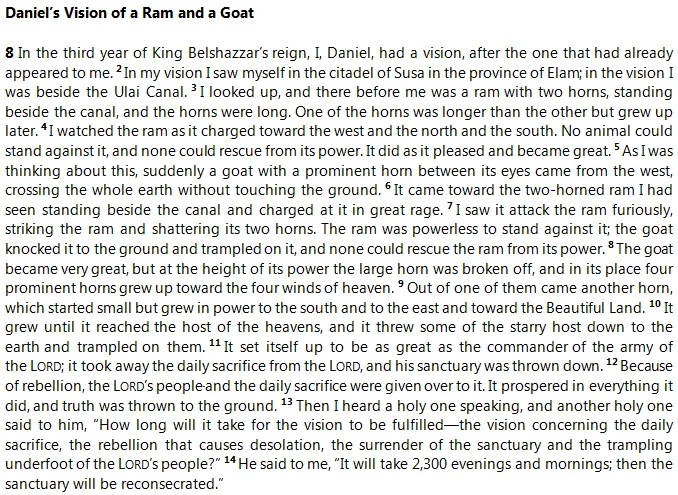
Daniel was left contemplating the meaning of the vision, when the angel Gabriel approached him and provided a precise interpretation of what he had seen:8
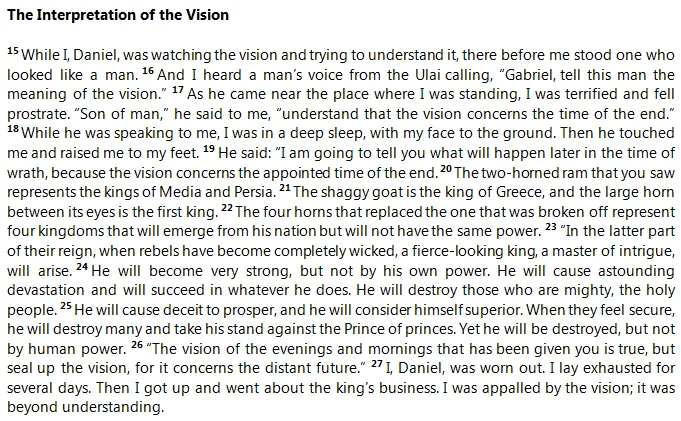
Indeed, Daniel’s vision corresponds closely to actual historical events:
•The angel Gabriel explained that the ram Daniel (PBUH) saw—with two horns, one higher than the other, pushing westward, northward, and southward, and becoming great—represented the kings of Media and Persia. Herodotus, the renowned Greek historian, described the formation of the Median Empire, noting that the Medes, who were initially dispersed in numerous smaller settlements, were united by a man named Deioces who established a great capital city at Ecbatana, reigned for fifty-three years, and consolidated at least six regional groups into the kingdom of Media. According to Herodotus, Deioces’ son Phraortes ruled for twenty-two years after him, and was succeeded by his own son, Cyaxares, who, in Herodotus’ words, “united all Asia beyond the Halys under his rule.”9 Cyaxares reigned for forty years before his death, after which he was succeeded by his son Astyages. During Astyages’ reign, the Persians revolted against the Medes. The Persian forces, under the leadership of Cyrus the Great, defeated Astyages’ army, and Cyrus subsequently ascended to the throne of both the Medes and the Persians.10 The Nabonidus Chronicle, a Babylonian cuneiform text recording major events of the sixth century BCE and regarded as one of the most reliable primary sources for this period, corroborates Cyrus’ victory over Astyages.11 One noteworthy aspect of Daniel’s prophetic vision is that the Medes initially constituted the superior ruling class, a fact attested by numerous passages in Herodotus’ Histories. For instance, Herodotus recounts that Astyages gave his daughter in marriage to “a Persian named Cambyses, a man he knew to be of good family and quiet habits—though he considered him much below a Mede even of middle rank.” This Cambyses was the father of Cyrus the Great, whose ascent would eventually overturn Median supremacy.12 When Cyrus assumed control of the empire, the Persian branch of the kingdom grew stronger, despite having risen second in order. As Herodotus records: “On the present occasion the Persians under Cyrus rose against the Medes, and from that time forward were masters of Asia.”13 This historical reality corresponds precisely with Daniel’s vision of the ram that had two horns, one higher than the other, with the higher one appearing last (Daniel 8:3).

The dual power of the Medo-Persian Empire, led first by Cyrus the Great and later by his son Cambyses II, continued to expand in both strength and territory. Herodotus records that the empire encompassed the whole of Asia, by which he meant Asia Minor rather than the modern continent. Cyrus then began to “push westward,” subjugating peoples such as the Ionians, reaching as far as the Aegean Sea.14 Herodotus observed that Cyrus was characterized by a “restless ambition.”15 Cambyses II, who succeeded his father Cyrus, appeared to share the same ambitious spirit, for he “pushed southward,” extending the empire’s dominion as far as Egypt.16 Darius, who ascended the throne after Cambyses II, declared dominion over a multitude of nations, extending his rule as far north as Armenia.17 Thus, the ram with two horns in Daniel’s vision unquestionably represented the Medo-Persian Empire, precisely as the angel Gabriel had explained.
•In Daniel’s vision, the ram with two horns—representing the Medo-Persian Empire—was defeated by a male goat that came from the west, bearing a prominent horn between its eyes. According to the angel Gabriel’s explanation, this male goat symbolized the kingdom of Greece, and the notable horn denoted its “first king.” Anyone familiar with ancient history readily recognizes this figure as Alexander the Great, who was arguably one of the most legendary military commanders in world history. Quintus Curtius Rufus, a Roman historian writing in the first century CE, observed that Alexander possessed “a lust for glory and fame reaching a degree which exceeded due proportion.”18 Alexander’s conquest of the known world was remarkably thorough. Rufus remarked: “The fates waited for him to complete the subjection of the East and reach the Ocean, achieving everything of which a mortal was capable.”19 In the course of his campaigns, Alexander defeated the Medo-Persian Empire and absorbed it into the Greek dominion. Accordingly, biblical scholars concur that the male goat’s prominent horn—later broken—represents Alexander the Great, while the four subsequent horns symbolize the generals who partitioned his empire. As the historian Rufus observed, in the absence of a designated heir, Alexander’s death inevitably invited competing claims to the throne.20 Amidst the scramble for Alexander’s throne, his kingdom was divided into four segments: Cassander took Macedonia and Greece, Lysimachus assumed control of Thrace and Asia Minor, Seleucus established dominion over Syria and Mesopotamia, and Ptolemy secured Egypt along with parts of Palestine: “[T]he Macedonian Empire split into four main kingdoms—the one of Seleucus (Asia), Ptolemy (Egypt), Lysimachus (Thrace), and Antipater’s son Cassander (Macedonia, including Greece).”21 Plutarch, the ancient historian, documented this division in detail. In his account of Demetrius, he wrote:22

Diodorus Siculus confirmed this account, noting that following Alexander’s death, his generals partitioned the empire among themselves, each securing authority over distinct regions:“When they had been brought into the council, they demanded that Cappadocia and Lycia be given to Cassander, Hellespontine Phrygia to Lysimachus, all Syria to Ptolemy and Babylonia to Seleucus.’’23 Both writers note that Antigonus and his son Demetrius also contested control over portions of the empire; however, upon their defeat, Plutarch wrote: “The victorious kings carved up the entire domain which had been subject to Antigonus and Demetrius, as if it had been a great carcass, and took each his portion, adding thus to the provinces which the victors already had.’’24 Thus, more than 250 years after Daniel’s vision, Alexander’s kingdom was divided and governed by “four horns,” precisely as the angel Gabriel had foretold concerning the kingdom of Greece in Daniel 8:22:

Indeed, the accuracy of this statement is fully corroborated by secular historical records.
•In Daniel’s vision, a little horn emerged from one of the four horns (kingdoms) and grew to be great, extending its authority toward the south, the east, and the “Beautiful Land.” This horn exalted itself to a level comparable to the “commander of the army of the Lord” and took away the daily sacrifices from the Lord. The angel Gabriel explained that this horn represented a king who would be “a master of intrigue,” “consider himself superior,” and “be destroyed, but not by human power.” History records the life of an individual who matches this prophecy. From the Seleucid Empire arose Antiochus Epiphanes IV, whose reign, beginning in 175 B.C. and lasting until 164 B.C., was marked by deceit, tyranny, and brutality—just as Daniel’s vision and Gabriel’s explanation had predicted. A closer examination of these prophecies confirms that Antiochus Epiphanes IV fulfills the vision of the little horn. Daniel’s text indicates that this ruler would be so enamored with his own importance that “it set itself up to be as great as the commander of the army of the Lord” (Daniel 8:11), and the angel Gabriel emphasized that he would “consider himself superior” (Daniel 8:25). Comparing this prediction with the historical record of Antiochus Epiphanes IV reveals a striking fulfillment in the king’s hubris. As Bible scholar H.W. Hoehner notes, Antiochus Epiphanes IV “assumed the title of Theos Epiphanes, meaning ‘the manifest God.’”25 Coins minted during the reign of Antiochus IV further substantiate his claim to divinity. Mahlon H. Smith provides detailed images of a silver tetradrachm (a Greek coin valued at four drachmas) issued under Antiochus IV bearing the inscription “Basileos Antiochou Theou Epiphaniou Nikephorou,” which translates as “Of King Antiochus, God Manifest, Victory Bearer.” Smith also highlights a bronze coin depicting Antiochus IV with the phrase “God Manifest.”26 Undoubtedly, Antiochus Epiphanes IV exalted himself “as great as the commander of the army of the Lord,” a fact that lends further weight to the identification of him as the little horn of Daniel’s vision. Moreover, Daniel’s prophecy foretold that the little horn arising from the male goat would extend “in power to the south and to the east and toward the Beautiful Land” (Daniel 8:9). The “Beautiful Land” is a reference to Judea and Jerusalem, as confirmed by the prediction that the little horn would bring an end to the daily sacrifices in the Jerusalem Temple. History makes it possible to pinpoint the moment when these sacrifices ceased. The book of 1 Maccabees records that Antiochus IV waged war against Ptolemy, routed his army, and slew many.27 On his return from Egypt, Antiochus IV plundered the Temple. Two years later, he dispatched a general named Mysarch, who devastated many towns in Judah and slew a multitude of Jews. He also issued letters to Jerusalem commanding the cessation of burnt offerings, meal offerings, and libations in the Temple, together with the profanation of Sabbaths and festivals. Finally, in 167 B.C., he desecrated the altar in the Temple, which the author of 1 Maccabees describes as the abomination of desolation.28 Finally, when the angel Gabriel interpreted Daniel’s vision, he foretold that the wicked king represented by the little horn would be “destroyed, but not by human power” (Daniel 8:25). This prophecy found striking fulfillment in the fate of Antiochus Epiphanes IV. He did not fall in battle, as was the common end of kings in antiquity, nor was he struck down through an assassination by conspirators. In other words, his death came at the hand of no man. Instead, several historical sources attest that he succumbed to a severe distemper.29 Josephus records the following:30

Likewise, Polybius, the Greek historian of the second century B.C., recorded that Antiochus died at Tabae in Persia, stricken with madness—said by some to have been the result of divine displeasure.31 Diodorus Siculus, writing in the first century B.C., likewise recorded that Antiochus Epiphanes IV “was driven mad by certain apparitions and terrors, and finally died of disease.”32 Both Siculus and Polybius attributed Antiochus’ disease to divine displeasure over his attack on the temple of Artemis, while Josephus ascribed it to his offenses against the Temple of the Jews. Yet all three sources concur that he died of a “disease,” “distemper,” or “madness” that was not brought about by human hands. Thus, the death of Antiochus Epiphanes IV corresponds precisely with the prophecy of the little horn in Daniel 8:25, which foretold that he would be “destroyed, but not by human power.” Consequently, Daniel 8 provides an unmistakably accurate and detailed account of the historical events that unfolded between 550 B.C. and 164 B.C.
Clearly, the Qurʾānic characteristics of Ḏū al-Qarnayn are most readily applicable to Cyrus the Great. To begin with, according to the Bible, Prophet Daniel saw in his vision that the united kingdom of Media and Persia was like a two-horned ram before the rise of the Greeks. In Daniel’s lifetime, the Babylonians were defeated by Cyrus the Great, the first king and unifier of the Medes and Persians, who reigned from 559 to 530 B.C. Cyrus was the founder of the Achaemenid Empire, which stretched from the Aegean Sea to the Indus River and was, at that time, the largest empire the world had ever known. His rise began around 549 B.C., when he conquered the kingdom of Media and, soon after, Lydia. In 539 B.C., he went on to capture Babylon. After this, no kingdom of comparable power remained to oppose him. His dominion extended eastward into Sind and the region known as Turkistan, westward into Egypt and Libya, and northward into Thrace, Macedonia, the Caucasus, and Khwarazm. In effect, the entire civilized world of his era fell under his sway. Yet Cyrus was remembered not only as a brilliant military strategist but also as a remarkably benevolent and just ruler. The most famous example of his magnanimity is preserved in the Bible: after conquering Babylon, Cyrus permitted the exiled Jews to return to Jerusalem, restored to them the sacred vessels the Babylonians had seized, and encouraged them to rebuild the Temple that King Nebuchadnezzar had destroyed. For this reason, he is uniquely honored in the Hebrew Bible as the only foreign ruler to be identified as the “messiah” or “anointed one” of YHWH, the God of Israel. According to Isaiah 45:1–3, God Himself declared that He had anointed Cyrus for this task:33

Indeed, Cyrus is the only non-Jewish figure in the Bible to be honored in this way. The term “anointed one” is most often used in the Bible to designate someone entrusted with a special calling from God. Thus, Cyrus was a righteous and mighty ruler to whom God granted power and sovereignty to fulfill His will. If Cyrus had been a pagan, he would not have been venerated in the Hebrew Bible nor referred to as YHWH’s anointed one, or messiah. He is also mentioned explicitly in the Book of Ezra, which records that after capturing Babylon he issued a decree permitting the Israelites to return and resettle in their homeland:34

Undeniably, Cyrus was a worshiper of God and a God-fearing king, and he stands as the only known conqueror among the ancient rulers to be praised for his justice even by his enemies. The Cyrus Cylinder—an ancient clay artifact inscribed with a royal declaration in the name of Cyrus, describing the restoration of temples and the repatriation of exiled peoples—has been regarded by many scholars as corroborating the biblical decrees attributed to him.
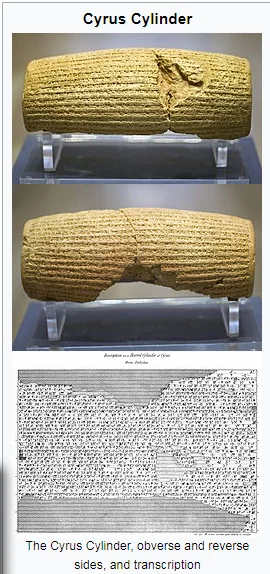
A replica of the Cyrus Cylinder is on display at the United Nations Headquarters in New York.35 What makes the Cyrus Cylinder unique is the policy it records: Cyrus’s decision to permit displaced peoples to return to their homelands and to restore their desecrated sanctuaries. The text of the Cylinder has therefore been viewed as evidence of Cyrus’s enlightened approach to cultural and religious diversity. Neil MacGregor, former Director of the British Museum, described it as “the first attempt we know about running a society, a state with different nationalities and faiths—a new kind of statecraft.’’36 Hence, Cyrus the Great is remembered in history for his political philosophy of tolerance and respect toward non-Persians, as well as his mercy toward defeated foes. He stands as an exemplary model of a benevolent conqueror, permitting his subjects to continue living and worshiping as they had before his reign. In his Cyropaedia, the Greek historian Xenophon celebrated Cyrus, writing that “he honored his subjects and cared for them as if they were his own children and they, on their part, revered Cyrus as a father.” 37 Cyrus was not admired by the Greeks alone—his reputation spread widely and was preserved across many different peoples, cultures, and historical traditions.
Hence, the characteristics of Ḏū al-Qarnayn described in the Qurʾān cannot be applied to Alexander the Great, for he was a pagan who proclaimed himself the son of Zeus-Ammon. By contrast, Cyrus is described in the Bible as a God-revering figure, a portrayal that aligns with the qualities of Ḏū al-Qarnayn in the Qurʾān where he is recorded addressing Allah as “my Lord.’’38 Moreover, Cyrus the Great was a pious and powerful king who ruled with remarkable tolerance, mercy, and justice. In contrast, although Alexander the Great was undeniably a brilliant military commander, he was also marked by paranoia, cruelty, and intrigue. His conquests were driven less by principle than by an insatiable desire for everlasting fame. As noted earlier, the first-century C.E. Roman historian Quintus Curtius Rufus observed that Alexander possessed “a lust for glory and fame reaching a degree which exceeded due proportion.”39 Alexander’s moral decline is often attributed to the corrupting influence of power, but his excessive drinking also played a notorious role in shaping his behavior. He was rarely without wine, and his relationship with alcohol is well attested in historical accounts, often bringing disastrous consequences. In 328 B.C., after a night of heavy drinking, Alexander killed his close friend Cleitus—who had once saved his life in battle—following an exchange of sharp insults. This rash act, carried out in a drunken fury, weighed heavily on him for the rest of his life. His grief over the later death of his dearest companion, Hephaestion—who himself drank heavily and ignored his physician’s strict recovery regimen—drove Alexander to shocking extremes: he had the attending physician crucified, ordered temples to local gods destroyed, and massacred the small tribe of the Cosseans, dedicating the slaughter in Hephaestion’s honor. Similarly, the infamous burning of Persepolis, one of Persia’s greatest cities, was another reckless act carried out while Alexander was intoxicated.40 In short, Cyrus the Great was not merely a conqueror but also a man of faith who governed by the principles of justice and generosity. In sharp contrast, Alexander the Great was a ruthless, power-driven tyrant who slaughtered populations, destroyed cities, and pursued glory for its own sake, ruling largely through fear. Cyrus, however, was revered not only as a mighty conqueror and a just ruler but also as a worshipper of God, held in high esteem by the Jews, for it was his conquest that led to the fall of Babylon and the liberation of the Israelites. Significantly, a depiction of Cyrus at Pasargadae, the site of his tomb, shows him wearing the ram-horned hemhem crown of Egypt, further emphasizing his far-reaching authority and symbolic stature.
Furthermore, the Qurʾān’s account of Ḏū al-Qarnayn encountering Gog and Magog aligns with Cyrus’s northern expedition and his battles with the Sakas. Gog and Magog are described as hostile tribes who oppressed the inhabitants of a valley, repeatedly invading their land and causing them great distress. Worn down by these aggressions, the people of the region turned to Ḏū al-Qarnayn, imploring him to deliver them from the terror of these tribes. They pleaded: {“O Ḏū al-Qarnayn! Surely Gog and Magog are spreading corruption throughout the land. Should we pay you tribute, provided that you build a wall between us and them?”} (Qurʾān 18:94). Ḏū al-Qarnayn resolved that the only way to safeguard the people from these barbaric tribes was to construct a massive barrier separating them from the savages: {He responded, “What my Lord has provided for me is far better. But assist me with resources, and I will build a barrier between you and them} (Qurʾān 18:95). To accomplish this, Ḏū al-Qarnayn instructed the people to bring forth blocks of iron, which he laid one upon another. To strengthen the structure, he then directed them to melt copper so that it might be used as a binding element for the construction: {Bring me blocks of iron!” Then, when he had filled up ˹the gap˺ between the two mountains, he ordered, “Blow!” When the iron became red hot, he said, “Bring me molten copper to pour over it”} (Qurʾān 18:96). The two tribes were unable to scale the wall, rendered slippery by the molten copper, and it was equally difficult to breach, as it was constructed of solid iron: {And so the enemies could neither scale nor tunnel through it} (Qurʾān 18:97). However, the Qurʾān states that these savages will be released shortly before the Last Days: {He declared, “This is a mercy from my Lord. But when the promise of my Lord comes to pass, He will level it to the ground. And my Lord’s promise is ever true”} (Qurʾān 18:98). Gog and Magog will continue to dig at this barrier until Allāh grants them permission to emerge at the end of time: {until ˹after˺ Gog and Magog have broken loose ˹from the barrier˺, swarming down from every hill, ushering in the True Promise. Then—behold!—the disbelievers will stare ˹in horror, crying,˺ “Oh, woe to us! We have truly been heedless of this. In fact, we have been wrongdoers”} (Qurʾān 21:96–97). It is nearly established that Gog and Magog were the wild, barbarian tribes of Central Asia, known by various names such as Tartars, Mongols, Huns, and Scythians (referred to as Sakas in Indian sources), who had been encroaching upon settled kingdoms and empires since ancient times. Historical records indicate that strong fortifications had been constructed in the southern regions of Caucasia. Cyrus the Great defeated these tribes and built a barrier of copper and iron in the Daryal Pass, the sole route through which they could attack the people who had sought his protection. Notably, remnants of this barrier still exist, whereas no comparable iron-and-copper fortification is associated with Alexander the Great. Sayyid abū al-Aʿlá Mawdūdī noted that some have mistakenly believed the wall attributed to Ḏū al-Qarnayn refers to the famous Great Wall of China, whereas in reality, this wall was constructed between Derbent and Daryal, two cities in Daghestan within the Caucasus, the region lying between the Black Sea and the Caspian Sea. Al-Mawdūdī further noted that while the mountains between the Black Sea and Daryal contain deep gorges that impede the passage of large armies, the terrain between Derbent and Daryal is free of such obstacles, with wide, navigable passes.41

After the conquest of Azerbaijan, ʿUmar ibn al-Khaṭṭāb dispatched Surāqah ibn ʿAmr in 22 A.H. on an expedition to Derbent. Surāqah appointed ʿAbd ar-Raḥmān ibn Rabīʿah as the chief of his vanguard. Upon entering Armenia, ʿAbd ar-Raḥmān encountered Shehrbraz, the local ruler, who surrendered without resistance. When ʿAbd ar-Raḥmān sought to advance toward Derbent, Shehrbraz informed him that he had already obtained complete knowledge of the wall built by Ḏū al-Qarnayn through a man who could provide all necessary details; this man was then presented before ʿAbd ar-Raḥmān.42 Two centuries later, the Abbasid Caliph abū Jaʿfar Hārūn ibn Muḥammad al-Muʿtaṣim, better known by his regnal name al-Wāthiq (227–233 A.H.), dispatched a party of fifty men under Salām at-Tarjumān to study the wall of Ḏū al-Qarnayn. Their observations have been recorded in detail by al-Ḥamawī in Muʿjam al-Buldān and by Ibn Kathīr in al-Bidāyah wa-n-Nihāyah. The expedition traveled from Samarrah to Tiflis (present-day Tbilisi), then proceeded through As-Sarir and Al-Lan to reach Filanshah, from where they entered the Caspian region and finally arrived at Derbent, where they observed the wall.43 This clearly demonstrates that, even as late as the third century of the Hijrah, Muslim scholars identified the wall in the Caucasus as the wall of Ḏū al-Qarnayn. Al-Ḥamawī further affirmed this view at multiple points in his Muʿjam al-Buldān. For example, he wrote: “This territory belongs to the Turks, which adjoins the wall of Ḏū al-Qarnayn just behind Bāb-ul-ʾAbwāb, which is also called Derbent.’’44 In this context, he cited a report by Aḥmad ibn Faḍlān, the ambassador of the Abbasid Caliph al-Muqtadir bi-Allāh, who provided a detailed description of the Caspian region, stating that: “Caspian is the name of a country whose capital is Itil (near the present Astrakhan) right through which flows River Itil, which joins the Caspian from Russia and Bulghar.’’45 Regarding Bāb-ul-ʾAbwāb, he stated that:46

In summary, the evidence presented above indicates that the hypothesis identifying the Qurʾān’s Ḏū al-Qarnayn with Cyrus the Great is both reasonable and highly probable, for among all the conquerors who lived prior to the revelation of the Qurʾān, no other figure’s attributes align so closely with the characteristics of Ḏū al-Qarnayn as those of Cyrus.
Notes and References
- 1
Qurʾān 18:83-98.
- 2
Archerismybae, “Was the Qur’anic Dhul Qarnayn a Plagiarism of the Alexander Romances?” The Hejazi Philosophorian, 11 Dec. 2019, https://hejaziphilosophorian.home.blog/2019/12/11/was-the-quranic-dhul-qarnayn-a-plagiarism-of-the-alexander-romances/.
- 3
“Victory Stele of Naram-Sin,” Joy of Museums Virtual Tours, accessed 22 Apr. 2023, https://joyofmuseums.com/museums/europe/france-museums/paris-museums/the-louvre/victory-stele-of-naram-sin/.
- 4
“Hemhem Crown,” Wikipedia: The Free Encyclopedia, last edited 12 Jan. 2024, https://en.wikipedia.org/wiki/Hemhem_crown.
- 5
Ibid.
- 6
Osama Shukir Muhammed Amin, “Two Bronze Drachms of Hadrian,” World History Encyclopedia, 18 Nov. 2018, https://www.worldhistory.org/image/9458/two-bronze-drachms-of-hadrian/.
- 7
“Daniel 8:1-14, New International Version,” Bible Gateway, accessed 22 Apr. 2023, https://www.biblegateway.com/passage/?search=Daniel+8%3A1-14&version=NIV.
- 8
“Daniel 8:15-27, New International Version,” Bible Gateway, accessed 22 Apr. 2023, https://www.biblegateway.com/passage/?search=Daniel+8%3A15-27&version=NIV.
- 9
Herodotus, The Histories, trans. Aubrey De Sélincourt, (New York, U.S.: Penguin Classics, 1996), book 1, pp. 95–103.
- 10
Ibid., book 1, pp. 127–130.
- 11
“ABC 7 (Nabonidus Chronicle),” Livius, accessed 23 Apr. 2023, https://www.livius.org/sources/content/mesopotamian-chronicles-content/abc-7-nabonidus-chronicle/.
The Nabonidus Chronicle is an ancient Babylonian text, part of a larger series of Babylonian Chronicles inscribed in cuneiform script on clay tablets. It deals primarily with the reign of Nabonidus, the last king of the Neo-Babylonian Empire, covers the conquest of Babylon by the Persian king Cyrus the Great, and ends with the start of the reign of Cyrus’s son Cambyses, spanning a period from 556 BC to sometime after 539 BC. It provides a rare contemporary account of Cyrus’s rise to power and is the main source of information on this period.
- 12
Herodotus, The Histories, trans. Aubrey De Sélincourt, (New York, U.S.: Penguin Classics, 1996), book 1, p. 107.
- 13
Ibid., book 1, p. 130.
- 14
Ibid., p. 169.
- 15
Ibid., p. 190.
- 16
Ibid., book 3, p. 1–27.
- 17
“The Behistun Inscription,” Livius, accessed 23 Apr. 2023, https://www.livius.org/articles/place/behistun/.
The famous Behistun inscription was engraved on a cliff about 100 meters off the ground. Darius tells us how the supreme god Ahuramazda chose him to dethrone a usurper named Gaumâta, how he set out to quell several revolts, and how he defeated his foreign enemies.
- 18
Quintus Curtius Rufus, The History of Alexander, trans. John Yardley, (New York, U.S.: Penguin Classics, 2001), book 10, p. 29.
- 19
Ibid., p. 36.
- 20
Ibid., p. 12.
- 21
“Alexander of Macedon Biography,” History of Macedonia, accessed 23 Apr. 2023, https://www.historyofmacedonia.org/AncientMacedonia/AlexandertheGreat.html.
- 22
Plutarch, Demetrius and Anthony, Pyrrhus and Gaius Marius, trans. Bernadotte Perrin (Cambridge, U.S.: Harvard University Press, 1920), book 18.
- 23
Diodorus Siculus, The Library of History, trans. Russel M. Greer, (Cambridge, U.S.: Harvard University Press, 1947), book 19, p. 57.
- 24
Plutarch, Demetrius and Anthony, Pyrrhus and Gaius Marius, trans. Bernadotte Perrin, (Cambridge, U.S.: Harvard University Press, 1920), book 18, p. 30.
- 25
W. H. Hoehner, “Antiochus” in Merrill C. Tenney, The Zondervan Pictorial Encyclopedia of the Bible, (Grand Rapids: U.S., 1976), vol. 1, pp. 192–193.
- 26
Mahlon H. Smith, “Antiochus IV Epiphanes,” American Theological Library Association Selected Religion Website, accessed 23 Apr. 2023, https://www.virtualreligion.net/iho/antiochus_4.html.
- 27
1 Maccabees, trans. Jonathan Goldstein, (New York, U.S.: Doubleday, 1976), book 1, pp. 17–19.
- 28
Ibid., pp. 44–64.
- 29
“Distemper” in older historical and medical usage denotes a general illness or disorder, often referring to an internal disease, plague, or bodily affliction. Several sources specifically describe the death of Antiochus IV as resulting from a severe illness accompanied by fever.
- 30
Josephus, The Works of Josephus Complete and Unabridged, trans. William Whiston (Peabody, U.S.: Hendrickson, 1987), book 12: Antiquities of the Jews.
- 31
Polybius, The Histories, trans. W.R. Paton (Cambridge, U.S.: Harvard University Press, 1927), book 31, p. 9.
- 32
Diodorus Siculus, The Library of History, trans. Russel M. Greer (Cambridge, U.S.: Harvard University Press, 1947), book 31, chapter 18a.
- 33
“Isaiah 45:1-3, New International Version,” Bible Gateway, accessed 22 Apr. 2023, https://www.biblegateway.com/passage/?search=Isaiah+45&version=NIV.
- 34
“Ezra 1:1-3, New English Translation,” Bible Gateway, accessed 23 Apr. 2023, https://www.biblegateway.com/passage/?search=Ezra%201%3A1%2D3&version=NET.
- 35
“Who was Cyrus the Great?” Northeastern Illinois University, accessed 23 Apr. 2023, https://www.neiu.edu/alumni-and-giving/giving/give-neiu/foundation-scholarships/cyrus-of-persia-scholarship/who-was-cyrus-great
- 36
Barbara Slavin, “‘Cyrus Cylinder’ a Reminder of Persian Legacy of Tolerance,” Al-Monitor, 6 March 2013, https://www.al-monitor.com/originals/2013/03/cyrus-cylinder-iran-religious-freedom-minority-rights.html.
- 37
Xenophon, Cyropaedia: The Education of Cyrus, trans. Wayne Ambler, (New York, U.S.: Cornell University Press, 2001).
The Cyropaedia (“Education of Cyrus”), written around 370 BC by Xenophon, the Athenian-born soldier, historian, and student of Socrates, is a novel about Cyrus the Great, but it is also a tract on kingship and generalship addressed to the class of educated Greek commanders and would-be leaders.
- 38
{They pleaded, “O Ḏū al-Qarnayn! Surely Gog and Magog1 are spreading corruption throughout the land. Should we pay you tribute, provided that you build a wall between us and them?” He responded, “What my Lord has provided for me is far better. But assist me with resources, and I will build a barrier between you and them. Bring me blocks of iron!” Then, when he had filled up ˹the gap˺ between the two mountains, he ordered, “Blow!” When the iron became red hot, he said, “Bring me molten copper to pour over it.” And so the enemies could neither scale nor tunnel through it. He declared, “This is a mercy from my Lord. But when the promise of my Lord comes to pass, He will level it to the ground. And my Lord’s promise is ever true”} (Qurʾān 18:94–98).
- 39
Quintus Curtius Rufus, The History of Alexander, trans. John Yardley (New York, U.S.: Penguin Classics, 2001), book 10, p. 29.
- 40
Andy Kelly, “Alexander the Great - King, Commander, Alcoholic,” Get Your Cork Out, 30 Jul. 2020, http://www.getyourcorkout.com/articles-reviews/alexander-the-great/.
- 41
Sayyid abū al-Aʿlá al-Mawdūdī, Towards Understanding the Qurʾān (English version of Tafhīm al-Qurʾān), trans. and edit. Zafar Isḥāq ʾAnṣārī, (Markfield, U.K.: The Islamic foundation, 1988), Chapter al-Kahf (Qurʾān 18:98), footnotes 71, available at: https://www.islamicstudies.info/tafheem.php?sura=18&verse=83&to=101.
- 42
Abū Jaʿfar Muḥammad ibn Jarīr aṭ-Ṭabarī, Tafsīr Ibn Jarīr aṭ-Ṭabarī, (Bayrūt, Lebanon: Muʾassassat ar-Risālah, 2000), vol. III, pp. 235–239; ʿImād ad-Dīn abū al-Fidāʾ Ismāʿīl ibn ʿUmar ibn Kathīr, al-Bidāyah wa-an-Nihāyah, (Bayrūt, Lebanon: Dār al-Kutub al-ʿIlmiyyah, 2001), vol. VII, pp. 122–125; Yāqūt Shihāb ad-Dīn ibn ʿAbd Allāh ar-Rūmī al-Ḥamawī, Muʿjam al-Buldān, (Bayrūt, Lebanon: Dār Bayrūt li-ṭ-Ṭibāʿah wa-n-Nashr, 1955), under Bāb-ul-Abwāb: Derbent as cited in Sayyid abū al-Aʿlá al-Mawdūdī, Towards Understanding the Qurʾān (English version of Tafhīm al-Qurʾān), trans. and edit. Zafar Isḥāq ʾAnṣārī, (Markfield, U.K.: The Islamic foundation, 1988), Chapter al-Kahf (Qurʾān 18:98), footnotes 71, available at: https://www.islamicstudies.info/tafheem.php?sura=18&verse=83&to=101.
- 43
ʿImād ad-Dīn abū al-Fidāʾ Ismāʿīl ibn ʿUmar ibn Kathīr, al-Bidāyah wa-n-Nihāyah, (Bayrūt, Lebanon: Dār al-Kutub al-ʿIlmiyyah, 2001), vol. II, p. 111 and vol. VII, pp. 122–125; Yāqūt Shihāb ad-Dīn ibn ʿAbd Allāh ar-Rūmī al-Ḥamawī, Muʿjam al-Buldān, (Bayrūt, Lebanon: Dār Bayrūt li-ṭ-Ṭibāʿah wa-n-Nashr, 1955), under Bāb-ul-ʾAbwāb: Derbent as cited in Sayyid abū al-Aʿlá al-Mawdūdī, Towards Understanding the Qurʾān (English version of Tafhīm al-Qurʾān), trans. and edit. Zafar Isḥāq ʾAnṣārī, (Markfield, U.K.: The Islamic foundation, 1988), Chapter al-Kahf (Qurʾān 18:98), footnotes 71, available at: https://www.islamicstudies.info/tafheem.php?sura=18&verse=83&to=101.
- 44
Yāqūt Shihāb ad-Dīn ibn ʿAbd Allāh ar-Rūmī al-Ḥamawī, Muʿjam al-Buldān, (Bayrūt, Lebanon: Dār Bayrūt li-ṭ-Ṭibāʿah wa-n-Nashr, 1955), under “Khazar” (Caspian) as cited in Sayyid abū al-Aʿlá al-Mawdūdī, Towards Understanding the Qurʾān (English version of Tafhīm al-Qurʾān), trans. and edit. Zafar Isḥāq ʾAnṣārī, (Markfield, U.K.: The Islamic foundation, 1988), Chapter al-Kahf (Qurʾān 18:98), footnotes 71, available at: https://www.islamicstudies.info/tafheem.php?sura=18&verse=83&to=101.
- 45
Ibid.
- 46
Ibid.