Is Petra in Jordan the original site of the Kaʿbah, and was the latter subsequently transferred from Petra to Makkah during the Umayyad Caliphate?
Until recently, Western scholarship largely accepted the traditional Muslim narrative of origins, which holds that Islam began in Makkah, the location of its holiest sanctuary, the Kaʿbah. However, in the late 1970s, John Wansbrough—credited with founding the so-called “revisionist” school of Islamic Studies through his fundamental critique of the historical reliability of classical Islamic narratives about Islam’s beginnings and his attempt to construct alternative narratives—together with two of his students, Patricia Crone and Michael Cook, published works advocating a radically different approach to the study of Islam’s origins.1 Among other claims, these revisionists argued that Islam did not originate in Makkah but somewhere else in northwestern Arabia. Wansbrough generally promoted skepticism regarding the origins of early Islamic sources. Most notably, he contended that the Qurʾān was composed and compiled through a long process spanning some 200 years, dating not to 1st-century AH Ḥijāz2 but to 2nd–3rd-century AH Abbasid Iraq.3 Because of this, he argued that the Qurʾān could not be attributed to Muḥammad, being more recent than traditional accounts suggest. Consequently, he postulated that the figure of Muḥammad, as presented in Islamic tradition, was a later invention or, at the very least, could not be directly connected to the Qurʾān.4 That is, the Prophetic figure to whom Islamic tradition attributes the Qurʾān was, in his view, retroactively constructed after the text had already been written and compiled. Wansbrough advanced the radical theory that, in the words of historian Herbert Berg, “neither the Quran nor Islam is a product of Muhammad or even Arabia, nor were the original Arab conquerors of the Umayyad Empire actual Muslims.”5 He maintained that evidence for the seventh-century CE Ḥijāz as the location of Islam’s origins was bereft of archaeological support and scarcely attested in pre-Islamic Arabic or external sources. He further argued that it owed its historiographical existence almost entirely to the creative endeavour of Muslim and Orientalist scholarship.6 As will be explained, the claim advanced by Wansbrough and his students that Islam did not originate in Makkah is blatantly false. Similarly, Wansbrough’s theory that the Qurʾān was composed and compiled over a long period of more than 200 years is also now considered untenable by many, due to the discovery of early Qurʾānic manuscripts—many of which were subjected to radiocarbon analysis between 2010 and 2014—and their dating to the seventh century CE.7 By and large, Wansbrough’s research has been described by critics as methodologically weak, unsound, and even amateurish—assessments that render it not only offensive to Muslims but also an insult to the standards of Western scholarship. According to Andrew Rippin—a Canadian scholar of Islamic studies and Professor of Islamic History at the University of Victoria—and Herbert Berg—an American scholar of religion whose work focuses on Islamic origins—the lack of interest among non-Muslim scholars in Wansbrough’s theories can be attributed to his departure from the path of least effort and resistance in scholarship. Rather than engaging seriously with the vast corpus of Islamic literature on the history of Islam, the Qurʾān, and Muḥammad, he dismissed it wholesale, thereby abandoning the standard scholarly approach, taking a superfluously difficult, contrarian path, and generating unnecessary, unsubstantiated complications. As Rippin and Berg put it, Wansbrough “destroyed” what had been accepted as historical facts without offering any viable alternative.8
Crone and Cook were principally inspired and mentored by Wansbrough, although they diverged from his account in several respects. As noted, Wansbrough critiqued traditional narratives of Islam’s origins as historically unreliable and proposed radically new reconstructions, sharply differing from both Muslim orthodoxy and the consensus of most Western scholars. Similarly, his students, Crone and Cook, argued that traditional Islamic sources cannot be fully trusted and that early Islamic history must be reconstructed using alternative sources. Their book, Hagarism—a quasi-pejorative and possibly racially charge, label for the historical phenomenon of early Muslims—questioned nearly all of what Muslims believe to be historical truths. Crone and Cook proposed a new term for early Muslims, whom they called the “Hagarenes,” meaning the biological descendants of Abraham through Hagar. They used this racialized term to distinguish early Muslims from Jews, who are regarded as the descendants of Abraham through Sarah. The authors argued that near-contemporary sources (that is, sources written close in time to the events) used the term “Hagarenes” to designate a seventh-century CE Arab movement whose conquests and resulting caliphate were inspired by Jewish messianism. They further argued that an alliance of Arabs and Jews sought to reclaim the Promised Land from the Byzantine Empire, that the Qurʾān consists of eighth-century revisions of various Judeo-Christian and other Middle Eastern sources—much later than the seventh-century dating provided by traditional Islamic accounts—and that Muḥammad served as the herald of ʿUmar ibn al-Khaṭṭāb, “the redeemer,” a Judaic messiah.9 Crone and Cook claimed to have demonstrated that Makkah was not Islam’s birthplace by arguing that the earliest mosques in Egypt and Iraq faced northwest Arabia rather than Makkah. For their assertion that Prophet Muḥammad (PBUH) and the early believers heralded the imminent arrival of a Messiah—whom they identified with the second caliph, ʿUmar ibn al-Khaṭṭāb—they relied on several roughly contemporary Jewish and Christian sources (i.e., produced in the 7th century CE, around the time of early Islam), together with the well-known fact that, in Muslim tradition, ʿUmar bears the epithet al-Fārūq, which they interpreted as being etymologically related to the Syriac term for “savior.” Funnily enough, these two revisionists ended up revising themselves. By 1991, Crone and Cook had repudiated the theory advanced in their own wretched book. On April 3, 2006, Dr. Liaquat Ali Khan—a professor of law at Washburn University School of Law in Topeka, Kansas—held a telephone conversation with Cook in which they discussed Hagarism. Cook told Khan the following, which he later confirmed by email: “The central thesis of that book was, I now think, mistaken. Over the years, I have gradually come to think that the evidence we had to support the thesis was not sufficient or internally consistent enough.”10 On April 6, 2006, Dr. Khan met with Crone to discuss her views on the book, and she was even more outspoken in repudiating its central thesis. She concurred with critics who had described the work as “a graduate essay” and candidly remarked: “We were young, and we did not know anything. The book was just a hypothesis, not a conclusive finding. I do not think that the book’s thesis is valid.”11 Wansbrough himself, who had mentored the authors, believed that large portions of their book could be questioned, given concerns about their authenticity and reliability. He reviewed the work, focusing specifically on its first part. He began by praising the book, observing that the authors demonstrated extraordinary erudition, remarkable diligence, and lively, engaging prose. However, he went on to note that:12

The hypotheses proposed in Hagarism have also been criticized by numerous scholars and even journalists. Robert Bertram Serjeant, a renowned British Orientalist, philologist, and historian, known for his extensive work in Islamic studies—especially Arabian history—and one of the leading Arabists of his generation as well as Director of the Middle East Centre at the University of Cambridge, observed in his brilliant and devastating review of Hagarism:13

Oleg Grabar, a French archaeologist and historian of Islamic art and architecture whose exceptionally broad expertise and analytical subtlety helped transform the Western study of Islamic culture, wrote that:14

Norman O. Brown, a renowned scholar and author whose influential work and teaching encompassed the classics, theology, history, psychology, sociology, and literature, among other disciplines, asserted that:15

David Waines, a British emeritus professor of Islamic studies at Lancaster University and author of the bestselling textbook An Introduction to Islam, stated:16

Josef van Ess, an eminent German scholar and Professor of Islamic Studies and Semitic Languages at Eberhard Karls University of Tübingen, Germany, described Hagarism as an experiment and argued that:17

R. Stephen Humphreys, an American historian specializing in the history of Southwest Asia and North Africa and author of Islamic History: A Framework for Inquiry, asserted:18

Gordon D. Newby, a historian and scholar of religious studies whose research specialties include early Islam, Muslim relations with Jews and Christians, and comparative studies, said:19

Jack Tannous, Associate Professor of History at Princeton University, whose research fields include early Islamic history and the Qurʾān, said:20

Alexander Stille, an American author, journalist, and professor at the Columbia Journalism School, stated:21

Toby Lester, an American journalist and independent scholar, commented that:22

Hence, the flawed “revisionist” idea that Islam did not originate in Makkah, but somewhere else in northwestern Arabia, can be traced to Wansbrough and his students, Crone and Cook. Their speculative theories—or, more accurately, playful nonsense—caused considerable confusion, but the prevailing trend among Western scholars of Islam remains firmly opposed to such radical skepticism. Nonetheless, decades later, some “revisionists” continue to disregard early Muslim sources and maintain the claim that Islam did not begin in Makkah. Among them, some argue that the Kaʿbah was originally located in or near Petra, while others refrain from speculating on its precise location.
Tom Holland and Jay Smith are among the revisionists who argue against Makkah as the birthplace of Islam. Holland is a British broadcaster, author, and documentary filmmaker best known for his popular history books, such as In the Shadow of the Sword: The Birth of Islam and the Rise of the Global Arab Empire, and for his films, including Islam: The Untold Story. Smith is an American Christian evangelist and apologist known for videos such as “An Historical Critique of Islam’s Beginnings.” They present an alternative narrative of Islam’s historical origins. Holland attempted to rewrite the historical narrative of early Islam, arguing that the earliest biographies of Prophet Muḥammad (PBUH) were composed roughly 200 years after his passing, that Makkah is not mentioned in any sources until about a century later, that the earliest mosques do not face Makkah, and that the origins of Islam were not in Makkah but further north.Smith is among those who have sought to popularize Holland’s ideas. Like Holland, he argued for a revision of the orthodox narrative along similar lines, but the alternative narratives of early Islam advanced by both are fraught with problems. The primary issue is that their theories contradict an enormous body of evidence. They completely ignore entire categories of evidence, including the oral tradition within Islam, references to Prophet Muḥammad (PBUH) in early non-Muslim documents, archaeological findings containing Islamic elements, and the earliest Qurʾānic manuscripts discovered in recent years, such as the Birmingham Manuscript, which dates to the Prophet (PBUH)’s lifetime. Moreover, as we shall see, many of their claims are poorly researched and mistaken. In fact, their assertions would be discounted even by Patricia Crone—one of the scholars with whom the “revisionist” narrative began, who wrote numerous books on early Islam, brought the revisionist perspective to prominence, and whose work is relied upon by most “revisionist” historians when presenting their so-called evidence. That is, much of the material advanced by Holland and Smith draws on Crone’s research, yet even she did not take such extreme positions. In one of her articles, she openly acknowledged: “We shall never be able to do without the literary sources, of course, and the chances are that most of what the tradition tells us about the prophet’s life is more or less correct in some sense or other.”23
Indeed, Holland and Smith extended Crone’s work into fantastical interpretations she herself would not have endorsed. The “evidence” they cite in support of the “revisionist” narrative is historically untenable. Here, we focus on their claim that Makkah is not mentioned in any sources prior to Islam and that references to it do not appear for at least a century after the Prophet (PBUH) passed away. Smith went further, presenting numerous maps in his videos that purportedly show all the trade routes, none of which pass through Makkah—though he never indicates the sources of these maps. Clearly, Holland and Smith, along with like-minded “revisionist historians,” are mistaken. First, it should be recalled that ancient Arabs rarely recorded their own history. As a result, information about them and about very early Islam survives primarily through oral tradition or the writings of non-Arabs. Nevertheless, one major reference to Makkah prior to Islam appears in the works of Ptolemy—an astronomer, mathematician, and geographer of Greek descent who lived and worked in Alexandria, Egypt, during the second century CE. Ptolemy listed fifty cities in Arabia, including one he spelled “Makoraba” in Greek (Latin translations prefer “Machoraba” or “Macoraba”), which he placed in the western Arabian Peninsula. Historically, there has been a consensus in Orientalist scholarship that Macoraba refers to Makkah.24 However, Crone—who is the primary source for both Holland’s and Smith’s perspectives—dissented from this scholarly consensus, asserting in her work Meccan Trade and the Rise of Islam that the evidence linking the two is of poor quality.25 Ian D. Morris—a historian of early Islamic society who authored a detailed article on Ptolemy’s reference to Makkah—supported Crone’s dissenting perspective.26 Morris’s paper is of paramount importance because it clearly explains the various scholarly positions. Although he acknowledged the “validity” of Crone’s arguments, he provided an excellent and thorough historical timeline of the evolution of the link between Macoraba and Makkah and traced the genealogy of this idea within orthodox Orientalist scholarship over several centuries. To begin with, Morris acknowledged the prevailing consensus in academic scholarship that Macoraba refers to Makkah.27 He then traced the identification of Macoraba as Makkah back to Samuel Bochart, a mid-seventeenth-century Huguenot (i.e., French Protestant) pastor, scholar, and Orientalist. Morris quoted Bochart’s assertion that Mecca and Macoraba are one and the same: “(Mecca)…in Ptolemy is Macoraba, i.e., מכת רבה Mecca rabba, or ‘great Mecca.’”28 Morris highlighted Crone’s views. She argued that the name Macoraba has no connection to Makkah, that interpreting “rabbah” as “great” relies on a Hebrew derivation, and that, in order for the identification to be plausible, an Arabic rather than a Hebrew derivation would be required to justify reading Macoraba as Makkah rabbah. Furthermore, she maintained that there is no evidence that Makkah functioned as a significant trading center in the 6th and 7th centuries CE that would warrant such a title. It should be noted that although Crone initially cast doubt on the fact that Makkah was a major center for commerce, she later revised some of her claims. She argued that Makkan trade involved animal skins, manufactured leather goods, Ḥijāzī woolens, clarified butter and camels, suggesting that most of these goods were destined for the Roman army, which is known to have required vast quantities of leather and hides (i.e., raw animal skins) for its equipment. Morris then cited recent scholarship, specifically Mikhail D. Bukharin and G.W. Bowersock, who disagreed with Crone’s views and argued that Makkah was indeed a major historical trading center. He noted that no satisfactory derivation has been proposed to explain the difference between the names Makkah and Macoraba, and that the scholarly consensus should either be abandoned or defended more rigorously. Nevertheless, Morris’s fundamental conclusion is that Macoraba may still correspond to Makkah rabbah (“Makkah the Great”), although he emphasized that, despite the first part of the name (i.e., Maco) remaining consistent, stronger evidence is required to establish the precise genealogy and transmission of the second part (i.e., raba) from Arabia to Egypt in Ptolemy’s time. Hence, as Morris’s paper demonstrates, academic opinion remains divided regarding Ptolemy’s reference to Macoraba, although for several centuries, the prevailing consensus in Orientalist scholarship has been that Ptolemy’s Macoraba refers to Makkah.In short, there are today dissenting voices challenging the historical consensus that Ptolemy’s Macoraba refers to Makkah. However, Holland and Smith’s outright denial of any mention of Makkah prior to the advent of Islam is incorrect, as they clearly failed to acknowledge both the centuries-long consensus and the ongoing scholarly discussion regarding Ptolemy’s reference to Macoraba.Finally, while Christian revisionists such as Holland and Smith attack Islamic traditions, they often overlook the evidentiary gaps in their own. For instance, Jesus is said to have been born in a city called Nazareth, but although Nazareth is mentioned in the New Testament gospels, there are no extant non-biblical references to it until around 200 CE, when Sextus Julius Africanus, cited by Eusebius, refers to Nazara as a village in Judea and locates it near Cochaba (modern-day Kaukab). Does this absence of earlier sources imply that the city or village never existed?
Dan Gibson—a Canadian amateur archaeologist, filmmaker, and writer—has also widely promoted the idea that Islam did not originate in Makkah.29 In fact, he is the latest of revisionist historians of early Islam who are desperate to show that Islam began in Petra rather than Makkah, and that early Islamic history was therefore forged. In his 2011 book Quranic Geography, he claimed to overturn everything that both Muslim and non-Muslim scholarship know about one aspect of Islamic practice, namely the qiblah, the sacred prayer direction toward the Kaʿbah in Makkah—arguing that for the first two centuries Muslim prayer was directed toward Petra rather than Makkah. As evidence, he asserted that dozens of early mosques face toward Petra “with remarkable accuracy.” It should be recalled that Gibson’s starting point was the long-disproved premise of Crone and Cook. Nonetheless, he claimed to have traveled across the Middle East, visiting the earliest mosques in existence, which he believed faced the city of Petra—located north of Makkah—and on this basis, he argued that Islam was born in Petra. David A. King wrote a damning critique of Gibson’s work for the Muslim Heritage website in 2017.30 King is more than qualified to speak on this subject, as he is the world’s leading scholar in the history of Islamic astronomy and mathematics in the second half of the twentieth century.31 In 2018, he wrote a long paper against Gibson titled “The Petra Fallacy: Early Mosques Do Face the Sacred Kaaba in Mecca, but Dan Gibson Doesn’t Know How.”32 To begin with, King noted that Gibson has no formal academic training:33
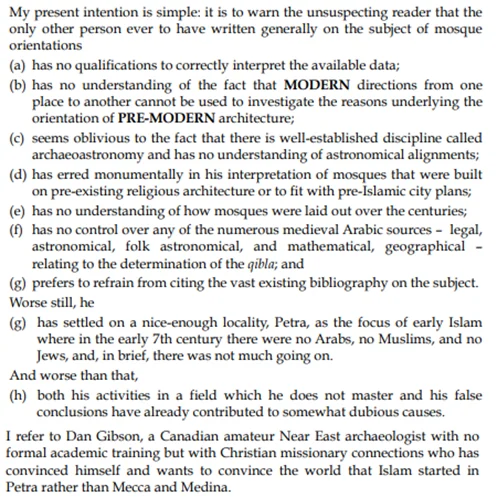
King attacked Gibson’s work, saying it is no better than that of a first-year college student. He also noted that Gibson cited his works in several places in his book, often poorly and out of context:34

King demolished Gibson’s absurd theory that the early mosques faced Petra—a theory also advocated by Jay Smith, who based his work on Gibson—arguing that, due to the absence of necessary technical equipment—trigonometry, geometry, geographical coordinates, astronomical instrumentation—it was not possible to determine the direction of Petra accurately for any locality from al-Andalus (Muslim-ruled Iberia) to China. He noted that this equipment only became available to Muslims in Iraq in the late 8th and early 9th centuries. Consequently, he concluded, Gibson’s attempt to fabricate evidence for an earlier period falls flat.35 Hence, the early Muslims used folk astronomy to determine the qiblah (the prayer direction toward the Kaʿbah), which was “devoid of theory and based solely on what one can see in the sky.”36 King explained how early Muslims calculated the qiblah:37

He observed:38

Incidentally, King believes that Gibson is not deliberately trying to deceive his audience and that he rather genuinely thinks he has made a groundbreaking discovery—that Islam originated in Petra and that the Nabataeans were its original founders—even though “not a single historian of Nabataean history, language, religion, architecture, or culture has produced any item of information that would give credence to this breaking news about Petra.”39 This brings us back to Cook and Crone and their imagined cradle of Islam in northwestern Arabia. It also brings us back to Smith, who, as noted, adopted Gibson’s argument, asserting that while Petra was not the commercial hub of northwestern Arabia, it served as its religious center; that both the Kaʿbah and the Black Stone were originally located in Petra; and that the original Muslims—whom he firmly believes were never called that in the first place—worshipped in Petra and faced that direction, as the followers of many other pagan religions did. Indeed, what Cook and Crone, as well as Smith and Gibson, fail to recognize is that, as King asserted, “Few would disagree that Petra is the nicest place in the entire region. But in the early 7th century it had long ceased to thrive and appears to have been more or less deserted.”40
In his lengthy video The Untold Story, Smith presented over a dozen mosque examples—all taken from Gibson’s book—which he argued point to the city of Petra, and others facing Jerusalem. King commented on a few of these mosques as follows:
The Umayyad Mosque in Damascus41

The Mosque of ʿUmar in Jerusalem42

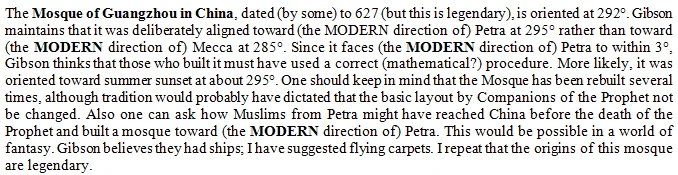
The Mosque of Guangzhou in China43
The Grand Mosque in Sanaa44

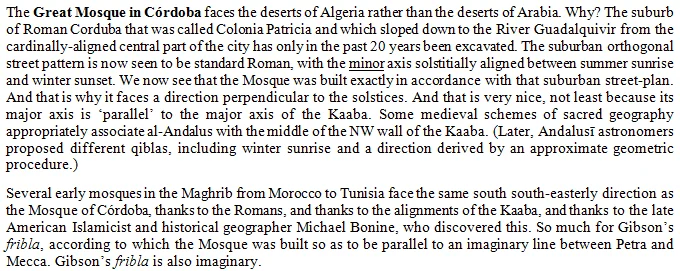
The Great Mosque in Córdoba45
King commented on many more mosques in his other article published in 2017, offering explanations for various early mosque orientations and showing that they have nothing to do with Petra. That is, he demonstrated that, contrary to Gibson’s claim, those who built these early mosques clearly intended them to face the qiblah toward the Kaʿbah in Makkah, not Petra.46 King argued that those who built the early mosques could not possibly have known the qiblah’s direction accurately and often relied on the winter solstice (the shortest day of the year) sunsets and sunrises. To reiterate, accurate techniques were invented centuries later. Hence, King asserted:47

Finally, King examined the bibliographies in Gibson’s works and observed that they lack almost all academic studies on astronomy and geography in early Islam. He noted that “none of the articles dealing with orientations of Islamic religious architecture are cited,” and that “not a single study of Islamic folk astronomy is included.” According to King, most works relevant to the topic at hand (i.e., the orientation of early Islamic mosques and the determination of the qiblah) have not been consulted, and the majority of those cited in the bibliographies—and many in the footnotes—are irrelevant.48 Ultimately, Gibson’s claim that the early Muslims worshipped facing a qiblah located in Petra is extremely weak and blatantly false. As King put it:49

King stated the following regarding Gibson’s Early Islamic Qiblas:50

King further stated:51
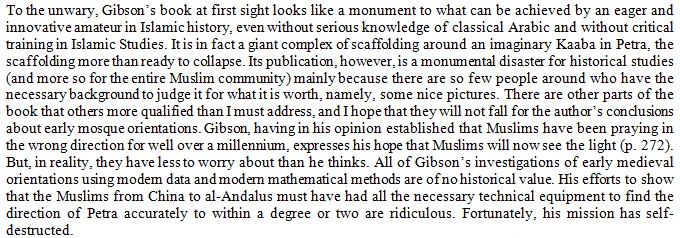
It is indeed a shame that Holland and Smith advocate Gibson’s weak arguments, but this is hardly surprising, as their academic expertise is scarcely any stronger than his. King said:52

Despite all the evidence outlined above, most revisionists insist that the early Muslim community shifted its origins away from its actual birthplace to another city, claiming that this change was imposed during the Umayyad period for political reasons. Indeed, the notion that the Kaʿbah’s original location could have been moved without causing any uproar or anger among Muslims is entirely implausible. Nevertheless, this theory rests on the assumption that the complete silence of the early Muslims regarding the relocation of their central holy site was due to a deliberate effort to conceal it. In other words, revisionists assume that all Muslims deliberately wanted the shift of the qiblah from Petra to Makkah to be quickly forgotten, lest it undermine Makkah’s legitimacy. However, it should be recalled that after the death of the Prophet (PBUH), the Muslim community faced political and social divisions, with various factions competing for leadership. All books of Ḥadīth and Islamic history record multiple accounts of these divisions, yet none mention this major event of the qiblah’s relocation. The following questions justifiably arise: How could all the factions have agreed on the shift of the qiblah? Even if, for the sake of argument, we accept that the Umayyad rulers could have concealed this shift during their reign, how could they have prevented all their opponents from even discussing it privately with their families? How is it conceivable that, after the Umayyad Caliphate ended, every Muslim simply accepted such a blunder—the changing of Allāh’s House and Islam’s birthplace—and agreed to keep it a secret? Besides, even if one generation had agreed to such a change, how could all later generations have kept this secret without ever speaking of it? Wansbrough, Crone, Cook, as well as Gibson, Holland, and Smith—a small, defiant, and largely discredited group of Orientalists and revisionists promoting fringe theories—have treated Islam as if it were an extinct culture, as though the fossilized remains of Muslims had just been unearthed, and they kindly analyzed them, producing all their supposed findings. Their approaches are clear attempts to strip the Muslim community of its own history. They claim that the first two centuries of Islamic history are obscure, but even a cursory glance at the records shows this to be untenable, as the history of the Muslim community has been massively and continuously transmitted from generation to generation since the time of the Prophet (PBUH) to the present day. Moreover, within the first decades of Islam, Muslims had spread to various regions, and Christians and Jews in those areas closely observed the rise of this new religion. It is therefore inconceivable that a momentous event—such as relocating the Kaʿbah from Petra to Makkah—could have occurred during the Umayyad Caliphate without attracting the notice of non-Muslims, especially historians. Simply put, it would have been a major event, yet there is not a single trace of it. As Robert Hoyland—a historian whose research specialties include early Islamic history—has observed, had such a drastic change in the direction of prayer from Makkah to Petra taken place, people would certainly have noticed.53 Recognized authorities in early Islamic studies, representing the mainstream view, also share Hoyland’s opinion. In a detailed article, Mark Anderson—a lecturer on Islam, the Qurʾān, and Muslim-Christian dialogue, holding a master’s degree in Islamic Studies from McGill University and another in Christian Religion from Westminster Theological Seminary—demonstrated that none of the six lines of evidence used by revisionists to support their view is compelling.54 Anderson concluded his article by saying:55

It is significant that many Western scholars who have studied Islam in recent centuries have relied on Muslim accounts on this matter. It is even more significant that non-Muslims writing about Islam from its earliest days were able to observe the direction of Muslim prayer, and their records confirm that Muslims have consistently prayed toward Makkah.56 Therefore, there is no justification for the ludicrous theories dreamed up in the minds of revisionists. Indeed, they know virtually nothing about Islam, and their understanding of it is far inferior even to that of a Muslim child at the earliest stage of learning.Nevertheless, they show no hesitation in deceiving and telling outright lies, which find listening ears only among those entirely unfamiliar with Islam.They portray Muslims—to the Western masses—as savages who have no civilization and left no historical records. They make it appear as though they alone bear the responsibility of telling our nation’s history—as if we do not exist.But suppose we did not exist—would these Orientalists and historians then be justified in accusing ancient Muslims of relocating the sacred city from Petra to Makkah and concealing all traces?Have they not heard of al-Masjid an-Nabawī, the mosque built by Prophet Muḥammad (PBUH) in al-Madīnah?Have they not heard of Jannat al-Baqīʿ, the graveyard adjacent to al-Masjid an-Nabawī where more than 10,000 Companions are buried?Have they not heard of the locations where the Prophet’s expeditions (PBUH) took place?Have they not heard of Mount Uḥud? Have they not heard of the Seven Mosques, still visited by pilgrims today—a group of small mosques constructed close to each other just south of Mount Selaʾ, the site of the Battle of the Trench?Have they not heard of the House of Sayyidah Khadījah, the wife of the Prophet (PBUH), where some of the earliest events of Islam unfolded, and which was rediscovered during the Ḥaram extensions in 1989?Have they not heard of the endowments established by the Companions in Makkah?Have they not heard of Shiʿb abī Ṭālib (the Valley of abū Ṭālib)—now known as the ʿAlī Valley—where Banū Hāshim and Banū al-Muṭṭalib were forced to withdraw from Makkah and endure a three-year boycott?Have they not heard of the millions of Muslims traditionally believed to be descended from the Prophet’s daughter Fāṭimah and her husband ʿAlī [may Allah be pleased with them both]? Unfortunately, due to our lack of proper vigilance and engagement with Islamic history, ignorant and fanatical Orientalists—whose works are anything but friendly or impartial attempts to study Islam—have dared to rewrite our history, treating it as if it were a defunct civilization rather than a tradition massively and consecutively transmitted from generation to generation since the time of the Prophet (PBUH) to the present day. Such Orientalists deliberately conceal historical facts to sustain their fallacious arguments, blinded by envy to the extent that they seek to make us question our history, our Kaʿbah, our Qurʾān, and our religion in any way and at any cost.
Amazingly, the word “Baca,” an ancient name for Makkah mentioned in Qurʾān 3:96, also appears in the Bible, where Prophet David (PBUH) refers to it in Psalms 84:6.57
Baca (in Psalms) and Bakkah (in the Qurʾān) both refer to Mecca (Makkah, Saudi Arabia), the site of the first House of worship on earth designated by Allāh for humanity. This House, the Holy Kaʿbah, is the direction toward which all Muslims pray and the destination of their pilgrimage.
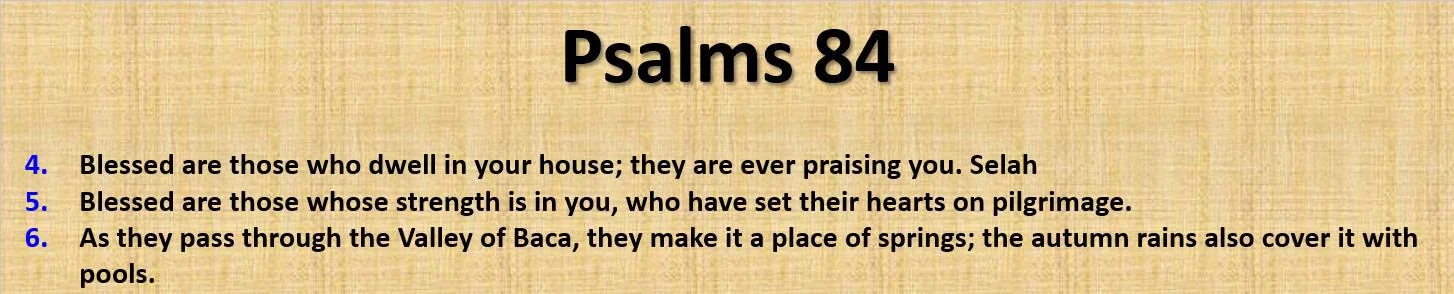
“Blessed are those who dwell in your house; they are ever praising you. Selah.” (Psalms 84:4). That is, they pray to Allāh and praise Him forever in His House. But where is this House of the Lord located? Is it the Jewish Temple, which was destroyed, or the Churches, which have been corrupted with polytheistic practices, icons, and statues? Let us continue reading Psalms 84 to find out:
“Blessed are those whose strength is in you, who have set their hearts on pilgrimage.” (Psalms 84:5). This verse closely parallels the Qurʾānic verse: {Our Lord! I have made some of my offspring settle in a barren valley near Your Sacred House! Our Lord! I did so that they may establish Prayer. So make the hearts of ˹believing˺ people affectionately inclined to them} (Qurʾān 14:37).
“As they pass through the Valley of Baca, they make it a place of springs; the autumn rains also cover it with pools.” (Psalms 84:6). The House of the Lord is located in the Valley of Baca. Another name for Makkah is Bakkah, as mentioned in the Qurʾānic verse: {Surely, the first House ˹of worship˺ established for humanity is the one at Bakkah—a blessed sanctuary and a guide for ˹all˺ people} (Qurʾān 3:96). Both the Bible and the Qurʾān refer to Baca/Bakkah as the place where pilgrimage to the House of Allāh takes place. The Kaʿbah, built by Prophet Abraham (PBUH) and his son Ishmael (PBUH), is in Makkah. The name Makkah is also mentioned in the Qurʾān: {He it is Who restrained their hands from you, and your hands from them in the valley of Makkah, even though He had made you victorious against them} (Qurʾān 48:24), providing clear evidence of Prophet Muḥammad’s struggle against and victory over the Pagans in Makkah, not Petra. Indeed, Psalms 84 is so explicit that it offers sufficient proof for truth seekers among the People of the Book (Jews and Christians) to accept Islam without hesitation. This is the Good News Translation version of Psalms 84:6:58

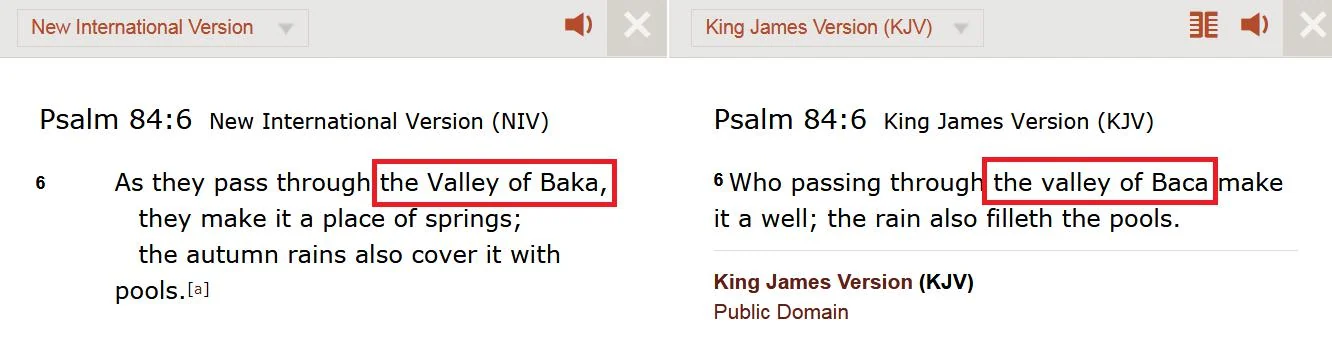
The “Valley of Baca” here refers to the arid, waterless, barren desert valley of Makkah, while “a place of springs” points to the famous Zamzam Well, located near the Kaʿbah and still flowing after thousands of years.59 In fact, the Arabic verb bakaʾa means “lacking in water,” indicating that the Valley of Baca signifies a dry valley. A similar description is found in the Qurʾān: {Our Lord! I have settled some of my offspring in a barren valley, near Your Sacred House, our Lord, so that they may establish prayer. So make the hearts of ˹believing˺ people incline towards them and provide them with fruits, so perhaps they will be thankful} (Qurʾān 14:37). Unfortunately, Jewish and Christian scribes have distorted—and continue to distort—the Words of Allāh. In the Arabic version of the Bible, the phrase “the Valley of Baca” was falsely translated as “the valley of bukāʾ” (i.e., weeping), even though no such place exists on the face of the earth. Approved versions of the Bible, however, refer to the “Valley of Baca/Baka,” not the valley of weeping. The New International Version (NIV) and the King James Version (KJV)—the most popular and widely read modern English translations of the Bible—use “Valley of Baca/Baka” with a capital “B,” indicating that it is a proper noun, i.e., an actual geographic location.
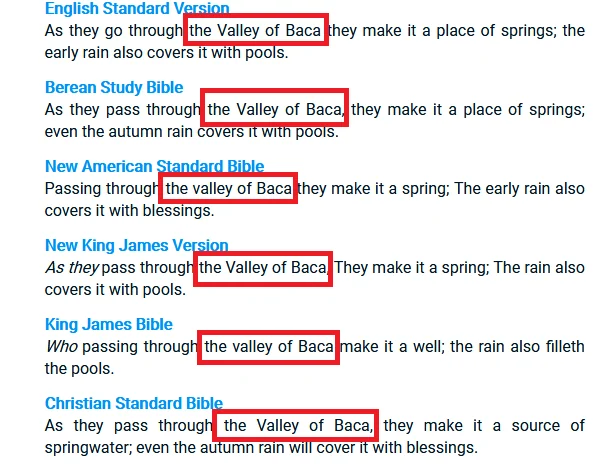
The “Valley of Baca” is also mentioned in the English Standard Version (ESV), Berean Study Bible (BSB), New American Standard Bible (NASB), New King James Version (NKJV), and Christian Standard Bible (CSB).
The phrase “the valley of weeping” appears only in Middle Eastern versions of the Bible, namely the Arabic and Aramaic translations. The Bible clearly foretold that the House of the Lord would be in Makkah, yet the People of the Book deliberately concealed this truth. They replaced “the Valley of Baca” with “the valley of weeping” for the simple reason that Muslims in the Middle East could access their Scriptures and thus use this prophecy as evidence for the validity of Islam. The Qurʾān sternly warns them for knowingly hiding the truth—something they have done, continue to do, and will always do. Allāh says: {Those who hide the clear proofs and guidance that We have revealed—after We made it clear for humanity in the Book—will be cursed by Allāh and ˹all˺ those who curse} (Qurʾān 2:159). The Jewish Rabbis and Christian scholars did not allow this knowledge to reach even the Jewish and Christian masses, let alone non-Jewish and non-Christian peoples of the world. The verse states that they will be cursed by Allāh—that is, cast far from His mercy. It also states that all things curse such people for this evil act—that is, all creatures, each in their own way, supplicate to Allāh to withhold His mercy from them.60 This stern warning is directed at the Jewish Rabbis and Christian scholars who conceal the clear proofs in their Scriptures that testify to the truthfulness of Prophet Muḥammad and his Message: {Indeed, those who hide Allāh’s revelations, trading them for a fleeting gain consume nothing but fire into their bellies. Allāh will neither speak to them on the Day of Judgment, nor will He purify them. And they will suffer a painful punishment. They are the ones who trade guidance for misguidance and forgiveness for punishment. How persistent are they in pursuit of the Fire!} (Qurʾān 2:174–175). That is because they recognized Prophet Muḥammad (PBUH) when he began his mission, yet knowingly concealed the truth and deliberately kept true guidance hidden, despite being duty-bound to spread it. In short, Makkah perfectly fits the description of Baca in Psalms 84:6. Any atheist who ignores the prophecies in the Bible, chooses to conceal the truth, or rejects what Allāh has revealed is no less guilty than the Jews and Christians who rejected the Truth after it was made clear to them. The curse of Allāh, the angels, and all people will be upon those who deny the truth of Muḥammad’s Prophethood on the Day of Resurrection, and Allāh will not accept any obligatory or supererogatory acts of worship from them. Undoubtedly, the Scriptures that Orientalists rely upon thoroughly foretold the House of the Lord in Baca—modern-day Makkah—but they are people of falsehood who fabricate lies and hide the truth even after it was made clear to them.
To conclude, the claim that Islam began in Petra rather than Makkah is blatantly implausible. Likewise, the contention that Ḥadīth (the corpus of Prophetic traditions) is completely silent on the alleged relocation of the early Muslims’ central shrine because they wanted it quickly forgotten, lest it diminish Makkah’s sanctity and legitimacy, is even more patently implausible. As already explained, the historical realities of the period in which the alleged relocation supposedly occurred strongly argue against Ḥadīth’s complete failure to mention it—namely that within a few years of the Prophet (PBUH)’s death in 632 CE, the Muslim community was widely dispersed and divided, with multiple factions vying to gain or maintain power. Obviously, the alleged change of the qiblah (prayer direction) would have been a matter of paramount importance, since Muslims have always worshipped in a single prescribed direction. Yet, while Ḥadīth reflects the early Muslim community’s regional and sectarian divisions in numerous respects, it records no disagreement whatsoever on this point, despite the community’s broad geographic distribution, deep divisions, and the crucial significance of the qiblah. Indeed, it is highly implausible, to say the least, that so widespread and divided a community could unanimously agree to relocate its sacred center and somehow manage to do so without leaving a single trace of the relocation in the Ḥadīth record. As already stated, even if every Muslim alive at the time of the alleged relocation had vowed to keep it secret, it is highly unlikely that the next generation would not have leaked multiple versions of the incident into Ḥadīth. The mainstream academic view regarding the origins of Islam and its early events aligns closely with the Islamic narrative that has been preserved for over 1,400 years. In other words, the orthodox narrative of early Islamic history is the one widely accepted among non-Muslim scholars. Revisionist historians’ arguments, whether in their literature or in documentary/video productions, may initially appear shocking and unsettling. Their presentations can be compelling, with authors speaking confidently and citing numerous “facts.” However, when authorities in the field of early Islamic history critically examine these “facts,” they quickly collapse. This explains why the revisionists’ ideas have failed to gain support from the vast majority of Western scholars of early Islamic history, let alone from Muslims. Oddly enough, the vast majority of the proponents of the implausible theory that the Kaʿbah was not originally in Makkah are Christian missionaries. Indeed, given the scarcity of historical evidence for much of the Bible—not least the complete anonymity of the authors of the Gospels—they would do well to stop throwing stones from their own very fragile glass house. Undeniably, Wansbrough’s Qur’anic Studies: Sources and Methods of Scriptural Interpretation, Crone and Cook’s Hagarism: The Making of the Islamic World, and Gibson’s Early Islamic Qiblas—which presents more up-to-date “findings” that revise some of the initial conclusions in his Quranic Geography—are among the clearest examples of modern Islamophobic Orientalism. These books remind us that the works of Orientalists, far from being objective or scientific, are often laden with prejudice and consistently aimed at undermining Muslims’ adherence to their religion. In other words, the history of Orientalism is hardly one of unbiased examination of Islamic sources, particularly under the influence of Christian bigotry. On a final note, one of the most clearly unacceptable positions of revisionists is their refusal to accept the Muslim traditions outright. Undoubtedly, it must be acknowledged that there is nothing wrong with treating Muslim sources with skepticism, recognizing their potential for bias or exaggeration. Indeed, this is the standard practice in historical documentation. However, it must also be acknowledged that materials written by non-Muslims are equally, if not more, liable to unreliability. Hence, it is unreasonable to completely reject Muslim sources, and even more unreasonable to do so in favor of purely hostile anti-Islamic sources. What is particularly remarkable is that some revisionists linked to Evangelical Christian missionary activity with a fundamentalist orientation, such as Jay Smith—a Christian missionary and apologist best known for his polemics and apologetics directed at Islam rather than for academic scholarship—exemplify a double standard in historical skepticism. They selectively apply standards of historical criticism by criticizing Muslim sources for potential bias and demanding strict evidence from Muslims, while failing to apply the same level of critical scrutiny to their own sources. That is, they tolerate historical limitations in Christian sources—such as questions of authorship, chronological gaps, the authors’ theological or ideological biases, issues of textual transmission and redaction, and contradictions between accounts. However, they exaggerate or weaponize supposed similar limitations in Muslim sources, treating them as fatal flaws, even though such limitations are generally absent in early Muslim sources, since the Qurʾān, Ḥadīth corpus, and early Islamic historical reports are comparatively well-dated, attributed, and preserved. In a word, it is inconceivable that Islam began in Petra or elsewhere in Nabatea rather than Makkah.
Notes and References
- 1
John Wansbrough, Qur’anic Studies: Sources and Methods of Scriptural Interpretation, (Amherst, U.S.: Prometheus Books, 2004); Patricia Crone and Michael Cook, Hagarism: The Making of the Islamic World, (Cambridge, U.K.: Cambridge University Press, 1977).
- 2
The sacred heartland of Islam: a geographical region encompassing most of the western part of modern-day Saudi Arabia, including the holy cities of Makkah and al-Madīnah, as well as Jaddah, Tabūk, Yanbūʿ, aṭ-Ṭāʾif, and Baljurashī.
- 3
John Wansbrough, Quranic Studies, Sources and Methods of Scriptural Interpretation, (Amherst, U.S.: Prometheus Books, 2004), p. 202.
- 4
Andrew Rippin, The Blackwell Companion to the Qurʾan, (New Jersey, U.S.: Blackwell Publishing, 2006), p. 199.
- 5
Herbert Berg, “The Implications of, and Opposition to, the Methods and Theories of John Wansbrough” in Ibn Warraq, The Quest for the Historical Muhammad, (Amherst, U.S.: Prometheus Books, 2000), p. 495.
- 6
John Wansbourgh, Res Ipsa Loquitur: History and Mimesis, (Jerusalem, Occupied Palestine: The Israel Academy of Sciences and Humanities, 1987), p. 9 quoted in Herbert Berg, “The Implications of, and Opposition to, the Methods and Theories of John Wansbrough” in Ibn Warraq, The Quest for the Historical Muhammad, (Amherst, U.S.: Prometheus Books, 2000), p. 491.
- 7
Gabriel Said Reynolds, “Introduction, Quranic Studies and its Controversies” in The Qurʾān in its Historical Context, (London, U.K. and New York, U.S.: Routledge, 2007).
- 8
Andrew Rippin, “Literary Analysis of Quran, Tafsir, and Sira: The Methodologies of John Wansbrough” in Richard C. Martin, Approaches to Islam in Religious Studies, (Tucson, U.S.: The University of Arizona Press, 1985), p.159 quoted in Herbert Berg, “The Implications of, and Opposition to, the Methods and Theories of John Wansbrough” in Ibn Warraq, The Quest for the Historical Muhammad, (Amherst, U.S.: Prometheus Books, 2000), pp. 501–2.
- 9
R. Stephen Humphreys, “Chapter Three: Early Historical Tradition and the First Islamic Polity,” in Islamic History: A Framework for Inquiry, (Princeton, U.S.: Princeton University Press, 1992), pp. 84–85. DOI: https://doi.org/10.1515/9780691214238-005.
- 10
Liaquat Ali Khan, “Hagarism – The Story of a Book Written by Infidels for Infidels,” The Daily Star, vol. 5, no. 680, 28 Apr. 2006.
- 11
Ibid.
- 12
John Wansbrough, “Review of Hagarism: The Making of the Islamic World,” Bulletin of the School of Oriental and African Studies, University of London, vol. 41, issue 1, 1978, pp. 155–156.
- 13
Robert Bertram Serjeant, “Review of Quranic Studies: Sources and Methods of Scriptural Interpretation by J. Wansbrough; Hagarism: The Making of the Islamic World by Patricia Crone, Michael Cook,” Journal of the Royal Asiatic Society of Great Britain and Ireland, no. 1, pp. 78, JSTOR, accessed 7 July 2023, http://www.jstor.org/stable/25210922.
- 14
Oleg Grabar, “Review of Hagarism: The Making of the Islamic World by Patricia Crone & Michael Cook,” Speculum, vol. 53, no. 4, 1978, pp. 795–799, JSTOR, accessed 7 Jul. 2023, https://doi.org/10.2307/2849793.
- 15
Norman O. Brown, Apocalypse and/or Metamorphosis, (Oakland, U.S.: University of California Press, 1991), p. 65.
- 16
David Waines, “Excursus on Islamic origins,” in An Introduction to Islam, (Cambridge, U.S.: Cambridge University Press, 2003), p. 307, DOI: https://doi.org/10.1017/CBO9780511801037.012.
- 17
Josef van Ess, “The Making of Islam,” Times Literary Supplement, 8 September 1978, p. 998.
- 18
R. Stephen, Humphreys, “Chapter Three: Early Historical Tradition and the First Islamic Polity,” in Islamic History: A Framework for Inquiry, (Princeton, U.S.: Princeton University Press, 1992), pp. 84–85, DOI: https://doi.org/10.1515/9780691214238-005.
- 19
Gordon Newby, A History of the Jews of Arabia, (Los Angeles, U.S.: University of California Press, 1988), p. 110.
- 20
Jack Tannous, “Review of Fred M. Donner, Muhammad and the Believers: At the Origins of Islam,” Expositions, vol. 5, issue 2, 2011, pp. 126–141, https://expositions.journals.villanova.edu/article/view/685/604.
- 21
Alexander Stille, “Scholars Are Quietly Offering New Theories of the Koran,” The New York Times, 2 March 2002, https://www.nytimes.com/2002/03/02/arts/scholars-are-quietly-offering-new-theories-of-the-koran.html?pagewanted=3&src=pm.
- 22
Toby Lester, “What Is the Koran?” Atlantic, Jan. 1999, https://www.theatlantic.com/magazine/archive/1999/01/what-is-the-koran/304024/.
- 23
Patricia Crone, “What Do we Actually Know about Mohammed?” Open Democracy, 10 June 2008, https://www.opendemocracy.net/en/mohammed_3866jsp/.
- 24
Ian D. Morris, “Mecca and Macoraba,” Al-ʿUṣūr al-Wusṭá, vol. 26, no. 1, 15 Nov. 2018, p. 3, footnote 9, https://www.middleeastmedievalists.com/wp-content/uploads/2018/11/UW-26-Morris.pdf.
Edward D. A. Hulmes, “Mecca,” in Ian Richard Netton, Encyclopedia of Islamic Civilisation and Religion, (Abingdon, U.K.: Routledge, 2008), p. 401: “Ptolemy… called the city Macoraba.”
Arent Jan Wensinck and Jacques Jomier, “Mecca” in P. J. Bearman et al., Encyclopaedia of Islam, (Leiden, the Netherlands: Brill, 1960–2005): “Mecca… was apparently known to Ptolemy as Macoraba.”
Jacqueline Chabbi, “Mecca” in Jane Dammen McAuliffe, Encyclopaedia of the Qur’ān, (Leiden, the Netherlands: Brill, 2003), vol. 3, pp. 337–341, p. 337: Mecca and Bakkah “may well be derivations from a more complete rendering of the name, which would be recognized in the Macoraba mentioned by Ptolemy.”
- 25
Patricia Crone, Meccan Trade and the Rise of Islam, (Princeton, U.S.: Princeton University Press, 1987).
- 26
Ian D. Morris, “Mecca and Macoraba,” Al-ʿUṣūr al-Wusṭá, vol. 26, no. 1, 15 Nov. 2018, p. 3, https://www.middleeastmedievalists.com/wp-content/uploads/2018/11/UW-26-Morris.pdf.
- 27
Ibid.
- 28
Ibid., p. 12, quoting Samuel Bochart, Geographia Sacra, (Caen, France: Petrus Cardonellus, 1646), vol. 1, Phaleg, 242; cf. 137, 237.
- 29
Dan Gibson, The Sacred City: Discovering the Real Birthplace of Islam, dir. David Taylor and ed. David Scott, (Kington, U.K.: Glasshouse Media, 2016); ---., Qur’anic Geography, (Surrey, Canada: Independent Scholars Press, 2011).
- 30
David A. King, “From Petra back to Makka – From “Pibla” back to Qibla: A Critique of Dan Gibson, Early Islamic Qiblas: A Survey of Mosques Built between 1AH/622 C.E. and 263 AH/876 C.E. (with Maps, Charts and Photographs),” Muslim Heritage, 22 Aug. 2017, https://muslimheritage.com/pibla-back-to-qibla/.
- 31
A British Orientalist with over 50 years of research on the history of science in the medieval Islamic world, focusing on original manuscripts and scientific instruments. He holds a doctorate from Yale University and has held professorships in Near Eastern Languages and the History of Science at New York University and Johann Wolfgang Goethe University in Frankfurt. In 2013, he was awarded the Alexandre Koyré Prize for his lifetime contributions. His work has expanded understanding of how Muslims historically applied scientific methods to the lunar calendar, prayer times, and the determination of the qiblah, and he has published numerous books and papers on Islamic astronomy, mathematics, and mosques, including his magnum opus In Synchrony with the Heavens, which analyzes over a millennium of prayer-time tables across the pre-modern Muslim world.
- 32
David A. King, “The Petra Fallacy - Early Mosques Do Face the Sacred Kaaba in Mecca but Dan Gibson Doesn't Know How / Comparing Historical Orientations with Modern Directions Can Lead to False Results,” Academia.edu, 1 Dec. 2018, https://www.academia.edu/37957366/KING_2018_The_Petra_fallacy_Early_mosques_do_face_the_Sacred_Kaaba_in_Mecca_but_Dan_Gibson_doesnt_know_how.
- 33
Ibid., pp. 9, 11, (sic).
- 34
David A. King, “From Petra back to Makka – From “Pibla” back to Qibla: A Critique of Dan Gibson, Early Islamic Qiblas: A Survey of Mosques Built between 1AH/622 C.E. and 263 AH/876 C.E. (with Maps, Charts and Photographs),” Muslim Heritage, 22 Aug. 2017, https://muslimheritage.com/pibla-back-to-qibla/.
- 35
Ibid.
- 36
David A. King, Astronomy before the Telescope, (London, U.K.: British Museum Press, 1996), p.144.
- 37
David A. King, “From Petra back to Makka – From “Pibla” back to Qibla: A Critique of Dan Gibson, Early Islamic Qiblas: A Survey of Mosques Built between 1AH/622 C.E. and 263 AH/876 C.E. (with Maps, Charts and Photographs),” Muslim Heritage, 22 Aug. 2017, https://muslimheritage.com/pibla-back-to-qibla/
- 38
David A. King, Astronomy before the Telescope, (London, U.K.: British Museum Press, 1996).
- 39
Ibid., p.12.
- 40
Ibid.
- 41
David A. King, “The Petra Fallacy - Early Mosques Do Face the Sacred Kaaba in Mecca but Dan Gibson Doesn't Know How / Comparing Historical Orientations with Modern Directions can Lead to False Results,” Academia.edu, 1 Dec 2018, p. 23, https://www.academia.edu/37957366/KING_2018_The_Petra_fallacy_Early_mosques_do_face_the_Sacred_Kaaba_in_Mecca_but_Dan_Gibson_doesnt_know_how
- 42
Ibid.
- 43
Ibid., pp. 23–24.
- 44
Ibid., p. 24.
- 45
Ibid.
- 46
David A. King, “From Petra back to Makka – From “Pibla” back to Qibla: A Critique of Dan Gibson, Early Islamic Qiblas: A Survey of Mosques Built between 1AH/622 C.E. and 263 AH/876 C.E. (with Maps, Charts and Photographs),” Muslim Heritage, 22 Aug. 2017, https://muslimheritage.com/pibla-back-to-qibla/.
- 47
Ibid.
- 48
Ibid.
- 49
David A King, “The Petra Fallacy: Early Mosques do face the Sacred Kaaba in Mecca,” Muslim Heritage, 15 Sep. 2020, https://muslimheritage.com/the-petra-fallacy/.
- 50
---., “From Petra back to Makka – From “Pibla” back to Qibla: A critique of Dan Gibson, Early Islamic Qiblas: A Survey of Mosques Built between 1AH/622 C.E. and 263 AH/876 C.E. (with Maps, Charts and Photographs),” Muslim Heritage, 22 Aug. 2017, https://muslimheritage.com/pibla-back-to-qibla/.
- 51
Ibid.
- 52
David A King, “The Petra Fallacy: Early Mosques do face the Sacred Kaaba in Mecca,” Muslim Heritage, 15 Sep. 2020, https://muslimheritage.com/the-petra-fallacy/.
- 53
“Was the Qiblah in Petra? Response to Dan Gibson | Dr. Shabir Ally,” YouTube, uploaded by Let the Quran Speak, 3 Aug. 2020, https://youtu.be/yaQ6xo9wNLQ, [4:06-4:17].
- 54
Mark Anderson, “Is Mecca or Petra Islam’s true birthplace?” Understanding Islam, 27 Sep. 2018, https://understandingislam.today/is-mecca-or-petra-islams-true-birthplace/.
Revisionists variously claim the following evidence supports their theory:
•The qur’anic data
•Other early written evidence
•The hadith’s data on Mecca
•The archaeological record
•Al-Tabari’s historical record
•Mecca’s geographic conditions
- 55
Ibid.
- 56
Ibid., [4:28-4:53].
- 57
“Psalm 84:4-6, New International Version,” Bible Gateway, accessed 10 March 2024, https://www.biblegateway.com/passage/?search=Psalm+84%3A4-6&version=NIV.
- 58
“Psalm 84:6, Good News Translation,” Bible Gateway, accessed 10 March 2024, https://www.biblegateway.com/passage/?search=Psalm+84%3A6&version=GNT.
- 59
A sacred, miraculous well in Makkah, Saudi Arabia, which miraculously appeared to save Hagar and her infant son Ishmael from dehydration in the desert.
- 60
A group of scholars, at-Tafsīr al-Muyassar, (al-Madīnah al-Munawwarah, Saudi Arabia: King Fahd Complex for the Printing of the Noble Qurʾān, 2009).