Did the Prophet (PBUH) have intimate relations with all of his wives every night?
Islam’s critics often seize upon the reports describing the Prophet (PBUH)’s visits to all his wives in a single night, using them to cast his polygynous marriage in a negative light. They claim that he (PBUH) engaged in intimacy with all his wives every night. In reality, however, this occurred only once and for a specific purpose. The most frequently cited report on the Prophet (PBUH)’s nightly visits to all his wives was narrated by Anas ibn Mālik who reported that the Prophet of Allah (PBUH) would go around (i.e., visit) all of his wives in a single night, and at that time he had nine wives.1 There is another variant of this report with slightly different wording. Qatādah narrated that Anas ibn Mālik reported: “The Prophet (PBUH) would visit all his wives in turn at the same hour of the night and day, and at that time they were eleven in number.” I asked Anas, “Did the Prophet (PBUH) have the [sexual] capacity for this?” He replied, “We used to say that the Prophet (PBUH) was granted the capacity of thirty [men].” And Saʿīd reported from Qatādah that Anas said to them [at that time the Prophet (PBUH) had] nine wives.2 It is noteworthy that the phrase “eleven in number” includes the Prophet (PBUH)’s two concubines, Maria and Rayḥānah.3 It should be understood that the Arabic terms yaṭūfu and yadūru used in the reports ordinarily mean “to go around” or “to visit,” without implying anything about the purpose of the visit. However, when applied to a person’s wives, they do suggest intimacy.4 It is an established fact that the Prophet (PBUH) had a daily routine of visiting all his wives. ʿUrwah narrated that ʿĀʾishah said: “O nephew! Allah’s Messenger (PBUH) did not favor some of us over others in the allocation of the time he spent with us. Hardly a day passed by except that he would visit us all in turn. He would approach each wife without engaging in intercourse until he reached the one whose day it was, and he would spend the night with her.”5 This report clearly establishes that the Prophet (PBUH) engaged in intercourse only with the wife whose turn it was on a given day, even though he routinely visited all his wives. This is further confirmed in another report in which ʿĀʾishah added that the Prophet (PBUH) would make daily visits to all his wives after ʿaṣr prayer.6
Indeed, the report of Anas appears to contradict that of ʿĀʾishah, for the latter stated that the Prophet (PBUH) would have intercourse only with the wife whose turn it was, whereas Anas reported that he (PBUH) would visit all his wives in a single night and that the purpose of these visits would be intercourse. The English translation of Anas’s report gives the impression that it was the Prophet (PBUH)’s regular practice to visit all his wives in a single night for this purpose. However, bringing together other reports makes it clear that this occurred only once. Anas mentioned that the Prophet (PBUH) had eleven women when this incident took place (i.e., nine wives and two concubines).7 It is known that he (PBUH) had nine wives simultaneously only during the final years of his life. He (PBUH) married Maymūnah, his last wife, in the month of Ḏū al-Qiʿdah, 7 A.H., 8 and therefore, what Anas reported could not have occurred before that year. As for the two concubines, Maria arrived in al-Madīnah in 8 A.H.,9 while Rayḥānah passed away upon returning from the Farewell Pilgrimage in Ḏū al-Ḥijjah, 10 A.H.,10 only a few months before the Prophet (PBUH)’s demise. Accordingly, the incident—that is, the Prophet (PBUH) engaging in intercourse with all his wives in a single night—must have taken place sometime between early 8 A.H. and late 10 A.H. Moreover, another version of Anas’s report clearly indicates that this occurred only once: “One day, the Messenger of Allah (PBUH) had intercourse with [all] his wives in a single ġusl (i.e., the ritual major ablution performed after sexual intercourse).”11 In fact, this particular incident refers to the Farewell Pilgrimage, for ʿĀʾishah reported: “I perfumed Allah’s Messenger (PBUH) (kuntu uṭayyibu), and then he went around (fa-yaṭūfu) [all] his wives—that is, he had sexual intercourse with them all—and in the morning [after taking the ritual bath] he assumed the state of iḥrām (ritual consecration for ḥajj or ʿumrah), while the fragrance of the perfume was still emanating from his body.”12 It is worth mentioning that the Arabic phrase “kuntu uṭayyibu” in the original report is often inadequately translated as “I used to/would apply perfume,” and the verb “fa-yaṭūfu” as “he used to/would go around.” Nonetheless, the mention of the Prophet (PBUH) assuming iḥrām makes it clear that the report refers to a specific incident that took place during the Farewell Pilgrimage. Muḥammad ibn al-Muntashir narrated on the authority of his father that he had asked ʿĀʾishah about the qawl (opinion) of Ibn ʿUmar “I do not like to wake up in the morning assuming the state of iḥrām while the fragrance of perfume is still emanating from my body.” ʿĀʾishah said, “I perfumed Allāh’s Messenger (PBUH) and he went round (had sexual intercourse with) all his wives, and in the morning he was muḥrim (after taking a bath).’’13 Ibrāhīm ibn Muḥammad ibn al-Muntashir narrated on the authority of his father, who said: I asked ʿĀʾishah and mentioned to her the qawl (statement) of Ibn ʿUmar, “I do not like to wake up in a state of iḥrām after having perfumed myself.” ʿĀʾishah replied, “I perfumed Allah’s Messenger (PBUH) and then he went around [all] his wives—that is, he had sexual intercourse with them all—and in the morning [after taking the ritual bath] he assumed the state of iḥrām (ritual consecration for ḥajj or ʿumrah).”14 Hence, English translators have understood the words kāna and kuntu used in the reports of Anas and ʿĀʾishah respectively as implying continuity or habitual practice. However, the word kāna does not necessarily denote persistence or routine. An-Nawawī clarified this point, citing ʿĀʾishah’s report as an example:15

Therefore, the correct translation of the reports of Anas and ʿĀʾishah should not include the expression “used to.”
As noted earlier, the Prophet (PBUH) would visit all his wives every day but had intimacy only with the one whose turn it was on a given day. However, he (PBUH) had intercourse with all of his wives in a single night only on the eve of the Farewell Pilgrimage, and this was done for a specific purpose. Ibn al-ʿArabī explained: “This did not occur except during the Farewell Pilgrimage, before assuming the state of iḥrām, and his purpose was to fulfill their [sexual] needs prior to his journey.”16 Al-Ḥāfiẓ al-Munāwī similarly stated that the Prophet (PBUH) did have intercourse with all his wives in a single night only before assuming the state of iḥrām for the Farewell Pilgrimage; otherwise, although he (PBUH) visited all his wives daily, he spent the nights with them in turn.17 In fact, it is recommended for married individuals to engage in intimacy with their spouses both before assuming the state of iḥrām for ḥajj and after exiting it. We know that all the wives of the Prophet (PBUH) accompanied him on the Farewell Pilgrimage. Accordingly, he (PBUH) visited them all in a single night to enable them to fulfill this recommended practice. Yūsuf al-Banūrī, the late Pakistani scholar, following his teacher Anwar Shāh al-Kashmīrī,18 explained that Anas’s report refers to this recommended act of spousal intimacy before entering and upon exiting the state of iḥrām:19
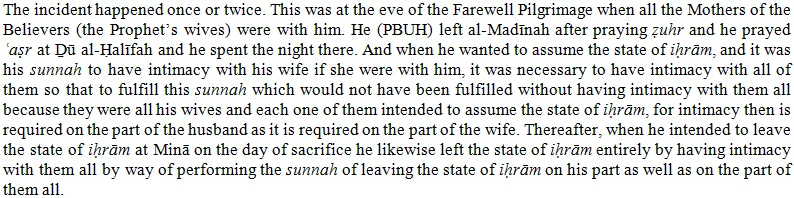
That is, the Prophet (PBUH) did visit all his wives in a single night during the Farewell Pilgrimage, both before assuming the state of iḥrām and after exiting it, in order to enable them all to fulfill a recommended practice related to iḥrām.
To conclude, critics have seized upon this matter—the Prophet (PBUH) engaging in intercourse with all his wives in a single night—to portray him in a negative light. In reality, however, it highlights a remarkable aspect of his marital life: he (PBUH) took great care of all his wives and treated them with perfect equity. Clearly, raising allegations over such minor matters demonstrates that the enemies of Islam can target only its branches, but they can never challenge its roots—that is, its foundational beliefs and principles. Indeed, Allah’s religion is flawless in all matters, great or small, and Allah’s Messenger (PBUH) was infallible throughout his life; thus, nothing that the opponents of Islam assert can tarnish his impeccable character.
Notes and References
- 1
Muḥammad al-Bukhārī, Ṣaḥīḥ al-Bukhārī, (Cairo, Egypt: Dār as-Salām. 1999), book: 5, ḥadīth: 36, available at: https://sunnah.com/bukhari:284.
- 2
Ibid., book: 5, ḥadīth: 21, available at: https://sunnah.com/bukhari:268.
- 3
Aḥmad ibn Ḥajar al-ʿAsqalānī, Fatḥ al-Bārī Sharḥ Ṣaḥīḥ al-Bukhārī, (Bayrūt, Lebanon: Dār al-Maʿrifah, 1959), vol. 1, p. 378.
- 4
Maḥmūd ibn Aḥmad al-ʿAynī, ʿUmdat al-Qārī Sharḥ Ṣaḥīḥ al-Bukhārī, (Bayrūt, Lebanon: Dār Iḥyāʾ at-Turāth al-ʿArabī, n.d.), vol. 3, p. 213; Aḥmad ibn Ḥajar al-ʿAsqalānī, Fatḥ al-Bārī Sharḥ Ṣaḥīḥ al-Bukhārī, (Bayrūt, Lebanon: Dār al-Maʿrifah, 1959), vol. 1, pp. 151, 371.
- 5
Abū Dāwūd as-Sijistānī, Sunan Abī Dāwūd, (Cairo, Egypt: Maktabat al-Maʿārif, 1998), book: 8, ḥadīth: 109, available at: https://sunnah.com/bulugh/8/109, ḥadīth grade: ḥasan (good).
- 6
Muḥammad al-Bukhārī, Ṣaḥīḥ al-Bukhārī, (Cairo, Egypt: Dār as-Salām. 1999), book: 68, ḥadīth: 18, available at: https://sunnah.com/bukhari:5268.
ʿĀʾishah narrated: “Allāh’s Messenger (PBUH) was fond of honey and sweet edible things and (it was his habit) that after finishing the ʿAṣr prayer he would visit his wives and would come close to one of them at that time…”
- 7
“The Prophet (PBUH) would visit all his wives in turn at the same hour of the night and day, and at that time they were eleven in number.”
- 8
Abū ʿAbd Allāh Muḥammad ibn Saʿd, aṭ-Ṭabaqāt al-Kubrá (The Book of the Major Classes), (Bayrūt, Lebanon: Dār al-Kutub al-ʿIlmiyyah, 1990), vol. 8, p. 175.
- 9
Ibn al-ʾAthīr al-Jazarī, Usd al-Ġābah fī Maʿrifat aṣ-Ṣaḥābah, (Bayrūt, Lebanon: Dār al-Fikr, 1989), vol. 6, p. 261.
- 10
Ibid., vol. 6, p. 120.
- 11
Abū Dāwūd as-Sijistānī, Sunan Abī Dāwūd, (Cairo, Egypt: Maktabat al-Maʿārif, 1998), book: 1, ḥadīth: 218, available at: https://sunnah.com/abudawud:218.
- 12
Muḥammad al-Bukhārī, Ṣaḥīḥ al-Bukhārī, (Cairo, Egypt: Dār as-Salām. 1999), book: 5, ḥadīth: 20, available at: https://sunnah.com/bukhari:267.
- 13
Ibid., book: 5, ḥadīth: 23, available at: https://sunnah.com/bukhari:270.
- 14
Ibid., book: 5, ḥadīth: 23, available at: https://sunnah.com/bukhari:270.
- 15
Abū Zakariyyā Yaḥyá ibn Sharaf al-Nawawī, al-Minhāj fī Sharḥ Ṣaḥīḥ Muslim ibn al-Ḥajjāj, (Cairo, Egypt: Muʾassasat Qurṭubah, 1994), vol. 6, p. 21.
- 16
Sayyid Muḥammad Anwar Shāh ibn Muʿaẓẓam Shāh al- Kashmīrī, al-ʿUrf ash-Shaḏiyy, (Bayrūt, Lebanon: Dār Iḥyāʾ at-Turāth al-ʿArabī, 2004), vol. 1, p. 159.
- 17
Al-Ḥāfiẓ al-Munāwī, Fayḍ al-Qadīr, (Bayrūt, Lebanon: Dār al-Maʿrifah, 1972), vol. 5, p. 228.
- 18
Sayyid Muḥammad Anwar Shāh ibn Muʿaẓẓam Shāh al- Kashmīrī, Fayḍ al-Bārī, (Bayrūt, Lebanon: Dār al-Kutub al-ʿIlmiyyah, 2005), vol. 1, p. 462.
- 19
Muḥammad Yūsuf al-Banūrī, Maʿārif as-Sunan, (Karachi, Pakistan: Maktaba Binoria, 1991), vol. 1, p. 466.