Is science capable of answering all questions?
It is undeniable that science is a reliable means of addressing questions about the physical world. Thanks to modern science, we now understand the human body more deeply than ever before and can explore the natural world with unprecedented precision. Indeed, many aspects of our convenient and modern lifestyles are direct results of scientific advancement. The various appliances, tools, and devices that ease our work and household tasks are all products of scientific discovery. Science has profoundly influenced numerous sectors of contemporary society—including transportation, communication, education, medicine, energy, defense, agriculture, economics, and leisure, to name just a few. However, while no one can deny that science generates solutions to practical problems and provides insights into the workings of nature, the claim that science can answer every possible question is entirely unfounded. Proponents of scientism—those who hold an extreme view of science—assert, often with considerable intellectual arrogance, that empirical science has no limits and that there is nothing it cannot ultimately explain. With triumphal confidence, they maintain that no meaningful question lies beyond the reach of science, and that with enough time and resources, science will eventually provide answers to all human inquiries. This claim is what scientism is all about—a ‘worship of science’, a belief that elevates science to an almost religious status and holds that it is the sole path to understanding human beings and the world.
In point of fact, science has clear limitations. There are many deeply meaningful questions that it cannot answer—even in principle, and even with the most advanced technology imaginable. To begin with, each discipline is constrained by the particular tools at its disposal—in the case of science, these are mathematics and empirical observation. As Martin Cothran, Director of the Classical Latin School Association and editor of The Classical Teacher magazine published by Memoria Press, observes: “the tools of science are quantitative; they are therefore limited in the possible answers they might give to quantitative answers. When a scientist is faced with a non-scientific, qualitative question, he should realize that he is out of his depth and would be better off treading lightly.’’1 Moreover, there are meaningful questions that lie beyond the scope of science. That is, many matters cannot be effectively examined through scientific methods. For instance, there are beliefs that—by their very nature—cannot be proven or disproven, such as the existence of supernatural powers and beings. Likewise, science cannot determine moral truths; it cannot tell us what we ought to do, or what is morally right or wrong. Simply put, science can enhance our understanding of what is, but it cannot guide us on what ought to be done, as it operates on the principle of amorality—in order to fulfill its objective study of nature, science remains silent on moral issues. Erwin Schrödinger, the father of quantum physics, stated: “The scientific worldview contains of itself no ethical values.”2 We cannot get an “ought” from an “is”, and science tells us only the “is”. For example, science can tell us the results of putting arsenic in our grandmother’s breakfast, but it cannot tell us whether doing this to quickly get her property is right or wrong. Most people would hopefully find such a scheme revolting, but that revulsion would not come from their science, for its amorality would keep it deafeningly silent. Rather, that revulsion would come from their ethical and spiritual fabric—something that the partisans of scientism dismiss as an invalid or nonessential source of knowledge. However, it must be understood that such dismissal can be catastrophically consequential. It should not be forgotten that the absence of morality amidst the ascendance of science paved the way to the worst manmade horror in recent history: the Holocaust.3
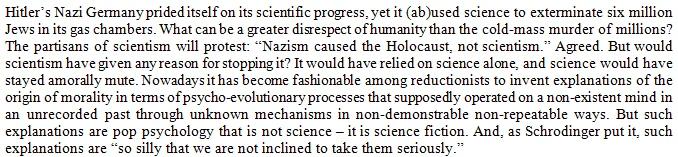
Additionally, science cannot provide an answer even to the critical question of “how do we determine what are the proper and improper uses of science?’’—a question that pertains to an area that even the advocates of scientism deem important: science itself. That is, although scientists often care deeply about how their discoveries are used, science itself does not indicate what should be done with scientific knowledge. For instance, science can explain how to recombine DNA in new ways, but it does not specify whether that knowledge should be used to correct a genetic disease, develop a bruise-resistant apple, or construct a new bacterium. For nearly every major scientific advancement, one can envision both beneficial and harmful applications of that knowledge. Once again, science helps people describe how the world is, and then they must decide how to use that knowledge. Furthermore, the scientific worldview contains no aesthetic values—that is, science does not make aesthetic judgments. It cannot, for example, determine whether a painting is beautiful or dreadful. Scientistic extremists dismiss many cherished human fields, such as art and poetry, as inconsequential, insisting that only science can provide knowledge about things that truly matter. However, dismissing fields that have enriched the human heart for millennia as inconsequential amounts to a profound disrespect for humanity.4
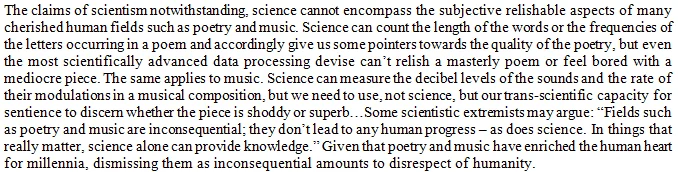
Some extremist reductionists try to reduce all aesthetic phenomena down to neurochemical firings and ultimately to the random oscillations of unconscious fundamental particles, but Nobel Laureate physicist Erwin Schrödinger encourages us to treat such explanations with the strong skepticism they deserve: “I am very astonished that the scientific picture of the real world around me is deficient. It is ghastly silent about all and sundry that is really near to our heart that really matters to us. It gives a lot of factual information, puts all our experience in a magnificently consistent order, but it cannot tell us a word about red and blue, bitter and sweet, physical pain and physical delight; it knows nothing of beautiful and ugly, good or bad, God and eternity. Science sometimes pretends to answer questions in these domains, but the answers are often very silly that we are not inclined to them seriously.’’5 Despite the fact that our highly scientific age tempts many to believe that science can—or will someday—provide answers to all of life’s big questions, responsible and sincere scientists, unlike scientistic zealots, readily and humbly admit that science does not have answers to many of the most pressing human questions concerning meaning and purpose. They acknowledge that questions arising in the realms of aesthetics, morality, and theology will never be resolved by empirical science. As Erwin Schrödinger put it: “In particular, and most importantly, this is the reason why the scientific worldview contains of itself no ethical values, no esthetical values, not a word about our own ultimate scope or destination, and no God, if you please. Whence came I and whither go I?”6 Even if science were to answer all our questions in physics, chemistry, and biology, our most profound and fundamental inquiries—such as ‘why do we exist?’, ‘what is the purpose of our life?’, ‘why is there suffering?’, ‘is there life beyond death?’, ‘what is our destination after death?’, ‘why are there moral values?’, and ‘what are the attributes of the soul?’—would remain unresolved. Defenders of scientism often respond, “None of these are scientific questions! If science cannot answer a question, then it is not a real or meaningful question!” Peter Atkins, a British chemist and former Professor of Chemistry at the University of Oxford and Fellow of Lincoln College, is not among those scientists who also possess strong philosophical acumen—those who manage to remain articulate even when speaking outside their field of scientific expertise. Unfortunately, Atkins has not been able to make that transition while still making sense. He begins by drawing a distinction between two types of “big questions,” stating:7
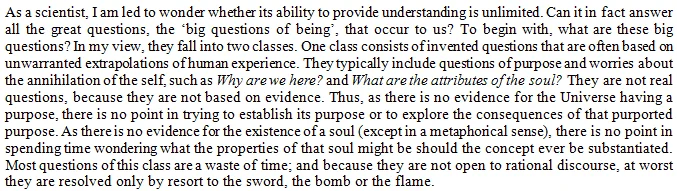
Atkins’ claim that such questions are not real because they are not based on evidence stems from a view that gained popularity in the early 20th century known as logical positivism—the idea that unless something can be proven scientifically, it is meaningless. The problem, however, is that this very assertion cannot itself be proven scientifically, and therefore, by its own standard, it is meaningless. In other words, logical positivism is self-defeating.8
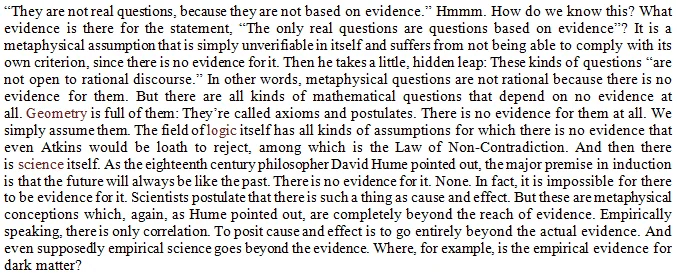
The questions that are dismissed by Atkins and other partisans of scientism as meaningless are, in fact, deeply important, and it is entirely appropriate to ask them—though doing so requires us to look beyond the sciences for answers. Moral judgments, aesthetic evaluations, decisions about how scientific discoveries should be applied, and beliefs about the supernatural all lie outside the scope of science, but that does not make them unimportant. On the contrary, the realms of ethics, aesthetics, and religion play a foundational role in shaping human societies, yet the questions they raise cannot be settled through scientific means. The idea that only empirical data can be trusted falls short of capturing the full range of human experience. Much of what we regard as meaningful in life cannot be proven scientifically. For instance, no one can scientifically prove that their family loves them, nor can they provide scientific evidence of their personal dreams and hopes for the future. Atkins goes on to state:9

Clearly, the question of the “nature of consciousness” is something entirely different from the “relative strengths of the fundamental forces and the existence of the fundamental particles.” Atkins gives no account of how the nature of consciousness could even be considered conceptually empirical! Atkins further says:10

Atkins employs a typical scientistic trope to make something sound scientific when it is not, in that he claims the question “why is there something rather than nothing?” is merely a disguised form of “how is it that something emerged from nothing?”11
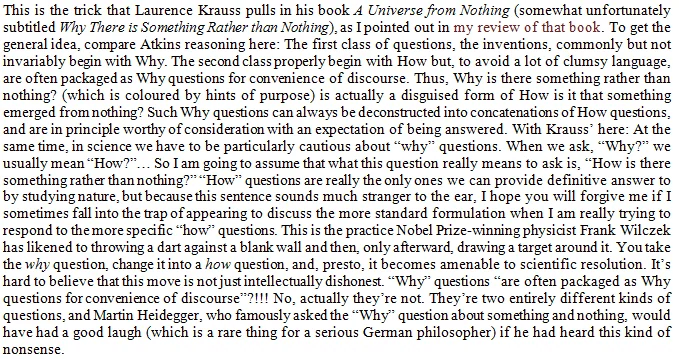
The fact of the matter is that “why” questions are not identical to “how” questions. Science has not yet answered all the “how” questions, and as for the “why” questions that seek meaning or purpose behind things—such as why the universe exists, why it is the way it is, or what the purpose of our existence is—these are certainly beyond the reach of science. No conceivable advancement in science will enable scientists to answer such ultimate questions. In a nutshell, science can help us make practical decisions about everyday matters, such as the best food, the best drink, the most effective treatment or medication, and the most efficient means of travel. It can also help us address important issues like predicting which areas might be hit by a tsunami after an earthquake, understanding how the hole in the ozone layer formed, or protecting our crops from pests. But while this wide scope might make science seem boundless, it is not—science has definite limits. Essentially, when we reflect on the significance and purpose of life, we naturally seek answers that lie beyond the physical world. In this regard, religion remains the only source that offers us a sense of meaning and purpose. Martin Heidegger, one of the most influential philosophers of existentialism, believed that since the rise of Greek philosophy, Western civilization has been on a path toward nihilism, and he maintained that only a god could save modern humanity from the contemporary cultural and intellectual crisis. Reflecting on technological society and the threat it poses to Western civilization, Heidegger remarked in an interview with Rudolf Augstein and Georg Wolff for Der Spiegel on September 23, 1966: “Philosophy will not be able to bring about a direct change of the present state of the world. This is true not only of philosophy but of all merely human meditations and endeavors. Only a god can still save us.”12 Indeed, only Allāh can save humanity from the trap of absurdism, nihilism, meaninglessness, purposelessness, and alienation in which it finds itself entangled. In a word, science and religion do not attempt to answer the same questions; we need religion to understand the world and our place in it, and to answer those questions that fall beyond the realm of science.
Notes and References
- 1
Martin Cothran, “Scientific Hubris: Why Science Can’t Answer All the Big Questions,” Memoria Press, 8 Oct. 2018, https://www.memoriapress.com/articles/scientific-hubris-why-science-cant-answer-all-the-big-questions/.
- 2
Erwin Schrödinger, Nature and the Greeks, (Cambridge, U.K.: Cambridge University Press, 1954).
- 3
“Scientism Fosters not Respect for Science, but Disrespect for Humanity,” The Spiritual Scientist, 17 Jul. 2014, http://www.thespiritualscientist.com/2014/07/scientism-fosters-disrespect-for-humanity/.
- 4
Ibid.
- 5
Erwin Schrödinger, Nature and the Greeks, (Cambridge, U.K.: Cambridge University Press, 1954), p. 93.
- 6
Ibid.
- 7
Peter Atkins, “Why it’s Only Science that Can Answer All the Big Questions,” Aeon, 21 August 2018, https://aeon.co/ideas/why-its-only-science-that-can-answer-all-the-big-questions.
- 8
Martin Cothran, “Scientific Hubris: Why Science Can’t Answer All the Big Questions,” Memoria Press, 8 Oct. 2018, https://www.memoriapress.com/articles/scientific-hubris-why-science-cant-answer-all-the-big-questions/.
- 9
Peter Atkins, “Why it’s Only Science that Can Answer All the Big Questions,” Aeon, 21 Aug.2018, https://aeon.co/ideas/why-its-only-science-that-can-answer-all-the-big-questions.
- 10
Ibid.
- 11
Martin Cothran, “Scientific Hubris: Why Science Can’t Answer All the Big Questions,” Memoria Press, 8 Oct. 2018, https://www.memoriapress.com/articles/scientific-hubris-why-science-cant-answer-all-the-big-questions/.
- 12
Martin Heidegger, “Nur noch ein Gott kann uns retten,” Der Spiegel, 30 Mai, 1976, pp. 193–219, trans. W. Richardson as “Only a God Can Save Us” in Thomas Sheehan, Heidegger: The Man and the Thinker, (Chicago, U.S.: Precedent Publishing, 1981), pp. 45–67, http://www.ditext.com/heidegger/interview.html.