Do all human beings share a single mother?
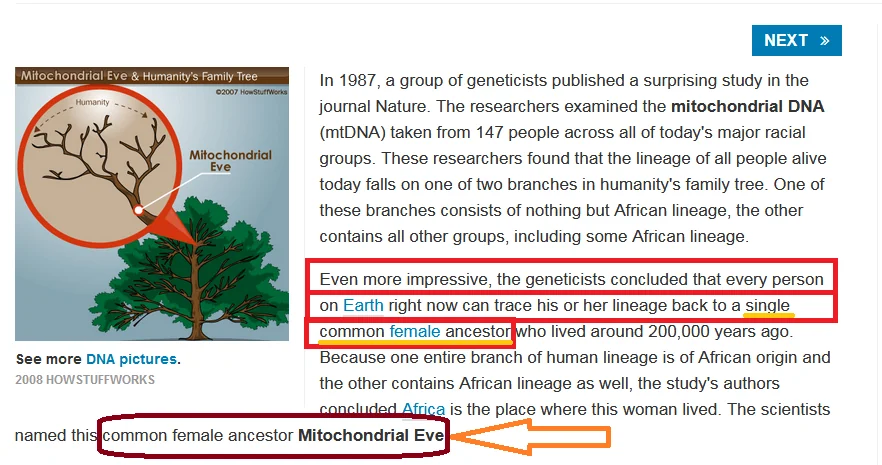
In 1987, a group of geneticists—Rebecca Louise Cann, Mark Stoneking, and Allan Charles Wilson—conducted a study at the University of California in which they compared mitochondrial DNA from human populations across the world. Mitochondrial DNA (mtDNA) is a small circular genome located in mitochondria, which are organelles found outside the nucleus in the cytoplasm of most complex (eukaryotic) cells. Cann, Stoneking, and Wilson used mtDNA sequences to examine genetic differences and trace human migration patterns through maternal inheritance. It is well established that mammals inherit their mitochondria and mtDNA exclusively from their mothers through the egg cell. During fertilization, the sperm contributes essentially only its nuclear DNA, while the cytoplasm—which contains the mitochondria—is supplied by the egg, explaining why mitochondria are maternally inherited. After analyzing mtDNA from 147 individuals representing five different geographic regions, the researchers concluded that all human populations share a common maternal ancestor who lived in Africa approximately 200,000 years ago.1

Allan Charles Wilson quickly dubbed this common maternal ancestor “Mitochondrial Eve.”2
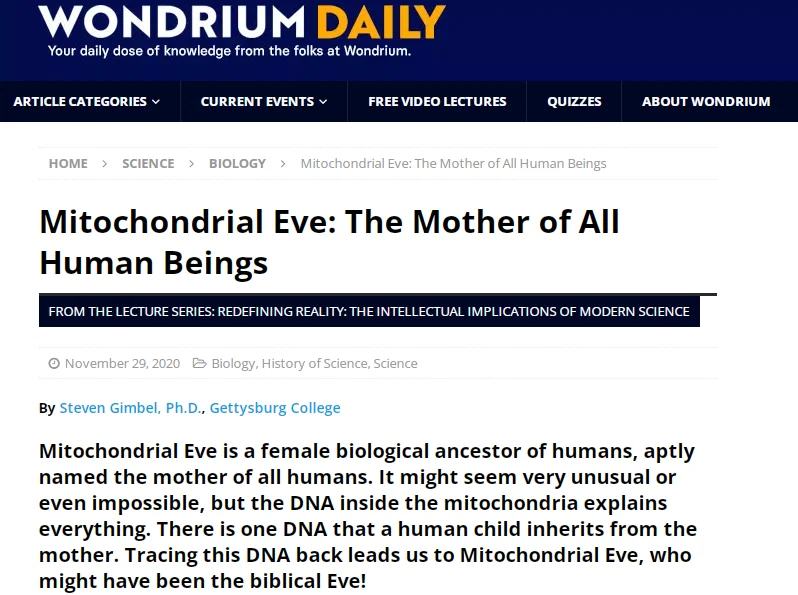
Hence, Cann, Stoneking, and Wilson were able to determine that all humans alive today are related to a single woman; in other words, we all descend from a common female ancestor.3
Today, you can learn about your deep ancestry—your ancestors from hundreds or even thousands of years ago—by tracing the paths they took as they migrated around the world. These insights are possible thanks to National Geographic’s analysis of your Genographic genetic information.4

Notes and References
- 1
Rebecca Louise Cann et al., “Mitochondrial DNA and Human Evolution,” Nature, vol. 325, no. 6099, 1 Jan. 1987, pp. 31–36. DOI: https://doi.org/10.1038/325031a0.
- 2
Steven Gimbel, “Mitochondrial Eve: The Mother of All Human Beings,” Wondrium Daily, 29 Nov. 2020, https://goo.su/Ul6uplP.
- 3
Josh Clark, “Are We All Descended from a Common Female Ancestor?” HowStuffWorks, accessed 7 Aug. 2023, https://science.howstuffworks.com/life/evolution/female-ancestor.htm.
- 4
“The Genographic Project® Geno 2.0 Next Generation Helix Product,” National Geographic, accessed 7 Aug. 2023, https://www.nationalgeographic.com/pages/article/genographic.