Is there archaeological evidence supporting the existence of Biblical Prophets such as David and Solomon, as well as the Israelite Exodus from Egypt?
This is a truly ludicrous question. Simply put, the absence or scarcity of direct archaeological evidence related to the Prophets should not be surprising, because the Prophets did not leave behind statues or temples that record their history. Consequently, those who study history primarily through temples and statues are, in effect, learning only about the history of pagans, since the Prophets firmly warned their communities against monuments erected for worship and idols. They even cautioned against turning their graves into objects of worship. For example, Prophet Muḥammad (PBUH) said: “O Allāh, do not turn my grave into an idol that is worshipped.’’1 Likewise, the second of the Ten Commandments—the central stipulations of Allāh’s covenant with Israel, given to Moses (PBUH) at Mount Sinai—condemns idolatrous religious practices.2

It is worth remembering that when Jesus (PBUH) was asked what good deed one must do to attain eternal life, his answer was to keep the commandments.3

The point is that the Prophets categorically forbade graven images, that is, statues and icons. Therefore, if one seeks the history of the Prophets within temples, they are ultimately misleading themselves. However, this does not mean that no traces whatsoever of the Prophets can be discovered through archaeological research. On the contrary, evidence for their historical existence may be found in ancient clay tablets and written records produced by others about them. For example, there are remarkable pieces of evidence supporting the Bible’s account of the Exodus, which, although foundational to biblical history, is regarded by mainstream scholars as largely fictional. The Bible relates that when Pharaoh refused to release the Israelites, God struck Egypt with ten plagues: water turning to blood (Exodus 7:14–25), frogs (Exodus 7:25–8:11), lice (Exodus 8:16–19), flies (Exodus 8:20–32), livestock pestilence (Exodus 9:1–7), boils (Exodus 9:8–12), hail (Exodus 9:13–35), locusts (Exodus 10:1–20), darkness (Exodus 10:21–29), and the killing of firstborn male children (Exodus 11–12). The Qurʾān likewise recounts this historical event. Allāh says: {Indeed, We afflicted Pharaoh’s people with famine and shortage of crops so they might come back ˹to their senses˺. In times of prosperity, they said, “This is what we deserve,” but in adversity, they blamed it on Moses and those with him. Surely all is destined by Allāh. Yet most of them did not know. They said, “No matter what sign you may bring to deceive us, we will never believe in you.” So We plagued them with floods, locusts, lice, frogs, and blood—all as clear signs, but they persisted in arrogance and were a wicked people. When tormented, they pleaded, “O Moses! Pray to your Lord on our behalf, by virtue of the covenant He made with you. If you help remove this torment from us, we will certainly believe in you and let the Children of Israel go with you.” But as soon as We removed the torment from them—until they met their inevitable fate—they broke their promise} (Qurʾān 7:130–135). One of the most compelling pieces of evidence aligning with both the Biblical and Qurʾānic accounts of the Exodus is the Ipuwer Papyrus—also known as Papyrus Leiden I 344 recto or the Admonitions of Ipuwer—which is currently housed in the Dutch National Museum of Antiquities in Leiden, Netherlands.
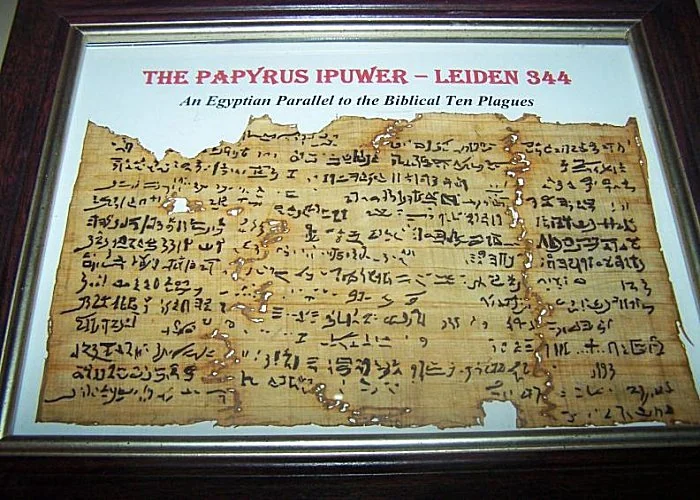
This papyrus, discovered in Egypt in the early 1800s, describes catastrophes that befell ancient Egypt, closely resembling those recorded in the Bible’s Book of Exodus and in the Qurʾān. It is an eyewitness account of the ten plagues—the events that led to Moses (PBUH) liberating the Israelites from slavery in Egypt—written in Egyptian hieratic script, rather than hieroglyphics, by a person named Ipuwer. Some scholars date the Ipuwer Papyrus to around 1550 B.C., while others suggest it is a copy composed closer to 1290 B.C. Although no conclusive evidence exists to pinpoint its exact date of composition, its writing style indicates that it was authored by an eyewitness. Many scholars place it roughly around the biblical date of 1440 B.C.4 Here is a list of the remarkable similarities between the biblical account and the Egyptian record, as documented in the Ipuwer Papyrus:5
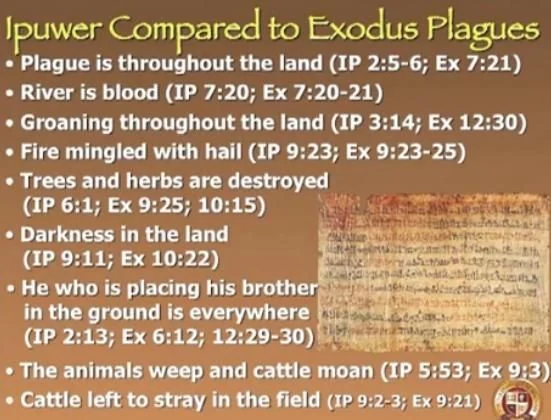
Below is an English translation of lines from the Ipuwer Papyrus, written in hieratic script, followed by the corresponding passage from the Bible:6
“There’s blood everywhere…Lo, the River is blood” (Ipuwer Papyrus 2:5–6, 2:10): This describes the Nile River turning to blood, a strikingly similar event to what is recorded in the Bible (Exodus 7:20–21).7

“Men shrink from tasting—human beings, and thirst after water… That is our water! That is our happiness! What shall we do in respect thereof? All is ruin” (Ipuwer Papyrus 2:10, 3:10–13): This passage describes the people’s thirst, which is understandable given that the Nile was their primary source of water. A similar event is recorded in the Bible (Exodus 7:24).8

“Lo, trees are felled, branches stripped” (Ipuwer Papyrus 4:14, 6:16): The biblical account (Exodus 9:24–25) similarly describes the plague of hail, which destroyed the trees and crops of Egypt.9

“Lo, grain is lacking on all sides” (Ipuwer Papyrus 6:3): Following the plague of hail, the Egyptians’ harvest was destroyed. The Ipuwer Papyrus specifically notes that the grain itself was depleted, not merely the plants—in other words, the plants had matured and the grain was ready to be harvested, yet all was destroyed. The biblical account (Exodus 9:31) similarly records this event.10

“Birds find neither fruits nor herbs” (Ipuwer Papyrus 6:1): This phrase depicts a land where birds cannot find food, likely as a result of the plague of hail or the plague of locusts. The point is that, as the biblical text (Exodus 10:14–15) states, not a green thing remained because of the plagues.11

“Groaning is throughout the land, mingled with laments” (Ipuwer Papyrus 3:14): This phrase depicts the Egyptians mourning their dead throughout the land. The biblical description of the Passover (Exodus 12:30) is very similar and likely refers to the same event.12

“Lo, many dead are buried in the river, the stream is the grave, the tomb became a stream, and he who puts his brother in the ground is everywhere” (Ipuwer Papyrus 2:13): This statement parallels the biblical description (Numbers 33:4) of Egyptians burying their dead after the Passover plague. Massive burials were taking place because there was not a house in Egypt without someone dead.13

“All is ruin!” (Ipuwer Papyrus 3:13): This statement summarizes the condition of the great empire of Egypt, whose natural resources and population had been devastated. The Egyptians had witnessed Allāh’s power and greatness like no other people before. Once again, the biblical account (Exodus 10:7) parallels Ipuwer’s writing.14

“The land is without light” (Ipuwer Papyrus 9:11): This statement by Ipuwer is remarkable, as one of the plagues mentioned in the Bible is the plague of darkness over the Egyptians. Some critics have attempted to explain this event as a solar eclipse, but total solar eclipses last only from about 10 seconds to 7.5 minutes. In contrast, Ipuwer describes the entire land of Egypt being without light. Exodus 10:22–23 records that God smote the land of the Egyptians with darkness for three days.15

“Gold and lapis lazuli, silver and malachite, carnelian and bronze… are fastened on the neck of female slaves” (Ipuwer Papyrus 3:2–3:3): This is one of the most striking passages in the Ipuwer Papyrus. The text lists precious and semi-precious stones and metals adorning the necks of female slaves. This detail is significant for several reasons. First, it confirms that the Egyptians possessed slaves. According to the Bible (Exodus 1:13–14), the Israelites were, at this time, enslaved by the Egyptians.16

The Qurʾān likewise states that the Israelites were enslaved in Egypt: {indeed, Pharaoh ˹arrogantly˺ elevated himself in the land and divided its people into ˹subservient˺ groups, one of which he persecuted, slaughtering their sons and keeping their women. He was truly one of the corruptors} (Qurʾān 28:4). Second, slaves are not ordinarily honored with precious and semi-precious stones and metals, yet this line of the papyrus explicitly states that slaves were adorned with such ornaments. According to the Bible (Exodus 12:35–36), the Israelites, as slaves, requested and were given gold and silver by the Egyptians at the conclusion of the plagues.17

Both the Bible and the Qurʾān recount what the Israelites did with the jewelry they borrowed from the Egyptians before fleeing Egypt. The Bible states that Aaron gathered the Israelites’ gold earrings and ornaments, fashioned a molten calf, and was entirely responsible for setting up the golden calf as a god. In contrast, the Qurʾān absolves Prophet Aaron (PBUH) of any involvement in the calf-worship: {O Children of Israel! We saved you from your enemy, and made an appointment with you on the right side of Mount aṭ-Ṭūr, and sent down to you manna and quails, ˹saying,˺ “Eat from the good things We have provided for you, but do not transgress in them, or My wrath will befall you. And whoever My wrath befalls is certainly doomed. But I am truly Most Forgiving to whoever repents, believes, and does good, then persists on ˹true˺ guidance.” ˹Allāh asked,˺ “Why have you come with such haste ahead of your people, O Moses?”18 He replied, “They are close on my tracks. And I have hastened to You, my Lord, so You will be pleased.” Allāh responded, “We have indeed tested your people in your absence, and as-Sāmiriyy19 has led them astray.” So Moses returned to his people, furious and sorrowful. He said, “O my people! Had your Lord not made you a good promise?20 Has my absence been too long for you? Or have you wished for wrath from your Lord to befall you, so you broke your promise to me?”21 They argued, “We did not break our promise to you of our own free will, but we were made to carry the burden of the people’s ˹golden˺ jewelry, then we threw it ˹into the fire˺, and so did the as-Sāmiriyy.” Then he moulded for them an idol of a calf that made a lowing sound. They said, “This is your god and the god of Moses, but Moses forgot ˹where it was˺!” Did they not see that it did not respond to them, nor could it protect or benefit them? Aaron had already warned them beforehand, “O my people! You are only being tested by this, for indeed your ˹one true˺ Lord is the Most Compassionate. So follow me and obey my orders”} (Qurʾān 20:80–90). It is noteworthy that the Ipuwer Papyrus contains numerous references to the Ten Plagues that afflicted Egypt prior to the Exodus. There are striking similarities between the unique catastrophes described in the papyrus and the biblical and Qurʾānic accounts of the Plagues of Egypt. Clearly, the Ipuwer Papyrus, the Bible, and the Qurʾān describe the same events. In short, the Ipuwer Papyrus provides evidence that the Ten Plagues of Egypt and the Exodus of the Israelites are not mere myths but historical events. The papyrus was translated by Alan Henderson Gardiner in 1909, and the full text appears in Admonitions of an Egyptian from a Hieratic Papyrus in Leiden. It describes major upheavals in Egypt, including famine, drought, the flight of the slaves with jewelry, and widespread death throughout the land.22
Many ask: Why did the ancient Egyptians never write about the Exodus? Their silence is hardly surprising, given the tendency to overlook defeat in historical writing. As the saying goes, history is written by the victors, which is why historians rarely—if ever—find records of military defeats preserved in ancient cultures. Like other ancient civilizations, the Egyptians did not document major defeats; thus, it is unsurprising that they did not record their stunning failure in pursuit of their slaves, the Israelites. Nonetheless, as detailed above, the Ipuwer Papyrus vividly depicts the conditions of the Exodus, and many of Ipuwer’s statements correspond closely with the accounts in the Bible and the Qurʾān. On the other hand, the kings of ancient Egypt took great pride in their military accomplishments. Hence, another artifact supporting the Bible’s and Qurʾān’s account of the Israelite Exodus is the Merneptah Stele—also known as the Israel Stele or Victory Stele of Merneptah—discovered in 1896 by pioneering Egyptologist Flinders Petrie and preserved in the Museum of Egyptian Antiquities in Cairo. Conventionally dated to 1208 B.C., the stele was erected in the fifth year of Pharaoh Merneptah, son of Ramesses II. It primarily commemorates a victory in a campaign against the Libu and Meshwesh Libyans and their Sea People allies,23 but its final two lines refer to a prior military campaign in Canaan, in which Merneptah states that he defeated Ashkelon, Gezer, Yanoam, and Israel, among others. For this reason, the stele has gained considerable fame as the only ancient Egyptian artifact generally accepted as mentioning “Isrir” or “Israel.”
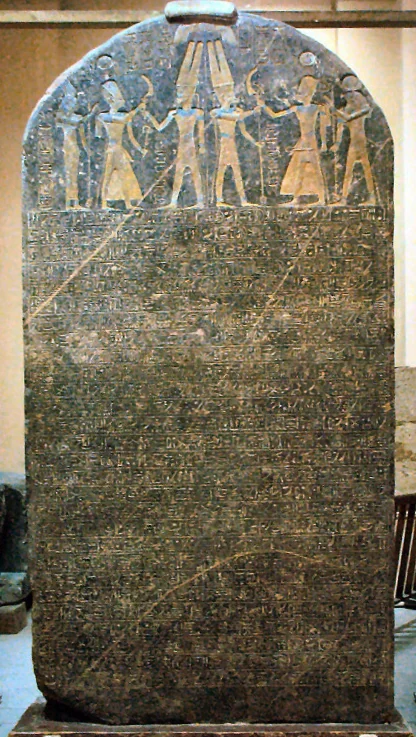
For more than a century, this was the oldest known inscription mentioning Israel. It indicates that the Israelites were already in Canaan at this time, at least forty years after leaving Egypt according to biblical chronology. As noted, the stele is sometimes called the “Israel Stele” because most scholars translate a set of hieroglyphs in line 27 as “Israel.” The following section of the Merneptah Stele highlights where “Israel” is mentioned.24
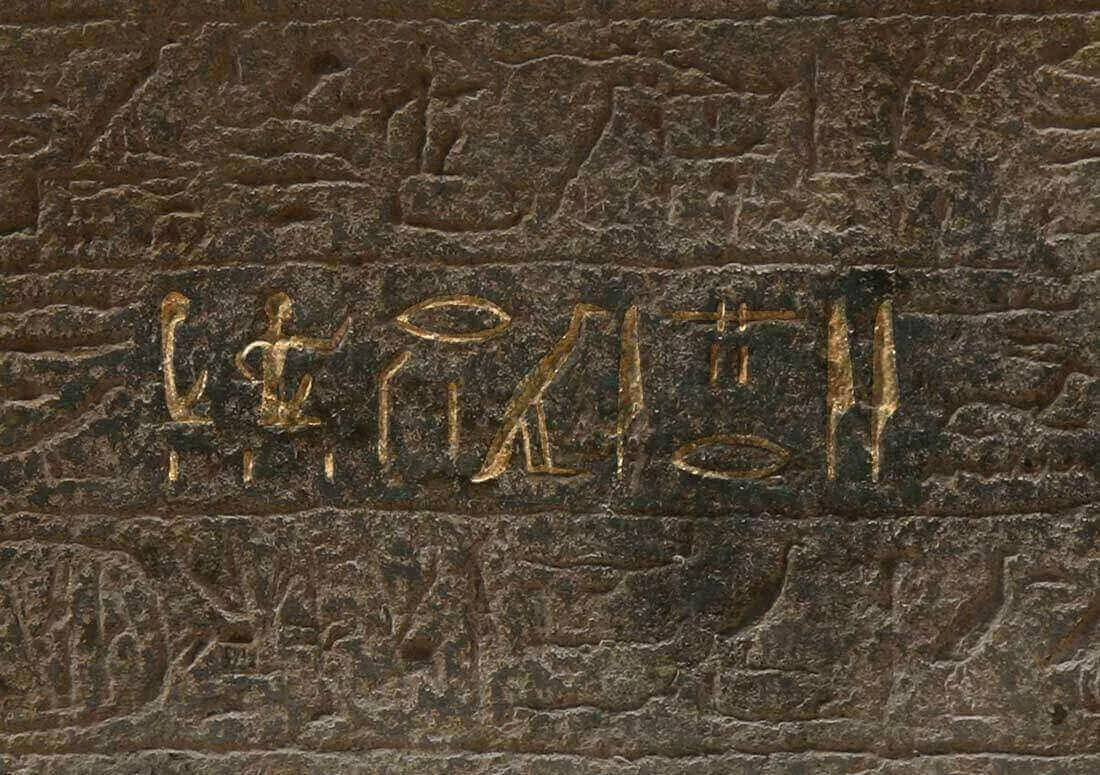
The line about Israel reads: “Israel is wasted, bare of seed” or “Israel lies waste, its seed no longer exists.”25 Wilhelm Spiegelberg, a German philologist on Flinders Petrie’s archaeological team, was called by Petrie to translate the inscription. He was puzzled by one symbol near the end, representing a people or tribe whom Merneptah had victoriously smitten—I.si.ri.ar. Petrie quickly suggested that it read “Israel,” and Spiegelberg agreed that this translation was correct.26 Petrie remarked, “Won’t the reverends be pleased?” At dinner that evening, realizing the importance of the find, he said, “This stele will be better known in the world than anything else I have found.” The discovery made headlines in the English press.27 The line referring to Israel is shown below (reversed to match the English translation; the original Egyptian hieroglyphs read from right to left):28
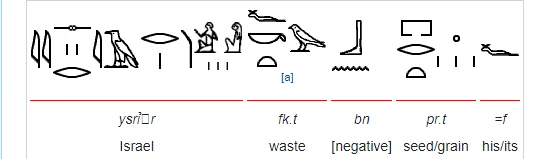
While Asqaluni, Gezer, and Yanoam are assigned the determinative for a city—a throw stick followed by three mountains—the hieroglyphs referring to Israel instead employ the throw stick (the determinative for “foreign”) together with a seated man and woman (the determinative for “people”) placed above three vertical lines, which function as a plural marker.29

The determinative “people” has been the subject of considerable scholarly discussion. As early as 1955, John A. Wilson, an American Egyptologist, advanced the idea that this determinative indicates that the ysrỉꜣr were a people, writing: “The argument is good, but not conclusive, because of the notorious carelessness of Late-Egyptian scribes and several blunders of writing in this stela.”30 This idea was subsequently developed further by other scholars.31 According to The Oxford History of the Biblical World, the “foreign people” sign was typically used by the ancient Egyptians to denote nomadic groups or peoples without a fixed city-state, thereby implying a semi-nomadic or rural status for Israel at that time.32 According to James Hoffmeier, an American Old Testament scholar, archaeologist, and Egyptologist, “no Egyptologists would ever read the signs of a foreign ethnic entity as indicating a foreign land, but a people group.”33 In contrast to this apparent Israelite statelessness, the other Canaanite groups fought by Egypt—Asqaluni, Gezer, and Yanoam—are described in the stele as emerging city-states.34 Hence, shortly before 1200 B.C.E., the ancient Egyptians were aware of a group of people somewhere in the central highlands35—a loosely affiliated tribal confederation, if you will—called the “Israelites.”36 Therefore, the Merneptah Stele is a priceless inscription, as it is considered the earliest extra-biblical reference to ancient Israel and is widely regarded as authentic, providing valuable historical information.37
The Shishak Inscription is another artifact of great significance to biblical archaeology. In 925 B.C., near the end of his reign—shortly after King Solomon’s death—Pharaoh Shishak, identified as Shoshenq I, swept through Israel and Judah, conquering city after city during the reign of Rehoboam. The Bible describes this campaign:38

Upon returning to Egypt, Pharaoh Shishak ordered a record of his victories to be inscribed on a wall of the Great Temple of Amun-Re at ancient Karnak, in what is now Luxor, Egypt. Known as the Bubastite Portal, it lists over 150 locations he claimed to have conquered during his campaign in the northern lands.39

Other biblical locations that Pharaoh Shishak claims to have conquered include Gibeon, Arad, Gezer, and Beth-Shemesh. This brings us to the question: Is there direct archaeological evidence that Prophet Abraham (PBUH) ever existed? The answer is yes—there is evidence supporting the biblical and Qurʾānic narrative of Abraham’s existence. One of the earliest references to Abraham (PBUH) may be found in a Negev town listed in Pharaoh Shishak’s victory inscription, pa’ha-q-ru-a ‘i-bi-ra-ma, which is best interpreted as “the fortification of Abram,” or more simply, “Fort Abram.”40 The location and chronological context of this site make it plausible that the Abram after whom it was named is the Abram of biblical tradition. In fact, pa’ha-q-ru-a ‘i-bi-ra-ma is how the hieroglyphic text on the wall in the Temple of Amun-Re referred to Beersheba,41 which was built up in the Negev at the time of David and Solomon in the 10th century B.C. as a fortified city on Israel’s southern border to guard against Egyptian invasion.42
In fact, there is also direct archaeological evidence of Prophet David (PBUH) and his kingdom. The Tel Dan Stele—a fragmentary Canaanite inscription dating to the 9th century B.C.E.—is widely regarded as the most significant extra-biblical reference to the House of David.43 The most notable feature of this inscription is its unprecedented reference to the “House of David” (Hebrew: byt dwd) in line 9, making it the earliest known extra-biblical mention of David and the dynasty he founded. In the carefully incised text, written in neat Aramaic characters, the Aramean king who erected the stele boasts that he defeated the “king of Israel” and the “king of the House of David.” This is the Tel Dan Stele, on display at the Israel Museum in Jerusalem, with the sequence B Y T D W D highlighted in white.44
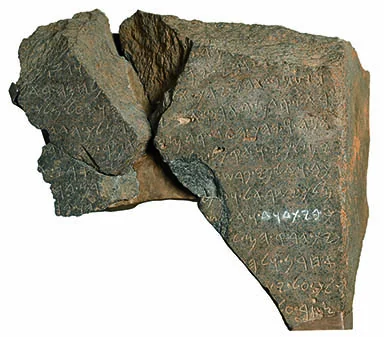
Hence, the stele’s fragmentary inscription—first read and translated by the renowned epigrapher Joseph Naveh—provides strong evidence that King David of the Bible (and the Qurʾān) was a genuine historical figure, rather than a purely literary construct of later biblical writers and editors. More importantly, the stele—erected by one of ancient Israel’s fiercest enemies more than a century after David’s death—nonetheless acknowledges David as the founder of the kingdom of Judah.45 What follows is the transcription in Hebrew letters provided by Avraham Biran and Joseph Naveh. Dots separate words, as in the original inscription; empty square brackets indicate damaged or missing text, while text enclosed in square brackets represents reconstructions proposed by Biran and Naveh:46
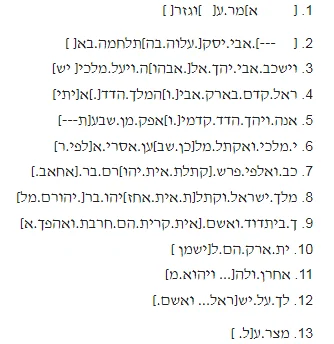
The text is romanized as follows:47
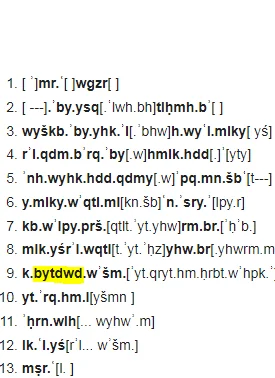
The 1995 translation by Biran reads as follows:48
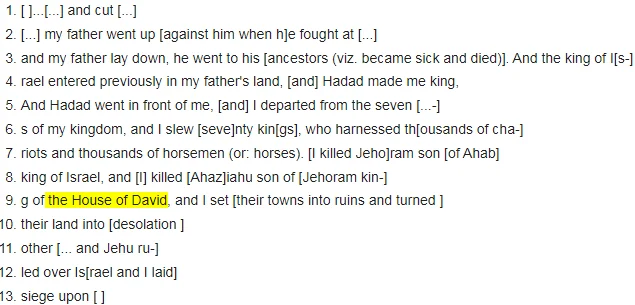
The significance of the Tel Dan Stele for the biblical account of Israel’s history lies especially in lines 8 and 9, which mention a “king of Israel” and a “House of David.” The latter is widely accepted by the majority of scholars.49 The Tel Dan Stele generated considerable debate, with numerous articles discussing its age, authorship, and authenticity. However, it is generally accepted by scholars as genuine and as a reference to the House of David.50 Prophet David (PBUH) was not only an illustrious Prophet of the Israelites but also their king:{So they defeated them by Allāh’s Will, and David killed Goliath. And Allāh blessed David with kingship} (Qurʾān 2:251).
It is noteworthy that the discovery of the Tel Dan Stele prompted some scholars to re-evaluate an artifact discovered before it, namely the Mesha Stele—commonly known as the Moabite Stone—now housed in the Louvre Museum in Paris, France. Dating from the mid-9th century B.C., this stele contains a 34-line inscription celebrating the Moabite vassal king Mesha’s rebellion against, and military victory over, the Israelites. In 1994, the renowned philologist and epigrapher André Lemaire reconstructed the phrase בת[ד]וד (bt[d]wd) in line 31 as “House of David”—a tantalizing reference to King David. This line is one of the most difficult in the text due to severe damage, with the legible letters interpreted by Lemaire as BT[*]WD, the square brackets representing a damaged space likely containing a single missing letter.51
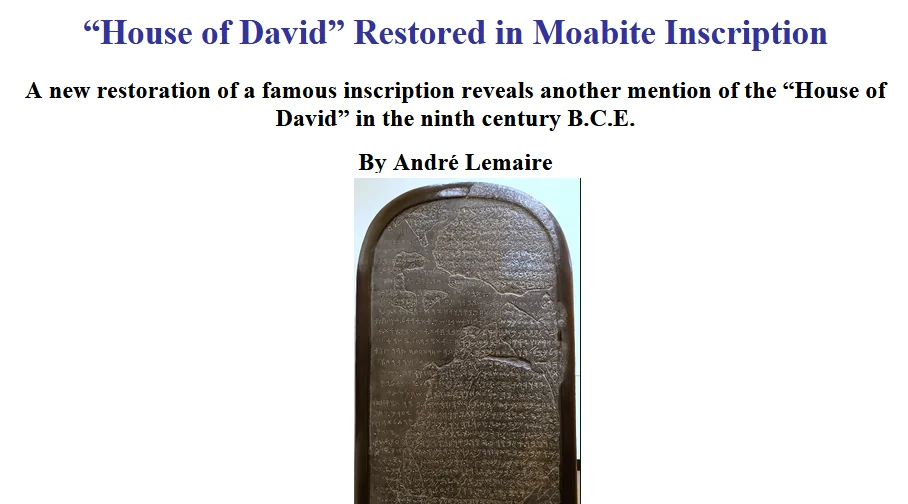

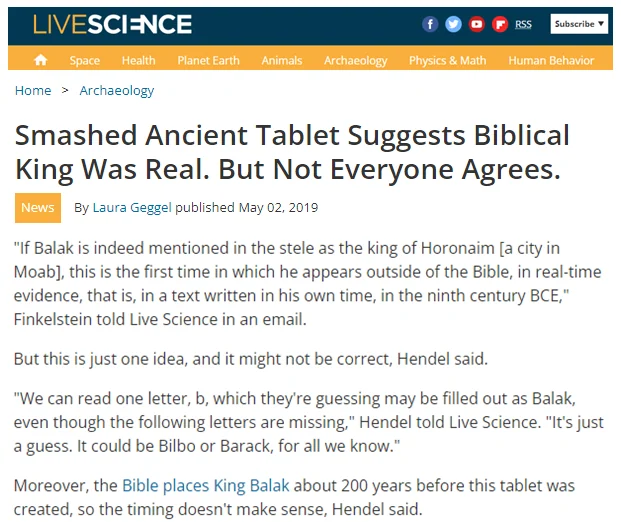
In 2019, two Tel Aviv University professors—archaeologist Israel Finkelstein and historian Nadav Na’aman—together with Collège de France biblical scholar Thomas Römer—proposed that the long-standing hypothesis identifying line 31 of the Mesha Stele with Beit David, the biblical House of David, should be reconsidered. Based on their reanalysis of high-resolution images of a papier-mâché impression (known as a squeeze) taken of the intact inscription before the stele was damaged in 1869, they argued that the monarch mentioned is represented by three consonants beginning with “B.” They contended that the vertical stroke in line 31 marks a transition between two sentences, indicating that the letter waw, previously understood as part of the name “David,” instead begins a new word. On this reading, the letter bet is not part of the word “Beit” (‘house of’) but begins a personal name instead. Consequently, the trio—none of whom are trained epigraphers—cautiously suggested that the damaged sequence does not refer to the “House of David” but may instead preserve the name of the biblical Moabite king Balak, whom they consider the more plausible referent.52 However, not all scholars accept the Balak theory. Ronald Hendel, professor of Hebrew Bible and Jewish Studies at the University of California, Berkeley, pointed out that Balak lived approximately 200 years before David, rendering any reference to him chronologically unlikely. Hendel thus dismissed the Balak hypothesis as nothing more than a guess because, as he put it, “the timing does not make sense.”53
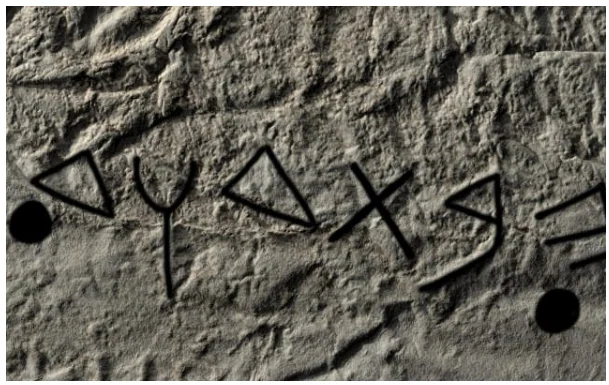
Epigrapher and historian Michael Langlois—who holds a PhD in Historical and Philological Sciences from the Sorbonne, is currently a researcher at the French Research Center in Jerusalem, and has spent years closely studying the Mesha Stele—was similarly dismissive of the Balak hypothesis, asserting that his own advanced 3D imaging methods confirm that line 31 contains the phrase “House of David.”54

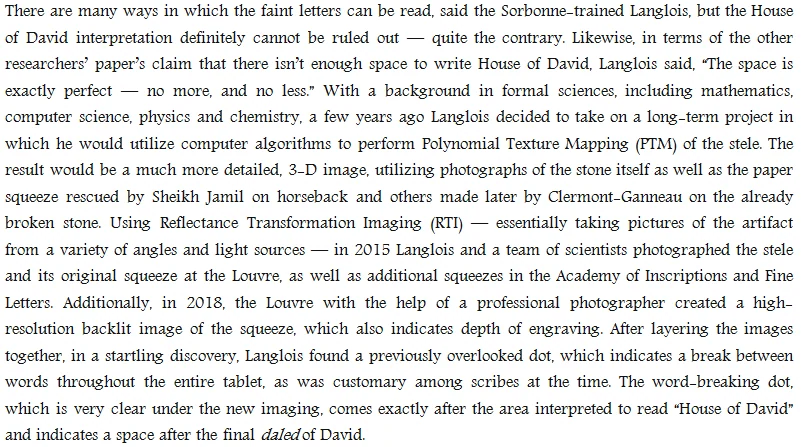
Langlois stated that this evidence rules out the “vertical stroke” proposed by the trio—Israel Finkelstein, Nadav Na’aman, and Thomas Römer—in their paper.55 He explained that this is the case because no new sentence could begin before the waw, as there are no known Moabite words spelled solely with a waw and a final dalet. Shown here is a digital drawing of the proposed reading at the end of line 31 of the Mesha Stele inscription.56
Langlois repeatedly told The Times of Israel that he is not attempting to “prove” the Bible. However, he added:57

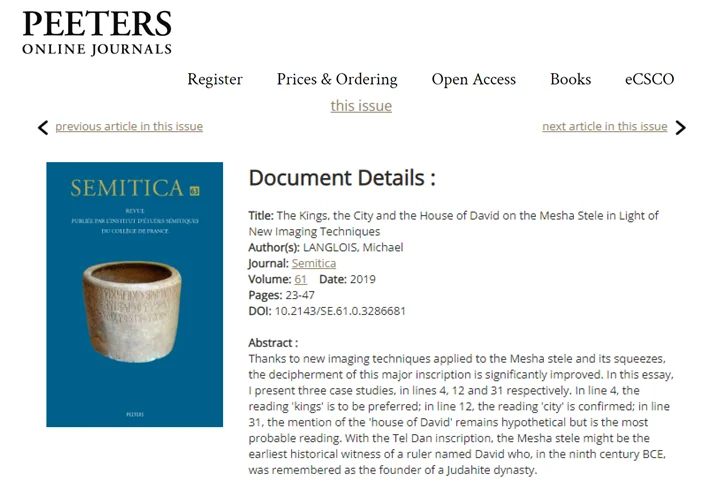
Langlois has published a groundbreaking paper employing advanced imaging techniques, which support the reading of the line in question as “House of David.”58
Hence, new technology is enabling a re-examination of ancient artifacts, revealing more information than ever before. Recent studies of the Mesha Stele, employing advanced digital imaging techniques, confirm that Prophet and King David (PBUH) indeed existed. This stele offers the earliest evidence of the Judean kingdom and its Davidic dynasty. As noted above, it represents the second clear reference to the House of David from the period of the Israelite monarchy. This discovery is particularly significant because the archaeological community has often been skeptical about David (PBUH), with many questioning whether he ever ruled a powerful Israel as described in the Bible and the Qurʾān. In short, we can be confident that Allāh has preserved a reliable record of the past in His Revelations, especially the Qurʾān, and even in the Bible, which, despite being distorted, still contains elements of the truth in certain Books.
Notes and References
- 1
Aḥmad ibn Ḥanbal, al-Musnad, (Cairo, Egypt: Dār al-Ḥadīth, 1990), ḥadīth: 7352, grade of ḥadīth: ṣaḥīḥ.
- 2
“Exodus 20:4-6, New International Version,” Bible Gateway, accessed 10 March 2024, https://www.biblegateway.com/passage/?search=Exodus+20%3A4-6&version=NIV.
- 3
“Matthew 19:16-17, New International Version,” Bible Gateway, accessed 10 March 2024, https://www.biblegateway.com/passage/?search=Mathew+19%3A16-17&version=NIV.
- 4
“The Ipuwer Papyrus,” Evidence 4 Faith, 30 Nov. 2021, https://evidence4faith.org/portfolio/ipuwer/.
- 5
“The Evidence for the Exodus,” the notzrim, accessed 17 Jul. 2023, https://thenotzrim.org/evidence-of-exodus/.
- 6
“The Ipuwer Papyrus,” Evidence 4 Faith, 30 Nov. 2021, https://evidence4faith.org/portfolio/ipuwer/.
- 7
“Exodus 7:20-21, English Standard Version,” Bible Gateway, accessed 10 March 2024, https://www.biblegateway.com/passage/?search=Exodus%207%3A20-21&version=ESV.
- 8
“Exodus 7:24, English Standard Version,” Bible Gateway, https://www.biblegateway.com/passage/?search=Exodus+7%3A24&version=ESV.
- 9
“Exodus 9:24-25, English Standard Version,” Bible Gateway, accessed 10 March 2024, https://www.biblegateway.com/passage/?search=Exodus+9%3A24-25&version=ESV.
- 10
“Exodus 9:31, English Standard Version,” Bible Gateway, accessed 10 March 2024, https://www.biblegateway.com/passage/?search=Exodus+9%3A31+&version=ESV.
- 11
“Exodus 10:14-15, English Standard Version,” Bible Gateway, accessed 10 March 2024, https://www.biblegateway.com/passage/?search=Exodus+10%3A14-15+&version=ESV.
- 12
“Exodus 12:30, English Standard Version,” Bible Gateway, accessed 10 March 2024, https://www.biblegateway.com/passage/?search=Exodus+12%3A30+&version=ESV.
- 13
“Numbers 33:4, English Standard Version,” Bible Gateway, accessed 10 March 2024, https://www.biblegateway.com/passage/?search=Numbers+33%3A4&version=ESV.
- 14
“Exodus 10:7, English Standard Version,” Bible Gateway, accessed 10 March 2024, https://www.biblegateway.com/passage/?search=Exodus+10%3A7+&version=ESV.
- 15
“Exodus 10:22-23, English Standard Version,” Bible Gateway, accessed 10 March 2024, https://www.biblegateway.com/passage/?search=Exodus+10%3A22-23+&version=ESV.
- 16
“Exodus 1:13-14, English Standard Version,” Bible Gateway, accessed 10 March 2024, https://www.biblegateway.com/passage/?search=Exodus+1%3A13-14+&version=ESV.
- 17
“Exodus 12:35-36, English Standard Version,” Bible Gateway, accessed 10 March 2024, https://www.biblegateway.com/passage/?search=Exodus+12%3A35-36+&version=ESV.
- 18
Moses selected a delegation of seventy people from his people to go to Mount aṭ-Ṭūr, the place appointed for him to receive the Tablets. On the way, he hastened toward his appointment with Allāh, arriving before the delegation.
- 19
As-Sāmiriyy, or the man from Samaria, was a hypocrite who led the Children of Israel into idolatry.
- 20
To reveal the Torah for their guidance.
- 21
To worship Allāh alone until Moses returned with the Tablets.
- 22
Alan Henderson Gardiner, t (Pap. Leiden 344 recto), (Leipzig, Germany: J. C. Hinrichs'scheBuchhandlung, 1909), available at: https://archive.org/details/admonitionsofegy00gard/page/n15/mode/2up.
- 23
A confederation of seafaring raiders who attacked Egypt and the eastern Mediterranean during the late Bronze Age.
- 24
Steve Law, “Top 10 Artifacts Show Biblical Exodus was Real History,” Patterns of Evidence, 1 Jun. 2019, https://www.patternsofevidence.com/2019/06/01/artifacts-show-biblical-exodus/.
- 25
“Merneptah Stele,” Wikipedia: The Free Encyclopedia, last edited 16 Jul. 2023, https://en.wikipedia.org/wiki/Merneptah_Stele.
- 26
Margaret Drower, Flinders Petrie: A life in Archaeology, (London, U.K.: Victor Gollancz, 1985), p. 221.
- 27
Ibid.
- 28
“Merneptah Stele,” Wikipedia: The Free Encyclopedia, last edited 16 Jul. 2023, https://en.wikipedia.org/wiki/Merneptah_Stele.
- 29
Ibid.
- 30
James B. Pritchard, Ancient Near Eastern Texts Relating to the Old Testament, (Princeton, U.S.: Princeton University Press, 1969), p. 378, footnote 18, available at: https://archive.org/details/ancient-near-eastern-texts-relating-to-the-old-testaments-james-b.-pritchard/page/376/mode/2up.
- 31
Michael G. Hasel, “The Battle of Kadesh: Identifying New Kingdom Polities, Places, and Peoples in Canaan and Syria,” in S. Bar et al., Egypt, Canaan and Israel: History, Imperialism, Ideology and Literature--Proceedings of a Conference at the University of Haifa, 3-7 May 2009, (Leiden, the Netherlands: Brill, 2009), pp. 65–86, [67]. DOI: https://doi.org/10.1163/ej.9789004194939.i-370.27.
- 32
Carol A. Redmount, “Bitter lives: Israel in and out of Egypt” in Michael Coogan, The Oxford History of the Biblical World, (Oxford, U.K.: Oxford University Press, 2001), p. 97.
- 33
J. K. Hoffmeier, “The Egyptian Origins of Israel: Recent Developments in Historiography,” in Thomas E. Levy et al., Israel’s Exodus in Transdisciplinary Perspective: Text, Archaeology, Culture, and Geoscience, (New York, U.S.: Springer, 2015), pp. 196–208 [202].
- 34
William Dever, “Archeology of the Hebrew Bible,” PBS Online, 18 Nov. 2008, https://www.pbs.org/wgbh/nova/article/archeology-hebrew-bible/.
- 35
Elevated, hilly regions in the central part of ancient Canaan, roughly between the coastal plain and the Jordan Valley, often inhabited by rural or semi-nomadic communities.
- 36
William Dever, “Archeology of the Hebrew Bible,” PBS Online, 18 Nov. 2008, https://www.pbs.org/wgbh/nova/article/archeology-hebrew-bible/.
- 37
William G. Dever, What Did the Biblical Writers Know and When Did They Know It?: What Archeology Can Tell Us About the Reality of Ancient Israel, (Grand Rapids, U.S.: William B. Eerdmans Publishing, 2001), pp. 118–19; Avraham Faust, Israel’s Ethnogenesis: Settlement, Interaction, Expansion and Resistance, (London, U.K.: Routledge, 2016); Israel Finkelstein and Amihay Mazar, The Quest for the Historical Israel: Debating Archaeology and the History of Early Israel, (Atlanta, U.S.: Society of Biblical Literature, 2007); Israel Finkelstein and Neil Asher Silberman, The Bible Unearthed: Archaeology’s New Vision of Ancient Israel and the Origin of Sacred Texts, (New York, U.S.: Simon and Schuster, 2002).
- 38
“2 Chronicles 12:2-4, New International Version,” Bible Gateway, accessed 10 March 2024, https://www.biblegateway.com/passage/?search=2%20Chronicles%2012%3A2-4&version=NIV.
- 39
David G. Hansen, “Megiddo, the Place of Battles,” Associates for Biblical Research, 5 Nov. 2014, https://biblearchaeology.org/research/conquest-of-canaan/3084-megiddo-the-place-of-battles.
Each “name ring” portrays a bound prisoner with a cartouche beneath it on which a toponym is listed in Egyptian hieroglyphics. While some of these name rings have been lost to erosion, many remain. One of the places that Shishak conquered was Megiddo. This was confirmed in the 1920’s, when excavators at Megiddo discovered a fragment of a victory stele that the Egyptian pharaoh had erected to commemorate his conquest of the city.
- 40
P. Kyle Mccarter, “Abraham as a Historical Figure: What Cultural, Textual, and Archaeological Sources can Tell us about this Patriarch,” My Jewish Learning, accessed 18 Jul. 2013, https://www.myjewishlearning.com/article/abraham/; “Beersheba,” Near East Tourist Agency, accessed 18 Jul. 2023, https://www.netours.com/info/holy-land/negev/beersheba.
- 41
Beersheba, or Beer Sheva—officially Be'er-Sheva (Hebrew: בְּאֵר שֶׁבַע, romanized: Bəʾēr Ševaʿ, literally “Well of the Oath” or “Well of the Seven”)—is the largest city in the Negev desert of southern Palestine. The name Beersheba originates from an event involving Abraham and Abimelech, the king of Gerar. The two made a covenant over a water well, and the area became known as Beersheba, meaning “the well of the oath” (Genesis 21:25–34).
- 42
Randall Price, The Stones Cry Out, (Oregon, U.S.: Harvest House Publishers, 1997), chapter 5, p. 98.
- 43
Eric Hovee, “Tel Dan Stele,” Center for Online Judaic Studies, 14 Jan. 2009, http://cojs.org/tel_dan_stele-_c-_840_bce/; Thomas H. Maugh II, “Stone Tablet Offers 1st Physical Evidence of Biblical King David: Archeology: Researchers say 13 lines of Aramaic Script Confirm the Battle for Tel Dan Recounted in the Bible, Marking a Victory by Asa of the House of David,” Los Angeles Times, 14 Aug. 1993, https://www.latimes.com/archives/la-xpm-1993-08-14-me-23862-story.html.
- 44
“Tel Dan stele,” Wikipedia: The Free Encyclopedia, last edited 3 Jul. 2023, https://en.wikipedia.org/wiki/Tel_Dan_stele.
- 45
Biblical Archaeology Society Staff, “The Tel Dan Inscription: The First Historical Evidence of King David from the Bible,” Biblical Archaeology Society, 4 March 2023, https://www.biblicalarchaeology.org/daily/biblical-artifacts/the-tel-dan-inscription-the-first-historical-evidence-of-the-king-david-bible-story/.
- 46
“Tel Dan stele,” Wikipedia: The Free Encyclopedia, last edited 3 Jul. 2023, https://en.wikipedia.org/wiki/Tel_Dan_stele.
- 47
Ibid.
- 48
Avraham Biran and Joseph Naveh, “The Tel Dan Inscription: A New Fragment,” Israel Exploration Journal, vol. 45, no. 1, 1995, pp. 1–18.
- 49
Lawrence J. Mykytiuk, Identifying Biblical Persons in Northwest Semitic Inscriptions of 1200–539 B.C.E., (Atlanta, U.S.: Society of Biblical Literature, 2004), p.126: “is best translated as “the house of david,” meaning the dynasty of David or the territory it ruled.”
Daniel Pioske, David’s Jerusalem: Between Memory and History (Routledge Studies in Religion), (London, U.K.: Routledge, 2015), p. 180: “The most straightforward reading of the phrase byt dwd in line A9 of the Tel Dan inscription is the construct phrase “House of David,” and this interpretation has garnered the assent of the majority of scholars familiar with the text.”
- 50
Lester L. Grabbe, Ahab Agonistes: The Rise and Fall of the Omri Dynasty, (New York, U.S.: Bloomsbury Publishing, 2007): “The Tel Dan inscription generated a good deal of debate and a flurry of articles when it first appeared, but it is now widely regarded (a) as genuine and (b) as referring to the Davidic dynasty and the Aramaic kingdom of Damascus.”
Eric H. Cline, Biblical Archaeology: A Very Short Introduction, (Oxford, U.K.: Oxford University Press, 2009): “Today, after much further discussion in academic journals, it is accepted by most archaeologists that the inscription is not only genuine but that the reference is indeed to the House of David, thus representing the first allusion found anywhere outside the Bible to the biblical David.”
Lawrence J. Mykytiuk, Identifying Biblical Persons in Northwest Semitic Inscriptions of 1200–539 B.C.E., (Atlanta, U.S.: Society of Biblical Literature, 2004), p. 113: “Some unfounded accusations of forgery have had little or no effect on the scholarly acceptance of this inscription as genuine.”
- 51
André Lemaire, “‘House of David” Restored in Moabite Inscription,” Biblical Archaeology Society, vol. 20 no. 3, May–June 1994, pp. 1, 7, available at the Wayback Machine - Internet Archive: https://web.archive.org/web/20120331134523/http://www.cojs.org/pdf/house_of_david.pdf.
- 52
Israel Finkelstein et al., “Restoring Line 31 in the Mesha Stele: The ‘House of David’ or Biblical Balak?” Tel Aviv, vol. 46, issue 1, 2019, pp. 3–11. DOI: https://doi.org/10.1080/03344355.2019.1586378.
- 53
Laura Geggel, “Smashed Ancient Tablet Suggests Biblical King was Real. But Not Everyone Agrees,” LiveScience, 2 May 2019, https://www.livescience.com/65381-mesha-stele-biblical-king.html.
- 54
Amanda Borschel-Dan, “High-Tech Study of Ancient Stone Suggests New Proof of King David’s Dynasty,” The Times of Israel, 3 May 2019, https://www.timesofisrael.com/high-tech-study-of-ancient-stone-keeps-davidic-dynasty-in-disputed-inscription/.
- 55
Israel Finkelstein et al., “Restoring Line 31 in the Mesha Stele: The ‘House of David’ or Biblical Balak?” Tel Aviv, vol. 46, issue 1, 2019, pp. 3–11. DOI: https://doi.org/10.1080/03344355.2019.1586378.
- 56
Amanda Borschel-Dan, “High-Tech Study of Ancient Stone Suggests New Proof of King David’s Dynasty,” The Times of Israel, 3 May 2019, https://www.timesofisrael.com/high-tech-study-of-ancient-stone-keeps-davidic-dynasty-in-disputed-inscription/.
- 57
Ibid.
- 58
Michael Langlois, “The Kings, the City, and the House of David on the Mesha Stele in Light of New Imaging Techniques,” Semitica, vol. 61, 2019, pp.23–47, available at Peeters Online Journals: https://doi.org/10.2143/SE.61.0.3286681.