Some atheists say, “I made supplications, but Allāh did not answer them.” Why might the divine response to supplication be delayed? Some atheists even mock Muslims, asking, “You have supplicated against Israel repeatedly—so has anything changed?”
There is a ḥadīth narrated by the two shaykhs, al-Bukhārī and Muslim, in their Ṣaḥīḥs (Authentic Collections), about three men who entered a cave to spend the night, when a rock fell from the mountain and blocked its entrance.1 Each of the three supplicated to Allāh by virtue of the best righteous deed he had performed, and with each supplication, the rock moved slightly, due to the strength of their faith, the merit of their deeds, and their persistent supplications. The first man had been exceptionally dutiful to his parents, treating them with kindness, waiting all night with a bowl of milk in his hands for them to wake and drink. The second man had turned away from a woman he loved most passionately after she yielded herself to him in return for money he had given her. The third man had invested the wages of a hired laborer who had left without taking them; he used the proceeds to purchase cows and their herders, and when the laborer later came to claim his due, he gave them to him. The rock moved slightly with each man’s supplication, and with the third man’s, it slipped aside, allowing the three to emerge from the cave safe and sound. The lesson to be learned from this ḥadīth is that for our supplications to be answered, we must pursue legitimate means to achieve our goals and maintain a reserve of good deeds performed during times of ease. The Prophets and the devout, righteous believers throughout history used to supplicate to Allāh while on horseback—that is, after they had taken all possible measures and exerted their utmost efforts in preparation for the encounter with the enemy. Prophet Nūḥ (peace be upon him) called upon his Lord after patiently inviting his people to Him for nine hundred and fifty years. Allāh says: {Your Lord has proclaimed, “Call upon Me, I will respond to you} (Qurʾān 40:60). But He also says: {Prepare against them what you ˹believers˺ can of ˹military˺ power and cavalry to deter Allāh’s enemies...} (Qurʾān 8:60). Hence, we should pursue all legitimate means to achieve our desired ends while simultaneously calling upon Allāh, Glorified and Exalted is He, for support and victory. Pursuing all practical, permissible means does not negate reliance on Allāh; rather, true reliance includes exerting one’s utmost efforts and then entrusting the outcome to Him. Allāh has granted His servants two keys to unlock the treasures of His mercy and attain His provisions and bounties: action and supplication. Neither can replace the other. Action does not replace supplication, nor does supplication replace action. Therefore, one should not restrict oneself to supplication while neglecting action.
Supplication is the essence and spirit of worship. Humans were created for the purpose of worshipping Allāh, and the ultimate aim of worship is to draw them nearer to Him. Supplication fulfills this purpose. The Prophet (PBUH) said, “Verily, supplication is worship.”2 However, there are sins that can block supplication—that is, they prevent it from being answered. One example is consuming ḥarām (unlawful) food. The Prophet (PBUH) mentioned a man who travels a long distance in a disheveled and dusty state, stretching out his hands to heaven and saying, “My Lord, my Lord.” He (PBUH) said: “Yet his food is unlawful, his drink is unlawful, his clothing is unlawful, and his nourishment is unlawful. How, then, can his supplication be accepted?” 3 Hence, Muslims must earn their livelihood through lawful means, for unlawful earnings can impede the acceptance of supplication. In addition, they should observe proper adab (etiquettes) when invoking Allāh. In the Qurʾān, they are instructed to call upon Allāh in two manners befitting a servant who supplicates and beseeches his Lord: with humility and in private: {Call upon your Lord humbly and secretly. Surely He does not like the transgressors} (Qurʾān 7:55). That is, the servant should humbly acknowledge the greatness of his Lord and his own humility through expressions of the heart, tongue, and body. Verbal supplication should express the depth of emotion present in the supplicant’s heart and manifest his submission, dependence, insignificance, and neediness. In other words, supplication shatters the pride and ego of the supplicant and opens his eyes to his true place in the universe. As for supplicating in privacy, it helps the servant devote full their attention to the act of supplication and protects them from the danger of ostentation. Indeed, it fosters complete sincerity and an intimacy that can only be attained through private communication with the Lord. Hence, humility and privacy are among the etiquettes of supplication taught to us by the Almighty Himself, so that we may supplicate to Him in a manner worthy of Him. Conversely, invoking Allāh with the intention of testing Him, as atheists do, constitutes transgression rather than supplication, and {Allāh does not like transgressors} (Qurʾān 2:190). Moreover, a Muslim should not be hasty or impatient in supplication, as the Prophet (PBUH) said: “The supplication of any one of you will be answered, provided he does not hasten and say, ‘I have supplicated, but it has not been answered.’”4 When Mūsá and Hārūn (peace be upon them) prayed against Pharaoh and his chiefs after they refused to accept the truth, Allāh said to them: {Your prayer is answered! So be steadfast} (Qurʾān 10:89). However, Pharaoh and his followers were destroyed long after this supplication. Similarly, Prophet Ibrāhīm (peace be upon him) prayed to Allāh to raise a Prophet from among the people of Makkah, saying: {Our Lord! Raise from among them a messenger who will recite to them Your revelations…} (Qurʾān 2:129). Thousands of years after Prophet Abraham (PBUH) made this supplication to Allāh, Prophet Muḥammad (PBUH) was sent. Thus, we should supplicate to Allāh, the Glorious and Exalted, and He, Glory be to Him, answers our supplications with His wisdom and knowledge, in whatever way He wills and whenever He wills. In brief, a Muslim should make supplications, take all permissible measures, be content with Allāh’s decree, maintain good expectations of Allāh, and anticipate—and be certain of receiving—only the best from Him.
Furthermore, a Muslim should always reflect upon the wisdom behind Allāh’s decree. Contemplation of Divine wisdom is the garden of the righteous and the orchard of the people of knowledge, for affliction may be the greatest good that the mind can ever conceive. Consider the Companions of the Prophet (PBUH) during the Battle of the Trench (also known as the Battle of the Confederates, when a coalition of Makkan tribes and their allies laid siege to al-Madīnah). When they found themselves surrounded by a vast force of ten to twelve thousand men from the front and by the Banū Qurayẓah from behind, they did not waver in their faith; rather, it was strengthened even more. They surrendered to Allāh and His decree with complete conviction and satisfaction of the heart. Allāh says: {when the believers saw the enemy alliance, they said, “This is what Allāh and His Messenger had promised us. The promise of Allāh and His Messenger has come true.” And this only increased them in faith and submission} (Qurʾān 33:22). Only the trench stood as a barrier between the Muslims and the Confederates. From a purely worldly military perspective, it would have taken only a few days for the Muslims’ defeat to be inevitable. Once the Confederates crossed the trench, the Muslims would have faced doom with nowhere to flee. Yet they exclaimed, “This is what Allāh and His Messenger had promised us.” Indeed, time seems to stand still in such a moment of complete submission to Allāh’s will and contemplation of His wisdom. What was the outcome? Divine assistance came to the Muslims: Allāh sent a wind against the Confederates, along with angels who shook them and cast terror into their hearts, causing them to flee and never return. Allāh says: {O believers! Remember Allāh’s favour upon you when ˹enemy˺ forces came to ˹besiege˺ you ˹in Medina˺, so We sent against them a ˹bitter˺ wind and forces you could not see. And Allāh is All-Seeing of what you do} (Qurʾān 33:9). This is why the community of the Companions was the closest to perfection in the history of humanity. Therefore, one should always be content with Allāh’s decree, even if it differs from—or is entirely opposite to—what one hopes for. Know that nothing occurs except according to the knowledge, will, command, predestination, and wisdom of Allāh. Allāh says: {Had it been your Lord’s Will, they would not have done such a thing} (Qurʾān 6:112). And He says: {He has created everything, ordaining it precisely} (Qurʾān 25:2). Rest assured, O servant of Allāh, for He, in His infinite wisdom, manages all your affairs. Allāh says: {No calamity befalls ˹anyone˺ except by Allāh’s Will. And whoever has faith in Allāh, He will ˹rightly˺ guide their hearts ˹through adversity˺. And Allāh has ˹perfect˺ knowledge of all things} (Qurʾān 64:11). We should reflect on these verses daily and be certain that everything Allāh decrees embodies perfect goodness and wisdom, even if it differs from what we hope and pray for. Consider the state of the Islamic nation during the Tatar invasion, and then reflect on what it became a century later. The Tatar invasion of Muslim lands was marked by extreme ruthlessness and devastation, and people openly wondered whether the light of Islam would be extinguished forever. The famous historian Ibn al-Athīr wrote in his al-Kāmil fī at-Tārīkh (The Complete History):5

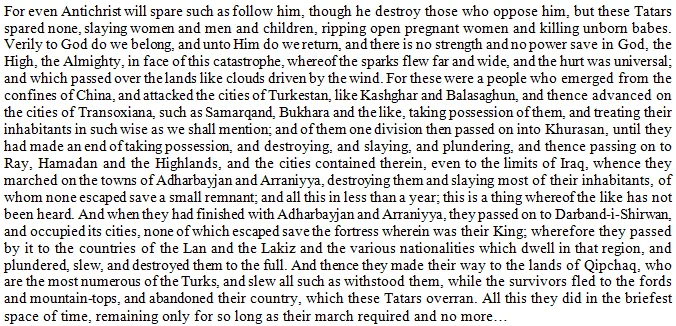
Ibn al-Athīr believed that the Tatar invasion would mark the end of Islam and the Muslim nation. Little did he know that he was witnessing events preceding one of the greatest victories in Islamic history, even though it appeared to be the most catastrophic calamity to befall the Muslims. Yet Islam did not perish, and the Tatars were unable to exterminate the Muslim nation. Within a generation, the tide began to turn in Islam’s favor, as the conquerors came to admire the Islamic faith and eventually embraced it in large numbers. Today, the Tatars are regarded as part of Islam’s universal brotherhood, with hundreds of millions of Tatar Muslims. In fact, the peoples of Turkestan, Kyrgyzstan, Turkmenistan, Uzbekistan, Azerbaijan, and Crimea are all descendants of the Tatars. Hence, many of us may endure immense pain from ordeals that befall us, only to discover later that they were blessings in disguise. In our immediate experience, we may grieve over what appears to be a misfortune, only to rejoice shortly afterward upon realizing that it was, in fact, the best outcome. Therefore, we should supplicate and trust that everything Allāh decrees is good, and that goodness may lie in something other than what we pray for. Thus, supplication may be answered in a manner different from what we hope, yet this is ultimately for our own good. That is why al-istikhārah (the prayer of seeking Allāh’s guidance) is prescribed. It represents submission to the command of Allāh and a practical acknowledgment that one possesses no power or strength of one’s own. In al-istikhārah, we say: “…and ordain for me what is good wherever it may be, and help me to be content with it.”6 If Allāh were to answer every supplication of every human being and decree matters accordingly, the heavens and the earth would surely be corrupted. Allāh says: {had the truth followed their desires, the heavens, the earth, and all those in them would have certainly been corrupted} (Qurʾān 23:71). This is due to people’s corrupt and inconsistent desires: one hopes to become the strongest, another to possess mountains of gold and be the wealthiest on earth, and a third to see all of his enemies perish. There are supplications which, if they were answered, would disrupt the order of the heavens and the earth, yet Allāh has eternal and unalterable laws governing the universe. Therefore, we should supplicate to Allāh to grant us the best of this world as well as the best of the Hereafter, and Allāh, in His wisdom, decrees what is best for us.
Finally, we should know that Allāh answers the supplication of the distressed person, even if that person is an unbeliever: {Or ˹ask them,˺ “Who responds to the distressed when they cry to Him, relieving ˹their˺ affliction} (Qurʾān 27:62). There is no human on the face of the earth who has not experienced supplicating Allāh in times of distress and having that supplication answered. I will never forget the months I spent suffering from a strange illness that afflicted me. I consulted distinguished professors of medicine, yet this only increased my confusion. My symptoms worsened with the numerous tests and the use of a Holter monitor. By Allāh, I clearly remember the night I turned to my Lord and supplicated in the manner of one in distress. I then found myself opening a medical reference, and at that very moment I came across the diagnosis of my condition. All that was required was a single pill, by which Allāh removed all the symptoms I had been enduring. Indeed, it is Allāh who answers the supplication of the distressed when they call upon Him. Who among us has not experienced calling upon Allāh in times of distress? Who among us has not felt stranded, only to be rescued by our Lord when we turned to Him? Who among us—even atheists—has not cried out, “O Lord,” in a moment of great distress, and had that supplication answered in ways far better than anything we could ever imagine? Over a year ago, a Tunisian atheist contacted me. She explained that she came from an atheist communist family and made it clear that she neither thought about religion nor cared for it in the slightest. A few days later, however, she reached out to me again, declaring the two testimonies of faith. I was surprised by her sudden transformation. She explained that she had been involved in a life-threatening traffic accident, and nothing had kept her from death except her supplication. She called upon her Lord, and He saved her. Strangely, she returned to atheism months later. Verily, Allāh spoke the truth when He said: {When you are touched with hardship at sea, you ˹totally˺ forget all ˹the gods˺ you ˹normally˺ invoke, except Him. But when He delivers you ˹safely˺ to shore, you turn away. Humankind is ever ungrateful} (Qurʾān 17:67). In short, we all recognize the power of the supplication of the distressed, and we are all certain that Allāh is ever close to those who call upon Him in times of distress. Therefore, supplicate to Him and implore Him earnestly, for He is the Near One, always willing to answer the prayers of those who ask of Him, Glory be to Him.
Notes and References
- 1
Muḥammad al-Bukhārī, Ṣaḥīḥ al-Bukhārī, (Cairo, Egypt: Dār as-Salām. 1999), book: 34, ḥadīth: 162, available at: https://sunnah.com/bukhari:2215; Muslim ibn al-Ḥajjāj Ṣaḥīḥ Muslim, (Bayrūt, Lebanon: Dār al-Kutub ʿIlmiyyah, 2020), book: 78, ḥadīth: 5, available at: https://sunnah.com/bukhari:5974.
Ibn ʿUmar narrated: Allāh’s Messenger (PBUH) said: “While three men were traveling, they were overtaken by rain and sought shelter in a cave in a mountain. A large rock fell from the mountain and blocked the entrance of the cave. They said to one another, ‘Consider the righteous deeds you have performed solely for the sake of Allāh, and invoke Allāh by them, so that He may relieve you from this difficulty.’ One of them said, ‘O Allāh, I had elderly parents and small children for whose sake I worked as a shepherd. When I returned to them at night and milked the sheep, I would give the milk to my parents first, before attending to my children. On one occasion, I had gone far in search of grazing land and did not return until late at night, finding that my parents had already fallen asleep. I milked the livestock as usual, brought the milk, and stood at their heads, reluctant to wake them, yet also unwilling to give the milk to my children before my parents, though they cried from hunger at my feet. This continued until dawn. O Allāh, if You know that I did this solely to seek Your pleasure, grant us an opening through which we may see the sky.’ Accordingly, Allāh made an opening for them through which they could see the sky. Then the second man said, ‘O Allāh, I had a female cousin whom I loved as intensely as a man can love a woman. I sought to be with her, but she refused until I brought her one hundred dinars. I worked diligently until I collected the sum and approached her. However, when I sat between her legs to be intimate, she said, ‘O servant of Allāh, fear Allāh, and do not deflower me [except through a lawful marriage].’ So I withdrew from her. O Allāh, if You know that I did this solely to seek Your pleasure, move the rock slightly so that a wider opening may appear.’ Accordingly, Allāh shifted the rock, enlarging the opening for them. The other (third) man said, ‘O Allāh, I employed a laborer for wages equivalent to a faraq (a small measure) of rice. When he had completed his work, he requested his due, but when I offered it to him, he refused to accept it. I then continued to sow that rice on his behalf, repeatedly, until I was able to purchase some cows and their herders with the proceeds. Later, the laborer came to me and said, ‘O servant of Allāh, fear Allāh, do not wrong me, and give me my due.’ I replied, ‘Go [and take] those cows and their herders.’ He said, ‘Fear Allāh and do not mock me.’ I replied, ‘I am not mocking you; take those cows and their herders.’ He took them and departed. ‘O Allāh, if You know that I did this solely to seek Your pleasure, then remove the remaining part of the rock.’ Accordingly, Allāh released them from their difficulty.”
- 2
Muḥammad at-Tirmiḏī, Jāmiʿ at-Tirmiḏī, (Cairo, Egypt: Dār at-Taʾṣīl, 2016), book: 47, ḥadīth: 21, available at: https://sunnah.com/tirmidhi:2969.
- 3
Muslim ibn al-Ḥajjāj, Ṣaḥīḥ Muslim, (Bayrūt, Lebanon: Dār al-Kutub ʿIlmiyyah, 2020), book: 12, ḥadīth: 83, available at: https://sunnah.com/muslim:1015.
- 4
Muḥammad al-Bukhārī, Ṣaḥīḥ al-Bukhārī, (Cairo, Egypt: Dār as-Salām. 1999), book: 80, ḥadīth: 37, available at: https://sunnah.com/bukhari:6340.
- 5
Excerpt from “On The Tatars [Mongols], 1220-1221CE” in ʿAlī ʿIzz ad-Dīn Ibn al-Athīr, al-Kāmil fī at-Tārīkh, (Bayrūt, Lebanon: Dār Ṣādir, 1965), reprinted in Edward G. Browne, A Literary History of Persia, (Cambridge, U.K.: Cambridge University Press, 1902), vol. II, pp. 427–431, available at: https://sourcebooks.fordham.edu/source/1220al-athir-mongols.asp.
- 6
Muḥammad al-Bukhārī, Ṣaḥīḥ al-Bukhārī, (Cairo, Egypt: Dār as-Salām. 1999), book: 19, ḥadīth: 45, available at: https://sunnah.com/bukhari:1166.