Did Prophet Muḥammad plagiarize the account of Ḏū al-Qarnayn from The Syriac Alexander Legend?
The enemies of Islam have alleged—without presenting demonstrative evidence—that Prophet Muḥammad (PBUH) plagiarized the account of Ḏū al-Qarnayn (the Two-Horned One) in Qurʾān 18:83–102 from the Syriac text entitled Neṣḥānā d-Aleksandrōs (“The Victory [or Exploits] of Alexander”), also known as the Syriac Alexander Legend. Their aim in making this accusation is to undermine the divine origin of the Qurʾān by portraying it as a work derived from pre-existing sources. To begin with, those who claim that the Syriac Alexander Legend is the source for the Qurʾānic narrative are, in effect, accusing Muḥammad (PBUH)—the unlettered Prophet who could neither read nor write—of plagiarizing from a written text. Moreover, the notion that the Prophet (PBUH), particularly in al-Madīnah where he was constantly surrounded by his Companions, would secretly seek out such material, learn it, and then present it as divine revelation is implausible, especially given that he was never once caught in such an act. This allegation is even more improbable in light of the well-attested historical record of his life, including the fact that even his staunchest opponents acknowledged his honesty and truthfulness. Furthermore, the proponents of this borrowing theory have disregarded the Islamic accounts concerning the background of Chapter al-Kahf (The Cave) and the circumstances of its revelation. They have overlooked what the early Qurʾānic exegetes—including the Companions of the Prophet (PBUH)—as well as later exegetes stated regarding verses 18:83–102. There is consensus among the exegetes that Chapter al-Kahf, in its entirety, was revealed in Makkah before the Hijrah (622 CE). Ibn Kathīr, aṭ-Ṭabarī, al-Qurṭubī, Ibn ʿAṭiyyah, Abū Ḥayyān, and many others relate the narration from Ibn ʿAbbās indicating that Chapter al-Kahf was revealed in response to three questions posed by the disbelievers of Makkah, who had been instructed by the Jews to test the Prophet (PBUH)’s claim to Prophethood. These questions concerned the People of the Cave, Ḏū al-Qarnayn, and the spirit. The Qurʾān addresses the People of the Cave and Ḏū al-Qarnayn in verses 9–26 and 83–102, respectively, of Chapter al-Kahf, and the spirit in verse 85 of Chapter al-Isrāʾ. Ibn ʿAbbās narrated:1

Chapter al-Kahf explicitly presents the story of Ḏū al-Qarnayn as a response to a question that the Jews had instructed the Quraysh disbelievers to ask in order to challenge the Prophethood of Muḥammad (PBUH). Verse 83 opens with the statement, “They ask you.” Allah says: {they ask you ˹O Prophet˺ about Ḏū al-Qarnayn. Say, “I will relate to you something of his narrative”} (Qurʾān 18:83). Indeed, Chapter al-Kahf shows no signs or indications whatsoever of having been revealed in al-Madīnah. Nonetheless, for the sake of argument, let us assume that the story of Ḏū al-Qarnayn was revealed in al-Madīnah rather than in Makkah, as all the evidence suggests. If the story had come to al-Madīnah from Syria or Iraq, why then would the questioners have needed to ask the Prophet (PBUH) about Ḏū al-Qarnayn at all, if all he was going to do was recount the Syriac Legend already known there? This would undermine the purpose of the revelation of the story as a response to a question posed to the Prophet (PBUH). Undeniably, the aforementioned tradition attributed to Ibn ʿAbbās clearly indicates that chapter al-Kahf was revealed in Makkah before 622 CE. Most likely, this chapter was revealed early in the Prophet’s mission, since Ibn ʿAbbās’s tradition shows the revelation occurred prior to the intensification of Quraysh’s persecution of the Muslims, which is well known to have peaked between 620 and 622 CE. Unfortunately, the critics of Islam who desperately seek to prove that the Qurʾānic account of Ḏū al-Qarnayn depends on the Syriac Alexander Legend make numerous sweeping assumptions regarding Chapter al-Kahf and disregard the Islamic traditions associated with it.
As a matter of fact, the Qurʾānic account of Ḏū al-Qarnayn predates the Syriac Alexander Legend by at least eight years. The German Orientalist Theodor Nöldeke attributed the Christian Legend concerning Alexander to Jacob of Serugh, who died in 521 CE, and dated its composition to 514–515 CE.2 Nöldeke maintained that the Legend reflected the invasion of the Sabirian Huns in 515 CE and was composed shortly thereafter. He further implied that the theme of the Christian Legend was newly created from the Alexander Pseudo-Callisthenes (the so-called Alexander Romance, falsely attributed to Callisthenes). In the early 1900s, however, Carl Hunnius—a German-Baltic theologian and philologist renowned for editing and publishing the Syriac Alexander Legend from a Paris manuscript, alongside a German translation—convincingly refuted Nöldeke’s sixth-century dating of the Christian Legend. Hunnius demonstrated that the Legend contains ex eventu (prophecy after the fact) knowledge of the Khazar invasion of Armenia, carried out as military allies of Emperor Herakleios in 628 CE, thereby decisively challenging Nöldeke’s early dating.3 Likewise, the Hungarian Orientalist, linguist, and historian Károly Czeglédy—drawing on the thesis of Kmoskó Mihály, a professor of Semitic philology recognized by contemporary scholars as an expert in Syriac philology—has also argued that dating the Christian Legend of Jacob of Serugh to 628 CE is conclusive.4

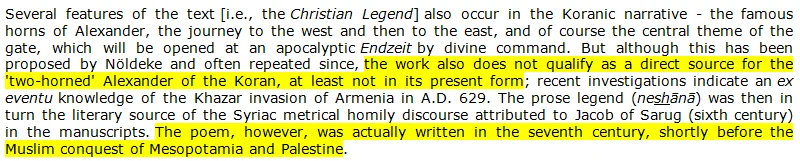
The vast majority of modern scholarship accepts a dating of c. 630 CE for the Syriac Legend of Alexander. Even Van Bladel, known for his view that the Qurʾānic account of Ḏū al-Qarnayn (Qurʾān 18:83–102) is a retelling of the Syriac Legend, aligns with the consensus of scholars on this matter.5 However, the fact remains that the Legend provides only the date 628 CE as the terminus a quo (the starting point or earliest limit in time) and does not specify a date to establish the terminus ad quem (the final limiting point in time). The German Orientalist Stephen Gero states:6
English Egyptologist, Orientalist, and philologist Sir Ernest Alfred Thompson Wallis Budge brought the Syriac Legend to light in 1889. In his book titled The History of Alexander the Great, Being the Syriac Version of Pseudo-Callisthenes, Budge provided a critical edition of the Legend with an accompanying English translation, based on five existing manuscripts, the earliest of which—as we shall shortly see—does not predate the eighteenth century.
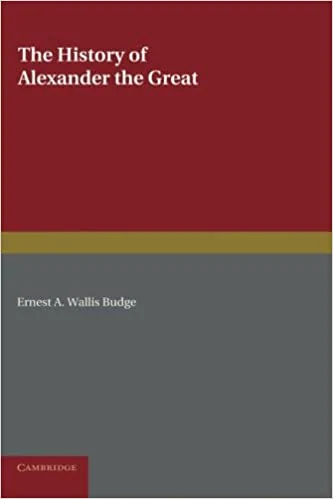
Budge also authored The Life and Exploits of Alexander the Great—a biography of the renowned leader translated from ancient manuscripts.

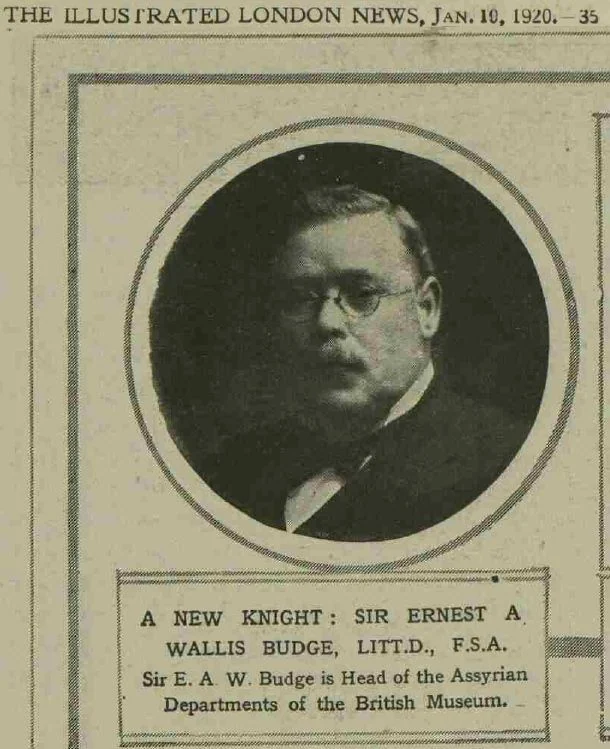
Budge was awarded the Most Excellent Order of the British Empire, a British order of knighthood, in 1920 for his distinguished contributions to Egyptology and the British Museum. He also served as the head of the Assyrian departments at the British Museum.
Budge was of the opinion that the Syriac Alexander Romance was not translated directly from Greek but rather through an intermediary Arabic translation. He argued that the strongest evidence for this is found in the Syriac forms of Greek proper names, which indicate that the Syriac translation was derived from an Arabic version of the Greek original.7


Budge concluded that the Syriac version was produced from an Arabic translation of a Greek original by a Christian priest sometime between the seventh and ninth centuries.8

Budge had long maintained that the Christian Legend was reworked and laden with additions, and that it was unlikely to be the work of Jacob of Serugh.9

Like Budge, Professor William Wright, in his 1887 article on Syriac literature published in volume XXII of the Encyclopaedia Britannica, argued—based on the spelling of proper names and vocabulary—that the Syriac version of Pseudo-Callisthenes was derived from an Arabic translation of a Greek original, dating the work considerably later than Budge did, specifically to the tenth century.10 Hence, the earliest date of the Syriac Alexander Legend is 628 CE, making it far more likely to have been influenced by the Qurʾān rather than vice versa.
Moreover, the proponents of the claim that the Qurʾānic account of Ḏū al-Qarnayn was copied from the Syriac account of Alexander have overlooked a crucial detail. At the conclusion of the Syriac Legend, three kingdoms—the Greeks (Byzantines), the Persians (Sassanids), and the Arabs—are mentioned as being in conjunction. The Legend states: “And when the Huns have gone forth, as God has commanded, the kingdoms of the Huns and the Persians and the Arabs, the twenty-four kingdoms that are written in this book, shall come from the ends of the heavens and shall fall upon one another, and the earth shall melt through the blood and dung of men. Then the kingdom of the Greeks shall move itself…”11 Now, since the Legend explicitly mentions the existence of an Arab kingdom, it is plausible to date its terminus a quo between 629 and 636 CE, as historically there were no significant Arab kingdoms during Alexander’s reign. The Legend clearly reflects the context of its own time, portraying the contemporary kingdoms in relation to the prophecy of the Day of Judgment. Persians are contrasted with Sassanids, Greeks with Romans, something that the Legend explicitly mentions.12 Who, then, are the Arabs contrasted with? Considering the historical context, the only reasonable possibilities are either the first Islamic State established by Prophet Muḥammad (PBUH) himself or the Rāshidūn (Rightly Guided) Caliphate, as these represent the only plausible entities corresponding to the Arab kingdom of that era.13 Those who wish to argue that the story of Ḏū al-Qarnayn is borrowed from the Christian Legend must either contend that this passage is original and not an interpolation or demonstrate that the Arab kingdom described in the Legend does not correspond to either the first Islamic state established by the Prophet (PBUH) or the Rāshidūn Caliphate; however, both positions are untenable.14

Attempts have been made to associate the “Arab kingdom” mentioned in the Christian Legend with the Ghassanids; however, this attribution is far from conclusive and is unlikely given their weakness and subordination to the Romans. Although it is historically impossible to determine the exact origin of the Syriac Legend or its sources, scholars have definitively concluded that it emerged sometime after 628 C.E. Islamic sources clearly indicate that Chapter al-Kahf was revealed in Makkah between 613 and 622 C.E., most likely before 620 C.E., as the tradition from Ibn ʿAbbās shows no hostility from the polytheists of Makkah toward the Prophet (PBUH), and, as noted earlier, persecution peaked between 620 and 622 C.E. Furthermore, even if critics were to argue that the chapter was revealed in al-Madīnah, they would still need to prove that it was revealed after the Christian Legend was composed, which is historically impossible.
Oddly, those who claim that the story of Ḏū al-Qarnayn must have entered the Qurʾān after 630 CE, whether through textual insertion (i.e., interpolation: a later addition into the original text) or oral transmission, entirely overlook the issue of the text’s integrity and its manuscript tradition. They give lay readers the impression that the text has survived unchanged to the present day and that its manuscript tradition is extensive, whereas this is not the case. In reality, the Syriac Christian Legend does not exist independently in any manuscript form; rather, it appears as a lengthy appendix in the surviving manuscripts of the Syriac translation of the Alexander Romance attributed to Callisthenes. All five extant manuscripts date either to the 18th century—the earliest being from 1708 CE—or the 19th century, more than a thousand years after the document’s composition.15 This is not to suggest that the late manuscripts themselves are problematic; rather, if one wishes to advance a thesis regarding a text influencing another text, they must be reasonably certain of the text’s structure at its point of origin—in this case, between 630 and 636 CE. In its current state, scholars have no way of knowing how the text may have evolved between its inception and 1708 CE. This also renders dating its origin particularly challenging, as scholars must rely on the a priori assumption that the text remained entirely free from editing for over a thousand years. Consequently, it is easy to see why much of the discussion surrounding the Legend is necessarily speculative. By contrast, the earliest extant Qurʾānic codex that mentions Ḏū al-Qarnayn is the renowned Topkapi manuscript, dated to the late 1st century or early 2nd century AH (i.e., the early to mid-8th century CE).16 However, while this early Qurʾān manuscript is dated between 672 and 722 CE, it should be remembered that memorization was the primary means of preserving the Qurʾān in early Islam. Consequently, we can confidently assert that the Qurʾān reached its final form by 632 CE. This is further supported by some recently discovered manuscripts from pre-ʿUthmānic codices. These findings are fully consistent with the orthodox belief that the Qurʾān was collected by Abū Bakr between 632 and 634 CE. In conclusion, the manuscripts of the Syriac Alexander Legend currently in our possession are very late, and any attempt to draw definite conclusions about the text itself is, at best, speculative, relying on the a priori assumption that the text existed in its present form between 630 and 636 CE.
Furthermore, another fact that decisively refutes the entirely unfounded claim that the story of Ḏū al-Qarnayn entered the Qurʾān through the Alexander Romance is that historians who have studied the manuscripts report that the story of Gog and Magog is absent from the oldest Greek, Latin, Armenian, and Syriac versions of the Romance:17

If anything, this suggests that the Alexander Romance had in fact appropriated the story of Gog and Magog from the Qurʾān. On a related note, although Christianity did not even exist during Alexander’s lifetime (356–323 BCE), the Neṣḥānā dīleh d-ʼAleksandrōs (i.e., The Heroic Deeds of Alexander), one of the most significant Syriac adaptations of the Alexander Romance attributed to Pseudo-Callisthenes, “Christianized” Alexander by portraying him as a devout follower of Christ. Clearly, it is impossible for Alexander to have been a Christian, as he lived three centuries before the advent of Christianity and was an adherent of the ancient Greek polytheistic religion, commonly referred to as Hellenism. This belief system involved the worship of a hierarchy of deities, with Zeus as the king of the gods, and Alexander even claimed to be the son of Zeus.
Taha Soomro—who completed his Bachelor of Arts in 2020 at the University of Sydney, majoring in Biblical Studies and Classical Hebrew, and whose research interests include Qurʾānic intertextuality and the Syriac language—demonstrates in his essay entitled “Did the Qurʾān Borrow from the Syriac Legend of Alexander?” that the Syriac Alexander Legend cannot be regarded as the source for the Qurʾānic narrative about Ḏū al-Qarnayn. Soomro intended his essay primarily as a response to Kevin van Bladel’s paper, “The Alexander Legend in the Qurʾān 18:83–102,” published in Gabriel Said Reynolds’ The Qurʾān in Its Historical Context, wherein van Bladel advanced the thesis that the story of Dū al-Qarnayn essentially depends on the Neṣḥānā d-Aleksandrūs, commonly referred to as the Syriac Alexander Legend in contemporary scholarship.18 In the opening section of his essay, Soomro analyzes the differences between the two texts precisely at the points where Van Bladel has posited similarities.19 Soomro also explored tangential issues pertaining to the Legend, such as the precise geography of Alexander’s travels. He then devoted a subsection to examining certain linguistic similarities noted by Van Bladel between the two texts. After thorough investigation, Soomro concluded that, while some relationship between the texts does exist, Van Bladel consistently overextends his comparisons and frequently misreads the source materials in his attempt to identify points of commonality between the Qurʾān and the Legend. This, in turn, exaggerates the apparent strength of his thesis that the Qurʾānic account is essentially derived from the Neṣḥānā d-Aleksandrūs. The following are examples of Van Bladel’s purported “exact” concordances between the Ḏū al-Qarnayn narrative and the Syriac Alexander Legend that Soomro examined more closely, finding differences not only in specific details but also at a broader structural level. Soomro began his comparative analysis by highlighting the differences concerning what Van Bladel considered the first precise correspondence between the two narratives, namely the respective protagonists’ journeys to the “fetid waters.”20
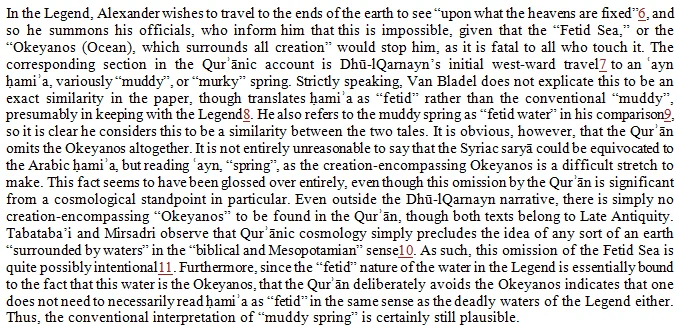
Soomro further explained that the cosmological differences are substantially more profound.21
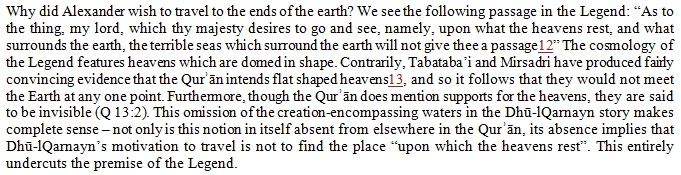
Soomro subsequently underscored that the Qurʾān diverges from the Legend concerning the directional sequence of the journeys undertaken by Alexander and Ḏū al-Qarnayn:22
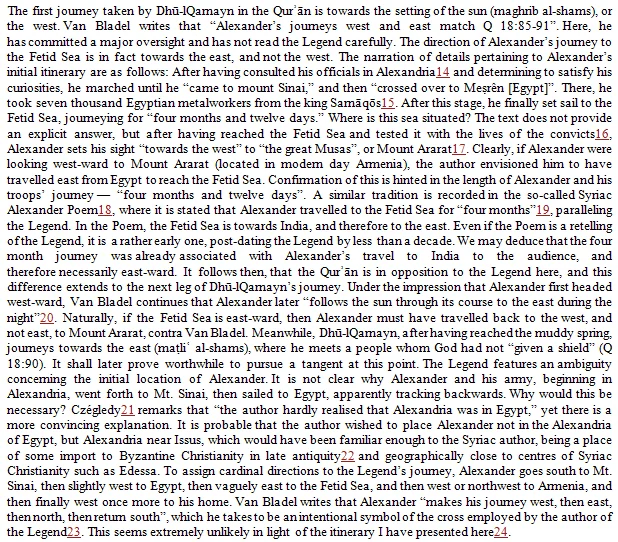
Soomro next identified several salient differences regarding the respective motives of Alexander and Ḏū al-Qarnayn in their interactions with the inhabitants of the land:23
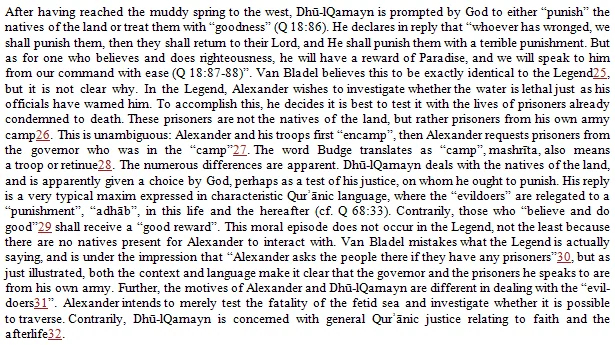
Additionally, Soomro underscored significant shortcomings in Van Bladel’s interpretation of the Syriac text, particularly concerning what he regarded as a pivotal parallel between the journeys of the protagonists in the Ḏū al-Qarnayn narrative and the Alexander Legend through the so-called “heavenly cords.”24
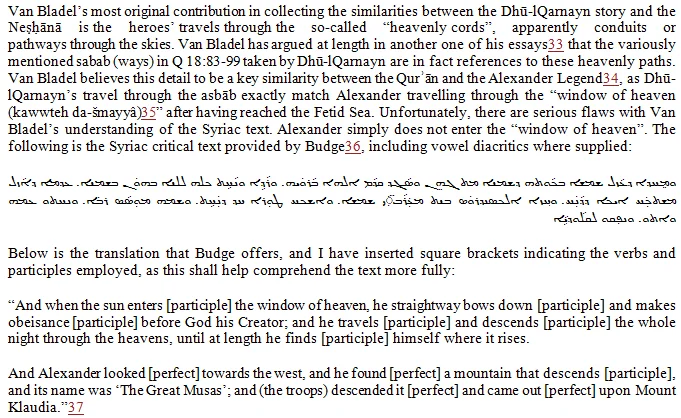
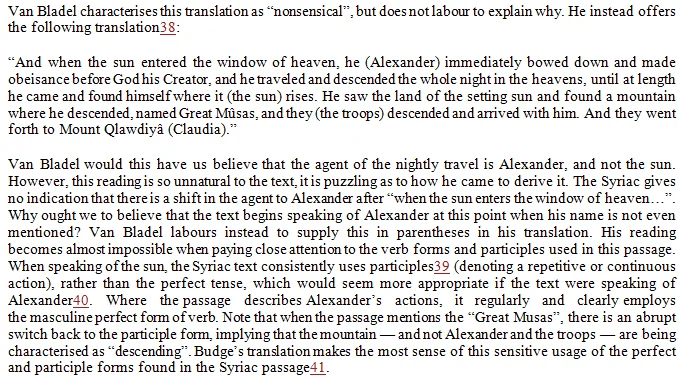
Soomro contended that this should suffice to negate any claim of precise similarity between the Legend and the Ḏū al-Qarnayn narrative regarding the manner in which the two figures travelled, rendering a detailed engagement with Van Bladel’s assertion that the Qurʾānic account refers to “heavenly cords” unnecessary. Nevertheless, he observed that a few remarks may still be offered:25
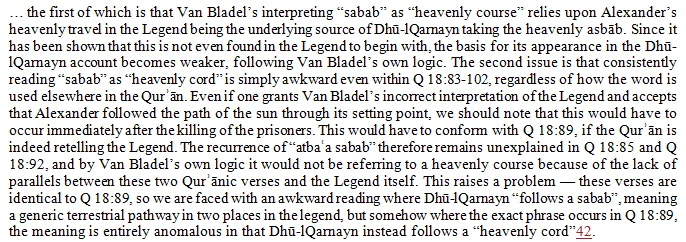
Moreover, Soomro thoroughly addressed the numerous discrepancies between the Qurʾānic account and the Legend in their respective episodes concerning the “burning sun” and the “sun-stricken natives”:26

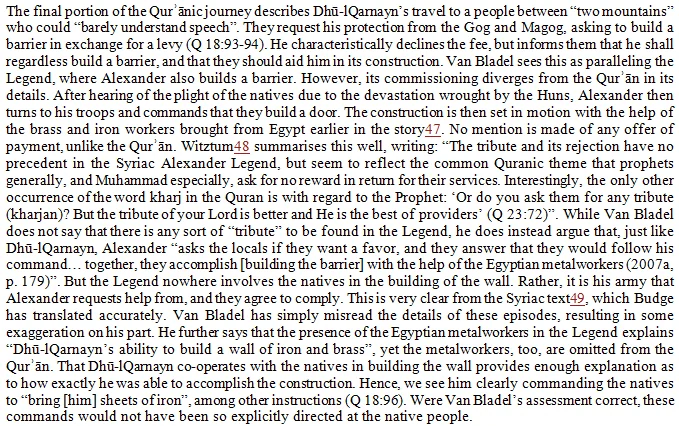
Soomro remarked that Van Bladel misinterpreted the details of the episodes concerning “the Mountain People”:27

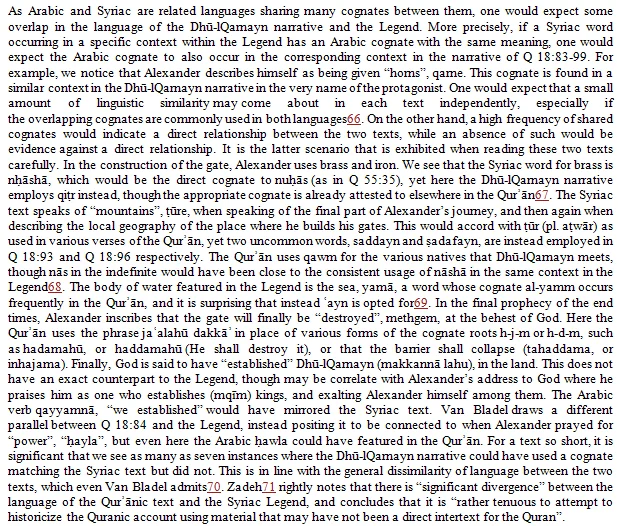
Furthermore, Soomro demonstrated that Van Bladel’s argument for a linguistic similarity between the two texts is unfounded, as the examples he offered are fundamentally flawed. Contrary to Van Bladel’s claim, Soomro contended that the Arabic of the Ḏū al-Qarnayn narrative is wholly exclusive to it, containing no single lexical item borrowed from the Syriac of the Legend. He further maintained that there is, in fact, a marked linguistic dissimilarity, which allows for a substantive argument against any direct dependence of the Qurʾān on the Neṣḥānā.28
Van Bladel and those who concur with his position have entirely overlooked the considerable number of differences between the two texts. Finally, Soomro observed that numerous additional points of divergence could be identified through any careful, parallel reading of the texts.
In summary, substantial evidence challenges the thesis that the Qurʾān’s account of Ḏū al-Qarnayn is essentially a retelling of the Syriac Alexander Legend. First, the Syriac account and the Qurʾānic narrative diverge in numerous instances, including specific events, descriptions, and expressions that critics have claimed as parallels. Second, the linguistic evidence further undermines the notion that the Qurʾān drew upon the Syriac text. Finally, the relative dating of the two works is decisive and strongly argues against any direct borrowing from the Legend. As discussed above, all indications point to Chapter al-Kahf having been revealed in Makkah (i.e., before 622 C.E.), whereas it is widely acknowledged that the Christian Legend was composed between 630 and 636 C.E., based on pre-existing oral and possibly written sources. Consequently, the possibility that the Qurʾānic account of Ḏū al-Qarnayn spread from Arabia shortly after its revelation and reached Syria or Mesopotamia—where the Legend is generally believed to have been compiled—cannot be historically ruled out, particularly given that the composer of the Christian Legend relied on oral traditions in its composition. Brannon M. Wheeler, Professor of the History of Religion, the Middle East, and the Bible at the United States Naval Academy in Annapolis, conducted a significant study on the alleged sources of Qurʾān 18:60–82 and 83–102, which encompass the accounts of Moses and al-Khiḍr as well as Ḏū al-Qarnayn. Wheeler states:29
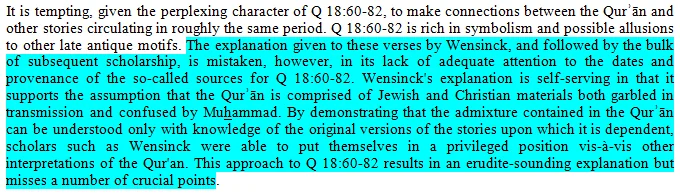
He further notes that:30
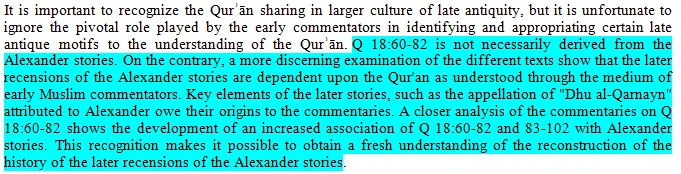
In conclusion, the Qurʾān constitutes the original and unaltered Word of Allah, free from external influence. Therefore, the claim that it contains any form of plagiarism is unfounded.
Notes and References
- 1
Abū Jaʿfar Muḥammad ibn Jarīr aṭ-Ṭabarī, Tafsīr Ibn Jarīr aṭ-Ṭabarī, (Bayrūt, Lebanon: Muʾassassat ar-Risālah, 2000); Abū Bakr Aḥmad ibn Ḥusayn al-Bayhaqī, Dalāʾil an-Nubuwwah, (Bayrūt, Lebanon: Dār al-Kutub al-ʿIlmiyyah, 1988); Jalāl ad-Dīn as-Suyūṭī, ad-Durr al-Manthūr fī at-Tafsīr bi-l-Maʾthūr, (Cairo, Egypt: Markaz al-Buḥūth wa-ad-Dirāsāt al-ʿArabīyyah wa-l-Islāmīyyah, 2003).
- 2
Theodor Nöldeke, “Beiträge Zur Geschichte Des Alexanderroman,” Denkschriften Der Kaiserlichen Akademie Der Wissenschaften, Philosophisch-Historische Classe, vol. 38, 1890, p. 31 as cited in “On the Sources of the Qur'anic Dhul-Qarnayn,” Islamic Awareness, last updated 5 March 2006, https://www.islamic-awareness.org/quran/sources/bbhorned.
- 3
Carl Hunnius, Das Syrische Alexanderlied, (Göttingen, Germany: Dieterischschen Universitäts-Buchdruckerei, 1904), pp. 21–24 as cited in “On the Sources of the Qur'anic Dhul-Qarnayn,” Islamic Awareness, last updated 5 March 2006, https://www.islamic-awareness.org/quran/sources/bbhorned.
- 4
Károly Czeglédy, “The Syriac Legend Concerning Alexander the Great,” Acta Orientalia Academiae Scientiarum Hungaricae, vol. 7, 1957, pp. 246–247 as cited in “On the Sources of the Qur'anic Dhul-Qarnayn,” Islamic Awareness, last updated 5 March 2006, https://www.islamic-awareness.org/quran/sources/bbhorned.
- 5
Kevin van Bladel, “The Alexander Legend in the Qur’an 18: 83–102” in Gabriel Said Reynold, The Qur'an in its Historical Context, (London, U.K.: Routledge, 2007), pp. 191–219.
- 6
Stephen Gero, “The Legend of Alexander the Great in the Christian Orient,” Bulletin of the John Rylands University Library of Manchester, vol. 75, issue 1, Mar. 1993, p. 7 as cited in “On the Sources of the Qur'anic Dhul-Qarnayn,” Islamic Awareness, last updated 5 March 2006, https://www.islamic-awareness.org/quran/sources/bbhorned.
- 7
Ernest A. Wallis Budge, The history of Alexander the Great: Being the Syriac Version of the Pseudo-Callisthenes, (London, U.K.: C. J. Clay and Sons Cambridge University Press, 1889), pp. lxi-lxii, available at: https://archive.org/details/BudgeSyriacAlexander/page/n66/mode/1up?view=theater.
- 8
Ibid., p. lxii.
- 9
Ibid., p. lxxvii.
- 10
Ibid., p. lx.
Professor Wright thought that Syriac was not the native language of the translator, and believed that he had only acquired it in the schools for the purpose of studying the Bible and the Syriac translations of Greek theological works; he believed that the Syriac version of Pseudo-Callisthenes was made from an Arabic translation of a Greek original, and placed the making of the work much later than I have done, namely in the tenth century.
- 11
Ibid, p. 155
- 12
Ibid.
“...and as brass which boils in the flame, so shall the power of the kingdoms melt away before the might of the kingdom of the Greeks which is that of the Romans.”
- 13
The Caliphate is so named after the first four leaders of the Islamic world, known as caliphs—which literally means “successors”—who succeeded Prophet Muḥammad (PBUH) following his death. This era is considered one of the most glorious periods in Islamic history. Prolonged warfare between the Byzantine and Sassanian Empires had significantly weakened both powers, enabling the expansion of Muslim territories.
- 14
Archerismybae, “Was the Qur’anic Dhul Qarnayn a Plagiarism of the Alexander Romances?” The Hejazi Philosophorian, 11 Dec. 2019, https://hejaziphilosophorian.home.blog/2019/12/11/was-the-quranic-dhul-qarnayn-a-plagiarism-of-the-alexander-romances/.
- 15
Juan Pedro Monferrer-Sala, “Alexander the Great in Syriac literary tradition,” Chapter 3 of Z. David Zuwiyya, A Companion to Alexander Literature in the Middle Ages, (Leiden, the Netherlands: Brill, 2011), p. 45. DOI: https://doi.org/10.1163/ej.9789004183452.i-410.24.
- 16
“The “Qur'ān of ʿUthmān” at the Topkapi Museum, Istanbul, Turkey From 1st / 2nd Century Hijra,” Islamic Awareness, last updated 31 Jul. 2008, https://www.islamic-awareness.org/quran/text/mss/topkapi.
- 17
Emeri J. Van Donzel and Andrea Barbara Schmidt, Gog and Magog in Early Eastern Christian and Islamic Sources: Sallam’s Quest for Alexander’s Wall, Chapter 2: “Alexander and Gog and Magog in Eastern Christian Sources,” (Leiden, the Netherlands: Brill, 2010), p. 17. DOI: https://doi.org/10.1163/ej.9789004174160.i-280.13.
- 18
Kevin van Bladel, “The Alexander Legend in the Qur’an 18: 83–102” in Gabriel Said Reynold, The Qur'an in its Historical Context, (London, U.K.: Routledge, 2007), pp. 191–219.
- 19
Soomro primarily focused on differences within sections that Van Bladel had posited as similar. Many other obvious discrepancies, which Van Bladel did not address, remain overlooked, though a cursory side-by-side reading of the texts readily reveals them.
- 20
Taha Soomro, “Did the Qurʾān Borrow from the Syriac Legend of Alexander?” Pondering Islam, 15 Feb. 2020, https://ponderingislam.com/2020/02/15/did-the-qur%CA%BEan-borrow-from-the-syriac-legend-of-alexander/comment-page-2/.
- 21
Ibid.
- 22
Ibid.
- 23
Ibid.
- 24
Ibid.
- 25
Ibid.
- 26
Ibid.
- 27
Ibid.
- 28
Ibid.
- 29
Brannon M. Wheeler, “Moses or Alexander? Early Islamic Exegesis of Qurʾān 18:60–65,” Journal of Near Eastern Studies, vol. 57, no. 3, 1 Jul. 1998, p. 214. DOI: https://doi.org/10.1086/468638.
- 30
Ibid.