Could it be that the universe has always existed through an infinite series of material or physical causes, thereby eliminating the need for a first cause to set it in motion?
The Kalām Cosmological Argument was originally formulated by Abū Ḥāmid al-Ġazālī, one of the most prominent medieval advocates of the doctrine of creation and a 12th-century Muslim theologian from Persia (modern-day Iran).1 Al-Ġazālī was concerned that the Muslim philosophers of his time were being swayed by ancient Greek thinkers such as Plato and Aristotle, who maintained that the universe flows necessarily from God and is thus without a beginning. After deeply engaging with their teachings, he composed a powerful critique of their views. In his remarkable book The Incoherence of the Philosophers, he argued that the universe must have a beginning, and since nothing begins to exist without a cause, it follows that the universe must have a transcendent creator. He expressed his argument in straightforward terms, stating, “Every being which begins has a cause for its beginning. Now the world is a being which begins. Therefore, it possesses a cause for its beginning.”2 Al-Ġazālī’s marvelously simple and logically airtight argument can be summarized in three steps: (1) Whatever begins to exist has a cause. (2) The universe began to exist. (3) Therefore, the universe has a cause. The first premise of this cosmological argument—whatever begins to exist has a cause—is indisputable, for something cannot simply pop into being uncaused. The principle of causality—that effects are always produced by causes—is the foundation of the scientific endeavor. This principle is so self-evident that it is virtually undeniable for any sincere seeker of truth, because for something to begin to exist without any cause whatsoever would mean it came into being from nothing, which is surely impossible. One might not expect atheists to challenge the premise that whatever begins to exist has a cause, yet they often do so in an attempt to escape the conclusion of the argument. They sometimes claim that physics theorizes subatomic particles can come into being out of nothing. However, such theories refer to particles originating as fluctuations within a vacuum, which is actually a sea of fluctuating energy governed by physical laws. But when we speak of the origin of the universe, we are asking about the source not only of matter but also of the very physical laws that govern the material world. William Lane Craig offers three reasons in support of the first premise of al-Ġazālī’s argument.3
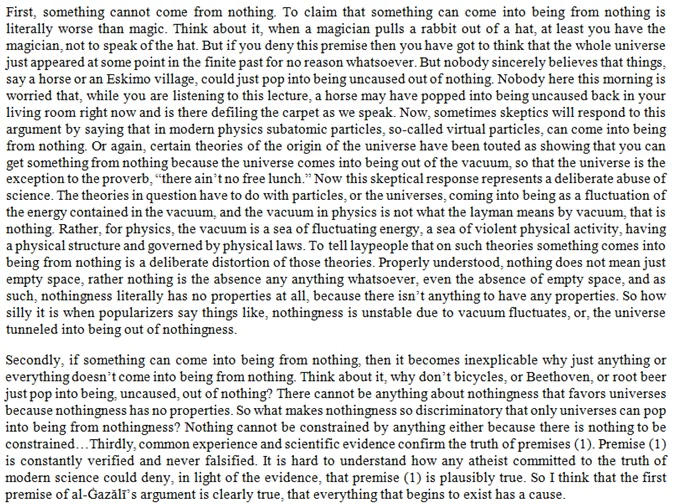
Attacking the first premise of the cosmological argument—that whatever begins to exist has a cause—reveals that atheists are often more interested in finding an academic refutation or exploiting loopholes than in sincerely seeking the truth.
Moreover, atheists who lack philosophical sophistication often target the second premise of the cosmological argument—that the universe had a beginning—by proposing an infinite regress of causes in an attempt to deny the existence of an uncreated being. In other words, they claim that the universe is eternal and has always existed in an endless series of causes, without the need for a first cause to initiate it. However, this leads to the problem of infinite regress. Simply put, an infinite sequence of contingent, temporal, and created causes is vicious and metaphysically impossible. During the Middle Ages, long before modern science offered any empirical evidence for the beginning of the universe, al-Ġazālī put forward several ingenious philosophical arguments to demonstrate that the past must be finite. He explained that if the universe never began to exist, then the number of past events in its history would be infinite—something that is impossible because an actually infinite number of things cannot exist. To illustrate the absurdity of this idea, al-Ġazālī imagined what it would mean if such an infinite collection could exist and then drew out the absurd consequences. One of his thought experiments was based on the movements of the planets around the Sun.4

The point of this example is the same as that demonstrated by the famous paradox of the Grand Hotel—the brainchild of the great German mathematician David Hilbert—which is to show that an actual infinite regression cannot exist in the real world because it would have to be both complete and incomplete at the same time. When William Craig shared Hilbert’s Grand Hotel paradox, he remarked that it is one of his favorite illustrations and described David Hilbert as a brilliant thinker who knew exactly how to highlight the bizarre consequences of an actually infinite number of things.5

Craig further stated:6

Here is another example of the kind of logical contradictions necessarily implied by treating infinity as an actual, quantifiable number:7

In short, there are various philosophical arguments establishing that an infinite regress is impossible. Essentially, if the universe were infinite in the past, there would have to be an infinite number of past events leading up to the present; however, if an actual infinite were possible, it would entail various logical absurdities. Infinite regressions are, in reality, imaginary numbers rather than natural ones—they can be represented abstractly in mathematical formulas, but they do not correspond to the concrete reality of contingent beings. Mathematicians affirm that an actual infinite regress cannot exist in the real world because it would have to be both complete and incomplete at the same time. A well-known illustration of this is the idea of a never-beginning and never-ending sequence of falling dominoes: by definition, it must have already completed its course, yet in reality, it remains unfinished because we can always imagine adding another domino to the series. This contradiction demonstrates that such a sequence cannot truly exist. The implication is clear—if an actually infinite number of things is impossible, then the number of past events in the universe must be finite, which means that the past is finite and the universe must have had a beginning. In other words, if there were an infinite number of preceding events or causes, we could never arrive at the present moment. There must, therefore, be a ‘first cause’ or ‘prime mover.’ A classic example used to illustrate the problem of infinite regress is that of a soldier waiting for the command to fire. Imagine a soldier at the front line asking the one behind him for permission to fire; that soldier then asks the one behind him, and so on. Unless there is a soldier who initiates the command—who acts as the ‘first cause’—the front-line soldier would never be able to fire. This analogy applies to the beginning of the universe: if there were an infinite chain of preceding events before the Big Bang, the Big Bang itself would never have occurred. Only positing God ultimately resolves the problem of infinite regress. Indeed, the claim that the universe is eternal runs counter to our entire human experience, which is grounded in the undeniable reality of discrete cause and effect. It is also important to note that there is no scientific proof whatsoever for the existence of an infinite regress of events in the universe. In addition to the philosophical arguments supporting the universe’s beginning, modern science has now produced one of its most astonishing developments: compelling empirical evidence that the universe began to exist. The standard Big Bang model predicts an absolute beginning to the universe, serving as a remarkable scientific confirmation of the second premise of al-Ġazālī’s cosmological argument. A growing body of scientific evidence continues to point decisively toward the past being finite.8

As William Craig explains, the evidence from observational astronomy shows that the entire universe is expanding, meaning that the distance between galaxies is steadily increasing over time. The startling implication of this is that if we trace this expansion backward in time, the universe becomes increasingly denser until it ultimately collapses to a single point—beyond which it literally did not exist. This initial event, marking the beginning of the universe’s history, has come to be known as the Big Bang.9 The Big Bang is particularly striking because it represents the origin of the universe from literally nothing, as all matter and energy—and even physical space and time themselves—came into existence at the moment of the Big Bang. As the British physicist P. C. W. Davies explains:10

Scientific evidence now convincingly shows that our universe began to exist approximately 13.8 billion years ago. The standard Big Bang model, therefore, predicts an absolute beginning of the universe and offers remarkable scientific confirmation of the second premise of al-Ġazālī’s cosmological argument. Throughout the twentieth century, repeated attempts to avoid the conclusion of a cosmic beginning—as predicted by the standard Big Bang model—have failed one after another. This continuous series of unsuccessful theories only reinforces the model’s prediction that the universe had a beginning, a conclusion that has endured for over 80 years amid extraordinary advancements in observational astronomy and in creative theoretical astrophysics. Undoubtedly, new theories will continue to be proposed in efforts to avoid an absolute beginning of the universe; however, while such proposals are to be welcomed in the spirit of scientific inquiry, there is no reason to expect that they will succeed where previous attempts have failed. Consequently, given the compelling evidence for a cosmic beginning, atheists can no longer take refuge in the possibility of a past-eternal universe. On a final note, even if, for the sake of argument, one were to accept the idea of an infinite regress—despite the absence of both scientific and intuitive support—this still would not eliminate the need for a cause beyond time and space to bring it into being and sustain it. An infinite series governed by a recursive principle, where each element depends on the preceding one, still requires a sufficient reason for the series as a whole. In other words, there must be a first element from which all others arise, but which itself is not produced in the same way. Therefore, based on the rational impossibility of an infinite past or an infinite regress of possible causes, and on the rational necessity of the principle of causality, the very concept of reality ultimately terminates in an entity whose existence is metaphysically necessary and absolute, independent and self-sufficient, and transcendent above any temporal nexus of past, present, or future.11
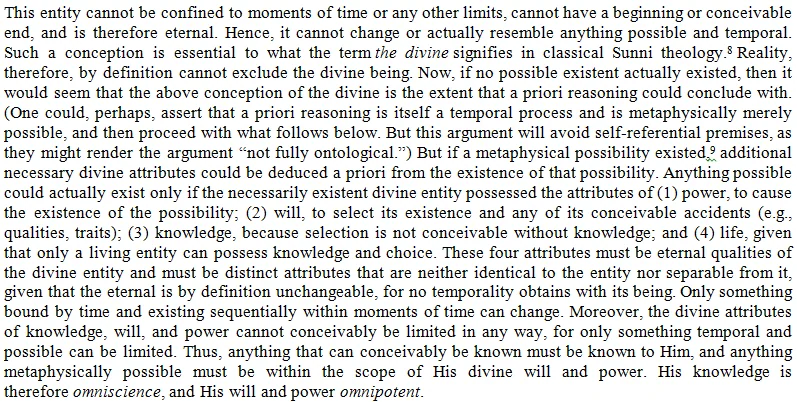
As such, Allāh’s entity must necessarily be one and unique, without any duality or partnership in His divinity.12
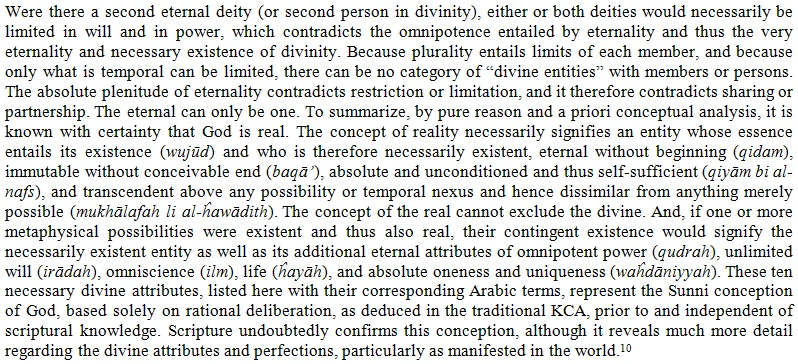
Furthermore, atheists often object by saying: “If a cause is sufficient to produce its effect, then once the cause exists, the effect must exist as well. Now, the cause of the universe never began to exist, since it is timeless, so why is the universe not beginningless as well? Why did the universe come into being only about 13 billion years ago? Why is it not as beginningless as its cause?” Al-Ġazālī maintained that the only solution to this problem—how a timeless cause can give rise to a temporal effect with a beginning, such as the universe—is that the cause must be a personal being who possesses freedom of will. His act of creating the universe is a free exercise of will, independent of any prior conditions, and can therefore be spontaneous and novel.13 That is, Allāh, the first uncaused cause, existed eternally, but a finite time ago freely willed to create a new effect and brought the universe into being. This thus leads us not merely to a transcendent cause of the universe, but to its personal Creator.
In a nutshell, Allāh is the only plausible explanation for the creation of the universe. A beginningless universe, in which every event is preceded by another going back endlessly into the infinite past with no stopping point—or rather, no starting point—is inconceivable. There had to be a beginning at some point in the past in order for anything to have ever begun at all. Thus, theism resolves the problem of infinite regress in the simplest and most efficient way possible: by affirming that God is the root cause of everything. Since the two premises of the Kalām Cosmological Argument are true—namely, that whatever begins to exist has a cause, and that the universe began to exist—the conclusion necessarily and inescapably follows that the universe has a cause for its existence. As for the attributes that the first uncaused cause must possess, being the creator of time, space, and matter itself, this cause must transcend both time and space. In other words, it must be transtemporal, spaceless, and immaterial—an apt description of what most people intuitively think of when they think of God. Indeed, long before modern astronomy uncovered powerful evidence for a cosmic beginning, the divinely revealed Scriptures had already declared for thousands of years that Allāh is the Creator of all things. As the late agnostic astronomer Robert Jastrow remarked:14

Again, as we have elaborated, the claim of an eternal universe or an infinite regression of events leads to a number of absurd propositions such as those mentioned above, which is why al-Ġazālī stated elsewhere: “In the world there are events with causes. If these events depend upon other events without end, this is impossible and cannot be believed by a rational person.”15 The cosmological argument definitively concludes that the uncreated Creator must exist. Therefore, Muslims—and all who affirm the doctrine of creation—have solid grounds, both philosophical and scientific, for believing in the existence of a beginningless, uncaused, timeless, spaceless, changeless, immaterial, enormously powerful, personal Creator who created the universe a finite time ago out of nothing. In short, the cosmological argument stands firm, and atheism is philosophically bankrupt.
Notes and References
- 1
The word Kalām is an Arabic term that refers to medieval Islamic theology.
- 2
Abū Ḥāmid al-Ġazālī, Kitāb al-ʾIqtiṣād fī al-Iʿtiqad, (Bayrūt, Lebanon: Dār al-Kutub al-ʿIlmiyyah, 1983), p. 19.
- 3
William Lane Craig, “How Did the Universe Begin?” YouTube, uploaded by ReasonableFaithOrg, 25 Apr. 2012, https://youtu.be/joaRwEk2V10?feature=shared, [48:12–54:03].
- 4
Abu Amina Elias, “If Allāh Created Everything, Who Created Allah?” Faith in Allah, 24 Oct. 2019, https://www.abuaminaelias.com/who-created-allah-the-creator/.
- 5
William Lane Craig, “How Did the Universe Begin?” YouTube, uploaded by ReasonableFaithOrg, 25 Apr. 2012, https://www.youtube.com/watch?v=joaRwEk2V10, [33:58–37:47].
- 6
Ibid., [37:48–38:30].
- 7
Jonathan McLatchie, “A Beginner’s Guide to the Kalam Cosmological Argument,” Solas, 23 March 2020, https://www.solas-cpc.org/a-beginners-guide-to-the-kalam-cosmological-argument/.
- 8
Jonathan McLatchie, “A Beginner’s Guide to the Kalam Cosmological Argument,” Solas, 23 March 2020, https://www.solas-cpc.org/a-beginners-guide-to-the-kalam-cosmological-argument/.
- 9
William Lane Craig, “How Did the Universe Begin?” YouTube, uploaded by ReasonableFaithOrg, 25 Apr. 2012, https://youtu.be/joaRwEk2V10?feature=shared, [40:16].
- 10
“In the Beginning: In Conversation with Paul Davies and Philip Adams,” The Big Questions, 17 Jan. 2002, https://www.abc.net.au/science/bigquestions/s460625.htm.
- 11
Faraz Khan, “Everything Other Than God Is Unreal,” IslamiCity, 25 March, 2021, https://www.islamicity.org/77175/everything-other-than-god-is-unreal/.
- 12
Ibid.
- 13
William Lane Craig, “How Did the Universe Begin?” YouTube, uploaded by ReasonableFaithOrg, 25 Apr. 2012, https://youtu.be/joaRwEk2V10?feature=shared, [1:00:02].
- 14
Robert Jastrow, God and the Astronomers, (New York, U.S.: W. W. Norton &, Company, 1978), p. 116.
- 15
Abū Ḥāmid al-Ġazālī, Tahāfut al-Falāsifah (The Incoherence of the Philosophers), (Bayrūt, Lebanon: Dār al-Kutub al-ʿIlmiyyah, 1971), p. 62.