How did experimental science begin? Are science and religion fundamentally in conflict?
Atheists claim that science and faith are fundamentally incompatible, and that the relationship between science and religion has historically been one of conflict and hostility. In reality, however, science was founded on the pursuit of God—that is, science owes its very existence to humanity’s desire to know God more deeply. The key question underlying scientific inquiry has always been: “Why is the universe orderly?” For many of the physicists, cosmologists, and biologists who laid the foundations of modern science, the answer was clear—there exists a loving, rational, all-powerful Creator of all things, Who constantly reveals Himself to humankind and upholds the universe by His infinite power. In other words, the founders of science envisioned a universe governed by laws that reflected the rationality and majesty of the orderly God Who created it to function lawfully. These scientists explored God’s world because they believed they could come to know God more fully by understanding His creation, and they viewed the universe as another of God’s Books, filled with His Signs, just like the Scriptures. In short, the scientific method rests on a single assumption: that the universe follows a set of physical laws, and those laws can be discovered through careful observation of how the universe behaves. It is important to recognize that the very concept of physical law is, at its root, a theological idea—a fact that many scientists find uncomfortable. As a result, the so-called “conflict thesis” between science and religion is widely rejected as a myth by historians of science today. For example, Peter Harrison, a Research Professor at the University of Queensland and a Senior Research Fellow at the Ian Ramsay Centre in Oxford, where for a number of years he was the Idreos Professor of Science and Religion, summarizes: “those who argue for the incompatibility of science and religion will draw little comfort from history. What historical record also suggests is that insofar as modern science posits natural laws and presupposes the constancy of nature, it invokes an implicit theology… the myth of a perennial conflict between science and religion is one to which no historian of science would subscribe.”1Even Peter Atkins, a Fellow of Lincoln College at the University of Oxford and a former Professor of Chemistry, and a well-known atheist who has written and spoken extensively on humanism, atheism, and the perceived conflicts between science and religion, said: “Science, the system of belief founded securely on publicly shared reproducible knowledge, emerged from religion.”2 In the same vein, Harold Nebelsick said: “the main motivating force behind the pursuit of natural knowledge from the time of Babylon and Greece in the East to the time of the Renaissance in the West was theological rather than scientific.”3 The point is that most of the founding figures of science—both men and women—were not atheists, but people of faith. Throughout history, religion has produced many lay scientists who established the foundational principles of experimental science and made numerous significant contributions to its development. In fact, the majority of scientific and technical innovations prior to the scientific revolution emerged from societies shaped by religious traditions. In his paper, Rev. Dr. Mark Worthing—lecturer at Flinders University and the University of Divinity, and a fellow of the Institute for the Study of Christianity in an Age of Science and Technology (ISCAST), the oldest and largest science and religion organization in Australia—highlights the early and crucial role that Medieval and Renaissance Catholicism, Protestantism, and English Protestant Puritanism played in the rise of modern science.4 However, this account of the religious contribution to the origins of natural science, as Dr. Mark Worthing explains, remains quite limited, as the picture becomes far more complex when we examine more fundamentally what science is and the philosophical and methodological presuppositions at its core. Worthing argues that while there are different perspectives on which cultural and theological context gave rise to science, it is monotheism more broadly that stands out as the key explanatory factor. This will be explored in greater detail later.
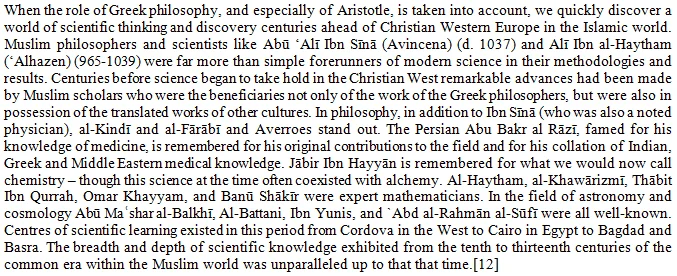
It is an incontestable fact that medieval Muslim scientists played a vital role in laying the foundations of modern science. Will Durant, one of the most well-known writers of popular philosophy and history, affirmed that Muslim scientists helped in laying the foundations for experimental science through their contributions to the scientific method and their empirical, experimental, and quantitative approach to scientific inquiry.5 Muslim scholars who worked in Bayt al-Ḥikmah (the House of Wisdom)6 laid the foundation for many modern sciences.7 For example, Abū Yūsuf Yaʿqūb ibn Isḥāq al-Kindī (801–873 AD) demonstrated a scientific outlook that marks him as one of the most remarkable scholars of the Middle Ages. His experimental approach to scientific problems positions him as a forerunner of the scientific revolution that would emerge centuries later. Gerolamo Cardano, one of the most influential mathematicians of the Renaissance, regarded him as one of the greatest minds.8 Indeed, al-Kindī is one of those rare figures in the history of science who, even before the sixteenth century, appeared to have initiated a shift in intellectual inquiry toward a scientific revolution. In addition, Muḥammad ibn Mūsá al-Khwārizmī (780–850 AD) founded algebra. Solomon Gandz, a historian of science, described al-Khwārizmī as the “father of algebra” and regarded his work as the foundation and cornerstone of the sciences.9 Moreover, the Banū Mūsá brothers—Muḥammad, Aḥmad, and al-Ḥasan, sons of Mūsá ibn Shākir al-Munajjim and scholars from ninth-century Baġdād—invented hundreds of devices, many of which laid the foundations for modern mechanics.10 Furthermore, Jābir ibn Ḥayyān—born in 101 A.H. (721 AD), during the final years of the era of the Ṣaḥābah11—laid the foundations for modern and contemporary scientific chemistry. Max Meyerhof, the prominent German historian, maintained that the development of chemistry in Europe can be traced directly back to Jābir ibn Ḥayyān: “His influence may be traced throughout the whole historic course of European alchemy and chemistry.”12 The strongest evidence for this is that many of the terms coined by Ibn Ḥayyān are still in use across various European languages. Eric John Holmyard, the noted historian of chemistry, rightfully referred to Ibn Ḥayyān as “The Father of Chemistry.” In his work Makers of Chemistry, where he traces the development of chemistry from its earliest origins to modern times, Holmyard stated that Islamic chemistry is, in fact, the foundation of modern chemistry. Jābir ibn Ḥayyān is credited with introducing experimental methodology into alchemy—the forerunner of modern chemistry—which influenced the discovery of numerous scientific concepts and experimental practices that laid the groundwork for empirical science. Ibn Ḥayyān recognized and emphasized the importance of experimentation, which distinguishes the scientific approach practiced by Muslims from the speculative tradition of the Ancient Greeks. He stressed the value of experimentation in the following words: “The first essential in chemistry is that you should perform practical work and conduct experiments, for he who performs not practical work nor makes experiments will never attain the least degree of mastery. But you, O my son, do experiments so that you may acquire knowledge. Scientists delight not in abundance of material; they rejoice only in the excellence of their experimental methods.’’13 Professor Berthelot, a well-known French chemist who was deeply influenced by Jābir ibn Ḥayyān, said: “Jābir thus becomes in chemistry what Aristotle was for logic.”14 Francis Bacon, one of the leading figures in natural philosophy and scientific methodology during the transitional period from the Renaissance to the early modern era, regarded Jābir ibn Ḥayyān as the first to teach the science of chemistry to the world, recognizing him as the father of chemistry. Ibn Ḥayyān is credited with the invention of several chemical processes still used in modern chemistry, including crystallization, calcination, sublimation, and evaporation, as well as the synthesis of acids and distillation using his most renowned invention, al-inbīq (the alembic). His other accomplishments included the preparation of various metals, the development of steel, dyeing of cloth and tanning of leather, varnishing of waterproof fabric, the use of manganese dioxide in glass-making, the prevention of rusting, and the identification of paints and greases. He also developed aqua regia to dissolve gold.15 Ibn Ḥayyān discovered various acids, including hydrochloric acid, nitric acid, sulphuric acid, and even distilled vinegar to produce acetic acid. After these discoveries, his primary concern became the neutralization of acids, leading him to work on and identify alkalis. Through continuous experimentation, he also developed vessels and numerous laboratory instruments, such as water baths, furnaces, and distillation systems, which significantly advanced scientific practice. In short, Jābir ibn Ḥayyān’s contributions to science are extraordinarily remarkable. His treatises on alchemy were translated into Latin and several other European languages, becoming standard references for European alchemists. As noted earlier, many technical terms introduced by him—such as alkali—entered various European languages and became part of the scientific lexicon. It is important to note that Ibn Ḥayyān was raised with Islamic values. He studied the Qurʾān and mathematics under Ḥarbī al-Ḥimyarī, an Arab scholar from Yemen who lived between the 7th and 8th centuries C.E.,16 and later studied under the guidance of Jaʿfar aṣ-Ṣādiq—an 8th-century Muslim scholar, jurist, and theologian. Ibn Ḥayyān was deeply religious and repeatedly stressed in his works that alchemy could only be practiced by completely submitting to the will of Allāh and becoming a true instrument of His will on Earth, as the manipulation of reality is ultimately possible only for Allāh. Inspired by his Islamic values, he pursued research and the acquisition of knowledge, as Islam encourages reflection upon nature. Thus, it can rightly be said that modern science owes much of its development to ninth-century Baġdād.17 The Rev. Dr. Mark Worthing—a Lutheran pastor and theologian with doctorates in both theology and the history and philosophy of science—argued that science began its rise within Islamic thought:18
Dr. Worthing further stated:19
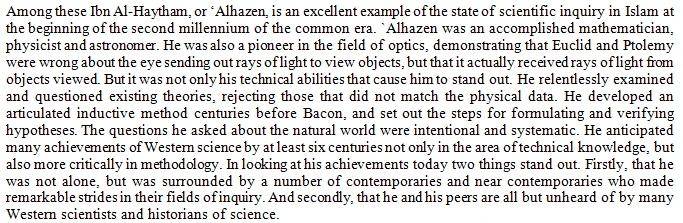
Dr. Worthing further observed:20

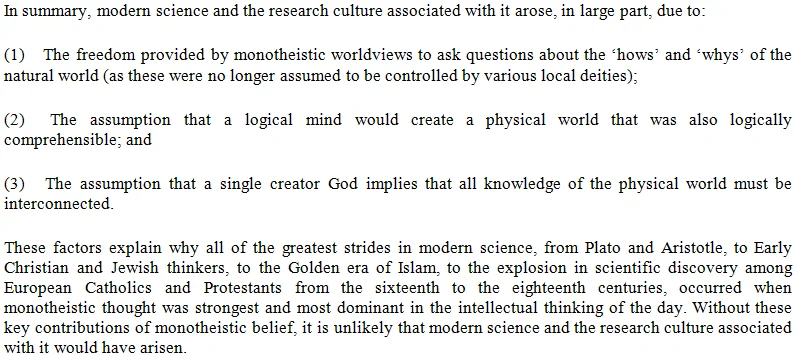
Hence, contrary to what is often assumed in today’s intellectual climate—namely, that science and research stand in opposition to faith, and that religion has hindered the development of modern science—the reality is that the greatest periods of scientific growth have been closely linked to eras, regions, and individuals grounded in monotheistic faith. This connection is not merely coincidental. Historical evidence strongly indicates that modern science owes its origins to religion, particularly the monotheistic traditions. Without question, monotheism has been a vital contributing factor in the rise of science throughout its various stages—from the philosophical traditions of the ancient Greeks, through the Islamic Golden Age of science, to the explosion of scientific advances arising out of sixteenth- and seventeenth-century Christian Europe. In essence, monotheism provided a framework in which meaningful questions could be asked of the natural world:21
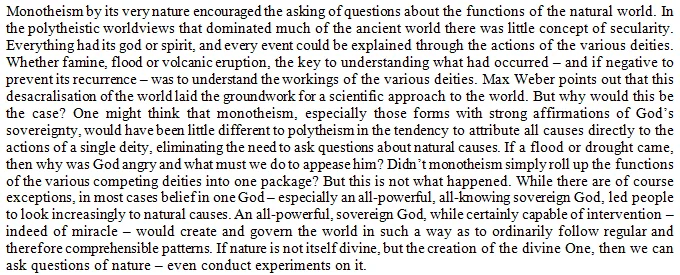
The second major contribution of monotheistic thought was its emphasis on the unity of knowledge.22
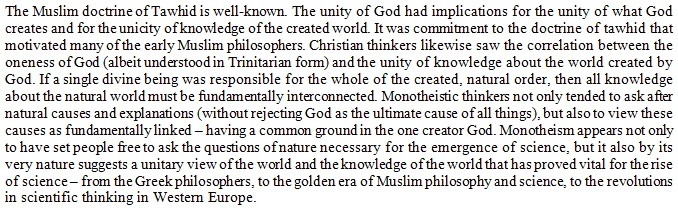
A core assumption of monotheism is that a logical mind will produce a logical world—the natural order reflects and reveals the Mind of God.23

Undoubtedly, monotheism is the key explanatory factor responsible for the rise of science. Dr. Worthing summed up the argument for the role of monotheism in the rise of science as follows:24
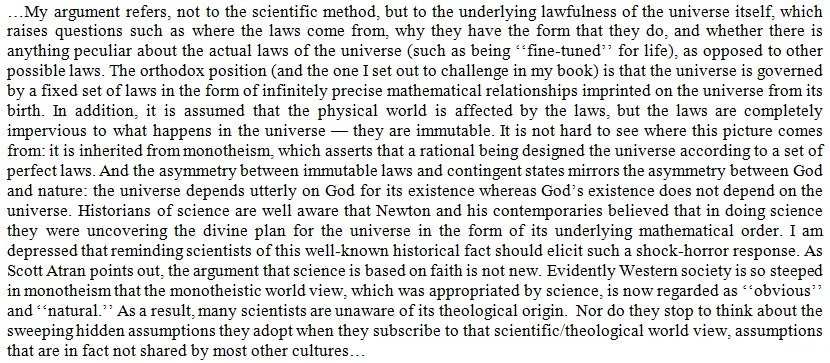
The basic belief that the world is understandable—that is, that the things and events in the universe occur in consistent patterns comprehensible through careful, systematic study—is shared by all scientists. Paul C. Davies, physicist, cosmologist, and astrobiologist at Arizona State University, comments:25

It is a well-known historical fact that the work of many leading scientists was motivated by their conviction that nature was governed by God-designed mathematical laws.26 These scientists first got the idea of absolute, universal, perfect, immutable laws from monotheism—the doctrine that God created the world and ordered it in a rational way. Even the most secular of scientists today presume that nature embodies not only order but simplicity and beauty. In short, the tacit assumptions running through science—that we live in a universe that is coherent, a universe that manifests a specific mathematical scheme of things, a universe that is intelligible to sentient mortals—stem from monotheism, as Davies put it:27
The fact of the matter is that the idea that nature is governed by mathematical laws was directly informed by theological considerations. Alexander Pope, one of the greatest English poets, neatly summarized the remarkable scientific achievements of Isaac Newton in his famous couplet: ”Nature and Nature’s laws lay hid in night. God said: ‘Let Newton be!’ and all was light.’’28Pope’s laudatory verse makes the point that Newton discovered some of the fundamental laws of nature, something known to every student of physics. However, what is often less appreciated is that part of the novelty of Newton’s achievement lay in his conviction that there were laws of nature there in the first place, awaiting discovery.29
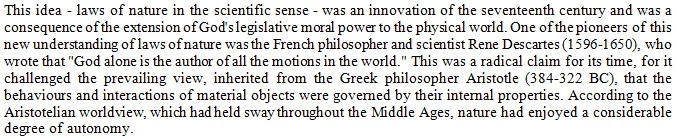
We can thus conclude that the claim that religion opposed science at every turn is groundless. In fact, not only did religion not resist the rise of science, but it also played a positive role in its development.
Notes and References
- 1
Peter Harrison, “Christianity and the Rise of Western Science,” ABC, 8 May 2012, https://www.abc.net.au/religion/christianity-and-the-rise-of-western-science/10100570.
- 2
Peter Atkins, “The Limitless Power of Science” in John Cornwell, Nature’s Imagination: The Frontiers of Scientific Vision, (Oxford, U.K.: Oxford University Press, 1995), p. 125.
- 3
Harold Nebelsick, Circles of God: Theology and Science from the Greeks to Copernicus, (Edinburgh, U.K.: Scottish Academic Press, 1985), p. 13.
- 4
Mark Worthing, “Monotheism as an Explanatory Key for the Rise of Science,” ISCAST, 16 Jan. 2018, https://iscast.org/news/monotheism-as-an-explanatory-key-for-the-rise-of-science/.
- 5
William James Durant, The Story of Civilization, Volume IV: The Age of Faith, (New York, U.S.: Simon and Schuster, 1950), p. 162–186.
- 6
Bayt al-Ḥikmah was one of the leading libraries in Islamic history, established during the Golden Age of Islam. Founded by the Abbasid dynasty in 830 C.E. in Baġdād, it served as an academy of knowledge that drew prominent scholars, scientists, and polymaths from far and wide, all dedicated to the advancement of knowledge. The academy became a major center of research, thought, and debate within Muslim civilization, enabling Baġdād to emerge as an unrivaled hub of scientific progress. At a time when Europe was experiencing intellectual decline, Bayt al-Ḥikmah played a vital role in illuminating the world.
- 7
Ufuk Necat Tasci, “How an 8th-Century Islamic library Laid the Foundations of Modern Science,” TRT World, 11 May 2021, https://www.trtworld.com/article/12766521?_rt=1.
- 8
Plinio Prioreschi, “Al-Kindi: A Precursor of the Scientific Revolution,” Journal of the International Society for the History of Islamic Medicine (ISHIM), vol. 1, no. 2, Oct. 2002, pp. 17–20, available at: https://www.ishim.net/ishimj/ishimj2.htm.
- 9
Solomon Gandz, “The Sources of Al-Khowārizmī’s Algebra,” Osiris, vol. 1, Jan. 1936, pp. 263–277, DOI: https://doi.org/10.1086/368426.
- 10
“How the Banu Musa Brothers from Ninth Century Baghdad Laid the Foundations for Modern Mechanics,” UmmahSonic, accessed 13 March 2023, https://ummahsonic.com/banu-musa-brothers-modern-mechanics/.
- 11
Abū aṭ-Ṭufayl ʿĀmir ibn Wāthilah al-Laythī was the last to die from among the Ṣaḥābah (Companions) of Allāh’s Messenger (PBUH), passing away in 110 A.H./730 AD.
- 12
Mohamed Raza Dungersi, A Brief Biography of Imam Jafar bin Muhammad (a.s.), (Dār as-Salām, Tanzania: Bilal Muslim Mission of Tanzania, 1999).
- 13
Salah Zaimeche, “The Advent of Experimental Chemistry,” Muslim Heritage, 24 Dec. 2001, https://muslimheritage.com/the-advent-of-experimental-chemistry/.
- 14
Marcellin Berthelot, La chimie au Moyen Âge, (Paris, France: Imprimerie nationale, 1983), vol. 3, p. 481
«Geber devient ainsi en chimie ce qu’Aristote fut pour la logique.»
- 15
Samir S. Amr and Abdelghani Tbakhi, “Jabir ibn Hayyan,” Annals of Saudi Medicine, vol. 27, issue 1, Jan.-Feb. 2007, pp. 52–53. DOI: https://doi.org/10.5144/0256-4947.2007.53.
- 16
“SCHOLARS (A - Z): Harbi al-Himyari,” Muslim Heritage, accessed 15 March 2023, https://muslimheritage.com/people/scholars/harbi-al-himyari/.
- 17
Ufuk Necat Tasci, “Enlightening the World with the House of Wisdom: Does Modern Science Owe its Development to 9th-Century Baghdad?” The New Arab, 13 Oct. 2022, https://www.newarab.com/features/does-science-owe-its-development-9th-century-baghdad.
- 18
Mark Worthing, “Monotheism as an Explanatory Key for the Rise of Science,” ISCAST, 16 Jan. 2018, https://iscast.org/news/monotheism-as-an-explanatory-key-for-the-rise-of-science/.
- 19
Ibid.
- 20
Ibid.
- 21
Ibid.
- 22
Ibid.
- 23
Ibid.
- 24
Ibid.
- 25
Paul Davies, “Taking Science on Faith,” Edge, 31 Dec. 2006, https://www.edge.org/conversation/taking-science-on-faith.
- 26
Nicolaus Copernicus, Johannes Kepler, Galileo Galilei, Tycho Brahe, René Descartes, Robert Boyle, Isaac Newton, Gottfried Wilhelm Leibniz, Pierre Gassendi, Blaise Pascal, Marin Mersenne, Georges Cuvier, William Harvey, John Dalton, Michael Faraday, William Herschel, James Prescott Joule, Charles Lyell, Antoine Lavoisier, Joseph Priestley, William Thomson, 1st Baron Kelvin, Georg Simon Ohm, André-Marie Ampère, Nicolas Steno, Louis Pasteur, James Clerk Maxwell, Max Planck, Gregor Mendel.
- 27
Paul Davies, “Taking Science on Faith,” Edge, 31 Dec. 2006, https://www.edge.org/conversation/taking-science-on-faith.
- 28
Writvik Gupta, “120+ Best Alexander Pope Quotes From One of the Greatest English Poets,” Kidadl, 14 Jan. 2021, https://kidadl.com/quotes/best-alexander-pope-quotes-from-one-of-the-greatest-english-poets.
- 29
Peter Harrison, “Christianity and the Rise of Western Science,” ABC, 8 May 2012, https://www.abc.net.au/religion/christianity-and-the-rise-of-western-science/10100570.