Why does the Muslim world fall behind in science, and why are ignorance and poverty so widespread within it?
It is undeniable that the Muslim world has lagged behind the West in science, technology, industrial development, and material wealth. Nevertheless, some Islamic countries rank among the highest in the world in terms of GDP per capita, and their citizens are among the wealthiest globally. Moreover, certain Islamic countries not only host universities dedicated to science but also entire specialized, planned areas that bring together universities, research institutions, and high-technology industries to foster innovation. Malaysia, for example, has several major science- and technology-oriented parks, hubs, and industrial/technological zones, some of which are regarded as contributing to the development of science cities.1 It also hosts numerous smaller science and technology parks, incubators, and cyber centers established under various government or university-linked initiatives. It is crucial to recognize that scientific advancement, technological progress, and material prosperity should not be regarded as the sole measures of a country’s worth. That is, a country’s scientific achievements, technological sophistication, and material wealth do not inherently indicate that it is on the path of truth, nor do the underdevelopment and poverty of another country imply that it is in error. Throughout history, those who rejected the Prophets’ message used the same criterion to assert their own correctness and to confuse the believers. Their reasoning was: if we enjoy a higher standard of life while the believers are deprived of all the comforts and luxuries we possess, then we cannot be in error. In their view, those who lead prosperous worldly lives are in the right, while those who endure hardship and poverty are in the wrong. Allāh says: {When Our clear revelations are recited to them, the disbelievers ask the believers ˹mockingly˺, “Which of the two of us is better in status and superior in assembly?”} (Qurʾān 19:73). Simply put, viewing material progress as proof of being in the right is a mistaken notion, for what does transient material prosperity have to do with being upon truth or falsehood? Indeed, history is replete with examples of prosperous nations that crumbled to dust and vanished without leaving a trace. Allāh says:{have they not travelled throughout the land to see what was the end of those ˹destroyed˺ before them? They were far superior in might; they cultivated the land and developed it more than these ˹Makkans˺ ever have} (Qurʾān 30:9). Many civilizationally advanced and materially powerful nations are far removed from Allāh’s religion and law. According to worldly standards, these nations are advanced, but according to Allāh’s standards they are profoundly backward. The point is that Allāh’s standard is not based on success in this world. That is, whether a nation has a strong economy or the most advanced science and technology, none of these achievements constitutes success with Allāh. Contemporary atheists regard their secular sciences as true knowledge and consider the knowledge brought by the Messengers of Allāh to be worthless, giving it no attention. Likewise, in their ignorance, the ancient peoples who rejected Allāh’s Messengers rejoiced in the worldly knowledge they possessed, were satisfied with it, and claimed they had no need for the knowledge that the Messengers brought them. Allāh says: {when their messengers came to them with clear proofs, they were prideful in whatever ˹worldly˺ knowledge they had} (Qurʾān 40:83). Hence, material progress and resources are not, in themselves, praiseworthy or blameworthy. Their value depends entirely on whether they are guided by divine revelation, oriented toward pleasing the Lord of the Worlds, and employed in the service of His religion. Likewise, experimental science is virtuous only when it is utilized to establish the true faith, promote good, remove evil, and bring genuine benefit by reforming people’s conditions—for the sake of Allāh alone, not for worldly gain, admiration, or praise. Only this type of material advancement and empirical knowledge is required and commendable.
The most exalted position attainable by Man is that of Allāh’s ally and helper. Allāh’s allies and helpers are those who, when granted authority and power, serve Allāh and strive to propagate His true religion:{˹They are˺ those who, if established in the land by Us, would perform prayer, pay alms-tax, encourage what is good, and forbid what is evil. And with Allāh rests the outcome of all affairs} (Qurʾān 22:41). Progress that adheres to divine revelation and seeks to implement it in actual life is both required and praiseworthy. In contrast, progress devoid of faith is abominable and worthless, and can, in fact, lead to madness and horror at any moment. It should be recalled that the countries involved in World War II—the deadliest and most destructive conflict in human history—were among the most economically developed nations of their time. Germany, one of Europe’s—and arguably the world’s—most scientifically and technologically advanced nations at the time, was a principal instigator of the war due to the rise of militarism in it and its desire for revenge. Estimates suggest that the Second World War caused the deaths of approximately 3% of the world’s population between 1939 and 1945—around 75 million people—many of whom perished as a result of genocide, mass bombings, disease, and starvation.2 Despite all of Germany’s material progress, an estimated 11 to 17 million civilians died as a result of Nazi ideological policies, whether directly or indirectly. This includes the systematic genocide of approximately 6 million Jews during the Holocaust, 2.7 million Poles and Slavs (including Ukrainians and Belarusians), and 4 million others deemed “useless eaters” possessing “life unworthy of life,” including the disabled and mentally ill, Soviet prisoners of war, homosexuals, Freemasons, Jehovah’s Witnesses, and the Romani—carried out as part of a deliberate program of extermination.3 This demonstrates that worldly progress devoid of faith can become a recipe for disaster. The question, however, is whether the application of Islamic legislation permits the kind of material and scientific progress that is praiseworthy in the sight of divine revelation. Those who raise this question claim that Muslims fell behind while others advanced because Islam is opposed to science, arguing that Islam is responsible for the unfortunate conditions prevailing in many Muslim countries today. Yet, in reality, when Muslims upheld Allāh’s religion and obeyed the Qurʾānic command to seek knowledge and study the natural world as a source of signs pointing to the Creator, they became leading cultivators of science and built a civilization that, throughout the Middle Ages, stood as the scientific center of the world. The point is that those who blame Islam for the decline of Islamic societies deliberately overlook the fact that Islam gave the world one of the greatest and most compassionate civilizations ever witnessed—more than twelve centuries of continuous civilizational flourishing.4 It should be noted that Islam is unique among the world’s major religions in that it gave rise to its own civilization—the Islamic civilization. By contrast, other religions were primarily adopted by pre-existing civilizations. For example, Western (Greco-Roman) civilization embraced Christianity, and the Indus Valley or Harappan civilization embraced what later developed into Hinduism. Many historians consider May 29, 1453, the date of the fall of Constantinople to the Muslim Ottoman Empire, as the event that marked the end of the Middle Ages. For centuries, Islam was the envy of the world—especially when contrasted with the period often described as Europe’s “Dark Ages.” Its influence on medieval Europe is undeniable and remains a fact of history, for it carried the light of learning to it and paved the way for its Renaissance and Enlightenment. While much of Europe at that time still lacked organized sanitation and public hygiene systems, the Muslim world had developed advanced urban planning, functional sewage networks, and regular practices of personal cleanliness, which were only later adopted in Europe. Interestingly, despite the political rhetoric against Islam, the United States has acknowledged Islam’s contributions in the domed ceiling of the Main Reading Room of the Thomas Jefferson Building in the Library of Congress—the largest library in the world. In 1897, when the building was constructed, Edwin Blashfield painted twelve figures on the dome representing countries or epochs considered at the time to have contributed most significantly to the evolution of Western civilization. Islam—the only religion depicted—is represented by a figure standing beside an alembic with a banner reading “Physics,” symbolizing the Islamic world’s contributions to the natural sciences.5
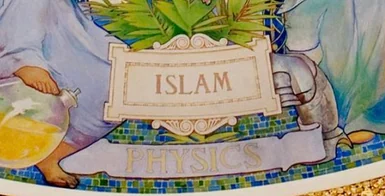
Only Islam is celebrated for its impact on a scientific field (Physics), whereas the other countries and epochs are recognized for their contributions in non-scientific fields. Blashfield’s mural on the dome of the Main Reading Room of the Library of Congress depicts these contributions as follows: Islam—Physics; Egypt—Written Records; Judea—Religion; Greece—Philosophy; Rome—Administration; the Middle Ages—Modern Languages; Italy—Fine Arts; Germany—Art of Printing; Spain—Discovery; England—Literature; and France—Emancipation.6

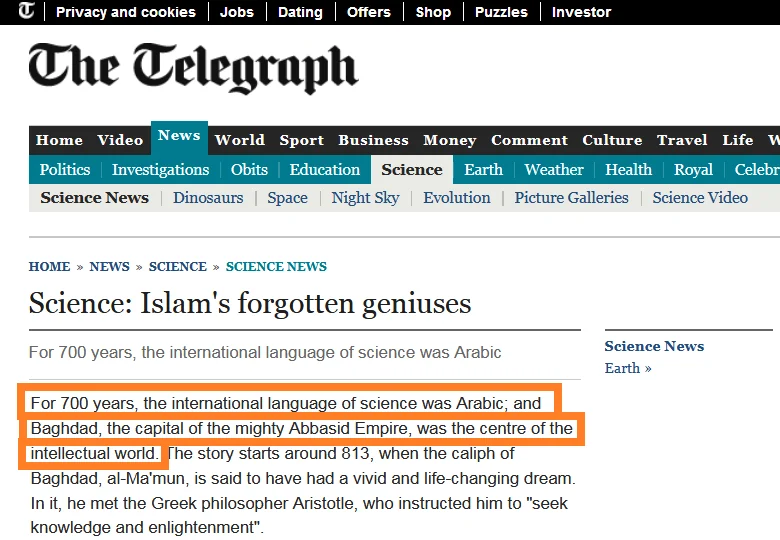
It is worth noting that for more than seven centuries, Arabic served as the international language of science, and Baġdād was the greatest epicenter of knowledge and learning the world had ever seen.7
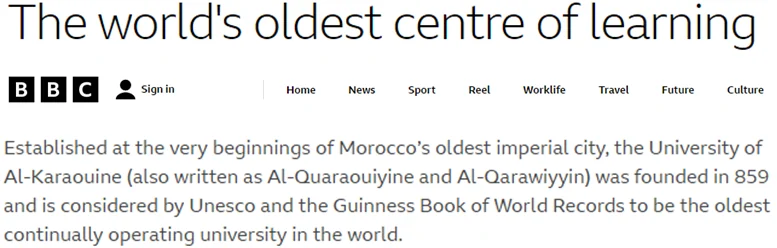
UNESCO and the Guinness Book of World Records recognize the University of al-Qarawiyyīn, founded in 859 CE in Fez, Morocco, as the oldest existing and continuously operating educational institution in the world.8
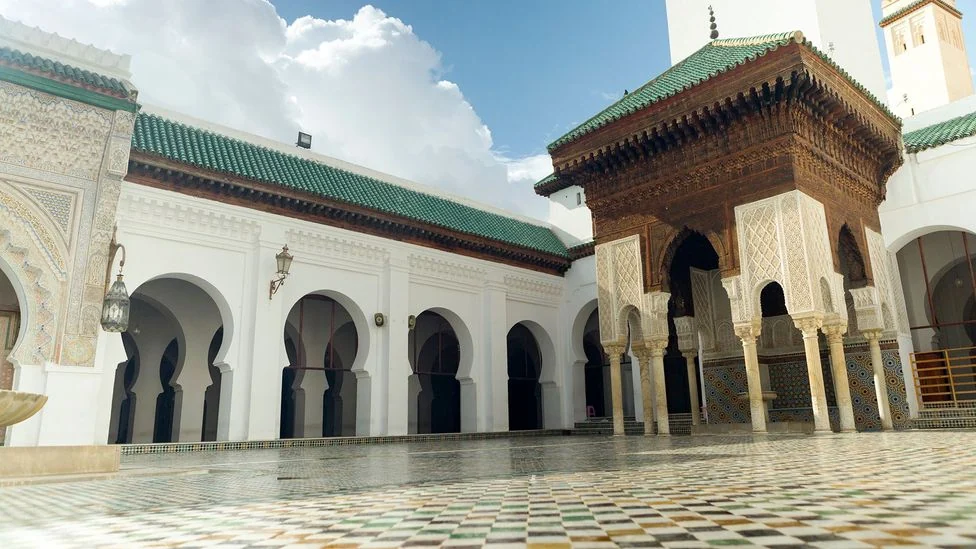
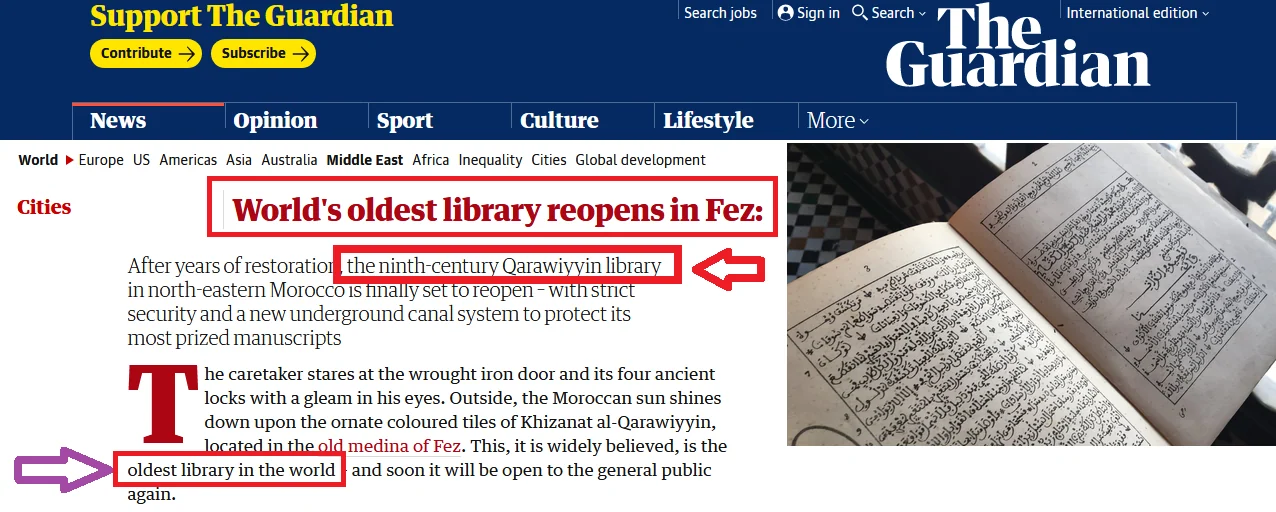
Incidentally, the oldest university in the Western world is the University of Bologna in Italy, founded in 1088 CE. Moreover, the world’s oldest library is not in Europe, as is commonly assumed. The al-Qarawiyyīn Library in Morocco, situated within the Islamic world, holds the distinction of being the oldest functioning library in the world.9
It is an established fact that the early Muslim eras were replete with remarkable achievements in medicine, science, and technology. Critics often accuse us of regurgitating the glorious Muslim past along with the accomplishments of early Muslim scientists and scholars as a way of masking our current mediocrity and indulging in complacency. Yet, recounting these legacies holds significant inspirational value for younger generations. Nevertheless, we should not dwell solely on the achievements of our predecessors, for while it is important to connect with our illustrious past, we should place greater emphasis on the present—the dismal state of scholarship within the contemporary global Muslim community. We should begin by diagnosing our “disease of lagging behind” so that we can prescribe an effective “treatment” and fully cure the “disease.”
We have fallen far behind the West due to our deviation from the straight path laid out by Islam; our failure to uphold and revere Allāh’s commands in our lives; the sins we commit, both privately and publicly; and the corruption and injustice that pervade our countries. Unfortunately, we follow the Qurʾān in name only, reading it without implementing its guidance. I swear by Allāh that our dire condition is a consequence of our own misdeeds. Allāh says: {whatever affliction befalls you is because of what your own hands have committed} (Qurʾān 42:30). Muslims who are seeking the aid of Allāh and wonder why we are in a state of weakness and humiliation today can learn much from the story of the Battle of Uḥud, which imparts a vital lesson: disobedience to Allāh and His Messenger (PBUH) leads to the Muslims’ defeat. The Prophet (PBUH) carefully arranged his Companions, both horsemen and archers, in preparation for the battle. He (PBUH) commanded the archers to guard the Muslims’ rear and instructed them not to leave their positions on the small outcrop of the mountain until he (PBUH) sent for them. Initially, Allāh granted victory to the Muslims. However, some of the archers, believing that the Makkans had been routed and would not return, abandoned their posts, thus disobeying the Prophet (PBUH). Khālid ibn al-Walīd, who was a polytheist at that time, noticed that the small outcrop of the mountain, which the Muslim archers had been guarding, had been abandoned and led a charge with the Makkans’ horsemen. They exploited the unprotected gap, attacked the Muslims, and killed seventy of them. After the battle, the Muslim believers sought an explanation for their defeat. Accordingly, Allāh informed them of its cause, saying: {Why is it when you suffered casualties ˹at Uḥud˺—although you had made your enemy suffer twice as much ˹at Badr˺—you protested, “How could this be?”? Say, ˹O Prophet,˺ “It is because of your disobedience.” Surely Allāh is Most Capable of everything} (Qurʾān 3:165). Allāh further revealed: {Indeed, Allāh fulfilled His promise to you when you ˹initially˺ swept them away by His Will, then your courage weakened and you disputed about the command and disobeyed, after Allāh had brought victory within your reach. Some of you were after worldly gain while others desired a heavenly reward. He denied you victory over them as a test, yet He has pardoned you. And Allāh is Gracious to the believers} (Qurʾān 3:152). That is, victory was taken away from the Muslims due to their disobedience to Allāh and His Messenger (PBUH). These verses make it clear that the Companions—the best, most pious, and most righteous of all Muslim generations—were defeated not because the enemy was stronger or his forces overwhelming, but because they fell short in obeying the command of the Prophet (PBUH). This proves that obedience to Allāh and His Messenger (PBUH) is the paramount factor in achieving success. What, then, does the Muslim nation expect in our times? Many Muslims engage in major sins such as fornication, lying, theft, drinking alcohol, gambling, and backbiting. There are those who deceive and oppress others without hesitation; who deal in interest; who watch pornography; who break the ties of kinship; who cheat on their spouses. There are Muslims who do not pray, or pay zakāt (obligatory alms), or fast Ramaḍān. There are even those who engage in polytheistic, superstitious, and innovated practices. And there are women who discard the ḥijāb (veil)—and the list goes on. Do we truly believe that Allāh will help us, grant us victory, and lift our humiliation while we remain in such a state?
No doubt, the decline in Muslims’ excellence in intellectual pursuits has been pronounced and persistent, but the situation is not irredeemable. It remains entirely possible for the Muslim nation to rise again and catch up with other nations. However, this requires that we first abandon our sins and our deviation from the Truth, seek Allāh’s forgiveness when we fall short, and rectify our behavior. We must return to the Qurʾān and Sunnah for guidance, believe and act as our Righteous Predecessors (the first three generations of Muslims—the Companions, the Successors, and the Successors of the Successors) did, and worship Allāh with sincerity—then He will bestow His bounties upon us. Prophet Nūḥ (PBUH) made this point clear to his people, saying: {Seek your Lord’s forgiveness, ˹for˺ He is truly Most Forgiving. He will shower you with abundant rain, supply you with wealth and children, and give you gardens as well as rivers} (Qurʾān 71:10–12). If we reform ourselves according to the commands of our Lord, He will manage all our affairs in the best manner, and we will attain the highest ranks in this world and in the Hereafter. Allāh says: {And whoever puts their trust in Allāh, then He ˹alone˺ is sufficient for them} (Qurʾān 65:3). In this verse, Allāh promises those who place their trust in Him that He will suffice for them against all odds. If we obey Allāh’s commands in every aspect of our lives and adhere to them to the best of our ability, then, I swear by Allāh, we can rejoice, for He will suffice for us. The Prophet (PBUH) said: “Be mindful of Allāh (His Commandments) and He will protect you.’’10 Moreover, to rise again, we must begin understanding and contemplating the numerous profound lessons of wisdom in our great religion, as found in the Holy Qurʾān and in the Sunnah of our Prophet (PBUH). Allāh urges us in the Qurʾān to employ our minds to reflect upon the universe so that we may comprehend His creation. Indeed, the pursuit of knowledge and reflection upon creation has long been central to the work of Islam’s greatest scholars. Figures such as Imām al-Ġazālī and Ibn Sīnā (Avicenna) emphasized the importance of employing reason and contemplation to understand the universe and the purpose of human existence. Additionally, the responsibility to address the current lack of scholarship and intellectual engagement within Muslim communities falls upon the educated among them. The sincerity and diligence of these individuals in research and scholarship can help Muslims become worthy successors of their illustrious predecessors. Furthermore, for the Muslim community to rise again, its leaders must have a clear vision and well-defined objectives, supported by the necessary strategic knowledge. Leadership is crucial, as leaders play a decisive role in setting the course for their peoples. Unfortunately, in many contemporary Muslim countries, leaders lack such vision, leaving their communities directionless and uncertain of their course. Vision, however, is like a guiding star—leaders may not immediately reach it, but by keeping it in sight, they and their followers can discern the direction in which they are heading.
In a nutshell, early Muslims accomplished remarkable advances in science, scholarship, and knowledge. Today, however, the decline in intellectual engagement among Muslims is so evident that it is difficult to reconcile their illustrious past with their present. Yet, there is no doubt that we can rise again, restore our former glory, and lead the world—if and only if we sincerely implement the Qurʾān and Sunnah in every aspect of our daily lives. We should move beyond merely talking about what we ought to do and instead actively implement the commands we are given. That is, Islam must become our way of life, not merely a set of beliefs. In short, if the Muslim nation fulfills Allāh’s obligations and avoids His prohibitions, He will grant it His bounties and facilitate its success.
Notes and References
- 1
Major science and technology parks, research hubs, and innovation centers in Malaysia include:
•Kulim Hi-Tech Park: An integrated high-technology industrial and science park hosting manufacturing facilities, research and development (R&D) centers, electronics and semiconductor companies, and other advanced technology firms.
•Technology Park Malaysia: A science and research park supporting knowledge-based industries, technology companies, and research and development initiatives.
•Cyberjaya: A major technology city and digital hub accommodating information and communications technology (ICT) companies, startups, and research institutions; frequently referred to as Malaysia’s “technology heart.”
•Selangor Science Park: A science and technology park designed to promote industry–university collaboration, research and development, and technology-oriented enterprises.
•Penang Science Park / Penang Technology and Industrial Zones: A center for electronics, manufacturing, and technology industries, often described as the “Silicon Valley of the East.”
- 2
“Casualties of World War II,” Lumen Learning, accessed 26 March 2023, https://courses.lumenlearning.com/suny-hccc-worldhistory2/chapter/casualties-of-world-war-ii/.
- 3
Ibid.
- 4
In historical terms, this period roughly spans from the 7th to the 19th century, during which Muslim civilization remained strong, influential, and productive in fields such as science, philosophy, medicine, governance, architecture, literature, and the arts. It began with the rise of Islam and the establishment of the first Islamic state under Prophet Muḥammad (PBUH) in the 7th century CE (c. 622 CE) and concluded with the gradual weakening of the major Islamic empires (Ottoman, Safavid, Mughal) and the increasing dominance of European colonial powers in the 18th–19th centuries. It is described as “continuous” because, from the Umayyads (661–750) to the Abbasids (750–1258), to the Andalusian states (756–1492), to the Fatimids (909–1171), Ayyubids (1171–1260), and Mamluks (1250–1517), and subsequently the Ottoman (1299–1922), Safavid (1501–1736), and Mughal (1526–1857) empires, there was always at least one major Islamic power leading in scholarship, governance, the arts, and the sciences. Although the centers of influence shifted geographically—Baghdad, Damascus, Córdoba, Cairo, Istanbul, Delhi—the civilizational momentum persisted for over twelve hundred years.
- 5
“[Main Reading Room. Interior of Dome. Library of Congress Thomas Jefferson Building, Washington, D.C.] Original Digital File,” Library of Congress, accessed 28 June 2023, https://www.loc.gov/resource/highsm.02070/.
- 6
Ibid.
- 7
Jim Al-Khalili, “Science: Islam’s Forgotten Geniuses,” The Telegraph, 29 Jan. 2008, https://www.telegraph.co.uk/news/science/science-news/3323462/Science-Islams-forgotten-geniuses.html.
- 8
Chris Griffiths & Thomas Buttery, “The World’s Oldest Centre of Learning,” BBC, 19 March 2018, https://www.bbc.com/travel/article/20180318-the-worlds-oldest-centre-of-learning.
- 9
Kareem Shaheen, “World’s Oldest Library Reopens in Fez: ‘You Can Hurt Us, But you Can’t Hurt the Books,’” The Guardian, 19 Sep. 2016, https://www.theguardian.com/cities/2016/sep/19/books-world-oldest-library-fez-morocco.
- 10
Muḥammad at-Tirmiḏī, Jāmiʿ at-Tirmiḏī, (Cairo, Egypt: Dār at-Taʾṣīl, 2016), book: 37, ḥadīth: 102, available at: https://sunnah.com/tirmidhi:2516.