Why did Islam, a religion revealed by Allāh for the benefit of humanity, allow slavery? Does it discriminate between free men and women and slave men and women?
The Qurʾān generally designates slaves with the expression “mā malakat aymānukum” (literally, “those whom your right hands possess”) rather than with the derogatory terms prevalent in 7th-century Arabia, such as ʿabīd (slaves), raqīq (bondservants), and jawārī (female slaves or bondmaids). Yet this very expression is among the most misunderstood and misrepresented Qurʾānic expressions. In reality, it indicates that the master did not simply “own” his slaves but rather served as their custodian, accountable before Allāh for their proper care and treatment. The expression specifically referred to prisoners of war of both genders, who in the absence of a formal prison system, were distributed among the households of the victorious Muslim army. In other words, it was only in the context of warfare that believing Muslims lawfully took possession of captives. Far from sanctioning exploitation, the Qurʾānic expression “mā malakat aymānukum” (lit. “those whom your right hands possess”) highlights Islam’s concern for safeguarding the dignity and rights of captives or prisoners of war. The “right hand,” in particular, has special merit and privileged functions that humans instinctively reserve for it. As Imām al-Qurṭubī remarked, it is the very hand used when referring to charitable spending,1 as well as the one used for making pledges of allegiance.2 Accordingly, the phrase “those whom your right hands possess’’ has a special meaning in Islamic usage and signifies the responsibility to treat captives or prisoners of war with dignity, compassion, and justice.
Islam made it clear that slavery did not deprive individuals of their fundamental rights as human beings. It affirmed that they were no different from free people in their need for respect, dignity, and justice. It elevated them from the condition of abject slavery to the honored status of brotherhood with free people. It even discouraged the use of the term “slave,” favoring instead expressions that reshaped the social perception of slavery and conveyed a sense of solidarity and familial bond. In this regard, the Prophet (PBUH) said: “None of you should say: ʿabdī (my male slave) and amatī (my female slave), and no slave should say, rabbī (my lord) and rabbatī (my lady). Let the owner [of a slave] say, fatāya (my young man) and fatatī (my young woman), and let the slave say, sayyidī (my master) and sayyidatī (my mistress), for you [all] are the slaves and the Lord is Allāh, Glorified and Sublime be He.’’3 Hence, the Prophet (PBUH) instructed Muslims to address their slaves in a manner that would make them feel like members of the family and erase the stigma of slavery. It is therefore intellectually dishonest to claim that Islam promoted slavery, for no religion sought to regulate and humanize the institution more effectively than Islam, which ultimately laid the groundwork for its abolition. When the opponents of Islam ask whether Islam permitted slavery and discriminated between free men and women and slave men and women, the answer is, without embarrassment or apology, yes. Essentially, Islam recognized slavery as part of the social system of its time and, accordingly, established rules to regulate it—playing a reformative role instead of one of mere recognition. In other words, Islam addressed an existing institution rather than inventing it. However, to adequately understand why Islam—a religion that emphasizes the common origin of all people and perfect equality among them—did not adopt an immediate and absolute abolitionist stance on slavery, it is important to fairly examine the details of the Islamic rulings concerning slavery with regard to its sources—that is, the ways in which individuals became enslaved—as well as the principles governing the treatment of slaves and the avenues provided in the Sharīʿah for attaining freedom. Moreover, it is important to consider the brutal treatment of slaves by non-Muslims in ancient civilizations, particularly the Roman and Egyptian civilizations, as well as the barbarity and dehumanization inherent in the practice of slavery by Western “civilized” nations in more recent times. To begin with, it is essential to understand the following facts:
•One of the basic principles of Islam is that no one has the right to unlawfully restrict or take away another person’s freedom, and whoever does so is an oppressor.
•When Islam emerged, slavery had many sources, mainly raids (i.e., tribal attacks aimed at capturing people and resources), debt (i.e., where an unpaid debtor could become a slave), extreme poverty (i.e., the inability to support oneself or one’s family forced individuals or families to sell themselves or their children into slavery to survive), and kidnapping (i.e., the abduction of individuals who were then sold into slavery). “Indeed, slavery spread in an appalling manner across all continents through kidnapping, and even in later centuries, this practice remained the primary source of slaves in Europe and North America. Islam, however, took a firm stand against it. Allāh said in the ḥadīth qudsī: “There are three whose opponent I will be on the Day of Resurrection, and whomever I oppose, I will defeat…a man who sold a free person and consumed his price.”4
•While there were many sources of slaves at the advent of Islam, there were virtually no means for manumitting them. However, Islam closed many avenues for enslaving people while simultaneously establishing numerous paths for their liberation. Notably, neither the Qurʾān nor the Sunnah contains any text commanding the taking of others as slaves, whereas both include numerous texts encouraging the manumission of slaves.
Hence, Islam restricted the sources of slavery that had existed long before its advent to a single one: enslavement resulting from war, which applied only to non-Muslim prisoners of war. Undeniably, prisoners are an inevitable consequence of armed conflict. Before Islam, prisoners had no protection or rights, and the prevailing custom was to either kill or enslave them. However, Islam, being neither bloodthirsty nor eager to enslave, introduced two additional options: unconditional release or ransom. Allāh said: “…Later ˹free them either as˺ an act of grace or by ransom until the war comes to an end.’’ (Qurʾān 47:4). That is, keeping prisoners of war as slaves was permitted—but not commanded—so long as they were neither exchanged for Muslim prisoners of war nor freed, whether as an act of grace or upon payment of ransom. It is recorded that the Prophet (PBUH) accepted ransoms from the polytheist prisoners captured at the Battle of Badr and released them, and he also freed some without requiring any ransom. Similarly, during the conquest of Makkah, he (PBUH) declared to the Makkans: “Go, for you are free.”5 The point is that the enslavement of prisoners of war was a common practice among all armies of the time, and Islam could not unilaterally abolish it while the enemies insisted on its continuation. However, it enjoined the believers to treat slaves with fairness and kindness. Roger Du Pasquier—a revert to Islam, as well as a distinguished Swiss writer and journalist with extensive knowledge of the Muslim world—wrote:6

Hence, Islam tolerated the practice of slavery only insofar as no viable alternative existed, and until people worldwide could agree on a system other than slavery for dealing with prisoners of war. It is worth noting that non-Muslim prisoners of war are considered wrongdoers, as they opposed the Truth and served as instruments in the commission of wrongdoing. Therefore, releasing them would give them the opportunity to hinder the spread of the Truth and to engage in wrongdoing and aggression against others.Ironically, when we point out that Islam limited the taking of captives to the context of warfare—merely as a situation necessitated by hostility between warring parties—opponents of Islam often counter by claiming that the West abolished captivity even during war. Indeed, in making this point, they do themselves a grave disservice, as it merely serves to remind us that historically, the West has followed a single, brutal rule in warfare: “Kill anything that moves!’’ In contrast, even in legitimate warfare, Islam imposes strict ethical boundaries.As al-Kāssānī stated: “It is not permissible to kill a woman, a child, an elderly man, a cripple, a man suffering from partial paralysis, a blind man, a person missing a hand or leg, a madman, a monk, or a traveler in the mountains.”7 In effect, Islam limited the sources of slaves to one: enslavement through war imposed on non-Muslim prisoners of war and their families (i.e. women and children). Simultaneously, it provided numerous avenues for slaves to regain their freedom, as elaborated below:
1.Al-ʿitq (voluntary emancipation by masters): Islam strongly encouraged this practice, and the Prophet (PBUH) himself set the best example. He freed all the slaves he owned before the revelation of Islam as well as those gifted to him afterward, and he urged all Muslims to do likewise. ʿAmr ibn al-Ḥārith [may Allāh be pleased with him], the brother of the Mother of the Believers Juwayriyah [may Allāh be pleased with her], reported: “When the Messenger of Allāh (PBUH) passed away, he left neither a dīnār (gold coin), nor a dirham (silver coin), nor a male or female slave, nor anything else, except his white mule, his weapons, and land that he had given in charity to wayfarers.”8
2.Allocating a portion of zakāt (obligatory charity) funds to freeing slaves: One of the prescribed categories of zakāt expenditure, as laid down in the Qurʾān, was the ransoming and liberation of slaves. Allah says: {Alms-tax is only for the poor and the needy, for those employed to administer it, for those whose hearts are attracted ˹to the faith˺, for ˹freeing˺ slaves, for those in debt, for Allāh’s cause, and for ˹needy˺ travellers. ˹This is˺ an obligation from Allāh. And Allāh is All-Knowing, All-Wise} (Qurʾān 9:60).
3.Freeing a slave as expiation for certain sins or failures in religious duties: This included acts such as breaking an oath, breaking a fast, or committing ẓihār (a pre-Islamic form of divorce whereby a husband declares his wife unlawful to him by saying, “You are to me like my mother’s back”). Manumission was also prescribed as expiation for accidental killing: Allāh commands that whoever kills a believer by mistake must free a believing slave and pay blood-money to the family of the victim.9 In this way, compensation was provided both to the victim’s family and to the community at large, since killing affects both.10

4.Voluntary emancipation for the sake of Allāh: Muslims are encouraged, in general terms, to free slaves purely for the sake of Allāh, as this is regarded as a highly virtuous act of devotion in His sight. Allahsays: {If only they had attempted the challenging path ˹of goodness instead˺! And what will make you realize what ˹attempting˺ the challenging path is? It is to free a slave} (Qurʾān 90:11–13).
5. Al-mukātabah (contract of emancipation): This is one of the methods prescribed in Islam for slaves to attain their freedom. Essentially, slaves were allowed to earn their freedom through written agreements with their masters. Allāh said: {And if any of those ˹bondspeople˺ in your possession desires a deed of emancipation, make it possible for them, if you find goodness in them} (Qurʾān 24:33). The term mukātabah refers to a contract between the owner and the slave, entitling the latter to earn freedom after paying an agreed sum within a specified period. Once the agreement is signed, the owner is not permitted to place obstacles in the way of the slave’s freedom. Instead, he is obliged to provide opportunities for the slave to earn the money and must release him or her once the full amount is paid on time. The same verse also contains a general command for believers to assist in freeing slaves: {And give them some of Allāh’s wealth which He has granted you} (Qurʾān 24:33). This directive applies to slave owners, ordinary Muslims, and the Islamic government alike: the owner is instructed to remit part of the emancipation sum if needed, fellow Muslims are encouraged to provide financial assistance to any slave seeking help to pay the sum required for emancipation, and the Islamic government is required to allocate a portion of zakāt funds for the emancipation of slaves.
Hence, Islam has historically taken a leading role in advocating for the emancipation of slaves and the eradication of slavery. What is even more remarkable is that Islam did not only exhort believers to free slaves as a virtuous act to earn Allah’s approval or as a means of expiating sins, but also encouraged their integration into society through marriage, thereby elevating their social status. Allāh said: {Marry off the ˹free˺ singles among you, as well as the righteous among your male slaves and female slaves. If they should be poor, Allāh will enrich them from His bounty} (Qurʾān 24:32). For example, during the campaign against Banū al-Muṣṭaliq, the Prophet (PBUH) married Juwayriyah bint al-Ḥārith, a female prisoner from the defeated tribe, in order to elevate her status, as she was the daughter of Ḥārith ibn abī Ḍirār, the prominent chieftain of the tribe. She had initially fallen among the spoils of war assigned to the Companion Thābit ibn Qays ibn Shammās. Troubled by this situation, she entered into a mukātabah (an emancipation contract) with him. However, lacking the means to fulfill the contract, and having heard of the Prophet (PBUH)’s generous and compassionate nature, she sought his assistance. The Prophet (PBUH) proposed marriage to her, thereby freeing her from the bondage of Thābit. As a result, the condition of her captured tribe improved, for when the Muslims learned that Juwayriyah had entered into the matrimonial bond with the Prophet (PBUH), thus becoming one of the Mothers of the Believers [may Allah be pleased with her], they released all the prisoners from Banū al-Muṣṭaliq.11 This entire account is narrated by ʿĀʾishah [may Allah be pleased with her] in this ḥadīth.12 In another narration, al-Ḥārith (Juwayriyah’s father) approached the Prophet (PBUH) and requested the return of his daughter, citing her status as the daughter of a chieftain. The Prophet (PBUH) replied that she was free to leave, but if she wished to remain, she was most welcome to do so. Deeply moved by the Prophet(PBUH)’s noble and compassionate character, she chose to stay. She was then formally freed and married to the Prophet (PBUH).13 It is important to clarify that permitting Muslim men to marry their female captives in no way constituted a license for them to indulge their sexual desires or to exploit those captives. Rather, there was profound wisdom in this ruling—a wisdom that remains entirely beyond the grasp of those who seize upon this issue as a pretext to attack Islam.14
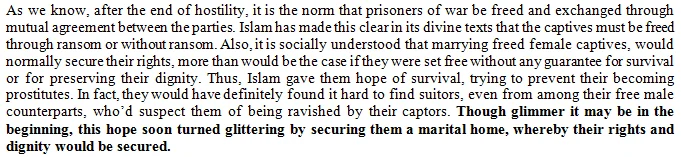
Indeed, the claim that Muslims took female war captives as sex slaves bears no resemblance to what Allah has described in the Qurʾān. As previously noted, the capture of female prisoners during war was the sole means of acquiring female slaves.15 The Muslim ruler had two options regarding the female captives: he could show them grace by releasing them without ransom, or he could exchange them for Muslim women captured by the enemy. Ordinarily, female captives would have been killed because they were part of the enemy’s fighting force, but Islam prohibits the killing of women even in legitimate warfare. Enslavement therefore served as a mitigated penalty for female prisoners of war, since they could not be executed under any circumstances. Hence, there is nothing objectionable in Islam discriminating between a free woman and a slave woman, for the former—regardless of whether she is Muslim or not—is a peaceful non-combatant, whereas the latter is a criminal. When non-Muslims wage war against Muslims, the latter fight—and kill—only those non-Muslim men who are capable of bearing arms and engaging in fighting; Islam forbids the killing of women, children, the elderly, hired servants (entrusted with tending the animals or similar duties), the disabled, and hermits living in monasteries. Rabāḥ ibn ar-Rabīʿ narrated: “We were with the Messenger of Allah (PBUH) on an expedition when he noticed some people gathered around something. He sent a man and said, ‘See what these people are gathered around.’ The man returned and reported, ‘They are gathered around a woman who has been killed.’ The Prophet (PBUH) said, ‘She was not one of those who were fighting.’ Khālid ibn al-Walīd was leading the vanguard, so the Prophet (PBUH) sent a man to him with the instruction, ‘Tell Khālid not to kill a woman or a hired servant.’”16 Therefore, there is a consensus in Islam that it is strictly forbidden to kill the women and children of non-Muslims engaged in fighting against Muslims.17
As for concubinage, it was not introduced by Islam but was prevalent long before its emergence. It is certainly inaccurate to claim that Islam permitted female slaves to be treated as “sex objects” or allowed Muslim men unrestrained physical gratification by “using” them in that manner. What Islam did permit was physical intimacy through lawful possession of slave women, alongside the sanctioned avenue of marriage. In this context, Allāh described the qualities of true believers, stating: {...those who guard their chastity except with their wives or those ˹bondwomen˺ in their possession, for then they are free from blame...} (Qurʾān 23:5–6). This verse establishes that a Muslim man incurs no blame for engaging in physical intimacy with his slave-women. However, this merely indicates permissibility; it is neither the purpose of the “master–slave” relationship nor is it encouraged. Abū al-Walīd al-Bājī al-Mālikī, the eminent classical scholar, wrote: “… the very purpose of marriage is [to render] intercourse [permissible] but the purpose of possession [of slave-women] is not intercourse.”18 As we shall elaborate below, both the Qurʾān and Sunnah affirm that although it is permissible to have physical intimacy with a slave-woman, the best course for a man is either to establish a proper marital bond with her after manumitting her, or to marry her off to another. It should therefore be understood that, while permissible, physical intimacy with female captives was neither the purpose of their enslavement nor a recommended practice. Such intimacy with slave-women was permitted for a twofold reason:19
a.Chastity on the part of the slave-woman so that she would not turn to lewdness or be forced into it for lack of a legitimate outlet for what is instinctive.
b.Chastity on the part of her owner/master.
By safeguarding chastity, Islam also ensures the protection and preservation of lineage, which is of great importance and indeed one of the very purposes of Islamic law. Furthermore, Islam ensured that if the recommendation of marrying off slave-women was not followed, then the permitted physical relationship itself would become, as will be elaborated shortly, a means for the eventual freedom of the slave-woman, while in the meantime securing many additional rights for her prior to her actual emancipation.20

Hence, pre-Islamic societies treated slave-women purely as property without rights. In Islam, however, concubinage functioned as a binding social contract analogous to a marriage contract. In other words, concubinage was a sharʿī relationship (lawful under Islamic law) between a free man and his female slave, parallel in form to marriage, through which sexual relations were made sharʿī and regulated. Islam thereby granted concubines the rights of maintenance, fair treatment, and protection from abuse, making them comparable—though not identical—to wives. The sharʿī relationship between a master and his concubine, which rendered sexual intercourse lawful, was exclusive to them alone, as if it were a marriage. Accordingly, a master could not transfer or sell his right to lawful intimacy with his concubine to anyone else. Moreover, just as it was unlawful for a man to compel his free wife into prostitution, it was likewise forbidden for him to do so with his concubine: {Do not force your ˹slave˺ girls into prostitution for your own worldly gains while they wish to remain chaste} (Qurʾān 24:33). In fact, it was not even lawful for a man to engage in sexual intercourse with a female slave owned by his wife or any other relative, since such a relationship amounted to adultery. Ḥabīb ibn Sālim related: “A man had sexual intercourse with the female slave of his wife, so he was brought to an-Nuʿmān ibn Bashīr. An-Nuʿmān said: ‘I will judge him according to the judgment of the Messenger of Allāh (PBUH). If his wife had made her lawful for him (i.e., had given him permission), then I will lash him one hundred times; and if she had not made her lawful (i.e., did not give him permission), then I will stone him [to death].’”21 This ruling illustrates that Islam protected concubines from sexual crimes and abusive masters, establishing clear boundaries to ensure their rights and safety. There are other rules related to marriage that also apply to the master–slave relationship, such as the prohibition on combining two sisters or close relatives under this relationship. Incidentally, according to the Ḥanafis, the master must provide a separate home for the female slave, just as he does for his wife. The point is that sexual relationships with concubines were not made lawful under Islamic lawby virtue of ownership alone; rather, they were only authorized through custodianship and the accompanying responsibilities of maintenance and proper treatment.
Moreover, Islam instituted numerous practices aimed at gradually phasing out slavery and concubinage from society. In particular, it provided multiple avenues for female slaves to attain their freedom and improve their social status, including:
The status of umm al-walad (mother of the child): Islam utilized a custom common internationally at the time—having intercourse with female captives—to gradually eliminate the harmful practice of slavery.It stipulated that if a female slave became pregnant by her master, her child would be born free, and she would automatically gain her freedom upon the death of her master. Clearly, if Islam had permitted sexual relations with female captives merely to satisfy men’s sexual desire, this arrangement would have been permanent; pregnancy would not have conferred any benefit for the female captive, and she would have remained her master’s property regardless. Instead, a concubine’s status was elevated to that of umm al-walad when she gave birth to her master’s child. Consequently, she was granted a sharʿī (Islamic legal) protection from being sold or separated from her child. The Prophet (PBUH) said: “Do not sell umm al-walad [the slave-woman who bears you a child].”22 ʿUmar ibn al-Khaṭṭāb [may Allāh be pleased with him] said: “Any female slave who gives birth to her master’s child, he may neither sell her, nor give her away, nor bequeath her. He may enjoy her, and upon his death, she [automatically] becomes free.”23 ʿUmar also said: “Her child renders her free, even if it is dead.”24 Ibn Rushd (Averroës) wrote:25

Ibn Rushd recorded that there was a consensus on the prohibition of selling a female concubine, even during her pregnancy.26
Mukātabah (emancipation contract): As explained earlier, a female slave may enter into a contract with her master stipulating that she will gain her freedom upon payment of a specified amount of money or after completion a designated period of work.
Mudābarah (deferred emancipation, i.e., freedom upon the master’s death): It is a contractual arrangement similar to mukātabah, except that the master pledges to grant the female slave her freedom upon his death.
Moreover, if a master abused or injured his concubine, he would be required to manumit (emancipate) her, as he would have violated the contractual duties inherent in his custodianship, which Islam legally recognizes as a binding arrangement. He could even be subject to criminal punishment for his abuse. For instance, a female slave who had been struck by her master with a piece of hot iron went to ʿUmar ibn al-Khaṭṭāb, and he manumitted her.27 Furthermore, men were encouraged to either marry their concubines or give them in marriage to other suitable men, thereby elevating their social status and terminating their sharʿī relationship (lawful under Islamic law) with them as concubines: {Marry off the ˹free˺ singles among you, as well as the righteous of your bondmen and bondwomen. If they are poor, Allāh will enrich them out of His bounty. For Allāh is All-Bountiful, All-Knowing} (Qurʾān 24:32). Concubinage was thus implicitly discouraged through the recommendation to marry or marry off the female slaves. The Prophet (PBUH) said: “If a man disciplines his female servant and does so properly, teaches her and teaches her well, then manumits her and marries her, he will have a double reward.”28 It should be recalled that the very last instruction the Prophet (PBUH) gave on his deathbed was a warning against mistreating slaves. This clearly demonstrates that he (PBUH) placed paramount importance on treating concubines well. ʿAlī ibn abī Ṭālib reported: “The final statement of the Messenger of Allāh (PBUH) was: ‘The prayer, the prayer! And fear Allāh with regard to those whom your right hands possess (i.e., slaves)!’”29 Obviously, the ritual prayer is the most important right owed to Allāh, and neglecting it constitutes one of the gravest sins against Him. Similarly, exploiting the vulnerable—namely, the slaves at the time—represents one of the most serious sins against people. One might ask: if a concubine cannot consent to her master’s ownership, how can she consent to a sexual relationship? It should be understood that the ḥadīth of Prophet Muḥammad (PBUH), “Harm must neither be inflicted nor reciprocated,”30 which prohibits harm to oneself and to others, is one of the five foundational Prophetic traditions around which the entire body of fiqh (Islamic jurisprudence) is structured. Hence, sexual violence is forbidden in Islam under this “no-harm” sharʿī (Islamic legal) principle, since sexual intercourse is intended as an act of spousal love and mutual pleasure. Ash-Shāfiʿī said: “As for sexual intercourse, its purpose is pleasure, and no one may be forced into it.”31 Ash-Shāfiʿī’s broad statement, “no one may be forced into it,” is a general observation regarding the nature of all intimate relations recognized and permitted under Islamic law, whether with a spouse or a concubine, as a mutually pleasurable activity. It can be inferred from another tradition that an incompatible sexual relationship between a master and a concubine should not be pursued through coercion; rather, it should be ended gracefully. Abū Ḏarr reported that the Messenger of Allāh (PBUH) said: “Whoever among your slaves is suitable for you, feed them from the same food you eat and clothe them from the same clothes you wear; and whoever is not suitable for you, then sell them, and do not torture the creation of Allāh.”32 That is, if a master and a concubine cannot form an amicable relationship, he must under no circumstances torture her physically or emotionally, for he is obligated to respect her inherent human dignity as a creation of Allāh. In such cases, he should sell her to another man who can establish an appropriate relationship with her, with the aim of eventually elevating her social status. Rape is strictly forbidden under all circumstances, especially as a weapon of war. While a female prisoner of war could be incorporated into Muslim society as a concubine to a master, this was only permissible on the condition that the relationship was recognized under a sharʿī (Islamic legal) authority and that the master fulfilled his rights toward her, including her protection from abuse. Therefore, a Muslim soldier would be punished as a rapist and fornicator if he had sexual intercourse with a female prisoner of war without adhering to this strictly defined sharʿī arrangement. Hārūn ibn al-ʾAṣamm reported that ʿUmar ibn al-Khaṭṭāb [may Allāh be pleased with him] dispatched Khālid ibn al-Walīd with the army. Khālid sent Ḍirār ibn al-ʾAzwar along with a company of horsemen to raid a district belonging to the tribe of Asad. They captured a woman who was a beautiful bride-to-be, and she amazed Ḍirār. He asked his companions for her, and they gave her to him, after which he had intercourse with her. Upon returning from the expedition, he regretted what he had done and collapsed in dismay. The matter was reported to Khālid, who, upon hearing what had happened, said, “Indeed, I have made her permissible and wholesome for you.” Ḍirār replied, “No, not until you write to ʿUmar.” ʿUmar responded that he should be stoned to death, but by the time his letter arrived, Ḍirār had passed away from natural causes. Khālid remarked, “Allāh would not have disgraced Ḍirār ibn al-ʾAzwar.”33 Ash-Shāfiʿī said: “If a man forcefully acquires a female slave and then has intercourse with her thereafter, and he is not ignorant [of the Islamic ruling on this], the female slave is to be taken from him, and he is punished for fornication.”34 Hence, the allegation that Islam allowed Muslim men to rape their female captives is entirely unfounded.
Oddly enough, atheists often boast that contemporary secular constitutions have abolished slavery altogether. Indeed, after many centuries of enslavement and oppression, the official international protocol to abolish slavery was only issued by the United Nations in 1953. In other words, the consciences of Western governments were not stirred until the last century—after they had already built their civilizations upon the corpses of free men unlawfully enslaved—at which point they abolished slavery with much self-congratulation.35
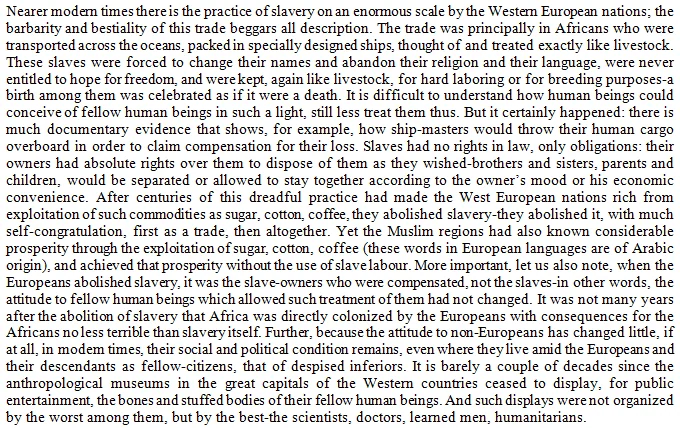
Indeed, no fair-minded person can compare this with the teachings of Islam, which recognized slavery as an injustice and affirmed the human rights of slaves more than fourteen centuries ago. From the outset, Islam set the goal of eradicating this social evil, but such a reform necessarily had to be gradual, as with all entrenched practices. That is, in the 7th-century Arabian context, slavery was too deeply embedded in the socio-economic fabric to be abolished at once.36
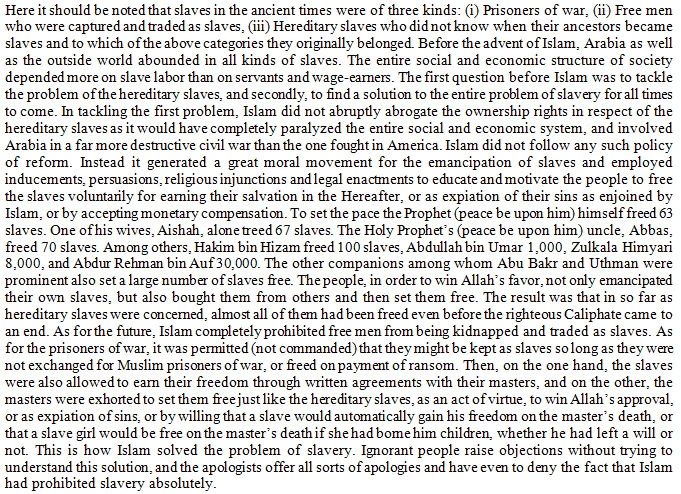
Hence, Islam did not ban slavery outright, for such a measure would not have been practical: releasing all the slaves at once would have created turmoil in society, with thousands left without means of survival, and refusing to take prisoners of war would have emboldened the enemies of the Muslims and given them far greater room for maneuver. Instead, Islam adopted a practical approach by permitting the enslavement of prisoners of war, while at the same time removing the greatest evils associated with slavery as practiced elsewhere. That is, it restricted the avenues to enslave people, encouraged manumission, and strictly regulated the treatment of slaves.37
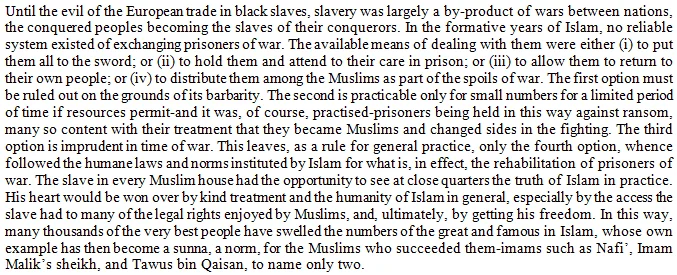
Islam thus effectively abolished the institution of slavery by forbidding the enslavement of people in any way except temporarily in the context of warfare. Critics of Islam nevertheless insist: why, then, when the Muslims had become secure in their conquests, did they not grant wholesale emancipation to former captives or slaves?38

There is an important point to emphasize regarding slavery, namely that a person’s way of life shapes in him a kind of second nature. In other words, when someone lives under a particular system or condition for a long time, it becomes deeply ingrained in his habits, mindset, and expectations. Therefore, Islam instituted a gradual strategy not only to eradicate slavery but also to provide freed slaves with full social rehabilitation—that is, reintegrating them into society with dignity, rights, and opportunities so they could live as independent and respected members of the community rather than as servants or outcasts.39
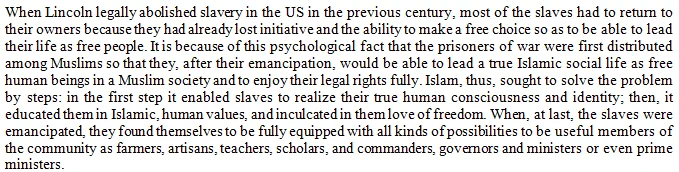
Islam ensured that freed slaves were not left without support or allies after their emancipation. The Prophet (PBUH) established a bond of brotherhood between them and their former masters, instructing them to call one another mawlá (helper or friend) so that they would stand by each other in times of need. Indeed, Islam reformed the institution of slavery by affirming that all human beings descend from a single progenitor—Adam (PBUH)—and that no one possesses an intrinsic right of superiority over another, regardless of race, nation, or social standing.40 The teachings of the Prophet (PBUH) became guiding principles that Muslims applied both as laws and as social norms:
•The Prophet (PBUH) said: “All people are the children of Adam, and Adam was [created] from dust.”41 This affirms the common descent of all humans, master and slave alike.
•The Prophet (PBUH) said: “An Arab has no superiority over a non-Arab, nor does a non-Arab have any superiority over an Arab, and a white person has no superiority over a black person, nor does a black person have any superiority over a white, except through piety and good actions.”42 The Prophet (PBUH) spoke these words during his Farewell Sermon. Indeed, he (PBUH) was always concerned about the well-being of slaves, mentioning them at times when he expected the greatest attention from his audience, such as during the Farewell Pilgrimage, when he addressed the largest assembly of his lifetime.
•The Prophet (PBUH) said: “Whoever kills his slave, we will kill him; and whoever mutilates his slave, we will mutilate him.”43 Thus, the slave came to be recognized as a human being whose personal safety was protected by a divine law that forbade any transgression against him.
•The Prophet (PBUH) said: “Indeed, your brothers are your servants whom Allah has placed under your hands (i.e., authority). Hence, anyone whose brother is under his hand must feed him from what he eats, clothe him from what he wears, and do not burden them with what they cannot bear; and if you do burden them with what they cannot bear, then help them.”44 Hence, unlike other civilizations, Islam required that slaves be regarded and treated within the framework of universal human brotherhood, rather than outside it.
•The Prophet (PBUH) said: “Whoever slaps or strikes his slave, his expiation is to manumit him.”45
•“Whoever accuses his slave of something while he (the slave) is innocent of what he alleged, he will be flogged on the Day of Resurrection, unless it turns out that what he said was true.”46 Thus, Islam upholds the dignity of slaves.
As evident from the above Prophetic traditions, Islam held masters fully accountable for the treatment of their slaves. It forbade physical abuse, false accusations, and the imposition of undue burdens upon slaves, while mandating their proper care, provision, and protection. In this way, Islam established the dignity, rights, and well-being of slaves, placing moral responsibility and justice at the heart of their treatment. Hence, Islamic teachings helped create a culture in which slaves were gradually assimilated into the community. As a result:
•While serving as head of state, ʿUthmān ibn ʿAffān [may Allāh be pleased with him] once had his servant pull his own ears publicly after he had earlier pulled the servant’s ear. Abū al-Malīḥ reported: ʿUthmān entered his house and found his servant boy playing in a camel’s trough. [Irritated,] ʿUthmān took him by the ear and tweaked it, but later regretted his action. He said to him (the servant boy), “Take my ear and tweak it in return.” ʿUthmān insisted that he do it, telling him to pull harder until he felt that what had been done to him was equal to what he had done. Then ʿUthmān remarked, “How easy is retribution in this world compared to retribution in the Hereafter!”47
•When ʿAbd ar-Raḥmān ibn ʿAwf walked among his slaves, no one could tell him apart from them.48 This was because he did not walk ahead of them, nor did he wear anything different from what they wore.
•One day ʿUmar ibn al-Khaṭṭāb passed by a group of people who were eating while their servants stood nearby. He said, ‘Why do I not see your servants eating with you? Do you not wish for them to share [in your meal])?’ A man replied, ‘No, by Allāh, O leader of the faithful. Rather, we reserve this for ourselves.’ ʿUmar became very angry and said, ‘What is the matter with people who reserve for themselves to the exclusion of their servants? May Allah do to them and do to them (i.e., deal with)!’ Then he said to the servants, ‘Sit down and eat.’ The servants sat and ate, while the leader of the faithful himself refrained from eating.49
•A man once entered upon Salmān al-Fārisī while he was making dough—though he was then the governor of al-Madāʾin (the Persian city of Ctesiphon). The man said to him, “O abū ʿAbd Allāh, what is this?” Salmān replied, “We have sent our servant on an errand, and we dislike for him to have two tasks at once.”50
In addition, slaves have priority over free men in any religious or worldly matters in which they are more capable or knowledgeable. For example, it is valid for a slave to lead the prayer if he is better versed in the Qurʾān or more proficient in its recitation and the rules of prayer than those present, including free men. In short, Muslims were commanded to hear to and obey even if a slave was appointed in charge of their affairs. Hence, slavery in Islam was fundamentally a system of kafālah (custodianship), that is, taking care of the captives of war and managing their affairs, making them productive members of society with guaranteed rights, rather than confining them to prisons and letting their potential go to waste while burdening the state. In this sense, slavery in Islam was somewhat a form of adoption, as slaves were treated like members of the family. Islam did not regard slaves as sub-human, nor as mere property or commodities. Rather, it recognized their human rights, ensured equality with their masters in terms of food and clothing, and forbade harming them in any way. Indeed, Islamic teachings were more than sufficient to grant slaves a safe and dignified life, and they remain unparalleled in the entire history of slave laws, both before and after the advent of Islam.
One might ask: When, in the history of Islam, were the teachings of humanity, fairness, and kindness in the treatment of slaves ever implemented? Anyone who asks such a question is not well-versed in Islamic history, for the achievements of Islam regarding slaves were not mere ideals but historical realities. Slaves in the Islamic world were not always at the bottom of the social hierarchy. On the contrary, they engaged in a wide range of work and responsibilities. They were honored, granted money to secure their freedom, sometimes married, and in some cases even became rulers. Unlike what occurred in the United States when a Black man—Barack Obama—became president, Muslims were not in the least disturbed when former slaves rose to positions of power. This is the natural outcome of Islam’s emphasis on the excellent treatment of slaves. Consider, for instance, Hārūn ar-Rashīd, whose name is known even among Western Europeans; although he was the son of a slave woman, he rose to wield authority over all Muslims. He was by no means the only example: the Mamluks, who were formerly slaves, ruled Egypt as well as much of the Middle East and North Africa from the 12th to the 15th century CE (approximately 648–923 AH). Indisputably, a significant number of slaves held positions of prestige, authority, and respect within the Islamic system, both culturally (in education, religion, and social life) and politically (in governance, administration, or military leadership). This was a result of Islam reforming the institution of slavery and transforming the attitudes of masters toward their slaves. Indeed, Islam treated slaves justly and kindly, sparing them the emotional and psychological traumas that pre-Islamic slaves, as well as slaves in the modern world, often endured and transmitted across generations. Hence, many slaves embraced Islam, became devout Muslims, and even sacrificed their lives in its cause. William Muir—19th-century Scottish Orientalist and historian of Islam—wrote:51

In addition to slaves who became leaders and military commanders, others rose to prominence as imāms (religious leaders) and as scholars, including Muḥammad ibn Sīrīn, Mujāhid ibn Jabr, al-Ḥasan al-Baṣrī, ʿAṭāʾ Allāh as-Sakandarī, Saʿīd ibn Jubayr, and others. This illustrates that exposing captives to the mercy of Islam was part of the wisdom behind slavery. The Prophet (PBUH) said: “Allāh marvels at a people who enter Paradise in chains.”52 This ḥadīth refers to prisoners of war who, upon being treated in accordance with Islamic guidelines by Muslims, embraced Islam and became steadfast believers.
In a nutshell, the falsehoods fabricated about Islam regarding slavery are entirely baseless. The truth is that the advent of Islam marked the restoration of human dignity to slaves. As discussed above, slavery was a deeply entrenched custom in the pre-Islamic world, and thus could not have been abolished abruptly, given its firm roots in the social and economic structures of pre-modern Arabia. Nevertheless, Islam introduced profound paradigm shifts that laid the groundwork for the eventual abolition of slavery. Indeed, it elevated the status of slaves to a level of humanity and dignity unprecedented anywhere else in the world, both in the ancient and modern eras. Gustave le Bon, the renowned French historian, remarked: “What is at least certain is that slavery among the Mahometans is very different from what it was among the Christians. The situation of slaves in the East is indeed much better than that of servants in Europe. They are part of the family, sometimes manage, as we have seen previously, to marry one of their master’s daughters and can rise to the highest positions. No humiliating idea is attached to slavery in the East, and it has been rightly said that the slave there is closer to his master than a servant with us.’’53
Notes and References
- 1
Muḥammad al-Bukhārī, Ṣaḥīḥ al-Bukhārī, (Cairo, Egypt: Dār as-Salām. 1999), book 24, ḥadīth: 27, available at: https://sunnah.com/bukhari:1423.
Abū Hurayrah [may Allāh be pleased with him] narrated from the Prophet (peace be upon him), who said: “Seven types of people will be shaded by Allāh under His Shade on the Day when there is no shade except His: … a man who gives in charity and hides it so that his left hand does not know what his right hand spends…”
- 2
Abū ʿAbd Allāh al-Qurṭubī, al-Jāmiʿ li-ʾAḥkām al-Qurʾān, (Bayrūt, Lebanon: Muʾassasat ar-Rissālah, 2006), commentary on verse 4:3.
- 3
Abū Dāwūd as-Sijistānī, Sunan Abī Dāwūd, (Cairo, Egypt: Maktabat al-Maʿārif, 1998), book: 43, ḥadīth: 203, available at: https://sunnah.com/abudawud:4975.
- 4
Muḥammad al-Bukhārī, Ṣaḥīḥ al-Bukhārī, (Cairo, Egypt: Dār as-Salām. 1999), book: 34, ḥadīth: 174, available at: https://sunnah.com/bukhari:2227.
- 5
Aḥmad ibn Ḥajar al-ʿAsqalānī, Fatḥ al-Bārī Sharḥ Ṣaḥīḥ al-Bukhārī, (Bayrūt, Lebanon: Dār al-Maʿrifah, 1959), vol. 7, p. 212.
- 6
Roger Du Pasquier, Unveiling Islam, (Cambridge, U.K.: Islamic Texts Society, 1992), p. 106, available at: https://archive.org/details/unveilingislam0000dupa/page/106/mode/2up?q=custom.
- 7
Abū Bakr al-Kāssānī, Badāʾiʿ aṣ-Ṣanāʾiʿ, (Bayrūt, Lebanon: Dār al-Kutub al-ʿIlmiyyah, 1986), vol. 9, p. 392.
- 8
Abū Zakariyyā Yaḥyá ibn Sharaf an-Nawawī, Riyāḍ aṣ-Ṣāliḥīn, (Bayrūt, Lebanon: Muʾassassat ar-Rissālah, 1998), introduction, ḥadīth: 474, available at: https://sunnah.com/riyadussalihin:474.
- 9
{It is not lawful for a believer to kill another except by mistake. And whoever kills a believer unintentionally must free a believing slave and pay blood-money to the victim’s family—unless they waive it charitably. But if the victim is a believer from a hostile people, then a believing slave must be freed. And if the victim is from a people bound with you in a treaty, then blood-money must be paid to the family along with freeing a believing slave. Those who are unable, let them fast two consecutive months—as a means of repentance to Allāh. And Allāh is All-Knowing, All-Wise} (Qurʾān 4:92).
- 10
Fethullah Gülen, “How is it that Islam, a Religion Inspired by Allāh for the Good of Humanity, Allows Slavery?” The Fountain, 1 Jan. 1994, https://fountainmagazine.com/1994/issue-5-january-march-1994/how-is-that-islam-a-religon-inspired-by-allah-for-the-good-of-humanity-allows-slavery.
- 11
Alfred Guillaume, The Life of Muḥammad: A Translation of Isḥāq’s Sīrat Rasūl Allāh, (Oxford, U.K.: Oxford University Press, 1955), p. 490–493.
- 12
Abū Dāwūd as-Sijistānī, Sunan Abī Dāwūd, (Cairo, Egypt: Maktabat al-Maʿārif, 1998), book: 31, ḥadīth: 6, available at: https://sunnah.com/abudawud:3931.
ʿĀʾishah [may Allah be pleased with her] narrated: Juwayriyah bint al-Ḥārith ibn al-Muṣṭaliq fell into the share of Thābit ibn Qays ibn Shammās, or one of his cousins. She entered into a mukātabah (an emancipation contract) for her own freedom…and when she approached the Prophet (PBUH) to request the completion of her mukātabah…she said, “O Messenger of Allah, I am Juwayriyah bint al-Ḥārith, and my matter is not hidden from you. I have fallen into the share of Thābit ibn Qays ibn Shammās, and I have entered into a mukātabah for my freedom, so I have come to ask you [assistance] regarding my mukātabah.” The Messenger of Allah (PBUH) said, “Would you like something better than that?” She asked, “And what is that, O Messenger of Allah?” He said, “I will fulfill your mukātabah on your behalf and marry you.” She replied, “I accept that.” When the people heard that the Messenger of Allah (PBUH) had married Juwayriyah, they released those among the prisoners who were in their hands, saying, “They are the in-laws of the Messenger of Allah (PBUH).”
- 13
Aḥmad ibn Ḥajar al-ʿAsqalānī, al-Iṣābah fī Tamyīz aṣ-Ṣaḥābah, (Bayrūt, Lebanon: Dār Iḥyāʾ at-Turāth al-ʿArabī, 1980), vol. 8, p. 74.
- 14
Kamal Badr, “What is a Captive that the Right Hands Possess?” Islam Online, accessed 28 May 2023, https://islamonline.net/en/what-is-a-captive-that-your-right-hands-possess-2/.
- 15
Sulṭān al-ʿUmayrī, Faḍāʾāt al-Ḥurriyyah, (Cairo, Egypt: al-Markaz al-ʿArabī li-d-Dirāssāt al-Insāniyyah, 2014).
- 16
Muḥammad Nāṣir ad-Dīn al-ʾAlbānī, as-Silsilah aṣ-Ṣaḥīḥah, (ar-Riyāḍ, Saudi Arabia: Maktabat al-Maʿārif, 1995), vol. 2, p. 314.
- 17
Abū Muḥammad ʿAlī ibn Aḥmad ibn Saʿīd ibn Ḥazm al-ʾAndalusī, Marātib al-Ijmāʿ, (Bayrūt, Lebanon: Dār al-Kutub al-ʿIlmiyyah, 1998), p. 201; abū Zakariyyā Yaḥyá ibn Sharaf an-Nawawī, al-Minhāj fī Sharḥ Ṣaḥīḥ Muslim ibn al-Ḥajjāj, (Cairo, Egypt: Muʾassasat Qurṭubah, 1994), vol. 12, p. 48, Aḥmad ibn ʿAbd al-Ḥalīm ibn Taymiyyah, aṣ-Ṣārim al-Maslūl, (Bayrūt, Lebanon: Dār al-Kutub al-ʿIlmiyyah, 1998), vol. 2, p. 253; Aḥmad ibn Ḥajar al-ʿAsqalānī, Fatḥ al-Bārī Sharḥ Ṣaḥīḥ al-Bukhārī, (Bayrūt, Lebanon: Dār al-Maʿrifah, 1959), vol. 6, p. 147
- 18
Abū al-Walīd al-Bājī al-Mālikī, al-Muntaqá: Sharh Muwaṭṭaʾ Mālik, (Cairo, Egypt: Dār al-Kitāb al-Islāmī, 1913), vol. 4, p. 82.
- 19
Al-Mawsūʿah al-Fiqhiyyah al-Kuwaytiyyah (Kuwaiti Encyclopedia of Islamic Jurisprudence), (Kuwait, Kuwait: Ministry of Endowments and Islamic Affairs, 1983), vol. 11, p. 297.
- 20
“On Physical Relations with Slave-Women in Islam,” Let me Turn the Tables, accessed 30 May 2023, https://www.letmeturnthetables.com/2012/09/no-rape-slave-women-islam.html.
- 21
Muḥammad at-Tirmiḏī, Jāmiʿ at-Tirmiḏī, (Cairo, Egypt: Dār at-Taʾṣīl, 2016), book: 17, ḥadīth: 34, available at: https://sunnah.com/tirmidhi:1451.
- 22
Abū al-Qāsim Sulaymān ibn Aḥmad aṭ-Ṭabarānī, al-Muʿjam al-Kabīr, (Cairo, Egypt: Maktabat ibn Taymiyyah, 1983), ḥadīth: 4147; Muḥammad Nāṣir ad-Dīn al-ʾAlbānī, as-Silsilah aṣ-Ṣaḥīḥah, (ar-Riyāḍ, Saudi Arabia: Maktabat al-Maʿārif, 1995), ḥadīth: 2417.
- 23
Mālik ibn Anas, al-Muwaṭṭaʾ, book 38, ḥadīth: 1471, https://sunnah.com/urn/514700.
- 24
ʿAbd Allāh ibn Muḥammad ibn abī Shaybah, Al-Muṣannaf, (Jaddah, Saudi Arabia: Dār al-Qiblah, 2006), ḥadīth: 21894.
- 25
Abū al-Walīd Muḥammad ibn Aḥmad ibn Rushd (Averroës), Bidāyat al-Mujtahid wa-Nihāyat al-Muqtaṣid (The Distinguished Jurist’s Premier), trans. Imran Ahsan Nyazee, (Reading, U.K.: Garnet Publishing, 1996), vol. 2, p. 476.
- 26
Ibid., vol. 2, p. 475.
- 27
Mālik ibn Anas, al-Muwaṭṭaʾ, (Bayrūt, Lebanon: Dār al-Ġarb al-Islāmī, 1997), book: 38, ḥadīth: 1472, available at: https://sunnah.com/urn/514710.
- 28
Muḥammad al-Bukhārī, Ṣaḥīḥ al-Bukhārī, (Cairo, Egypt: Dār as-Salām. 1999), book: 60, ḥadīth: 116, available at: https://sunnah.com/bukhari:3446.
- 29
Abū Dāwūd as-Sijistānī, Sunan Abī Dāwūd, (Cairo, Egypt: Maktabat al-Maʿārif, 1998), book: 43, ḥadīth: 384, available at: https://sunnah.com/abudawud:5156.
- 30
Abū Zakariyyā Yaḥyá ibn Sharaf an-Nawawī, al-ʾArbaʿūn an-Nawawiyyah, (Cairo, Egypt: Dār as-Salām, 2007), ḥadīth: 32, available at: https://sunnah.com/nawawi40:32.
- 31
Abū ʿAbd Allāh ash-Shāfiʿī, Kitāb al-Umm, (Bayrūt, Lebanon: Dār al-Maʿrifah, 1990), vol. 5, p. 203.
- 32
Abū Dāwūd as-Sijistānī, Sunan Abī Dāwūd, (Cairo, Egypt: Maktabat al-Maʿārif, 1998), book: 43, ḥadīth: 389, available at: https://sunnah.com/abudawud:5161.
- 33
Abū Bakr Aḥmad ibn Ḥusayn al-Bayhaqī, as-Sunan al-Kubrá, (Bayrūt, Lebanon: Dār al-Kutub al-ʿIlmiyyah, 2003), vol. 9, p.177, ḥadīth: 18222.
- 34
Abū ʿAbd Allāh ash-Shāfiʿī, Kitāb al-Umm, (Bayrūt, Lebanon: Dār al-Maʿrifah, 1990), vol. 3, p. 253.
- 35
Fethullah Gülen, “How is it that Islam, a Religion Inspired by Allāh for the Good of Humanity, Allows Slavery?” The Fountain, 1 Jan. 1994, https://fountainmagazine.com/1994/issue-5-january-march-1994/how-is-that-islam-a-religon-inspired-by-allah-for-the-good-of-humanity-allows-slavery.
- 36
Sayyid abū al-Aʿlá al-Mawdūdī, Towards Understanding the Qurʾān (English version of Tafhīm al-Qurʾān), trans. and edit. Zafar Isḥāq ʾAnṣārī, (Markfield, U.K.: The Islamic foundation, 1988), Chapter an-Nūr (Qurʾān 24:33), footnotes 58, available at: https://www.islamicstudies.info/tafheem.php?sura=24&verse=32&to=34.
- 37
Fethullah Gülen, “How is it that Islam, a Religion Inspired by Allāh for the Good of Humanity, Allows Slavery?” The Fountain, 1 Jan. 1994, https://fountainmagazine.com/1994/issue-5-january-march-1994/how-is-that-islam-a-religon-inspired-by-allah-for-the-good-of-humanity-allows-slavery.
- 38
Ibid.
- 39
Ibid.
- 40
{O humanity! Indeed, We created you from a male and a female, and made you into peoples and tribes so that you may ˹get to˺ know one another. Surely the most noble of you in the sight of Allāh is the most righteous among you. Allāh is truly All-Knowing, All-Aware} (Qurʾān 49:13).
- 41
Muḥammad at-Tirmiḏī, Jāmiʿ at-Tirmiḏī, (Cairo, Egypt: Dār at-Taʾṣīl, 2016), book 49, ḥadīth: 355, available at: https://sunnah.com/tirmidhi:3955.
- 42
Ibn Qayyim al-Jawziyyah, Zād al-Maʿād fī Hadyi Khayr al-ʿIbād, (Makkah al-Mukarramah, Saudi Arabia: ʿĀlam al-Fawāʾid, 2018), vol. 5, p. 144.
- 43
Abū ʿAbd ar-Raḥmān an-Nasāʾī, Sunan an-Nasāʾī, (Aleppo, Syria: Maktab al-Maṭbūʿāt al-Islāmiyyah, 1986), book: 45, ḥadīth: 33, available at: https://sunnah.com/nasai:4738.
- 44
Muḥammad al-Bukhārī, Ṣaḥīḥ al-Bukhārī, (Cairo, Egypt: Dār as-Salām. 1999), book: 49, ḥadīth: 28, available at: https://sunnah.com/bukhari:2545.
- 45
Muslim ibn al-Ḥajjāj, Ṣaḥīḥ Muslim, (Bayrūt, Lebanon: Dār al-Kutub ʿIlmiyyah, 2020), book: 27, ḥadīth: 45, available at: https://sunnah.com/muslim:1657a.
- 46
Muḥammad al-Bukhārī, Ṣaḥīḥ al-Bukhārī, (Cairo, Egypt: Dār as-Salām. 1999), book: 86, ḥadīth: 80, available at: https://sunnah.com/bukhari:6858.
- 47
ʿAbd Allāh ibn abī ad-Dunyā, al-Ahwāl, (Cairo, Egypt: Maktabat ʾĀl Yāssir, 1992), p. 255.
- 48
Shams ad-Dīn aḏ-Ḏahabī, Siyar Aʿlām an-Nubalāʾ, (Bayrūt, Lebanon: Muʾassassat ar-Risālah, 1996), vol. 1, p. 89.
- 49
ʿImād ad-Dīn abū al-Fidāʾ Ismāʿīl ibn ʿUmar ibn Kathīr, Musnad al-Fārūq, ʾAmīr al-Muʾminīn abī Ḥafṣ ʿUmar ibn al-Khaṭṭāb wa-Aqwāluhu ʿalā ʾAbwāb al-ʿIlm, (Al-Fayyūm, Egypt: Dār al-Falāḥ li-l-Baḥth al-ʿIlmī wa-Taḥqīq at-Turāth, 2009), p. 582.
- 50
Abū Nuʿaym al-Aṣbahānī, Ḥilyat al-Awliyāʾ wa-Ṭabaqāt al-Aṣfiyāʾ, (Bayrūt, Lebanon: Dār al-Kutub al-ʿIlmīyyah, 2010), p. 657.
- 51
William Muir, The Life of Moḥammad, (Edinburgh, U.K.: John Grant 31 George IV Bridge, 1923), p. 233–234, available at: https://ia804706.us.archive.org/10/items/lifeofmohammadfr00muir/lifeofmohammadfr00muir.pdf.
- 52
Muḥammad al-Bukhārī, Ṣaḥīḥ al-Bukhārī, (Cairo, Egypt: Dār as-Salām. 1999), book: 56, ḥadīth: 219, available at: https://sunnah.com/bukhari:3010.
- 53
Gustave Le Bon, La civilisation des Arabes, (Paris, France: Librairie de Firmin-Didot et Cie, 1884), book IV, p. 64, available at: https://archive.org/details/GustaveLeBonLaCivilisationDesArabesEditionIntegrale/page/n375/mode/2up.
Le Bon’s statement in French: “Ce qui est au moins certain, c'est que l'esclavage chez les mahométans est fort différent de ce qu'il était chez les chrétiens. La situation des esclaves en Orient est bien préférable en effet à celle des domestiques en Europe. Ils font partie de la famille, arrivent parfois, comme nous l'avons vu précédemment, à épouser une des filles de leur maître et peuvent s'élever aux plus hauts emplois. Aucune idée humiliante ne s'attache en Orient à l'esclavage, et on a dit avec raison que l'esclave y est plus près de son maître qu'un domestique chez nous.”