Did the Prophet (PBUH) order Zayd to divorce Zaynab bint Jaḥsh because he was enamored of her beauty?
The Prophet (PBUH)’s marriage to Zaynab bint Jaḥsh stands apart from his other marriages in that it is explicitly mentioned in the Qurʾān, wherein it is not only endorsed (divinely approved) but also contracted (solemnized by divine command). The context of this marriage is discussed in Chapter al-Aḥzāb (33:37, 40). Allah says: {And ˹remember, O Prophet,˺ when you said to the one for whom Allah has done a favour and you ˹too˺ have done a favour, “Keep your wife and fear Allah,” while concealing within yourself what Allah was going to reveal. And ˹so˺ you were considering the people, whereas Allah was more worthy of your consideration. So when Zayd totally lost interest in ˹keeping˺ his wife, We gave her to you in marriage, so that there would be no blame on the believers for marrying the ex-wives of their adopted sons after their divorce. And Allah’s command is totally binding} (Qurʾān 33:37). Allah further says: {Muḥammad is not the father of any of your men, but is the Messenger of Allah and the seal of the prophets. And Allah has ˹perfect˺ knowledge of all things} (Qurʾān 33:40). The dual purpose underlying the Prophet (PBUH)’s marriage to Zaynab was clearly and explicitly articulated in the Qurʾān immediately following its occurrence. The verses in question state unequivocally that the marriage was contracted for both social and sharʿī (Islamic legal) reasons. In essence, the Qurʾān presents a twofold rationale for this marriage. First, the Prophet (PBUH)’s subsequent marriage to Zaynab annulled the pre-Islamic prohibition against marrying the former wife of one’s adopted son, as well as the associated practice of assigning an adopted child the adoptive father’s patronym (i.e., family or ancestral name). This was because Zaynab had previously been married to Zayd ibn Ḥārithah, who was recognized as the Prophet (PBUH)’s adopted son and was known by his patronym (i.e., Zayd ibn Muḥammad). In other words, this marriage eliminated any social or legal basis for conflating an adopted son with a biological one—a conflation that had underpinned the pre-Islamic ban on marrying the former wife of an adopted son. Second, the marriage affirmed the absence of any male offspring attributable to the Prophet (PBUH), both at that time and thereafter, thereby signifying the finality of Prophethood with his death. The Qurʾān declares that the Prophet (PBUH) was not, nor would he be, the father of any male offspring, thereby ensuring that no descendant could assert a hereditary claim to his Prophethood or to the political authority derived from it. This declaration proved particularly prescient (showing remarkable foresight), as the Prophet (PBUH) had three biological sons, all of whom died in childhood. In fact, one of his sons passed away shortly after the revelation of the verse making this declaration.
As elaborated above, the Prophet (PBUH)’s marriage to Zaynab fulfilled important social and legal purposes. Nevertheless, it has become one of the most controversial episodes in his life and has long drawn the attention of his critics, particularly over the past few centuries. Nearly all prominent Western biographers of the Prophet (PBUH) discuss a version of the so-called “marriage out of infatuation” event in detail—even though it is conspicuously absent from the works of most Muslim biographers.1 The particulars of this peculiar event vary considerably across different versions, yet the central account proceeds as follows: one day, the Prophet (PBUH) went in search of Zayd, who was then married to Zaynab, the Prophet (PBUH)’s paternal cousin. Upon arriving at Zayd’s home, he found that Zayd was away and that only Zaynab was present to receive him (PBUH). She invited him (PBUH) to enter, but something in her appearance is said to have stirred a strong attraction in him, prompting him to leave immediately while uttering, “Glory be to Allah, who turns hearts as He wills.” When Zaynab informed Zayd of the Prophet (PBUH)’s visit and remark, Zayd understood its implication and at once offered to divorce her for the Prophet (PBUH)’s sake. However, the Prophet (PBUH) advised Zayd to maintain his marriage to Zaynab, though he is said to have inwardly desired that Zayd divorce her so he might marry her himself. For reasons left unclear, Zayd eventually proceeded to divorce Zaynab. Subsequently, the Prophet (PBUH) is described as receiving a revelation—recorded in Chapter al-ʾAḥzāb—that, while reproaching him for concealing his desire, nonetheless united him in marriage with Zaynab and fulfilled that desire. Dr. Hasan Ashraf termed this alleged event of marriage out of infatuation “the lovestruck narrative” in his paper.2 It is important to note that the full so-called marriage-out-of-infatuation event, as chronicled above, or even an abridged version of it, is conspicuously absent from the extant works of the earliest compilers of sīrah3 and maġāzī,4 most notably leading early authorities such as ʿUrwah ibn az-Zubayr, ibn Shihāb az-Zuhrī, Mūsá ibn ʿUqbah, Maʿmar ibn Rāshid, and, of course, Muḥammad ibn Isḥāq. It is, however, found in a handful of reports in some later and relatively obscure works of tafsīr (Qurʾān exegesis) and Ḥadīth (Prophetic traditions).5 David Powers—Professor of Near Eastern Studies at Cornell University and author of Zayd: The Little Known Story of Muḥammad’s Adopted Son and Muḥammad Is Not the Father of Any of Your Men: The Making of the Last Prophet—hinted that, since Ibn Isḥāq’s Kitāb al-Maġāzī (Book of the Prophet’s Expeditions) does not survive in its entirety and exists primarily in the abridgment of Ibn Hishām,6 it is likely that the latter bowdlerized (i.e., removed or sanitized) the lovestruck narrative.7 However, as Sean Anthony—Professor of Near Eastern Languages and Cultures at Ohio State University—noted in his critical review of Powers’ monograph (Zayd: The Little Known Story of Muḥammad’s Adopted Son)—the lovestruck narrative is absent not only from Ibn Hishām’s abridgement of Ibn Isḥāq’s Kitāb al-Maġāzī, but from all extant recensions of it (i.e., different versions or editions of the text preserved by various transmitters): the Madīnan recension of Ibrāhīm ibn Saʿd ibn Ibrāhīm; the Kūfan recensions of Ziyād al-Bakkāʾī and Yūnus ibn Bukayr; the Ḥarrānian recension of Muḥammad ibn Salamah al-Ḥarrānī; and the ar-Rayy recension of Salamah ibn al-Faḍl. Accordingly, the concise reference that Ibn Hishām and the other compilers uniformly made regarding the Prophet (PBUH)’s marriage to Zaynab, without any hint of the lovestruck narrative, is a faithful representation of Ibn Isḥāq’s original work.8
The argument advanced by those who affirm the historicity of the lovestruck narrative is straightforward and rests on what is known as the criterion of embarrassment—a principle of historical analysis whereby an account is considered likely to be authentic on the assumption that an author would have had no motive to invent an account that could reflect unfavorably upon or embarrass themselves or their cause. In essence, they point out that the reports that relate the marriage-out-of-infatuation event appear in works of Qurʾān exegesis and Ḥadīth authored and compiled by Muslims, and it is improbable that Muslims would have fabricated multiple false reports depicting the Prophet (PBUH) in such an unfavorable manner. Accordingly, proponents of the lovestruck narrative argue that these reports must be authentic and reflect an actual historical event. Before shedding light on Muslim responses and interpretations of this alleged marriage-out-of-infatuation event, it is noteworthy that even some distinguished Western scholars have questioned the historicity of the so-called lovestruck narrative. Montgomery Watt, the most prominent Western biographer of the Prophet (PBUH), questioned the historicity of the lovestruck narrative and situated the Prophet (PBUH)’s marriage to Zaynab within the broader context of the social reforms that he was seeking to enact.9 Watt suggested that the marriage was a “political act” aimed at ending the pre-Islamic practice of equating adopted sons with biological ones. He also noted that Prophet Muḥammad regarded the marriage as a duty imposed on him by God. Recently, Wilferd Madelung—an eminent historian of early Islam and Professor Emeritus at the University of Oxford, renowned for his extensive scholarship on early Islamic history—has likewise questioned the historicity of this narrative.10
The most prominent classical (medieval—that is, from roughly the 8th to 15th centuries CE) Qurʾān exegetes, Ḥadīth scholars, and biographers of the Prophet (PBUH) rejected the veracity of the lovestruck narrative. Their collective repudiation is epitomized by Ibn al-Qayyim, who sharply denounced those affirming the narrative’s authenticity as “ignorant” individuals who “do not esteem the Messenger of Allah as he deserves to be esteemed.”11 Several Muslim scholars who apparently regarded the lovestruck narrative as baseless chose not to engage with it in detail or even not to mention it at all.12 This approach is illustrated in Ibn Kathīr’s brief assessment of verse 37 of Chapter al-ʾAḥzāb, where he discussed reports from early Islamic authorities that he deemed lacking in authenticity and therefore chose to pass over in his exegesis, reflecting his rigorous commitment to relying solely on authentic sources. He stated: “Ibn Jārīr and Ibn abī Ḥātim mentioned here reports from some of the Predecessors [may Allāh be pleased with them], but they are ones that we would prefer to pass over because of their lack of authenticity, and so we do not include them. Imām Aḥmad also narrated here a ḥadīth transmitted by Ḥammād ibn Zayd from Thābit from Anas, in which there is ġarābah (oddity); we have likewise omitted its full context.”13 Those commentators on the verses in Chapter al-ʾAḥzāb who rejected the so-called lovestruck narrative—whether explicitly or implicitly—offered instead a simpler and more coherent version of the marriage account. Al-Qāḍī ʿIyāḍ called this version “the more sound view,” while Ibn Ḥajar praised it as “a clear and satisfactory narrative.”14 According to this account, the Prophet (PBUH) was informed through divine revelation of his forthcoming marriage to Zaynab [may Allah be pleased with her]. However, when Zayd [may Allah be pleased with him] approached him seeking a divorce from Zaynab, the Prophet (PBUH)—naturally mindful of the criticism he would face from his many detractors for defying established marital norms, namely the prohibition against marrying an adopted son’s former wife, as Ibn Ḥajar noted [“He felt embarrassed… and he feared that people would criticize him and say that he had married his son’s wife.”]—advised him to maintain the marriage. Consequently, Allah censured the Prophet (PBUH) in the Qurʾān for being overly concerned with the judgments of others and enacted the marriage Himself.
The rebuttals of the lovestruck narrative by medieval and contemporary Muslim biographers of the Prophet (PBUH) focus primarily on three arguments. First, as Abū Bakr ibn al-ʿArabī argued, none of the ḥadīths (narrations) that mention the marriage-out-of-infatuation event are free from significant narrative weaknesses.15 None has an isnād (chain of narrators) that is truly muttaṣil (extends continuously back to the Prophet, PBUH), and only one traces back to a Companion of the Prophet (PBUH)—and that too to a Companion who did not witness the event in question. Moreover, not a single ḥadīth is devoid of at least one impugned (i.e., questionable or unreliable) narrator in its isnād, and many have no isnād at all. This renders all of the ḥadīths, at best, severely ḍaʿīf (weak) and unsuitable for taṣḥīḥ li-ġayrihi (cumulative validation),16 if not entirely mawḍūʿ (fabricated).17 The late contemporary Ḥadīth expert Muḥammad al-ʾAlbānī reviewed a number of the transmissions concerning the alleged marriage-out-of-infatuation event—though not all of them—in his compendium of weak ḥadīths, and he graded them as munkar jiddan (severely repudiated) and entirely mawḍūʿ (fabricated).18 Second, Qāḍī ʿIyāḍ and Ibn al-ʿArabī both observed that Zaynab was not a stranger to the Prophet (PBUH); she was, in fact, his paternal cousin. During a time when the prescription of ḥijāb had not yet been instituted, it is hard to imagine that the Prophet (PBUH) had not already met Zaynab prior to the incident at Zayd’s house, when he is alleged to have become enamored of her beauty. Indeed, certain ḥadīths record direct interactions between them that occurred prior to the so-called infatuation event, such as when the Prophet (PBUH) visited Zaynab’s home to propose to her on behalf of Zayd.19 It should be noted that the isnād of the ḥadīth reporting this proposal visit includes narrators whose reliability has been questioned; nevertheless, there are several other distinct supporting ḥadīths that indicate interactions between the Prophet (PBUH) and Zaynab prior to her marriage to Zayd.20 The point, then, is that it is implausible to suggest that the Prophet (PBUH) suddenly became aware of Zaynab’s beauty and fell infatuated with her after a single glimpse late in his life—particularly considering that she was thirty-eight years old at the time of their marriage.21 Third and finally, it was the Prophet (PBUH) himself who arranged the marriage between Zaynab and Zayd [may Allah be pleased with them both]—a union initially met with considerable reluctance from both Zaynab and her brother, ʿAbd Allāh ibn Jaḥsh—due to Zayd’s former status as a slave—who had to be persuaded first by the Prophet (PBUH) and ultimately by the Qurʾān before they consented.22 As previously mentioned, Zaynab was a lady of noble birth and a close relative of the Prophet (PBUH), whereas Zayd had been a slave gifted to him by his wife Khadījah, whom he later freed and adopted as a son. The Prophet (PBUH) arranged Zayd’s marriage to Zaynab in order to establish equality among the Muslims and to dismantle the pre-Islamic custom that confined marriage to members of the same social status. Zaynab was initially reluctant, but she consented out of obedience to Allāh and in fulfillment of the wishes of His Messenger (PBUH). Hence, had the Prophet (PBUH) wished to marry Zaynab at that time, he could easily have done so rather than encouraging her to marry Zayd. The Jaḥsh family would have eagerly welcomed a marriage between Zaynab and the Prophet (PBUH), who was a noble Qurayshī and had never been a slave. Zaynab herself did not share the same level of lineage prestige, since although her mother was from the Quraysh, Arab tribal identity and status were determined through the father’s line, and her father, Jaḥsh ibn Riʾāb, belonged to Banū Asad ibn Khuzaymah—a tribe of lesser standing than the Quraysh. That her family would have been pleased with such a match is not mere conjecture: both ʿAbd ar-Razzāq aṣ-Ṣanʿānī and Muḥammad ibn Jarīr aṭ-Ṭabarī reported that when the Prophet (PBUH) visited Zaynab to convey a marriage proposal on behalf of Zayd, she initially thought the proposal was for herself and was overjoyed. When she learned that it was Zayd, not the Prophet (PBUH), who sought to marry her, she initially declined until the revelation of the verse in Chapter al-ʾAḥzāb which commanded obedience to the Prophet (PBUH) in all matters: {It is not for a believing man or woman—when Allah and His Messenger decree a matter—to have any other choice in that matter. Indeed, whoever disobeys Allah and His Messenger has clearly gone ˹far˺ astray} (Qurʾān 33:36).23 The marriage eventually took place, but it proved unsustainable due to the couple’s mutual incompatibility. Zayd repeatedly complained to the Prophet (PBUH) about Zaynab and expressed his desire to divorce her. However, the Prophet (PBUH) urged him to remain with her and be patient, advising him, “Keep your wife and fear Allah.” This is affirmed in both the Qurʾān24 and the Sunnah.25 Eventually, the issues between Zayd and Zaynab at home became too much for Zayd, and divorce followed. During the period of marital difficulties between Zayd and Zaynab, the Prophet (PBUH) had already received revelation that their marriage would end in divorce and that he would later marry Zaynab. After the divorce, Allah commanded the Prophet (PBUH) to marry her. Yet, in his heart, he was reluctant, fearing that people would speak ill of him since she had been married to his adopted son. Allah then revealed to him that he should fear Him rather than the people. Thereafter, the marriage took place in accordance with Allah’s command. Clearly, if the Prophet (PBUH) had been motivated by love or desire for Zaynab, he would not have arranged her marriage to Zayd in the first place. Moreover, had such claims been true, he (PBUH) would have permitted Zayd to divorce her the first time he came complaining, instead of repeatedly advising him to fear Allah and to keep his wife. Interestingly, the Prophet (PBUH) could foresee the false accusation that slanderers would fabricate to tarnish his impeccable character. Hence, he (PBUH) arranged for Zayd himself to propose to Zaynab on his behalf, as if deliberately to silence those who would later raise the allegation that he married her out of lust after becoming infatuated with her beauty while she was still married to Zayd. Anas reported: “When Zaynab’s ʿiddah (the period a woman must observe after divorce, during which she may not marry another man) ended, the Messenger of Allah (PBUH) said to Zayd, ‘Go and mention me to her (i.e., inform her that I wish to marry her).’ So Zayd set out and reached her while she was leavening her dough. He said: ‘When I saw her, awe overcame my heart so much that I could not look at her,26 as the Messenger of Allah (PBUH) mentioned her (i.e., his intention to marry her), so I turned my back to her and retreated. So I said, O Zaynab, the Messenger of Allah (PBUH) is mentioning you (i.e., his intention to marry you).’ She replied, ‘I will not do anything until I consult with my Lord.’ Then she rose and went to her praying place [in her house], and the Qurʾān was revealed [the verse contracting her marriage to the Prophet (PBUH)].27 The three arguments elaborated above, which form the primary foundation for the rebuttals of the lovestruck narrative by medieval and contemporary Muslim biographers of the Prophet (PBUH), may appear circumstantial individually, but collectively they are reasonable and even compelling, leading several Muslim historians to regard the lovestruck narrative as highly improbable. Nevertheless, much more can be said about the Prophet (PBUH)’s marriage to Zaynab. As we shall see, a close examination of the primary sources—the Qurʾān and the very ḥadīths that recount the so-called lovestruck narrative—reveals extensive evidence that challenges the narrative, rendering it not merely improbable but entirely untenable.
Dr. Hasan Ashraf—an Assistant Professor at the Mayo Clinic School of Medicine, whose research interests include the history of Arabia during Late Antiquity, early Islamic historiography, and the intersection of the early maġāzī (Prophetic expeditions) literature and Ḥadīth (Prophetic traditions)—conducted a detailed study analyzing the primary texts related to the marriage-out-of-infatuation event. This included the Qurʾān, as the preserved primary source documenting the marriage at the time of its occurrence, as well as the ḥadīths that recount the so-called lovestruck narrative. Ashraf argued that these sources provide a wealth of information that poses critical challenges to the lovestruck narrative. He then examined the underlying motives for the Qurʾānic injunction regarding the Prophet (PBUH)’s marriage to Zaynab, situating it within the pre-Islamic sociological context in which the marriage took place. He demonstrated that, far from being a marriage based on passion or desire, it was necessary to implement social and specifically marital reforms. Ashraf noted that the Qurʾānic evidence for this is found in the few verses of Chapter al-ʾAḥzāb that directly address the Prophet (PBUH)’s marriage to Zaynab.28 He asserted that several aspects of this marriage are illuminated by these verses:29

The precise wording of these verses immediately renders the lovestruck narrative entirely implausible:30
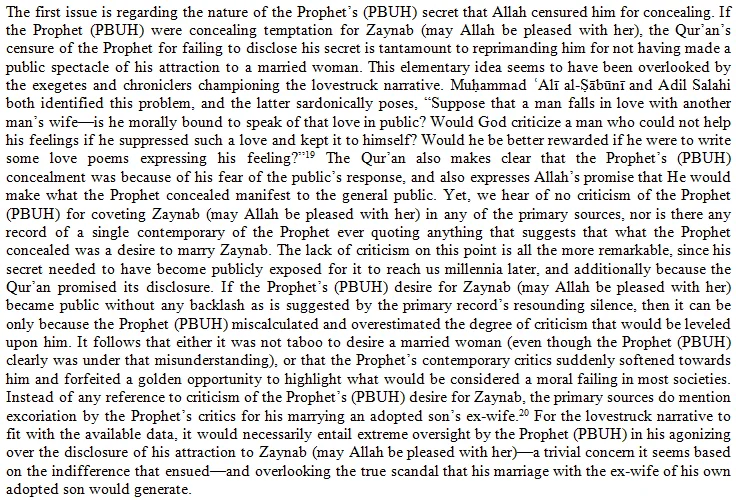
Ashraf further argued that:31
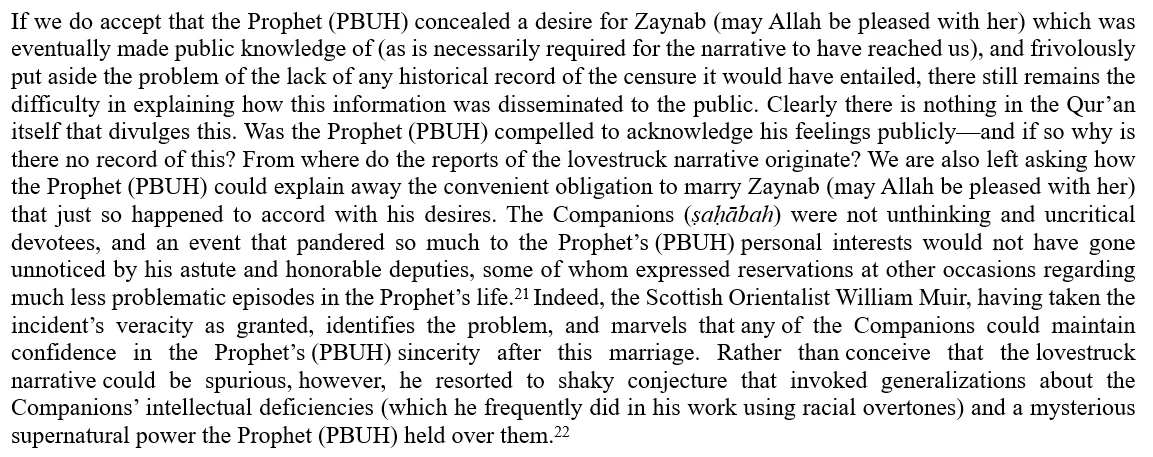
Conversely, the interpretation of the event offered by medieval and modern Muslim exegetes and historians who reject the lovestruck narrative align far more closely with the verses in Chapter al-ʾAḥzāb:32

As Ashraf observed, unlike the lovestruck narrative, this interpretation is compelling in its simplicity, consistent with the Qurʾānic verses in their entirety, and requires no fanciful tales from obscure sources to make sense of them:33
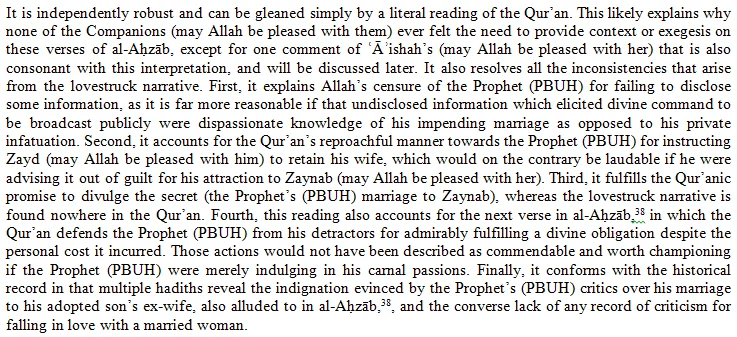
Ashraf then turned his attention to the reports that mention the lovestruck narrative. He began by listing all the reports that recount either the full version of the narrative or parts of it.34 He then analyzed these from a textual standpoint, revealing numerous insurmountable internal and historical inconsistencies. He included the isnāds (chains of transmission) not only to facilitate his subsequent isnād analysis, but also because the identities of the transmitters play a crucial role in tracing the historiographical development of the narrative—a task he undertook later in his study. Ashraf first noted that a superficial analysis might give the impression that the sheer number of reports about this event renders it a compelling account—as some have hastily concluded—but a closer examination reveals several major difficulties:35
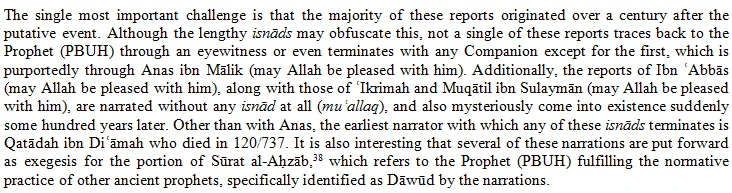
Ashraf observed that several reports concerning the Prophet (PBUH)’s marriage to Zaynab contain additional details. He focused on a select few that are either sound or offer valuable insights from a historiographical perspective:36

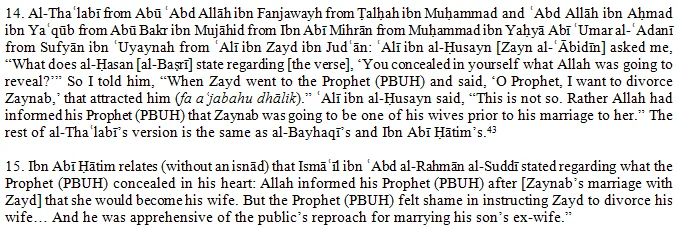
Ashraf pointed out that the final report is particularly noteworthy, as it provides additional detail that complements ʿAlī Zayn al-ʿĀbidīn’s exegesis:37

Ashraf asserted, in his textual analysis of the reports that reference the lovestruck narrative, that the first ten can be dismissed outright based on their internal content, even before subjecting them to a rigorous isnād analysis:38

Ashraf also noted that, apart from the reports of Anas and Muqātil ibn Sulaymān, none of the reports endorsing the lovestruck narrative indicate any domestic discord between Zayd and Zaynab prior to the Prophet (PBUH)’s visit to their home:39

As Ashraf elaborated, an additional internal difficulty with these reports is the allegation that Zayd offered his wife to the Prophet (PBUH) for marriage in the first place—not because it contravened pre-Islamic Arab—and Islamic—notions of honor—which it did—but because the prevailing social norms of the time regarded such an act as incestuous.40
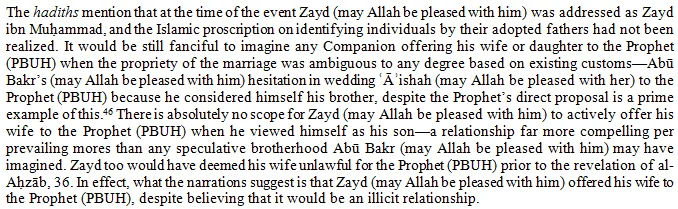
Ashraf also highlighted additional minor issues found in certain reports concerning the lovestruck narrative:41
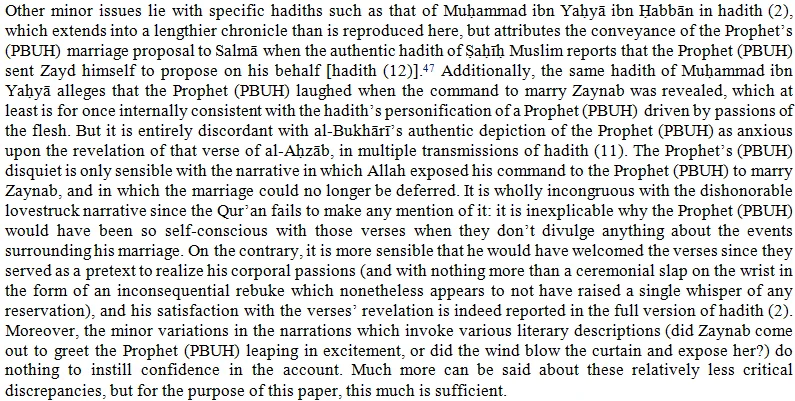
It is clear from the above that Ashraf has thoroughly refuted the lovestruck narrative. Nevertheless, he also provided a detailed isnād analysis, which at this stage serves primarily academic purposes.42
In a nutshell, the opponents of Islam disregard the explicit purposes of the Prophet (PBUH)’s marriage to Zaynab as articulated in the Qurʾān, instead portraying it as motivated by lust. They rely on a handful of inauthentic reports to support their lovestruck narrative. Essentially, they claim that the Prophet (PBUH) glimpsed Zaynab while she was the wife of his adopted son, Zayd, and became infatuated by her beauty, wherefore he promptly married her after her divorce. However, as elaborated above, the textual and contextual details of the reports promoting the lovestruck narrative decisively undermine its validity. The purposes of the Prophet (PBUH)’s marriage to Zaynab are unambiguously laid out in the Qurʾān: namely, the abrogation of the unjust pre-Islamic practice of adoption and the theological affirmation that the Prophethood of Muḥammad was not to be succeeded through lineage, unlike that of the Prophets of old—such as Ibrāhīm, Yaʿqūb, and Dāwūd (peace be upon them)—whose successors came from their own lineage. As noted earlier, the Qurʾān’s declaration that the Prophet (PBUH) would not be the father of any male offspring was particularly prescient, since none of his biological sons survived to maturity, and one died during childhood after the revelation of the verse making this declaration. Indeed, the social context necessitated the Prophet (PBUH)’s marriage to Zaynab, as it was imperative to abolish the pre-Islamic practice of adoption, which often fostered oppression. This practice was deeply entrenched in society at the time, and its eradication could not have been accomplished without a Prophetic precedent. As we have seen, invoking other grounds for the marriage—such as love or infatuation, as suggested in the lovestruck narrative—leads to contrived and incongruous inferences that conflict with the objectives explicitly articulated in the Qurʾān for it. Finally, the limitations of the simplistic explanation, that rests on the assumption that widely circulated tales must be authentic, are particularly evident in the case of the lovestruck narrative. Such reasoning has several inherent problems: it overestimates the reliability of popular accounts (assuming a narrative is accurate merely because it is widely repeated, without critically examining its sources or credibility), disregards the historical context in which these accounts first appeared (failing to consider when and under what circumstances the narrative emerged), overlooks the credibility of the accounts’ narrators (ignoring the reliability of the narrative’s transmitters), and neglects corroborating evidence (disregarding inconsistencies within the narrative and contradictions with other primary sources, such as the Qurʾān and authentic Prophetic traditions). In the case of the lovestruck narrative, it is entirely absent from the historical records of the first century after the Prophet (PBUH), indicating that its later circulation cannot be taken as evidence of authenticity. Relying on it as such is therefore both mistaken and misleading. The later appearance of the lovestruck narrative in so-called “early” tafsīr (Qurʾānic exegesis) works, such as that of aṭ-Ṭabarī, adds little credibility, since these commentaries were composed nearly three centuries after the Prophet (PBUH), well after the earliest generations of Muslims. By that time, versions of this narrative had already begun spreading through oral storytelling and popular retelling among later, less rigorous commentators, rather than through verified scholarly transmission. In other words, the appearance of the lovestruck narrative in those works reflects its later popularity rather than indicating an early, authentic origin. A careful historical analysis—one that gathers all existing reports promoting the lovestruck narrative and compares their wording—shows how the story gradually changed over time: it began with the Prophet (PBUH) fearing public criticism for marrying Zaynab and marrying her only after a Qurʾānic command, then evolved into him desiring the marriage, and finally into a tale of infatuation, where he was said to have fallen in love with her after a single glimpse, in a way reminiscent of the biblical story of David and Bathsheba. By the time it entered tafsīr works, this embellished tale—spread by storytellers and less critical commentators—had taken on a life of its own, evolving into a romantic legend that was passed down through generations and mistakenly regarded by many as a historical truth.
Notes and References
- 1
Washington Irving, Mahomet and His Successors,(New York, U.S.: The Cooperative Publishing Society, 1849), pp. 141–42; William Muir, The Life of Mahomet, (London, U.K.: Smith, Elder and Co., 1861), vol. 3, p. 231; David Margoliouth, Mohammed and the Rise of Islam, (New York, U.S. and London, U.K.: G. P. Putnam’s Sons, 1905), pp. 320–21; William Tisdall, The Religion of the Crescent or Islam: Its Strength, Its Weakness, Its Origin, Its Influence, (London: Society for Promoting Christian Knowledge, 1895), p. 177; Maxime Rodinson, Muhammad, (Middlesex, U.K.: Penguin Books, 1971), pp. 205–8; Nabia Abbott, Aishah: The Beloved of Mohammed,(London, U.K.: Saqi Books, 1998), pp. 16–18; Karen Armstrong, Muḥammad: A Prophet for Our Time,(New York, U.S.: Harper Press, 2007), p. 167.
- 2
Hasan Ashraf, “The Prophet’s (PBUH) Marriage to Zaynab bint Jaḥsh: A Reexamination from a Historiographic Perspective,” Yaqeen Institute, updated 22 March 2023, https://yaqeeninstitute.org/read/paper/the-prophets-marriage-to-zaynab-bint-jahsh#ftnt11.
“Almost all prominent Western biographies of the Prophet (PBUH), no matter how cursory their engagement of other critical issues, include the elaborate details of a variant of this event which does not even appear in most Muslim biographies. The full details of this peculiar variant differ quite a bit among various narrations, but the general theme is as follows: one day the Prophet (PBUH) went searching for Zayd ibn Ḥārithah, then married to Zaynab (who also happened to be the Prophet’s paternal cousin). Upon reaching Zayd’s house, he discovered that Zayd had stepped out, and only Zaynab remained to greet him. Zaynab invited the Prophet in, but something in her appearance stimulated a strong attraction to her in the Prophet (PBUH), and he immediately departed, uttering, “Glory be to Allāh, who causes hearts to turn!” Zaynab informed Zayd of his visit and statement, who recognized its implication, and immediately offered to divorce Zaynab for the Prophet’s benefit. The Prophet (PBUH), however, advised Zayd to uphold his marriage with Zaynab, though he concealed his inner desire that Zayd divorce her so that he could marry her instead. Zayd for one reason or another undertook his own initiative to divorce Zaynab. The Prophet (PBUH) then received a timely revelation (preserved in the aforementioned sūrat al-Aḥzāb) that, though it censured the Prophet for concealing his desires, wed the Prophet (PBUH) with Zaynab anyway and satisfied the Prophet’s deep desire…The argument forwarded by proponents of the historicity of what is termed in this paper “the lovestruck narrative” for succinctness is quite simple…”
- 3
Works on the biography and life of the Prophet (PBUH), which typically record significant events, including his marriages.
- 4
Works primarily focused on the Prophet (PBUH)’s expeditions, but which sometimes include events of sharʿī (Islamic legal), social, or theological significance, such as his marriages.
- 5
Later Qurʾānic commentaries that are not well-known or widely read, in contrast to the major, widely cited tafsīr works.
- 6
Ibn Hishām was a later editor who acknowledged editing, expurgating, or sanitizing the less savory portions of Ibn Isḥāq’s Kitāb al-Maġāzī (Book of the Prophet’s Expeditions). He explicitly stated that he omitted “things which it is disgraceful to discuss” and “matters which would distress certain people,” as well as reports he could not accept as trustworthy. In other words, Ibn Hishām actively curated the content he included, potentially removing or altering narratives he deemed inappropriate or unreliable. Consequently, some critics suggest that he may have edited out or modified the “lovestruck narrative” concerning the Prophet (PBUH)’s marriage to Zaynab bint Jaḥsh, particularly if he considered it contentious or inconsistent with the image he wished to present of the Prophet (PBUH).
- 7
David Powers, Zayd: The Little Known Story of Muḥammad’s Adopted Son, (Philadelphia, U.S.: University of Pennsylvania Press, 2014), p. 15 as cited in ibid., footnote 2.
- 8
Sean Anthony, “Review of David S. Powers, Zayd,” Review of Qur’anic Research, vol. 1, no. 1, 2015, pp. 1–5, available at: https://lockwoodonlinejournals.com/index.php/rqr/article/view/339 as cited in Hasan Ashraf, “The Prophet’s (PBUH) Marriage to Zaynab bint Jaḥsh: A Reexamination from a Historiographic Perspective,” Yaqeen Institute, updated 22 March 2023, https://yaqeeninstitute.org/read/paper/the-prophets-marriage-to-zaynab-bint-jahsh#ftnt11, footnote 2.
- 9
Montgomery Watt, Muhammad at Medina, (Oxford, U.K.: Oxford University Press, 1956), pp. 282–83.
- 10
Wilferd Madelung, “Social Legislation in Sūrat al-Aḥzāb,” in Islam and Globalization: Historical and Contemporary Perspectives (Proceedings of the 25th Congress of L’Union Européenne des Arabisants et Islamisants), Orientalia Lovaniensia Analecta, vol. 226 (Leuven, Belgium: Peeters, 2013), pp. 197–203.
- 11
Ibn Qayyim al-Jawziyyah, Zād al-Maʿād fī Hadyi Khayri al-ʿIbād, (Bayrūt, Lebanon: Muʾassasat ar-Risālah, 1998), vol. 4, pp. 244–46; ---., ad-Dāʾ wa-ad-Dawāʾ, (Makkah, Saudi Arabia: Dār ʿĀlam al-Fawāʾid, 2008), pp. 528, 554–55.
- 12
Among those who eschewed any reference to the narrative in modern times are Ṣafiyy ar-Raḥmān al- Mubārakfūrī, ar-Raḥīq al-Makhtūm, (ar-Riyāḍ, Saudi Arabia: Maktabat Darussalam, 1979); abū al-Ḥasan ʿAlī an-Nadwī, Prophet of Mercy, (London, U.K.: Turāth Publishing, 2014); ʿAlī Muḥammad aṣ-Ṣallābī, The Noble Life of the Prophet, (ar-Riyāḍ, Saudi Arabia: Maktabat Dār as-Salām, 2005).
- 13
ʿImād ad-Dīn abū al-Fidāʾ Ismāʿīl ibn ʿUmar ibn Kathīr, Tafsīr al-Qurʾān al-ʿAẓīm, (ar-Riyāḍ, Saudi Arabia: Dār Ṭaybah, 1997), vol. 6, p. 425.
- 14
Al-Qāḍī ʿIyāḍ ibn Mūsá, ash-Shifāʾ bi-Taʿrīf Ḥuqūq al-Muṣṭafá, (Bayrūt, Lebanon: Dār al-Kitāb al-ʿArabī, 1984), pp. 876–879; Aḥmad ibn Ḥajar al-ʿAsqalānī, Fatḥ al-Bārī Sharḥ Ṣaḥīḥ al-Bukhārī, (Bayrūt, Lebanon: Dār al-Maʿrifah, 1959), vol. 14, pp. 158–159.
- 15
Abū Bakr Muḥammad ibn ʿAbd Allāh ibn al-ʿArabī, ʾAḥkām al-Qurʾān, (Bayrut, Lebanon: Dār al-Kutub al-ʿIlmiyyah, 2003), vol. 3, pp. 576–78.
- 16
Hasan Ashraf, “The Prophet’s (PBUH) Marriage to Zaynab bint Jaḥsh: A Reexamination from a Historiographic Perspective,” Yaqeen Institute, updated 22 March 2023, https://yaqeeninstitute.org/read/paper/the-prophets-marriage-to-zaynab-bint-jahsh#ftnt11, footnote 12
That is, fabricated, extremely weak reports and reports arising from the same source cannot be used to corroborate one another and raise the grading of a specific hadith, though mildly defective reports of a multiplicity of origins can be utilized in this manner. This is for obvious reasons, since two fabricated reports provide no incremental epistemological strength to a report even if they present the same information, particularly if they draw on the same fabricated parent report. This is underscored in the case of the lovestruck narrative, whose multiple variant transmissions share a common origin, as will be demonstrated later. This is the reason that mutawātir reports require a preponderance of transmitters at every level in the isnād. All of the reports of the lovestruck narrative are devoid of a single eyewitness, and all but one are lacking even a narrator for the first century after the Prophet; thus, the unprecedented claim made in recent times that these reports collectively are mutawātir is ultimately baseless.
- 17
Ibn aṣ-Ṣalāḥ ash-Shahrazūrī, Muqaddimah, ed. Nūr ad-Dīn ʿIṭr, (Damascus, Syria: Dār al-Fikr, 1986), pp. 33–35; Ibn Ḥajar al-ʿAsqalānī, Nuzhat al-naẓar, ed. Nūr ad-Dīn ʿIṭr, (Karachi, Pakistan: Maktabat al-Bushrá, 2011), pp.60–61; Jalāl ad-Dīn as-Suyūṭī, Tadrīb ar-Rāwī fī Sharḥ Taqrīb an-Nawawī,ed. Muḥammad ʿAwwāmah, (Jaddah and al-Madīnah: Dār al-Minhāj and Dār al-Yusr, 2016), vol. 3, pp. 72–76.
- 18
Muḥammad Nāṣir ad-Dīn al-ʾAlbānī, Silsilat al-ʾAḥādīth aḍ-Ḍaʿīfah wa-l-Mawḍūʿah, (ar-Riyāḍ, Saudi Arabia: Maktabat al-Maʿārif, 2000), vol. 7, p. 402, entry 3390 and vol. 14, pp. 799–801, entry 6848.
- 19
Abū Jaʿfar Muḥammad ibn Jarīr aṭ-Ṭabarī, Jāmiʿ al-Bayān fī Tafsīr al-Qurʾān, (Bayrūt, Lebanon: Muʾassassat ar-Risālah, 2000), vol. 19, pp. 112–13
- 20
ʿAlī ibn ʿUmar ad-Dāraquṭnī, Sunan ad-Dāraquṭnī, (Bayrut, Lebanon: Muʾassasat ar-Risālah, 2004), vol. 4, pp. 461–62, ḥadīth: 3796; Abū Bakr Aḥmad ibn Ḥusayn al-Bayhaqī, as-Sunan al-Kubrá, (Bayrūt, Lebanon: Dār al-Kutub al-ʿIlmiyyah, 2003), vol. 14, pp. 176–77, ḥadīth: 13896.
- 21
Abū ʿAbd Allāh Muḥammad ibn Saʿd, aṭ-Ṭabaqāt al-Kubrá (The Book of the Major Classes), (Bayrūt, Lebanon: Dār al-Kutub al-ʿIlmiyyah, 1990), vol. 10, p. 111
- 22
Abū Jaʿfar Muḥammad ibn Jarīr aṭ-Ṭabarī, Jāmiʿ al-Bayān fī Tafsīr al-Qurʾān, (Bayrūt, Lebanon: Muʾassassat ar-Risālah, 2000), vol. 19, pp. 112–15; Jalāl ad-Dīn as-Suyūṭī, ad-Dur al-Manthūr fī at-Tafsīr bi-l-Maʾthūr, (Cairo, Egypt: Markaz al-Buḥūth wa-d-Dirāsāt al-ʿArabīyyah wa-l-Islāmīyyah, 2003), vol. 12, p. 49
- 23
ʿAbd ar-Razzāq aṣ-Ṣanʿānī, Tafsīr ʿAbd ar-Razzāq aṣ-Ṣanʿānī, (Bayrut, Lebanon: Dār al-Kutub al-ʿIlmiyyah, 1999), vol. 3, p. 40, ḥadīth: 2345; abū Jaʿfar Muḥammad ibn Jarīr aṭ-Ṭabarī, Jāmiʿ al-Bayān fī Tafsīr al-Qurʾān, (Bayrūt, Lebanon: Muʾassassat ar-Risālah, 2000), vol. 19, p. 113.
- 24
Allāh says: {And ˹remember, O Prophet,˺ when you said to the one for whom Allāh has done a favour and you ˹too˺ have done a favour, “Keep your wife and fear Allāh,” while concealing within yourself what Allāh was going to reveal. And ˹so˺ you were fearing the people, whereas Allāh was more worthy of your fear. So when Zayd totally lost interest in ˹keeping˺ his wife, We gave her to you in marriage, so that there would be no blame on the believers for marrying the ex-wives of their adopted sons after their divorce. And Allāh’s command is totally binding} (Qurʾān 33:37).
- 25
Muḥammad al-Bukhārī, Ṣaḥīḥ al-Bukhārī, (Cairo, Egypt: Dār as-Salām. 1999), book: 97, ḥadīth: 48, available at: https://sunnah.com/bukhari:7420
Aḥmad narrated to us, Muḥammad ibn abī Bakr al-Muqaddamī narrated to us, Ḥammād ibn Zayd narrated to us, from Thābit, from Anas, who said: Zayd ibn Ḥārithah came complaining, so the Prophet (PBUH) kept saying to him, “Fear Allah and keep your wife.” ʿĀʾishah [may Allah be pleased with her] said, If the Messenger of Allah (PBUH) were to conceal anything [that had been revealed to him,] he would have concealed this [verse]. Zaynab [may Allah be pleased with her] used to boast to the other wives of the Prophet (PBUH), saying, “Your families gave you in marriage, but it was Allah, Exalted is He, who gave me in marriage from above the seven heavens.” And from Thābit: The verse, “And you concealed within yourself that which Allah was to disclose, and you were fearing the people…” [Qurʾān 33:37], was revealed concerning Zaynab and Zayd ibn Ḥārithah.
- 26
Zayd [may Allah be pleased with him] reported that when he looked at her, he felt it would be inappropriate to gaze upon her, knowing that the Prophet (PBUH) intended to propose to her. Out of respect, he already accorded her the status of the Mothers of the Believers, averting his eyes, turning his back to her, and stepping back a distance. This occurred before the revelation of the prescription of ḥijāb.
- 27
Muslim ibn al-Ḥajjāj, Ṣaḥīḥ Muslim, (Bayrūt, Lebanon: Dār al-Kutub ʿIlmiyyah, 2020), book: 16, ḥadīth: 105, available at: https://sunnah.com/muslim:1428b.
- 28
{And ˹remember, O Prophet,˺ when you said to the one for whom Allāh has done a favour and you ˹too˺ have done a favour, “Keep your wife and fear Allāh,” while concealing within yourself what Allāh was going to reveal. And ˹so˺ you were considering the people, whereas Allāh was more worthy of your consideration. So when Zayd totally lost interest in ˹keeping˺ his wife, We gave her to you in marriage, so that there would be no blame on the believers for marrying the ex-wives of their adopted sons after their divorce. And Allāh’s command is totally binding. There is no blame on the Prophet for doing what Allāh has ordained for him. That has been the way of Allāh with those ˹prophets˺ who had gone before. And Allāh’s command has been firmly decreed. ˹That is His way with˺ those ˹prophets˺ who deliver the messages of Allāh, and consider Him, and none but Allāh. And sufficient is Allāh as a ˹vigilant˺ Reckoner. Muḥammad is not the father of any of your men, but is the Messenger of Allāh and the seal of the prophets. And Allāh has ˹perfect˺ knowledge of all things} (Qurʾān 33:37–40).
- 29
Hasan Ashraf, “The Prophet’s (PBUH) Marriage to Zaynab bint Jaḥsh: A Reexamination from a Historiographic Perspective,” Yaqeen Institute, updated 22 March 2023, https://yaqeeninstitute.org/read/paper/the-prophets-marriage-to-zaynab-bint-jahsh#ftnt11.
- 30
Ibid.
- 31
Ibid.
- 32
Ibid.
- 33
Ibid.
- 34
Ibid.
1. Aḥmad ibn Ḥanbal from Muʾammal ibn Ismāʿīl from Ḥammād ibn Zayd from Thābit from Anas ibn Mālik.
2. Aṭ-Ṭabarī, al-Ḥākim an-Naysābūrī, and Ibn Saʿd all narrate from Muḥammad ibn ʿUmar (al-Wāqidī) from ʿAbd Allāh ibn ʿĀmir al-ʾAslamiyy from Muḥammad ibn Yaḥyá ibn Ḥabbān.
3. Aṭ-Ṭabarī from Yūnus ibn ʿAbd al-ʾAʿlá from Ibn Wahb from Ibn Zayd.
4. Sulaymān ibn Aḥmad aṭ-Ṭabarānī from Muḥammad ibn ʿAbd Allāh al-Ḥaḍramī from al-Ḥasan ibn ʿAlī al-Ḥilwānī from Muḥammad ibn Khālid ibn ʿAthmah from Mūsá ibn Yaʿqūb from ʿAbd ar-Raḥmān ibn al-Munīb from Abū Bakr ibn Sulaymān ibn abī Ḥathmah.
5. Ibn ʿAdiyy from as-Sājī from al-Ḥasan ibn ʿAlī al-Wāsiṭī from ʿAlī ibn Nūḥ from Muḥammad ibn Kathīr from Sulaym, the mawlá (former slave) of ash-Shaʿbī from ash-Shaʿbī.
6. Aṭ-Ṭabarī from Bishr from Yazīd from Saʿīd from Qatādah, and ʿAbd al-Razzāq aṣ-Ṣanʿānī from Maʿmar ibn Rāshid from Qatādah regarding Chapter al-ʿAḥzāb, 37.
7. Aṭ-Ṭabarī and aṭ-Ṭabarānī both from ʿAlī ibn al-Mubārak aṣ-Ṣanʿānī from Zayd ibn al-Mubārak from Muḥammad ibn Thawr from ibn Jurayj regarding Chapter al-ʿAḥzāb, 37.
8. Muqātil ibn Sulaymān narrated without any isnād (muʿallaqan).
9. Ath-Thaʿlabī an-Naysābūrī and abū Muḥammad al-Baġawī related from Ibn ʿAbbās without any isnād: [Regarding Chapter al-ʾAḥzāb, 37].
10. Jalāl ad-Dīn as-Suyūṭī related without an isnād that ʿAbd ibn Ḥumayd and Ibn al-Munḏir narrated on the authority of ʿIkrimah (likely ʿIkrimah al-Barbarī, the mawlá (former slave) of Ibn ʿAbbās).
- 35
Ibid.
- 36
Ibid.
- 37
Ibid.
- 38
Ibid.
- 39
Ibid.
- 40
Ibid.
- 41
Ibid.
- 42
Ibid.