Did the Prophet (PBUH) really commit a massacre against the tribe of Banū Qurayẓah?
The opponents of Islam frequently cite the Banū Qurayẓah incident as evidence that Islam is inherently violent and barbaric. They intentionally distort the historical record, taking the event out of context and ignoring the vast majority of relevant details to serve their agenda. They claim that, under the leadership of the Prophet (PBUH), Muslims deliberately and ruthlessly killed all the men of this Jewish tribe, as well as captured their women and children. As we will demonstrate, this claim is entirely unfounded. It is important to begin by recalling that, in 622 C.E., the Prophet (PBUH) sought to establish peace and unity in al-Madīnah by drafting Mīthāq al-Madīnah (the Covenant of al-Madīnah).1 The expedition against the Banū Qurayẓah took place in January 627 C.E. (5 A.H.) following the Battle of the Trench and the tribe’s betrayal of the Muslims. As history has it, the Makkans allied with several pagan tribes with the aim of decisively defeating the Muslims of al-Madīnah, assembling what became the largest army in Arabia up to that time, known as the army of the Confederates. Understanding some basic geographic facts is essential here. Al-Madīnah—the early power base of Islam, where the first Muslim community developed—is situated between two major lava formations that were nearly impossible to cross, providing natural protection from attack on those sides. However, two sides remained exposed: one lay along the fortresses of the Banū Qurayẓah, while the other was open. As noted earlier, the Banū Qurayẓah had a treaty with the Muslims, stipulating that an attack on one party would be treated as an attack on the other, implying that the side occupied by this tribe should have been secure. To protect the exposed side, the Muslims dug a trench, and al-Madīnah was effectively secure on all four sides by the time the Quraysh arrived. It should be noted that the women, children, and elderly of the Muslim community were placed on the southern side near the Banū Qurayẓah, as it was supposedly the most secure area.2
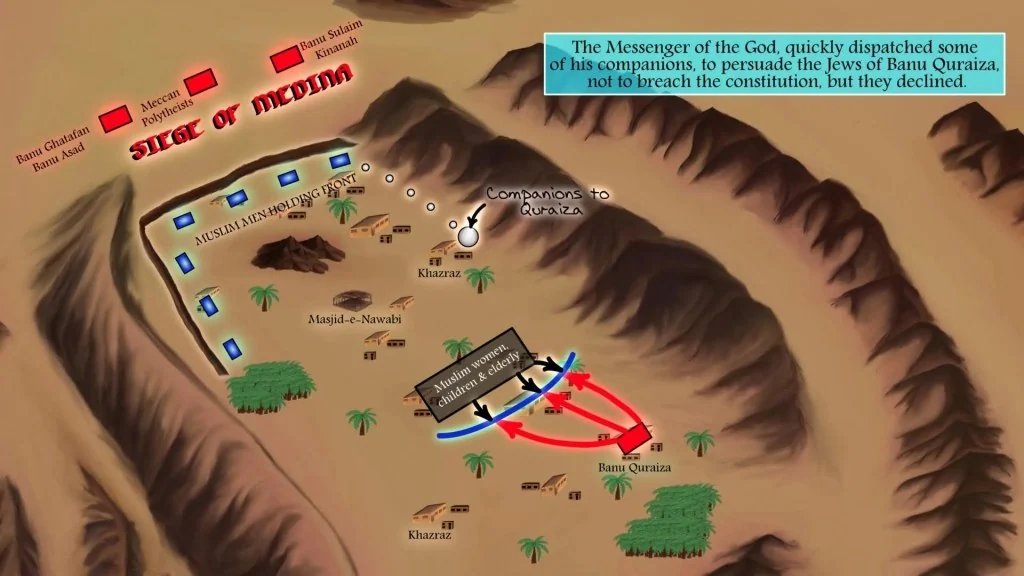
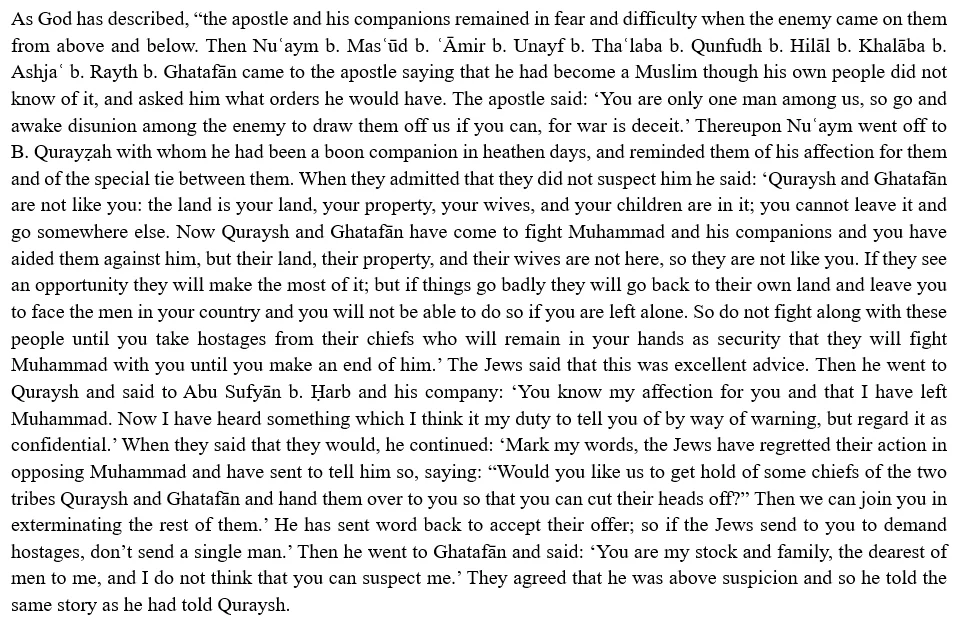
To put it briefly, Ḥuyayy ibn Akhṭab, the chief of the defeated Banū an-Naḍīr tribe, sought to incite Kaʿb ibn Asad, the chief of the Banū Qurayẓah, to break his pact and join the enemies of the Muslims with the aim of destroying the Muslim community. Ultimately, Kaʿb yielded and allied with the enemies of the Prophet (PBUH) to fight against the Muslims. The Banū Qurayẓah opened their southern front to the army of the Confederates and prepared to attack the Muslims themselves. The gravity of this action cannot be overstated, as it created a critical breach in the Muslim defense, allowing the largest Arab army in Arabia up to that time to advance. Indeed, had the Confederates broken through, the Muslims’ situation would have been hopeless and irreversible. The trench that had been protecting them would have become their doom, leaving them with nowhere to flee, and they would have been massacred one by one. The Confederates were pressing against al-Madīnah and had effectively cut it off, preventing provisions and any form of outside help or reinforcement from reaching its inhabitants. After months of terrible exhaustion, the Muslims felt as though they had fallen between the jaws of their enemies, for the Quraysh and the Ġaṭafān were besieging al-Madīnah from without, while the Banū Qurayẓah lay in wait from behind, ready to strike from within. The siege wore on and the situation grew increasingly desperate for the Muslims. It was by a remarkable stroke of fortune that Nuʿaym ibn Masʿūd secretly embraced Islam and employed a clever ruse to turn the situation in favor of the Muslims. Notably, before his conversion, Nuʿaym had been an ally of the Quraysh and a close friend of the Banū Qurayẓah. He first went to the Quraysh and told them that the Banū Qurayẓah regretted their betrayal of the Muslims and intended to renew their treaty with them. He added that he had heard they would demand several men from among the Quraysh as guarantees but would, in reality, hand them over to the Prophet (PBUH) as a gesture of reconciliation and a sign of good faith. Nuʿaym then went to the Banū Qurayẓah and told them that the Quraysh were growing weary of the prolonged siege and were planning to withdraw to Makkah, leaving them to face the Muslims alone. He advised them to request hostages from the Quraysh to ensure they would not abandon them—arguing that the Quraysh would not leave if their leaders were in the Banū Qurayẓah’s fortresses. When the Banū Qurayẓah made this request, the Quraysh assumed they were plotting treachery and consequently withdrew.3

Thus, Nuʿaym succeeded in sowing discord among the Confederates and disrupting their ranks. While they were in this state of disarray, Allāh miraculously supported His believing servants by sending upon the Quraysh and their allies a fierce, bitterly cold wind that tore through their tents, overturned their cooking vessels, extinguished their fires, lashed their faces, and filled their eyes with sand. Consequently, the allied forces fled under the cover of darkness in a state of utter confusion. That very night, the Prophet (PBUH) dispatched Ḥuḏayfah ibn al-Yamān, one of his Companions, to gather intelligence on the enemies’ morale and intentions. Ḥuḏayfah returned with the news that the enemy had turned on their heels. The news quickly spread among the Muslims, who cried out in joy and relief: “There is no god but Allāh alone. To His promise He has been true, His servant He has aided, His warriors He has honoured, and the Confederates He alone has defeated.” Now, after the Quraysh and their allies had fled, it was the Muslims against the Banū Qurayẓah, and the odds were no longer in the latter’s favor.
The anguish and fear experienced by the Muslims during the Battle of the Confederates are vividly portrayed in the following verses: {˹Remember˺ when they came at you from above and below you (i.e., east and west), when your eyes grew wild ˹in horror˺ and your hearts jumped into your throats, and you entertained ˹conflicting˺ thoughts about Allāh. Then and there the believers were put to the test, and were violently shaken} (Qurʾān 33:10–11). Allah refers to the Jews of Banū Qurayẓah who violated their treaty with the Muslims and sided with the Confederates, which alone is sufficient to refute the false claim that the Muslims massacred innocent people, as the opponents of Islam have misrepresented the incident: {And He brought down those from the People of the Book who supported the enemy alliance from their own strongholds, and cast horror into their hearts. You ˹believers˺ killed some, and took others captive} (Qurʾān 33:26). When news of the Banū Qurayẓah’s treachery reached the Prophet (PBUH), he dispatched Zayd ibn Ḥārithah with three hundred soldiers to guard the women and children of the Muslims. He also sent Saʿd ibn Muʿāḏ and Saʿd ibn ʿUbādah to verify whether the reports concerning the Banū Qurayẓah were true. They found that the tribe was guilty of even worse than what had been reported, for they spoke insultingly of the Prophet (PBUH) and declared, “There is no treaty between us and Muḥammad, nor any covenant.” At this critical juncture, the Prophet (PBUH) turned fervently to Allāh for support and supplicated against the Confederates, saying: “O Allāh, Revealer of the Book, Swift in reckoning, O Allāh, defeat the Confederates; O Allāh, defeat them and shake them!”4 Mūsá ibn ʿUqbah reported that when the Prophet (PBUH) learned of the treachery of the Jews of Banū Qurayẓah, he lay down and remained so for a long time. The people grew increasingly anxious and fearful when they saw him lying down. Then he raised his head and proclaimed aloud: “Allāh is Great! O Muslims, rejoice, for victory is near.”5 The Prophet (PBUH) saw the angel Gabriel (PBUH), who brought him glad tidings of victory. As mentioned earlier, a miraculous event took place during the Battle of the Confederates (also known as the Battle of the Trench), when the Banū Qurayẓah betrayed the Muslims. Divine assistance came to the believers as Allāh sent a powerful wind on an intensely cold night. Suddenly, the weather turned stormy, and the night grew bitterly cold. The change in the weather was so severe that the tents of the disbelievers were torn from their stakes, their cooking pots were overturned, and their fires were extinguished. Chaos spread through their ranks, terror filled their hearts, and their animals broke loose and fled into the darkness. This miracle was witnessed by both the Muslims and the disbelievers. Allāh says: {O believers! Remember Allāh’s favour upon you when ˹enemy˺ forces came to ˹besiege˺ you ˹in al-Madīnah˺, so We sent against them a ˹bitter˺ wind and forces you could not see. And Allāh is All-Seeing of what you do} (Qurʾān 33:9). What was this terror that was cast into the hearts of the polytheists? How is it that they did not return to besiege al-Madīnah, even in the days that followed? Truly, this is one of the secrets of divine support for the Prophets and the righteous. In fact, this was not the only miracle to occur during this battle, for a ḥadīth of indisputable authenticity reports yet another extraordinary event. Jābir ibn ʿAbd Allāh reported: “When the trench was dug, I saw the Messenger of Allah (peace and blessings be upon him) extremely hungry. So I went to my wife and said, ‘Do you have anything? For I have seen the Messenger of Allah (peace and blessings be upon him) in extreme hunger.’ She brought me a bag containing a saʿ (approximately three kilograms) of barley, and we also had a young, domesticated animal. I slaughtered it, and she ground the barley. She had finished when I finished, and I cut it [the meat] in her cooking pot. I then returned to the Messenger of Allah (peace and blessings be upon him), and she said, ‘Do not humiliate me with the Messenger of Allah (peace and blessings be upon him) and those with him (i.e., invite only as many people as the food would suffice for, given its scarcity).’ I approached him (peace and blessings be upon him) privately and said, ‘O Messenger of Allah, we have slaughtered a young animal and ground a saʿ of barley that we had; please come with a group of your companions.’ The Messenger of Allah (peace and blessings be upon him) called out, ‘O people of the trench, Jābir has prepared a feast for you, so all of you are welcome! Come quickly!’ He (peace and blessings be upon him) instructed, ‘Do not put down your pot from the fire, nor bake your dough, until I arrive.’ I then went home, and the Prophet (peace and blessings be upon him) arrived ahead of the people. When I reached my wife, she reproached me, saying: ‘May Allāh do such-and-such to you.’ But I replied, ‘I have done exactly as you instructed.’ She brought out our dough, and the Prophet (peace and blessings be upon him) spat into it and blessed it. He then went to our pot and spat into it and blessed it. Then he said [to my wife]: ‘Call another woman to bake [bread] along with you, and take out ladles [of meat] from your pot, but do not put it down from the fire.’ They numbered a thousand. By Allah, all of them ate [their fill] until they left it (the food) and went off while our pot was still bubbling (i.e., full of meat) as it had been (i.e., as if nothing had been taken from it) and our dough was still being baked as it had been.”6 Furthermore, after the wind caused chaos in the disbelievers’ camp and forced them to flee, the Muslims saw the angel Gabriel (PBUH) in human form with their own eyes. ʿĀʾishah [may Allāh be pleased with her] asked the Prophet (PBUH), “Who is that man you were speaking to?” He (PBUH) replied, “Did you see him?” She said, “Yes.” He asked, “Who do you liken him to?” She said, “Diḥyah ibn Khalīfah al-Kalbī.” The Prophet (PBUH) said, “That was Jibrīl and he commanded me to go to Banū Qurayẓah.”7 It is remarkable that atheists often ignore all these miracles and focus solely on the specious claim that the Prophet (PBUH) was a barbaric ruler who acted brutally towards the Banū Qurayẓah. Such selective attention is peculiar and reveals that those making this claim are not sincere seekers of truth, for they deliberately disregard the evidence affirming the authenticity of Islam’s message. Indeed, confusion only befalls the disobedient and rebellious. When the disbelievers argued that if the Qurʾān were truly the Word of Allāh it would not employ creatures as insignificant as mosquitoes in its parables, Allāh explained that doubts of this nature arise only in the minds of those whose disbelief has blinded them from seeing matters in proper perspective, but never touch the minds or hearts of true believers. Allāh further explained that He feels no embarrassment in using such imagery, for when the intention is to illustrate something detestable—a person, situation, or action—the reference to a mosquito or even a more insignificant creature neither violates the principles of eloquence and logic nor conflicts with dignity or modesty. In essence, such parables guide those prepared to reflect and understand, while generating confusion and misguidance for those who refuse to comprehend out of stubbornness or indifference. Glory be to Allāh: the same text or incident can lead to the guidance of some and the misguidance of others: {Surely Allāh does not shy away from using the parable of a mosquito or what is even smaller. As for the believers, they know that it is the truth from their Lord. And as for the disbelievers, they argue, “What does Allāh mean by such a parable?” Through this ˹test˺, He leaves many to stray, and guides many. And He leaves none to stray except the rebellious} (Qurʾān 2:26).
Let us now return to the incident of Banū Qurayẓah. After the pagan enemies retreated, the angel Jibrīl commanded the Prophet (PBUH) to march against Banū Qurayẓah for their act of treason—something that no reasonable person could find fault with. Banū Qurayẓah agreed to an unconditional surrender. The Prophet (PBUH) asked them how they wished to be judged, and they chose that Saʿd ibn Muʿāḏ, a chieftain of the Aws tribe, should determine their punishment.8 Abū Saʿīd al-Khudrī [may Allāh be pleased with him] reported: “When the Banū Qurayẓah offered to submit to the verdict of Saʿd ibn Muʿāḏ, the Messenger of Allāh (peace and blessings be upon him) sent for Saʿd, who was near him. Saʿd came riding a donkey, and when he approached, the Messenger of Allāh (PBUH) said [to the ʾAnṣār], “Go to your master (i.e., walk to him and help him dismount from his donkey).” He came and sat beside the Messenger of Allāh (PBUH), and he (PBUH) said to him, “These people have offered to submit to your verdict.” He replied, “I judge that al-muqātilah (i.e., the pubescent males who are capable of taking part in fighting and are expected to do so) should be killed, and that their women and children should be taken captive.” He (PBUH) said, “You have indeed judged among them with the judgment of the King (i.e., Allāh).” 9 Saʿd ibn Muʿāḏ is reported to have come to the conclusion that those guilty of treason should be executed in accordance with the Jewish law.10 No objective historian would describe the punishment of the Banū Qurayẓah as genocide or a massacre of an entire tribe, for it was not a systematic destruction of an ethnic or religious group based on their ethnicity or religion. The Banū Qurayẓah were not killed because they were Jews; rather, they were justly punished for their treason and the severe consequences the Muslims would have faced had their plan succeeded. In fact, the Banū Qurayẓah did not merely break a treaty—they also attacked the area of al-Madīnah where the Prophet (PBUH) had placed the Muslim women, children, and the elderly for their safety, in direct violation of the treaty, which stipulated that the Banū Qurayẓah were to support the Muslims if they were attacked. Treason is a serious crime, then and now, and it still carries the death penalty in many countries. Moreover, members of the Banū Qurayẓah who had not participated in the betrayal were spared; for example, ʿAmrū ibn Suʿdá al-Quraẓī was not punished because he had objected to the treason.11

Additionally, those who supported the breach of the treaty with the Muslims, but did not possess the physical ability to fight—such as women and children—were not killed. Punishment was therefore inflicted only on those who met the following criteria: treachery, siding with the Confederates against the Muslims, as well as having the mental and physical capacity to engage in fighting. All historical reports clearly indicate that only the pubescent males who actively participated in this treachery were executed. ʿAtiyyah al-Quraẓī, who witnessed the events, said: “The Apostle had ordered that every pubescent male of the Banū Qurayẓah should be killed. I was a boy, and since they found that I was not pubescent, they spared me.”12 Indeed, the claim that women and children were killed is an outrageous falsehood with no historical basis, for numerous authentic ḥadīths report that the Prophet (PBUH) categorically forbade the killing of women and children. He (PBUH) said: “Do not kill a woman, or a child, or an elderly person.”13 Furthermore, after the verdict was pronounced, anyone granted refuge by a Muslim was spared from punishment. For instance, Thābit ibn Qays interceded for az-Zubayr ibn Bāṭā al-Quraẓī in return for a favor the latter had once done for him, but he chose to be executed instead.14

Salmá bint Qays likewise interceded for Rifāʿah ibn Samawʾal al-Quraẓī.15

Finally, some members of the Banū Qurayẓah willingly embraced Islam and the Prophet (PBUH) granted them safety.
In summary, the Banū Qurayẓah expedition was not an act of genocide, but rather one of self-defense and justified retaliation. The evidence makes it clear that the Muslims did not massacre the tribe because they were Jewish, but punished only those members guilty of treason and of killing innocent Muslim women and children. The subsequent event—the taking of women and children as captives—was consistent with the norms of warfare at that time. In a word, no innocent members of this tribe were killed, and those who attempt to distort history to serve their own agenda should be ashamed of their dishonesty.
Notes and References
- 1
Its general terms were as follows: Muslims and Jews were to live as one people, with each party adhering to its own faith and refraining from interfering in that of the other. In the event of a conflict with a third party, each was obliged to assist the other, provided the latter was the aggrieved and not the aggressor. Should al-Madīnah come under attack, both groups were to unite in its defense, and peace, when desirable, was to be established through mutual consultation.
- 2
“Banu Qurayza – The True Story,” Medina Minds, 12 Feb. 2016, https://www.medinaminds.com/banu-qurayza-the-true-story/.
- 3
Alfred Guillaume, The Life of Muhammad: A Translation of Isḥāq’s Sīrat Rasūl Allāh, (Oxford, U.K.: Oxford University Press, 1955), pp. 458–460, available here: https://archive.org/details/TheLifeOfMohammedGuillaume/page/n257/mode/2up.
- 4
Muḥammad al-Bukhārī, Ṣaḥīḥ al-Bukhārī, (Cairo, Egypt: Dār as-Salām, 1999), book: 56, ḥadīth: 146, available at: https://sunnah.com/bukhari:2933.
- 5
Abū Bakr Aḥmad ibn Ḥusayn al-Bayhaqī, Dalāʾil an-Nubuwwah, (Bayrūt, Lebanon: Dār al-Kutub al-ʿIlmiyyah, 1988), vol. 3, p. 403.
- 6
Agreed upon ḥadīth, Muḥammad al-Bukhārī, Ṣaḥīḥ al-Bukhārī, (Cairo, Egypt: Dār as-Salām. 1999), book: 64, ḥadīth: 146, available at: https://sunnah.com/bukhari:4102; Muslim ibn al-Ḥajjāj, Ṣaḥīḥ Muslim, (Bayrūt, Lebanon: Dār al-Kutub ʿIlmiyyah, 2020), book: 36, ḥadīth: 189, available at: https://sunnah.com/muslim:2039.
- 7
Muḥammad Nāṣir ad-Dīn al-ʾAlbānī, as-Silsilah as-Ṣaḥīḥah, (ar-Riyāḍ, Saudi Arabia: Maktabat al-Maʿārif, 1995), vol. 3, p. 105.
- 8
The Banū Qurayẓah were allied with the Aws and Khazraj tribes in al-Madīnah through treaties. They chose Saʿd ibn Muʿāḏ to determine their punishment because he was a respected leader of the Aws tribe, renowned for his wisdom, fairness, and a strong sense of justice, having previously mediated disputes effectively. By appointing him, the Banū Qurayẓah accepted a neutral yet authoritative judgment, rather than leaving the decision to the Muslims as a whole, which might have appeared biased from their perspective.
- 9
Muḥammad al-Bukhārī, Ṣaḥīḥ al-Bukhārī, (Cairo, Egypt: Dār as-Salām. 1999), book: 56, ḥadīth: 249, available at: https://sunnah.com/bukhari:3043.
- 10
“Deuteronomy 20:13-14, Complete Jewish Bible,” Bible Gateway, accessed 11 June 2023, https://www.biblegateway.com/passage/?search=Deuteronomy+20%3A13-14&version=CJB.
13When Adonai your God hands it over to you, you are to put every male to the sword. 14 However, you are to take as booty for yourself the women, the little ones, the livestock, and everything in the city — all its spoil. Yes, you will feed on your enemies’ spoil, which Adonai your God has given you.
- 11
Alfred Guillaume, The Life of Muhammad: A Translation of Isḥāq’s Sīrat Rasūl Allāh, (Oxford, U.K.: Oxford University Press, 1955), p. 463, available here: https://archive.org/details/TheLifeOfMohammedGuillaume/page/n257/mode/2up.
- 12
Ibid., p. 466.
- 13
Mālik ibn Anas, al-Muwaṭṭaʾ, (Bayrūt, Lebanon: Dār al- Ġarb al-Islāmī, 1997), book: 21, ḥadīth: 971, available at: https://sunnah.com/urn/509710.
- 14
Alfred Guillaume, The Life of Muhammad: A Translation of Isḥāq’s Sīrat Rasūl Allāh, (Oxford, U.K.: Oxford University Press, 1955), p. 465, available here: https://archive.org/details/TheLifeOfMohammedGuillaume/page/n257/mode/2up.
- 15
Ibid., p. 466.