Why does Islam offer a heaven with sensual pleasures?
Atheists, and even Christians, often struggle to grasp the concept of Islamic Paradise, which is abundant with material delights such as lavish foods (fruits, meat, milk, honey, etc.), wine, fine clothing, jewels, palaces, expansive gardens with shady trees and flowing streams, and beautiful maidens. They argue that the reward of Paradise should be purely spiritual, and claim that, as depicted in Islam’s primary sources—the Qurʾān and Sunnah—Paradise appears excessively sensuous and devoid of spiritual depth. The discomfort of atheists and Christians with sex and sensuality, even when framed as divinely sanctioned blessings, stems from the Christian cultural background, which tends to view spirituality as incompatible with material pleasures and often portrays Heaven as a realm solely of spiritual rewards. However, in this life, physical pleasures such as eating and drinking do not prevent the faithful servants of Allāh from experiencing spiritual delight; in fact, they often appreciate spiritual blessings more than the physical ones. Similarly, the physical pleasures of Paradise will not diminish its spiritual joys. Indeed, there is no logical reason to object to the presence of physical and sensual pleasures in Paradise. The Prophet (PBUH) said: “Allāh said, ‘I have prepared for My righteous servants what no eye has ever seen, nor an ear has ever heard, nor has a human heart ever imagined.’”1 Such is the Bounty of Allāh, which He grants to His pious and righteous servants: those who do not indulge in disbelief, who are mindful of Him, who fulfill His commands and avoid His prohibitions, who forgo worldly luxuries for His sake, and who, when they commit any indecency or wrong against themselves, instantly remember Him and seek forgiveness for their sins—for who can forgive sins except Allāh?—and who do not willfully persist in wrongdoing, and who fear their Lord both in private and in public. Interestingly, those who show the most disapproval of Heaven’s sensual pleasures are often the very ones who renounce the religion of Allāh to pursue a hedonistic lifestyle. Contrary to their belief, the bliss of Heaven is pure, and sexual intercourse therein will be within the bounds of a lawful, pure marriage. Allāh says: {they and their spouses will be in ˹cool˺ shade, reclining on ˹canopied˺ couches} (Qurʾān 36:56). He also says: {And We will marry them to fair women with large, beautiful eyes} (Qurʾān 44:54). The bounties that Allāh has prepared for the believers in Paradise include everything they need for perfect happiness. Since humans are sexual beings, Heaven is a place where all its residents will enjoy lawful sexual relations in an ideal atmosphere of moral purity. As explained earlier, sex is not intrinsically evil in this world, and therefore its presence in Paradise should not pose any problem.
Some people ask: But the bliss of Paradise mentioned in the Qurʾān seems entirely related to what we need in this worldly life and appears to consist solely of physical delights. Indeed, the Qurʾān often describes Paradise in terms of sensory pleasures, for these direct pleasures serve as earthly projections or shadows of the Paradisal archetypes it seeks to convey. However, although the Qurʾān depicts Heaven in terms of material delights and sensual pleasures, people should not—as they are naturally inclined to do—interpret these Qurʾānic depictions in an overly narrow or merely earthly sense. Such depictions may be taken as foretastes of heavenly joys, but one must recognize their inadequacy, for the pleasures of Paradise are incomparable to worldly pleasures. Essentially, the unseen world, of which Paradise is a part, lies beyond human perception and description. Therefore, Allāh has employed illustrative language to bring a sense of its blessings closer to the human mind, as human language can only depict what humans observe, experience, and conceive. In other words, Paradise is described using terms familiar to humans, yet despite the similar terminology, there is no true comparison between the delights of Paradise and the pleasures of this world. According to the authentic tradition of Ibn ʿAbbās: “Nothing in Paradise resembles anything in the life of this world, except in name.”2 That is, only the names are common between things in this life and those in Paradise. In other words, the blessings of Heaven are described in the Qurʾān using the names of earthly things by way of similitude, yet these blessings are entirely free of impurity or any negative aspect. For instance, the heavenly wine resembles the wines of this world in name only, but in all other respects it is entirely different, being free from any harmful effects such as intoxication or headaches. Similarly, the gardens, rivers, fruits, milk, and honey of Paradise mentioned in the Qurʾān differ completely from their worldly counterparts. Indeed, the Qurʾān itself clarifies this matter, and to doubt it is simply a manifestation of ignorance and prejudice. Allāh has described all the bounties of the Hereafter as “hidden,” unlike anything found in this world: {No soul can imagine what has been hidden for them of comfort for eyes as reward for what they used to do} (Qurʾān 32:17). In interpreting this verse, the Prophet (PBUH) stated that the bounties of Heaven are such that no eye has ever seen, no ear has ever heard, and no human mind has ever conceived. By contrast, the bounties of this world are seen, heard of, and conceived by humans. Therefore, it is incorrect to compare the life of this world with the life of the Hereafter. In short, Paradise is a realm entirely unlike this world, and one should not interpret the descriptions of it in the Qurʾān according to the meanings of similar words in worldly contexts. Again, although the blessings of Heaven are named after earthly things, they do not correspond to the same physical entities. Consequently, it is inappropriate to conceptualize or portray Paradise through the lens of worldly pleasures and luxuries. Put differently, the true reality of Paradise is beyond human comprehension and will only be fully realized upon entering it. Nevertheless, Allāh has provided glimpses of it in the Qurʾān, using the names of worldly things familiar to humans as references to help their minds gain an approximate understanding of its blessings. In reality, Paradise surpasses anything humans can imagine or dream of. For this reason, the Qurʾān and Prophetic traditions clearly affirm that there will be blessings in Paradise which no eye has ever seen, no ear has ever heard, and no human heart has ever conceived. Hence, those who conceive of Paradise in terms of worldly conditions fail to grasp even the fundamentals of the Qurʾānic language.
The opponents of Islam argue that Muslims recognize no happiness in Heaven beyond sensual pleasures, claiming that the delights of Qurʾānic Paradise consist solely of physical enjoyment. Indeed, Paradise will be a realm of eternal and perfect delight, encompassing bodily pleasures such as the finest foods and drinks. Yet, the pleasure of Allāh—and the security and contentment that flow from it—constitutes a far greater bliss than any sensual enjoyment the believers will experience in Paradise:{Allāh has promised the believers, both men and women, Gardens under which rivers flow, to stay there forever, and splendid homes in the Gardens of Eternity, and—above all—the pleasure of Allāh. That is ˹truly˺ the ultimate triumph} (Qurʾān 9:72). This verse makes it clear that the Qurʾān does not consistently portray Paradise as being solely about physical delights, particularly of a sexual nature. While Allāh does promise His faithful servants sensual pleasures, He has not made these the ultimate source of happiness. Rather, the greatest joy for the inhabitants of Paradise will be the sight of their Lord. The Prophet (PBUH) said: “Allāh would lift the veil, and of all that has been granted to them, nothing would be more beloved to them than the sight of their Lord, Glorified and Sublime be He.”3 Indeed, the honor of seeing Allāh is the ultimate joy in the Hereafter and the most precious gift from Him. We pray that Allāh grant us Paradise and the pleasure of seeing His Noble Face.John Davenport—an English Puritan clergyman best known for his book An Apology for Mohammed and the Koran, in which he defended Islam against common misconceptions in Europe and praised aspects of the Qurʾān for their moral and spiritual insights—made the following valid observation:4

To conclude, Paradise contains bounties, beauties, and pleasures so great, vast, pure, and marvellous that they lie beyond the capacity of the human mind to comprehend. Just as one who has been blind from birth cannot accurately conceive of colors in this world, we cannot truly imagine the delights of Paradise, for they have no counterpart or basis of comparison in the earthly realm. Nevertheless, these delights are described in human language in the Qurʾān because this divine discourse addresses human beings, and it is therefore natural that they be conveyed in terms that humans can understand. Were we instead told of delights designated by names entirely unknown to us, would such a description be intelligible or even reasonable? To reiterate, the Qurʾān provides people with an idea of what awaits them in Paradise, serving as both encouragement and inspiration for them to strive to please their Lord and attain entry into it. Indeed, the reasoning of atheists is profoundly flawed, as they claim that anything good, beautiful, or cherished on earth cannot exist in Paradise. This is naïve, for if something is meaningful and justified in this world—the very place of testing—then there is no logical reason why believers should not enjoy it in the Abode of Bliss. Why do atheists presume that mundane things cannot exist in the world of the unseen? On what basis do they hold this conviction—do they possess a book that confirms it, or have they glimpsed the unseen to make such a judgment? What objection can there be to the notion that mundane things may exist in their most perfect and exalted form in the Hereafter? It is worth remembering that after our resurrection, although we shall be perfected humans, we will still be human. Since humans are neither merely soul nor solely body, there is nothing absurd in the notion that we will be provided in Paradise with everything that will soothe both the spirit and the body. In other words, we shall be resurrected as complete humans, with all our senses intact. If any of our senses were denied the objects to act upon, Paradise would cease to be a place of complete comfort and would instead become a source of discomfort for that particular sense. Such an idea is inconsistent with Paradise as envisioned in Islam, the religion of fiṭrah (the divinely endowed innate monotheistic disposition). John Davenport has addressed the question of the sensual character of Qurʾānic Paradise with clarity and common sense:5
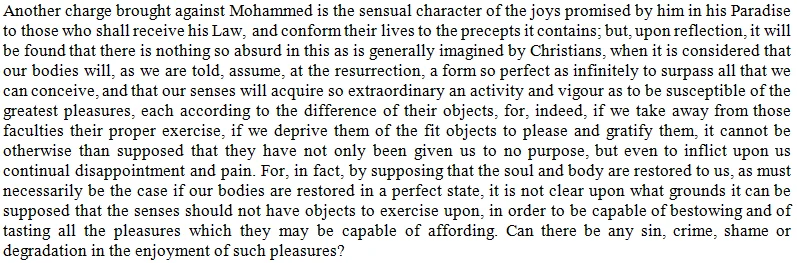
In short, no one can fully comprehend the true realm of Paradise until they enter it. Those skeptical about its physical and material delights fail to realize that Islam recognizes no dichotomy between the spiritual and the mundane; if they coexist in this world, there is no reason to deny their coexistence in the Hereafter. Undoubtedly, the Islamic conception of Paradise is the perfect one.
Notes and References
- 1
Agreed upon ḥadīth, Muḥammad al-Bukhārī, (Cairo, Egypt: Dār as-Salām. 1999), book: 65, ḥadīth: 301, available at: https://sunnah.com/bukhari:4779; Muslim ibn al-Ḥajjāj, Ṣaḥīḥ Muslim, (Bayrūt, Lebanon: Dār al-Kutub ʿIlmiyyah, 2020), book: 53, ḥadīth: 3, available at: https://sunnah.com/muslim:2824a.
- 2
Muḥammad Nāṣir ad-Dīn al-ʾAlbānī, Ṣaḥīḥ at-Tarġīb wa-at-Tarhīb, (Ar-Riyāḍ, Saudi Arabia: Maktabat al-Maʿārif, 2000), ḥadīth: 3769.
- 3
Muslim ibn al-Ḥajjāj, Ṣaḥīḥ Muslim, (Bayrūt, Lebanon: Dār al-Kutub ʿIlmiyyah, 2020), book: 1, ḥadīth: 354, available at: https://sunnah.com/muslim:181a.
- 4
John Davenport, An Apology for Muhammed and the Koran, (London, U.K.: J. Davy and Sons, 1869), pp. 152–3, available at: https://archive.org/details/anapologyformoh01davegoog/page/n135/mode/2up.
- 5
John Davenport, An Apology for Muhammed and the Koran, (London, U.K.: J. Davy and Sons, 1869), pp. 151–2, available at: https://archive.org/details/anapologyformoh01davegoog/page/n135/mode/2up.