Why is Man mukallaf (divinely assigned/accountable) in the first place?
Man is mukallaf—that is, divinely assigned and accountable under the precepts and injunctions of the Sharīʿah, and commanded to observe them—because this is the will of Allāh.1 In essence, Allāh is the sole Lord, and everything in existence is subject to Him; yet He willed to create beings who would, without compulsion, choose to obey Him voluntarily. This voluntary submission forms the basis of a great trial for mankind. That is, taklīf reveals the degree of one’s patience and resolve, and on the Day of Judgement, people will be ranked in accordance with their intentions and deeds. But what if someone wishes to reject this taklīf? The answer is: he cannot. It is not permissible for anyone to claim exemption from being mukallaf, for every human being willingly undertook this assignment before even entering the world. In fact, all of humanity accepted what the Qurʾān calls the amānah (trust)—that is, the full weight of the obligations and prohibitions of the Sharīʿah. Allāh offered this trust—the responsibility of moral choice between obedience and disobedience—to the heavens, the earth, and the mountains, but they declined it and were fearful of bearing such a burden. They chose instead to remain in a state of passive submission to Allāh, never seeking the dangerous freedom to disobey. Man, however, accepted this burden, despite knowing that immense beings had refused it. The following verse recounts the offer of this trust: {Indeed, We offered the trust to the heavens and the earth and the mountains, but they refused to carry it and were afraid of doing so; but Man carried it. Surely he is wrong-doing, ignorant ˹of the consequences˺} (Qurʾān 33:72). The offer of the trust occurred in reality, and these entities likewise expressed their inability to bear it in reality. Ibn Kathīr reported, on the authority of several Companions and Successors—including Ibn ʿAbbās, al-Ḥasan al-Baṣrī, Mujāhid, and others—the following details regarding this offer of the trust:2
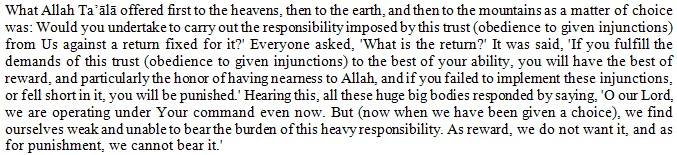
Hence, while one immense creation after another submitted that they should be excused from the severe test of life—that is, the trial of voluntary obedience to Allāh—Man, the frail creation, chose to undertake this test. It is reported from Ibn ʿAbbās that the Prophet (PBUH) said:3
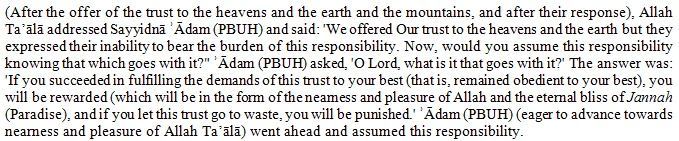
Thus, mankind willingly accepted to acknowledge Allāh’s Supremacy and obey His commands of its own free will—or else possess the capacity to deny Him and even rebel against Him. In a sense, after granting humans this freedom, Allāh concealed Himself from them, as though He did not exist at all. Yet, He will call them to account at an appointed time. Those who misuse the freedom granted by Allāh will suffer a most terrible punishment, whereas those who choose obedience despite ample opportunity for disobedience will be raised to ranks no other creation of Allāh has ever attained. The Qurʾān teaches that in the primordial past, all of humanity bore witness and testified to Allāh as their only Lord. Long ago—on a day sometimes referred to as the Day of the Covenant—Allāh brought forth the souls of all humans from the loins of Adam and asked them: “Am I not your Lord?” Every soul affirmed the covenant, responding, “Yes, we testify.” Thus, every human being is born having already testified to this covenant in the distant past: {And ˹remember˺ when your Lord brought forth from the loins of the children of Adam their descendants and had them testify regarding themselves. ˹Allāh asked,˺ “Am I not your Lord?” They replied, “Yes, You are! We testify.” ˹He cautioned,˺ “Now you have no right to say on Judgment Day, ‘We were not aware of this’} (Qurʾān 7:172). According to Islamic traditions, at a certain point prior to the creation of the universe, Allāh brought into existence all the human beings He intended to create until the Last Day. He endowed them with life, consciousness, and speech, and made it known to them that none besides Him is their Lord and none besides Him is worthy of worship. He then made them witnesses against themselves, lest they should claim ignorance on the Day of Judgment. Later, Allāh sent His Messengers and revealed His Books to remind humanity of this primordial covenant they had made with Him. This covenant will serve as evidence against mankind on the Day of Judgment. One might object: “But I do not recall any of this. What was the point of taking a covenant if it would later be erased from my memory?” In truth, the covenant that Allāh took from the progeny of Adam in the previous life has not been erased from their memory, and not one of them has forgotten it. Rather, the knowledge of this primordial covenant is deeply embedded in human nature—fiṭrah—which drives people to seek Allāh. That is, the primordial covenant produced within us an innate impulse that urges and compels us to believe in Allāh and yearn to know Him. Had this covenant remained vividly imprinted in our conscious memory—such that we could recall it as if we had just witnessed it—there would be no room left for belief in the unseen, nor any real test of faith. Remembering the covenant in such a direct way would make us like students walking into an exam room holding a page of model answers. But Allāh created this world as a place of trial, and for a test to be genuine, the possibility of both success and failure must exist, such that each individual chooses their path through the guidance provided to them. Thus, the covenant is the fiṭrah present within every human being—the natural spiritual and moral inclination toward Allāh and toward what is right. This is why all people have an intuitive sense that they will one day be held accountable, and why they instinctively gravitate toward what is morally pure and upright. It is also why they feel a sense of guilt when they knowingly act wrongly. In a word, Allāh took a covenant with humanity prior to their earthly existence, and their primordial affirmation of Allāh gave rise to their innate tendency to journey toward Him and toward what is good in this earthly life. Now, if someone were to object to the burden of fulfilling Divine obligations on the grounds that they do not remember the covenant, such a claim would carry no weight. It would be far wiser for them to uphold the covenant of Allāh as best they can and plead their case on the Day of Judgment—when no soul shall be wronged: {˹Consider˺ the Day ˹when˺ every soul will come pleading for itself, and each will be paid in full for what it did, and none will be wronged} (Qurʾān 16:111). If we think of life as a train ride, then the best option for anyone who believes that they did not choose to board the train of life and are not bound in any covenant with Allāh is, as long as they are on board this train, to abide by its precepts until they reach their final destination safe and sound, and then they can voice objections as they like. The person might argue: “Why should I abide by the precepts of a train that I was forced to take to begin with?” As noted above, it is important for such a person not to lose sight of the fact that they were not forced to take that train, but did so by their own choice and will—when Allāh offered the “trust” to the heavens, the Earth, and the mountains, they were afraid and therefore refused, but human beings accepted the responsibility to have the choice of being good or evil through their will. Further, suppose someone did accidentally board the wrong train or was even forced to do so—would this give them the right to commit serious offences (i.e., destructive sins) on the pretext that they boarded the wrong train? Or would it be better for them to adhere to the instructions as long as they are on board the train, and then raise objections after they get off? In short, abide by the Sharīʿah and you will realize that true freedom and salvation only exist when you live in obedience to the law of your Lord.
Notes and References
- 1
Taklīf means that Man is responsible and answerable for upholding belief in Allāh and His Messengers and Prophets, following our Prophet Muḥammad (PBUH), the Seal of the Prophets, and observing the required commands and prohibitions—once he possesses the capacity to carry them out. Through this accountability, he becomes deserving of either reward or punishment, depending on his obedience or disobedience to the Divine directives.
- 2
Muḥammad Shafīʿ ibn Muḥammad Yāsīn ʿUsmānī Deobandī, Maʿārif-ul-Qurʾān: A Comprehensive Commentary of the Holy Qurʾān, trans. Muḥammad Hasan Askari and Muhammad Shamīm, (Karachi, Pakistan: Maktaba-e-Darul-ʿUloom, 2010), Chapter ʾĀli ʿImrān (Qurʾān 33:72), p. 253, available at: https://islamicstudies.info/quran/maarif/maarif.php?sura=33&verse=72.
- 3
Ibid.