Is cognitive relativism a tenable philosophical position—more precisely, an epistemological one—and is it supported by any scientific evidence?
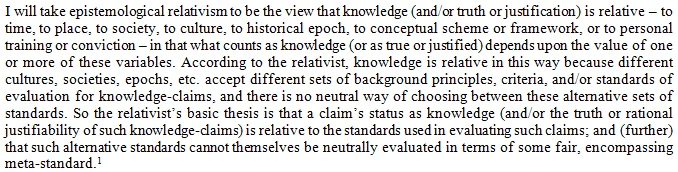
Broadly speaking, relativism is the view that, in certain domains, truth is relative to specific frameworks or standards—such that when individuals disagree on these matters, each may nonetheless be correct within their own respective context.1 That is, truth is regarded as a matter of opinion. Epistemic relativism, a specific form of relativism, holds that epistemic properties—such as justification, rationality, or warrant—are themselves relative to particular frameworks or cultural norms. As Harvey Siegel writes:2
Cultural relativism—the theoretical framework first articulated by Franz Boas in the late 19th century—is an anthropological perspective that regards all cultures as fundamentally equal. It asserts that there are no universal standards by which cultures can be judged; rather, the beliefs and practices of any given culture must be understood and evaluated solely within the context of that culture itself.3 Relativism, then, is the view that there is no absolute truth—only those truths that individuals or cultures happen to endorse. However, this doctrine is self-defeating, as its very claim to truth undermines itself. This paradox closely resembles the Epimenides Paradox. Epimenides, a Cretan philosopher, famously stated, “All Cretans are liars.” The paradox arises because if Epimenides is telling the truth, then as a Cretan, he must be lying—making the statement false. But if he is lying, then the statement “All Cretans are liars” is itself a lie, which implies that Cretans do tell the truth—thus making his statement true. In this way, the statement becomes both true and false, illustrating a self-referential contradiction. Relativism falls into a similar trap. To assert the relativist thesis—that the truth-value of any statement is always relative to a particular perspective—is to make a universal claim, which contradicts the very premise of the theory. Relativism entails that a single proposition can be simultaneously true from one standpoint and false from another. Thus, the relativist position is either false or, at best, just as relative as any opposing view, giving us no compelling reason to favor it over alternatives such as realism. The only way relativists could preserve their thesis would be to exempt it from its own rule—claiming that all truths are relative except the truth that all truths are relative. While this move may render the theory logically consistent, it is philosophically unsatisfying, as it arbitrarily assigns a privileged, non-relative status to a claim that denies such privilege to all others.4
In addition to being self-refuting and incoherent, relativism—particularly in its cognitive and cultural forms—would have deeply pernicious consequences if taken seriously or applied broadly in society. Chief among these is the erosion of critical thinking. If one accepts that there are no objective standards of right or wrong, then intellectual indifference and moral paralysis inevitably follow. In such a framework, “anything goes,” and the motivation to refine or improve our modes of reasoning is fundamentally undermined. This concern, first articulated by Plato, remains a central and enduring criticism of relativism, echoed by many philosophers throughout history.5

Hence, cognitive relativism is detrimental to the process of individual transformation and, by extension, to collective progress. It fosters stagnation by cultivating an environment that discourages innovation and meaningful change, whether through personal initiative or communal effort. Individuals lulled into the relative comfort of a stable, unchanging worldview are less likely to assume responsibility or take bold steps toward advancement. Over time, such a relativistic mindset may engender a host of negative dispositions, including lethargy, apathy, cynicism, and even fatalism. Put succinctly, cultural relativism imposes serious constraints on the advancement of humanity.6

Moreover, if there are no absolutes that define reality—if everything is relative to something else—then there can be no objective reality. Consequently, there would be no moral absolutes, no authoritative foundation for determining whether an action is right or wrong. Cultural relativism, therefore, leads to situational ethics: the belief that moral judgments are contingent upon the context in which they arise. In this view, there is no objective standard of right or wrong; whatever feels or appears right in a given moment is considered right. As a result, the denial of absolute truth—alongside cultural relativism (i.e., the notion that truth is dictated by social or cultural consensus) and moral subjectivism (i.e., the belief that moral rightness is determined by individual conviction)—permits individuals to act according to their own desires, without accountability. In other words, cultural relativism encourages each person to define morality and ethics according to their own circumstances. In such a world, where every individual adheres to a personal moral code, the result would be moral fragmentation and social chaos, as individual ethical systems take precedence over shared standards.7

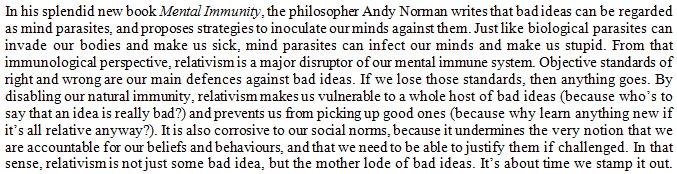
In a word, situational ethics—the natural corollary of cultural relativism—fosters a subjective, “whatever feels right” mentality and lifestyle, which ultimately has disastrous consequences for both individuals and society. Western postmodernism has produced cultures that regard all values, beliefs, lifestyles, and truth claims as equally valid. In such societies, tolerance has become the sole absolute and the cardinal virtue, while belief in absolute truth is condemned as intolerance—and therefore as the only true evil. Ironically, those who deny absolute truth often assert, “It is fine to believe whatever one wants, as long as one does not impose those beliefs on others.” Yet this statement is itself a moral claim about what is right and wrong—and those who make it frequently do attempt to impose it on others, thereby contradicting their own principle. In doing so, they establish a behavioral standard they expect others to follow, violating the very tolerance they claim to uphold. Indubitably, moral relativism is a tragedy—and arguably one of the most dangerous ideas ever conceived—because, under its logic, tolerance becomes the supreme obligation. In other words, relativism demands the tolerance of even harmful ideas and practices under the assumption that there are no universal standards of right and wrong. But if all opinions are equally valid, then no one can ever be objectively wrong—an idea that is not only illogical but also dangerous. Sometimes people are objectively wrong, and it is both dishonest and harmful to pretend otherwise. As philosopher Maarten Boudry aptly notes, relativism is not merely a bad idea—it is the mother lode of bad ideas.8
Furthermore, cultural relativism leads to societal fragmentation, as it alienates individuals from one another and permits personal opinions and perceptions to be regarded as universal truths.9
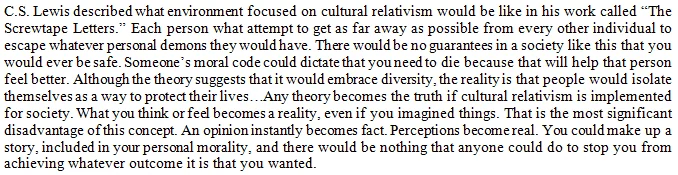
Hence, adherence to cultural relativism would eventually lead to the formation of individualized cultures rather than cohesive societies, thereby fundamentally altering the world as we know it.
The relativistic attitude sows the seeds of doubt. Allāh states that the idolaters of the Prophet’s time were devoid of certainty and wandered aimlessly in doubt. The Qurʾān exposes the beliefs of their forefathers as baseless—indeed, the certain truth came to them, yet they doubted it and refused to believe in it: {In fact, they are in doubt, amusing themselves} (Qurʾān 44:9). Absolute truth is a logical necessity, for one cannot coherently argue against its existence without relying on an absolute truth as the foundation of their argument. Put simply, if someone asserts, “There is no absolute truth”—the most commonly used formulation of the relativist stance—and they are absolutely certain of that claim, then they have already made an absolute statement. In effect, they are declaring that the only absolute truth is that no absolute truths exist, which is self-refuting. Thus, if proponents of cognitive relativism persist in expressing their position through absolute assertions, those assertions inevitably collapse into absurdity. In other words, cognitive relativism culminates in formal, logical contradiction. Saint Augustine observed that the very act of doubting is itself evidence that truth exists—specifically, the truth that one is doubting. Simply put, to doubt is to be aware of one’s own doubt, and that awareness constitutes a form of knowledge. Thus, even in the midst of doubt, there remains at least one undeniable truth: the fact that one is doubting. This self-awareness is itself a truth. Accordingly, even if someone questions whether truth exists, their doubt affirms the existence of at least one truth. In De Vera Religione (On True Religion), Augustine did not merely argue that certain truths ought not to be doubted; rather, he contended that one must not doubt that some truths do, in fact, exist. As Christopher Kirwan succinctly puts it in summarizing Augustine’s view: “Everyone who observes [intelligit] himself doubting observes a truth [verum], and about that which he observes he is certain; therefore he is certain about a truth. Everyone therefore who doubts whether truth exists [utrum sit veritas] has in himself a truth on which not to doubt...Hence one who can doubt at all ought not to doubt <the existence of> truth.’’10 That is, the very capacity to doubt presupposes the existence of absolute truth: after doubting many things, one ultimately realizes that one cannot doubt the act of doubting itself, for the act is self-verifying. In fact, there is substantial evidence for the existence of absolute truth. First, the human conscience—the inner awareness that certain things are inherently right or wrong—testifies to this truth. It compels us to recognize the wrongness of acts such as rape and murder and the value of virtues like compassion and generosity. These moral intuitions are consistent across cultures and historical periods, suggesting a universal moral law. Second, science offers further support for absolute truth. Scientific inquiry is predicated on the belief in an objective reality that can be discovered and understood. If absolutes did not exist, there would be nothing meaningful to study, nor any way to confirm the validity of scientific findings. Indeed, the very laws of science presuppose the existence of fixed truths. Thus, cognitive relativism, as Ernest Gellner argues, is not only logically incoherent and self-refuting but also untenable in light of empirical science, which yields consistent, testable, and technologically applicable results.11 Third, religion affirms the presence of absolute truth by providing meaning, purpose, and a framework for understanding human existence. Religion points to a personal and purposeful Creator—One who defines and grounds absolute truth, instills in humanity the desire to seek Him, and offers answers to life’s most profound questions.Hence, the human conscience, the empirical reliability of science, and the universal search for meaning through religion together point compellingly to the existence of absolute truth.
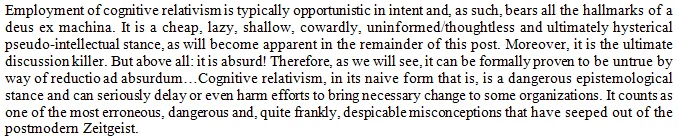
Undeniably, without absolutes, chaos ensues. That is, without absolute truths, life would be chaotic and unreliable. For instance, if gravity were not a fixed, unchanging law—an absolute—then people could not be sure they would remain in one spot when standing or sitting; they might suddenly float away or fall unpredictably, depending on how gravity behaved at any given moment. Likewise, if two plus two did not always equal four, the consequences for human civilization would be catastrophic—scientific laws would lose their validity, and commerce would become unworkable. Fortunately, absolute truth does exist, and it can be known and understood. In reality, what people often reject when they deny absolute truth is accountability. That is, those who claim that absolute truth does not exist typically seek to avoid being held responsible for their actions; for if absolute truth exists, then so do objective standards of right and wrong, to which individuals are accountable. Hence, the motivation behind relativism is often self-serving and opportunistic. People who proclaim that ‘truth is relative’ or that ‘everyone has their own truth’ do not truly believe this—they invoke relativism less as a sincere conviction than as a convenient shield against criticism and accountability. Yet, anyone with even a modicum of discernment can recognize that relativism is not only self-defeating, but also foolish, incoherent, and deeply harmful. As Michael Hallik puts it:12
Notes and References
- 1
Alessandra Tanesini, “Epistemic relativism,” Routledge Encyclopedia of Philosophy, 2017, https://www.rep.routledge.com/articles/thematic/epistemic-relativism/v-2.
- 2
Harvey Siegel, “Relativism, Incoherence, and the Strong Programme” in Richard Schantz and Markus Seidel, The Problem of Relativism in the Sociology of (Scientific) Knowledge, (Berlin, U.S.: De Gruyter, 2011), pp. 41–64, https://www.degruyter.com/document/doi/10.1515/9783110325904.41/html.
- 3
“Franz Boas,” National Academy of Sciences, accessed 28 March 2023, https://www.nasonline.org/member-directory/deceased-members/20001039.html.
- 4
Emrys Westacott, “Cognitive Relativism,” Internet Encyclopedia of Philosophy, accessed 27 March 2023, https://iep.utm.edu/cognitive-relativism-truth/#H1.
- 5
Ibid.
- 6
Natalie Regoli, “16 Cultural Relativism Advantages and Disadvantages,” Connect Us, 7 Jan. 2019, https://goo.su/K8SzYpx.
- 7
Ibid.
- 8
Maarten Boudry, “Why Relativism is the Worst Idea Ever,” The Blog of the APA, 29 Jul. 2021, https://blog.apaonline.org/2021/07/29/why-relativism-is-the-worst-idea-ever/.
- 9
Natalie Regoli, “16 Cultural Relativism Advantages and Disadvantages,” Connect Us, 7 Jan. 2019, https://goo.su/K8SzYpx.
- 10
As cited in Christopher Kirwan, Augustine-Arguments of Philosophers, (Abingdon, U.K.: Taylor & Francis, 2010), p. 24.
- 11
Rod Aya, “Gellner’s Case against Cognitive Relativism,” Thesis Eleven, vol. 128, issue 1, 6 May, 2015, pp. 26–40. DOI: https://doi.org/10.1177/0725513615584212.
- 12
Michael Hallik, “And Now for Something (Not Quite Completely) Different – Cognitive Relativism in Consultancy,” Xebia, 25 Jan, 2017, https://www.xebia.com/blog/and-now-for-something-not-quite-completely-different-cognitive-relativism-in-consultancy/.