Does Islam prescribe a ḥadd (fixed penalty) for apostasy?
One of the most common accusations leveled against Islam is that it allows no freedom of religion. This accusation relates to the traditional Islamic punishment for Muslims renouncing Islam, known in Arabic as riddah, and usually translated into English as apostasy. Indeed, this accusation is quite peculiar, given that both the religion of Islam and Islamic civilization historically exhibited a degree of religious tolerance that would make modern Westerners blush. What the proponents of this accusation fail to recognize—or conveniently overlook—is that, in the time of the Prophet (PBUH) and the early Muslim community, the Arabic noun riddah and the verb denoting engagement in it were not understood as referring to a private decision to change one’s faith, but rather as a public act of political secession from or rebellion against the Muslim community. This dimension of apostasy as an act of betrayal and opposition to one’s community is absent in the usual English understanding of “apostasy,” yet it is captured in sociological studies, which show that those who leave religious or secular communities in a way that constitutes apostasy often become active opponents of their former identity—more renegades than mere dissenters.1In a similar vein, the concern with riddah in Islam is not a matter of a Muslim exercising personal freedom of conscience to leave the faith, but arises when such a decision manifests as a public act with political consequences. Indeed, understanding the prescribed penalty for apostasy in Islam—similar to the prescribed penalties for theft and illicit sexual relations (i.e., hand amputation and stoning)—requires looking beyond provocative headlines and examining how jurisprudence (i.e., legal theory and practice) developed in the pre-modern world, particularly within Islam.
In essence, the modern confusion over the prescribed punishment for apostasy in Islam—as with other seemingly “harsh” prescribed punishments for other offenses—does not stem from any inherent flaw in Islam’s Scriptures and primary legal sources (the Qurʾān and Sunnah). Rather, it stems from a major development in human history: the greatly diminished role of religion in law and governance within modern societies. The disestablishment of state religions—that is, the separation of religion from governmental authority, whereby states no longer officially endorse or enforce a particular religion—represents one of the most profound institutional transformations of the modern era—that is, changes related to established systems and structures that form the foundation of society, such as government, law, and education. Consequently, it is crucial to understand the role of religion in the pre-modern world—where it was integral to law and governance—and its current, diminished or transformed role in the modern and global West (i.e., contemporary Western societies, especially in Europe and North America, characterized by secular governance, industrialization, and modern political institutions, as well as other societies worldwide influenced by Western culture, ideas, and institutions).2

The Muslims who built the Islamic civilization inherited and affirmed the ancient conception of the essential role of religion. Muslim political theorists maintained that a widely adhered-to religion and a stable state were the two most important pillars of worldly prosperity.3 This belief was often encapsulated in the saying: “Religion and earthly sovereignty are twins.”4 In Islamic civilization, “the order of the world under heaven was simple”: a divinely guided system in which Allah’s law, the teachings of the Prophet (PBUH), and righteous governance provided a clear moral and political framework, ensuring both worldly and spiritual well-being (i.e., felicity in this life and the next), while allowing non-Muslims to live according to their own religions under Muslim rule.5
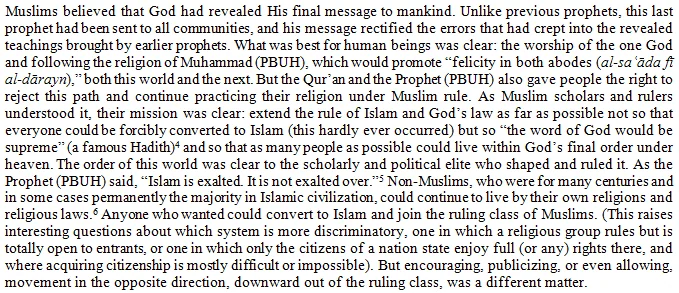
Within the logic of this order, to question Islam’s primacy is to undermine the societal framework itself. For this reason, all pre-modern Muslim schools of law treated apostasy as a serious crime, and the majority of scholars classified it among the ḥudūd (fixed-penalties) offenses, albeit with important distinctions.6 It is clear from how Muslim jurists described apostasy that they understood it primarily as a threat to the overarching political order, rather than as a crime in and of itself. The famous Ḥanafī jurist as-Sarakhsī stated: “Leaving Islam and embracing unbelief are grave offenses, but they lie between the servant (i.e., human being) and his Lord, and their punishment belongs in the Hereafter. Any punishments in this world [for apostasy] are siyāsāt mashrūʿah li-maṣāliḥ taʿūdu ilá al-ʿibād (policies sanctioned [by Sharīʿah] for the common good of human beings).” Indeed, someone who repeatedly and insistently proclaims apostasy from Islam is akin to a violent criminal threatening public safety. The common good that apostasy endangers is the Sharīʿah itself and the rights it pledges to protect for all its subjects, Muslim or non-Muslim alike: nafs (physical integrity: life and safety), māl (property), dīn (religion), ʿaql (reason), and ʿird (personal and family honor).7 However, unlike in the pre-modern “order under heaven” of Islamic civilization and Christendom (i.e., the collective Christian world of medieval and early modern Europe), in the modern world of nation-states religion either plays no role outside private life or is visibly subordinated to national identity. It is worth recalling that, following Martin Luther’s challenge to papal authority about five hundred years ago, Western Europe was plunged into over a century of devastating religious warfare, which finally ended when the warring monarchs agreed that the ruler of each kingdom would determine which sect of Christianity it would follow.8
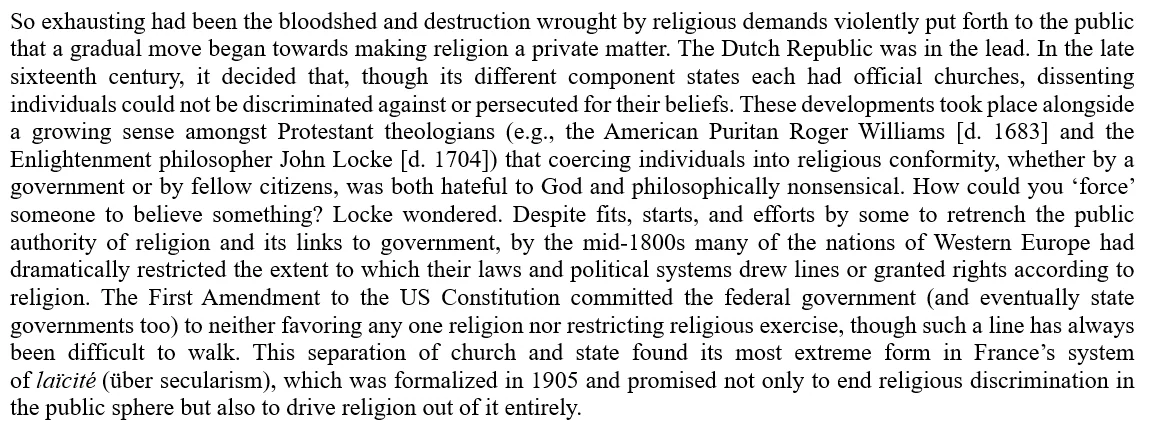
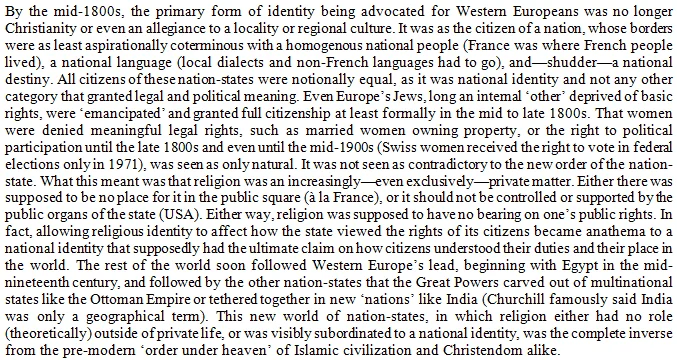
As religion declined as a formal force in the official life of Western Europe and its colonial offspring—countries shaped by European colonialism and influenced by European culture and institutions, such as the Americas, Australia, New Zealand, and other regions—the nation-state rose to take its place.9
It is not surprising that the official punishment for apostasy was severe in the public order of Dār al-Islām (lit. “Abode of Islam”)—that vast fabric of diverse kingdoms and peoples bound together by a belief in Islam’s legal order and in belonging to the nation of Prophet Muḥammad (PBUH). What chiefly shaped the Muslim juristic tradition’s position on apostasy was its understanding of order and identity. This, in fact, influenced the rules on apostasy more than any explicit prescription in the Qurʾān or the Prophet (PBUH)’s teachings. In all the classical schools of Islam, the prescribed punishment for an apostate is death. However, the jurists agreed that only the ruler could authorize this punishment, and that vigilantism—law enforcement carried out without legal authority by self-appointed individuals—was prohibited and punishable, since only a court or a qualified judge could declare someone an unbeliever. The ruling on apostasy rested primarily on three Prophetic traditions,10 which provide excellent examples of why such traditions must be interpreted in light of broader contextual and external evidence.11
For instance, it should be noted that Muslim scholars agreed that authorities should concern themselves only with outward expressions of apostasy, not with people’s private religious practice.12
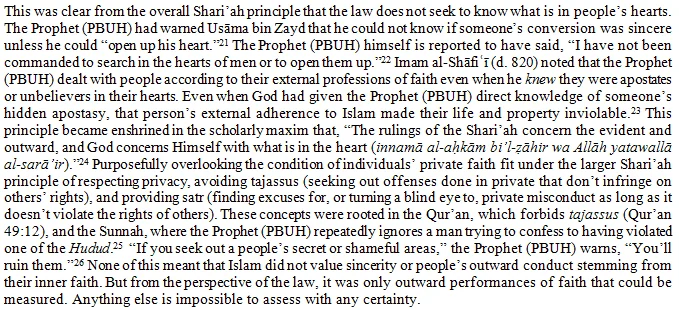
Hence, what is criminal about apostasy is its public dimension and the threat it poses to a public order grounded in a religious identity. The crime of apostasy in Islam is therefore more about protecting the state and the social order than policing individual beliefs. In other words, it is the public element of apostasy—not a person’s private decision to follow their conscience in changing their religion—that Islamic law addresses. It is precisely this characterization of apostasy as a public threat that explains why Muslim states historically showed so little interest in people’s private religious choices, and why centuries of Muslim jurists affirmed a ruling that seems to clash so clearly with the Qurʾān’s repeated statements on the freedom of religious choice.13

In fact, Muslim jurists’ placement of the topic of apostasy within their legal works further reveals that what concerned them was the public nature of apostasy and the way they believed it affected the political order.14
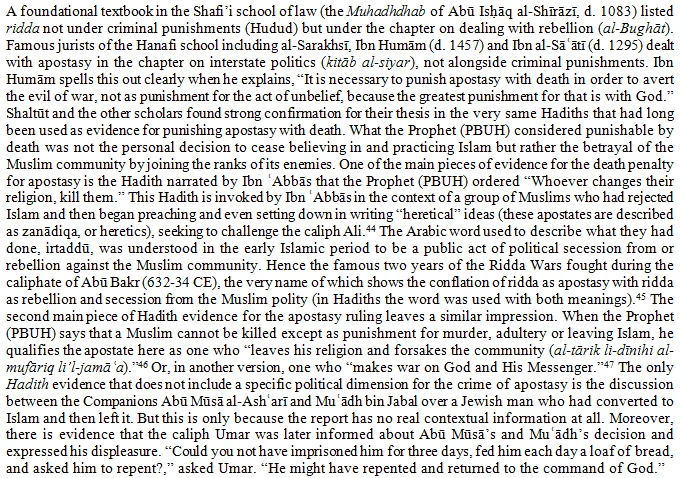
Hence, apostasy is punished only when it is perceived as a threat to public order. This is how the early Muslim community understood apostasy, as is most evident in the rulings of the Prophet (PBUH) himself and in the conduct of the early caliphs.15
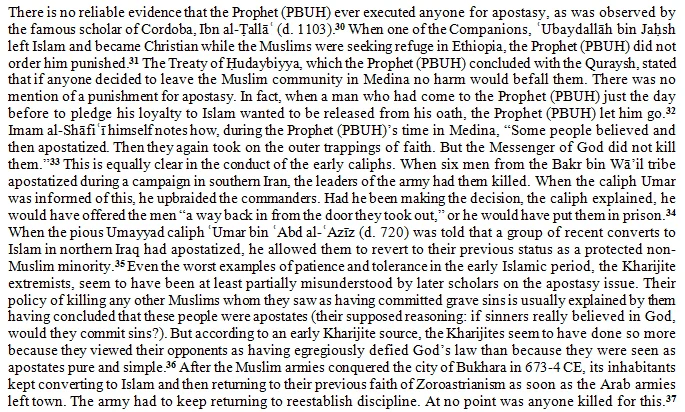
Of course, some people were executed for apostasy in the early Islamic period, yet in the cases where details are available, what stands out is the public nature of their apostasy and actions.16

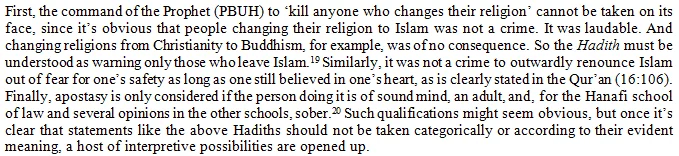
As Shaykh Maḥmūd Shaltūt—a scholar and reformer who held the highest religious office in Sunni Islam, that of Shaykh al-Azhar (Rector of al-Azhar), during the last five years of his life—explained, Islam does not punish kufr (disbelief) with death; rather, what is punishable by death is “fighting the Muslims, attacking them, and trying to split them away from their religion.”17 Accordingly, scholars such as Yūsuf al-Qaraḍāwī—one of the modern world’s most influential Muslim scholars—have compared the Islamic prescribed punishment for apostasy to the modern punishment for the crime of treason.18 As al-Qaraḍāwī clarified, there is no punishment for an individual’s decision to stop believing in Islam, since the Qurʾān explicitly states: {Let there be no compulsion in religion} (Qurʾān 2:256). However, those apostates who combine their leaving Islam with a public attempt to undermine the stability of the Muslim community are subject to the apostasy punishment. Hence, al-Qaraḍāwī introduced the distinction between ar-riddah al-mutaʿaddiyyah (transgressive apostasy) and ar-riddah al-qāṣirah (non-transgressive apostasy). The former—where a Muslim renounces their faith in a way that actively encourages others to do so or undermines communal stability—is subject to the apostasy punishment, whereas the latter—where one simply leaves Islam or embraces another religion privately—is left unpunished.19 Furthermore, it is worth noting that scholars disagreed on whether a Muslim who has renounced their religion should be given a chance to repent. Three Sunni schools of law required granting apostates a chance, while the Ḥanafis considered it recommended.20 The vast majority of Muslim scholars held that this chance to repent should be provided, based on a set of traditions in which the Prophet (PBUH) mentioned giving apostates a chance to change their minds, as well as on the precedent of the caliph ʿUmar, a renowned Companion of the Prophet (PBUH), who was displeased when he learned that an apostate had been killed. He suggested that the apostate should have been detained for three days, fed, and given a chance to reconsider his decision.21 Most legal scholars allowed apostates a period of three days or three chances to repent. Ibn Ḥanbal and Abū Ḥanīfah opined that apostates should be given a month to repent. Ibn Ḥazm reported one opinion, based on a ruling by the early jurist Ibrāhīm an-Nakhāʿī, that apostates could be asked if they wished to repent indefinitely.22
Again, in this ḥadīth,23 “a person who apostatizes from the religion and abandons the community” refers to someone who wages war against Allāh and His Messenger (PBUH). That is, the person who abandons his religion and the Muslim community is the one who apostatizes from Islam and then fights against Allāh and His Messenger (PBUH), not the person who merely becomes an apostate. Based on this, the ruling on apostates who are not involved in fighting against the Muslim community is not indicated in this ḥadīth. In other words, this ḥadīth does not address those who merely apostatize from Islam, but rather those who wage war against Allāh and His Messenger (PBUH), and it is established that the latter must be killed, whether they are Muslims or non-Muslims. Hence, in the Sharīʿah, the aim of punishing apostasy is to protect the communal faith and social order of a Muslim state. As previously elaborated, in the early days of Islam, apostasy was considered in the context of security and wartime conditions. The notion of apostasy in the time of the Prophet (PBUH) was therefore coupled with animosity toward Islam and the act of waging war against it: one who believed in the Prophet (PBUH) endeavored to support him, while one who committed apostasy sought to join the idolatrous community and fight against him. This explains why references to early capital punishment for apostasy were not due to apostasy itself, but rather to other capital crimes coupled with it. Indeed, apostasy posed a significant threat to the nascent Muslim community, and a passive attitude toward it would have jeopardized its very emergence. This is one reason why the consensus of scholars is that apostasy is a criminal offense within the context of an Islamic society.
It is clear from the above that apostasy is a grave offense, particularly in cases where it is not merely a private religious choice but a very public declaration of one’s reasons for leaving Islam—the apostate openly arguing for abandoning the faith and denigrating it. Public defamation of Islam should be understood as an infringement on the rights of others and a threat to their afterlife. That is, publicly attacking Islam is highly dangerous, as it may lead some to renounce their religion and thereby forfeit their Hereafter. Remarkably, some audacious, irreverent atheists demand permission to criticize and insult sanctities under the banner of freedom of expression, which is akin to a brigand asking to kill and rob people—an utterly inconceivable situation. Even more concerning is when these atheists attack religion and seek to spread atheism under the guise of freedom of expression. As previously noted, fitnah in religion—persecuting or tempting a Muslim to abandon their faith—is worse than theft or even murder, because apostasy threatens the eternal afterlife, whereas the transient worldly life is all that is lost if someone is killed. Our Lord says: {and fitnah is worse than killing} (Qurʾān 2:191).Indisputably, if someone chooses to disbelieve in their Lord or even worship a stone in the privacy of their home, they are free to do so. However, Islam criminalizes and severely punishes the act of publicly proclaiming one’s apostasy and spreading shubuhāt (specious arguments and doubts) about Islam—in the name of freedom of criticism of religion—with the aim of misleading Muslims and jeopardizing their faith. Indeed, this constitutes one of the gravest offenses in Muslim communities. If the apostate is someone struggling with doubts about Islam, these doubts would be addressed and clarified so that they may regain certainty in their faith. If the individual is seeking evidence for the validity of the religion of Islam, such evidence would be presented to them as long as there remains hope of their repentance, even if their search for the truth continues throughout their life. Ibn Taymiyyah related that an-Nakhāʿī said: “He whose repentance is conceivable should be continuously invited to repent and re-embrace his former faith (istitābah) indefinitely, by presenting proofs to him and dispelling his doubts, even if he remains in that state throughout his life.” This was also the view of Sufyān ath-Thawrī.24 However, Islam takes a firm stance against those who publicly proclaim their apostasy in order to lead others away from the faith, for such individuals are not sincere truth-seekers, but rather callers to disbelief.
It is legitimate to ask: Why do atheists object to murder, theft, and similar offenses, yet regard the defamation of Islam as normal and unobjectionable? The answer is quite simple. Atheists hold a flawed perception: they believe that any harm inflicted upon human beings—such as stealing from them or killing them—warrants punishment, whereas those who jeopardize people’s afterlife should not be punished because, in their view, criticizing religion is an exercise of personal freedom of speech. In other words, atheists have no objection to endangering people’s eternal afterlife, but they object to the slightest harm to people’s worldly life simply because they do not believe in the afterlife. Consequently, their worldview is purely materialistic, and they are unable to see matters in their proper perspective due to their disbelief. Nevertheless, they have no right to impose their inadequate worldview upon us. In Islam, destroying people’s worldly life is a crime, and so is destroying their afterlife—yet the latter is indisputably a far greater crime, for all worldly possessions and attractions are transient, whereas the afterlife is everlasting. The worldly life is, in truth, nothing more than a bridge leading to the final destination of eternity. Hence, attempts by atheists to spread disbelief are a thousand times more dangerous to people than highway robbery and murder. The worst that highway robbers can do is endanger a person’s worldly possessions and life; but those who tempt people to abandon their religion jeopardize their afterlife and rob them of it. Such individuals are thieves of the Hereafter and, without a doubt, the most dangerous of criminals. Ibn Taymiyyah [may Allāh have mercy on him] said: “Waging war against religion with the tongue can be more harmful than waging war against it with the hand.”25 That is, beautifying disbelief, distorting Islamic theological concepts, reversing moral notions, and casting doubts can be more dangerous to the Muslim community than even organized warfare.
Atheists might ask: Does Islam have the right to criminalize its defamation? The answer is yes—Islam unquestionably has the right to legislate measures that protect both people’s worldly life and their afterlife. Similarly, secular states enact laws to preserve their materialist, secular order, prohibiting challenges to so-called secular values and criminalizing acts that violate public order. In the same way, apostasy is punishable in Islam because it constitutes a violation of Allāh’s final order and poses a threat to the common good of humanity. The common good threatened by apostasy is the Sharīʿah itself and the right to religion—one of the fundamental rights it guarantees for all its subjects, whether Muslim or not. The essential point is that it is the unquestionable right of the Muslim state to prohibit tampering with the fundamentals of religion and to punish those who attempt to rob people of the Hereafter. Oddly enough, atheists want secular states to be the sole legislators and the only authorities with the right to maintain their order. One might ask: secular states allow criticism of any religion, do they not? Indeed, they do—but this is because religion is no longer the guiding spirit of secular nation-states. In other words, religion has been removed from the public sphere, confined to private life, and subordinated to national identity—a complete inversion of the pre-modern divinely ordained order of the world in Islamic civilization and Christendom, in which divine law shaped public life. Consequently, people in the modern secular West are free to criticize religion as they please, for the secular order has no sacred religious basis and is oriented entirely toward worldly matters. Yet, atheist secularists are intolerant of any criticism of the core values of their secular ideology. Funnily enough, in what can only be described as a kind of a secular heresy, sixteen European countries—as well as Canada and Israel—have enacted laws against Holocaust denial. These laws, which criminalize speech about historical events, raise several troubling concerns, for they clearly contradict what Amnesty International once described, in its 1985 criticism of the prosecution of various nationalists and other dissidents in what was then Yugoslavia, as “the non-violent exercise of internationally recognized human rights, in particular the right to freedom of expression.”26 The German penal code prohibits publicly denying the Holocaust and disseminating Nazi propaganda, both offline and online.27
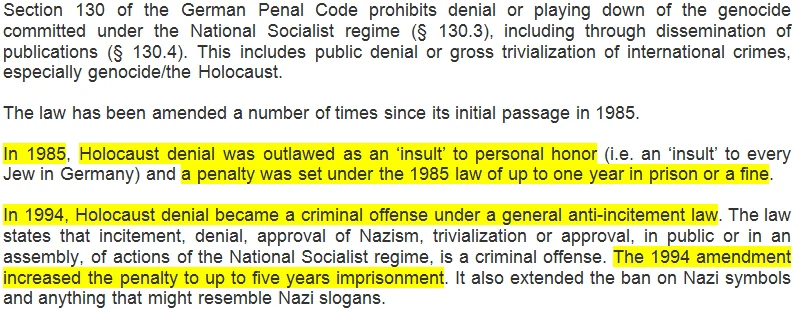
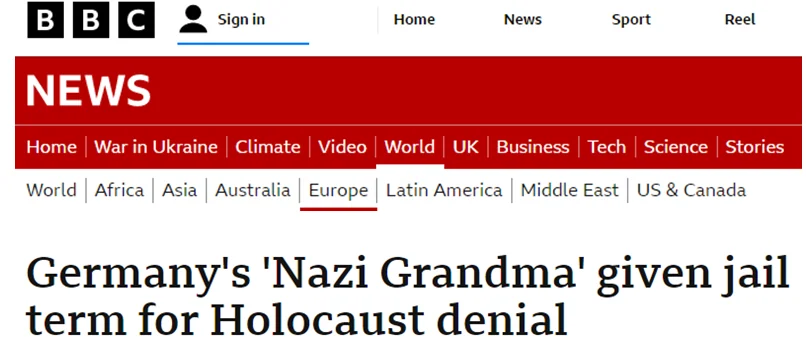
A German court sentenced an 89-year-old woman, Ursula Haverbeck—dubbed the “Nazi Grandma”—to 14 months in prison for Holocaust denial.28

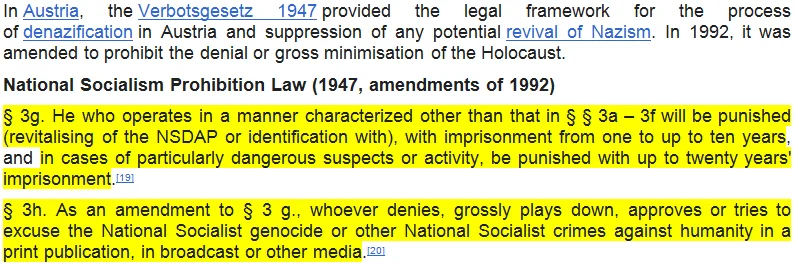
In Austria, the denial or gross minimization of the Holocaust is punishable by up to twenty years of imprisonment.29
In the Czech Republic, anyone who publicly denies, disputes, approves, or attempts to justify the Holocaust may be sentenced to six months to three years of imprisonment.30

Hence, given the enactment of genocide denial laws in secular states, it is disingenuous to invoke free speech as a justification for ridiculing religion and religious symbols. Put succinctly, the role of religion has changed dramatically in societies shaped by nationalism and Western secularism; religion has lost much of its social and cultural significance in the modern West. Therefore, criticizing religion is entirely permissible within the framework of the secular system. However, citizens of secular states are not permitted to violate secular values. For example, in some secular countries—such as France—the full Islamic veil is banned on the grounds that it violates the secular value of excluding conspicuous religious symbols from public life, and women who wear it are punished with a fine.31

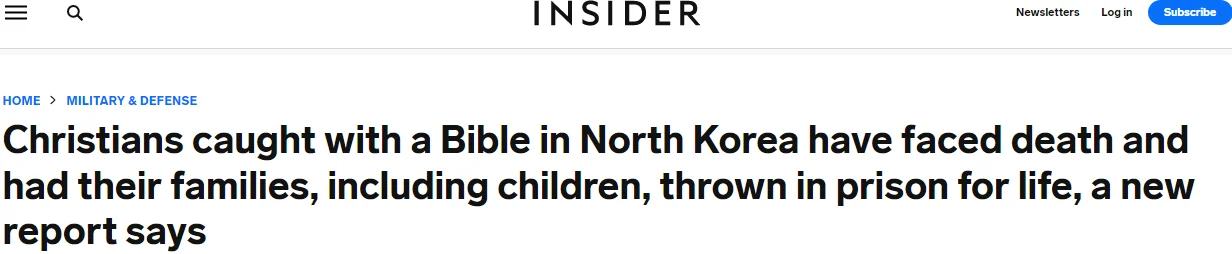
French secularists argue that such a law is necessary to uphold France’s secular values and way of life. They maintain that wearing the full Islamic veil undermines secularism and poses a threat to French national identity. Today, Western European countries have laws banning the full Islamic veil in public, burkini swimsuits on beaches, or headscarves in schools, all on the grounds that they allegedly violate public order—even though there is nothing inherently dangerous about headscarves or veils. Millions of Muslim women in dozens of countries wear these garments daily without their governments perceiving any threat to public order. Moreover, nuns in Western countries cover their hair and dress modestly, and secular face coverings such as balaclavas are commonly worn in cold weather. Rim-Sarah Alouane—a Ph.D. candidate in Public Law at the University of Toulouse 1 Capitole, whose research focuses on religious diversity, civil liberties, interfaith dialogue, and constitutional law—has observed that in the ongoing French controversy over headscarves and burkinis, the concept of public order has shifted from a reasonable desire to protect peace, health, and public safety to a tool used to justify and legitimate restrictions on freedom of religion.32 Even more alarming, Christians in North Korea who are caught with a Bible face the death penalty, and their families—including children—can be sentenced to life imprisonment.33
In fact, secular atheistic systems even criminalize experimental science when it happens to contradict their worldview, effectively “legislating” science to suit their political agenda. In doing so, they disregard genuine scientific inquiry in favor of research that validates their preferred ideology. Lysenkoism—a biological doctrine championed by Trofim Lysenko, which claimed that environmentally induced traits could be inherited—illustrates the disastrous consequences that arise when politics and ideology interfere with science. Lysenko enjoyed Stalin’s support, and his 1948 speech, which enabled him to dominate Soviet biology, was prepared in part by Stalin himself. He rejected the science of genetics—particularly the work of Gregor Mendel—as foreign, impractical, idealistic, and a product of “bourgeois capitalism,” even declaring the proponents of Mendelian genetics to be enemies of the people. More than 3,000 mainstream biologists were dismissed or imprisoned, and numerous scientists were executed in the campaign to suppress scientific opposition.34 The Soviet government imposed a complete ban on the practice and teaching of Mendelian genetics because, contrary to Mendel’s laws of inheritance, Lysenko believed that acquired traits could be inherited. He claimed that heredity could be altered by “educating” plants and denied the existence of genes. Lysenkoism was convenient for a Soviet government attempting to engineer a perfect social utopia. Under this system, the authorities believed they could rapidly force plants, animals, and even the Soviet people to meet practical objectives.35 The president of the Soviet Academy of Agriculture, Nikolai Vavilov—Russia’s most prominent botanist and geneticist, who had been Lysenko’s mentor but later denounced him—was arrested by the KGB on August 6, 1940, for his support of Mendelian genetics. He died in the Saratov prison on January 26, 1943. Remarkably, Vavilov taught himself 15 languages to communicate with native farmers. He is regarded as the world’s greatest plant explorer and is said to have collected more seeds, tubers, and fruits from around the world than any other person in history—over 200,000 specimens. Incidentally, a stony background asteroid discovered on May 15, 1977, by Soviet astronomer Nikolai Chernykh was named in honor of Vavilov and his physicist brother, Sergey Ivanovich Vavilov.36 Hence, genetics research in the Soviet Union was effectively destroyed, and teaching and investigation in neurophysiology, cell biology, and many other biological disciplines were severely disrupted or banned. Vadim J. Birstein’s The Perversion of Knowledge: The True Story of Soviet Science chronicles Soviet science under the control of the KGB and the Communist Party, revealing the dark side of this ostensibly glittering achievement.37 Drawing on Birstein’s firsthand experience as a Soviet scientist and extensive Russian-language sources not easily accessible to Western readers, the book presents shocking new information on biomedical experimentation on humans and examines the pernicious effects of Lysenko’s pseudo-biology. It also includes poignant case histories of scientists and researchers who collaborated and those who resisted, highlighting the moral choices and their consequences. Indeed, subordinating science to a preferred ideological outlook and depriving researchers of the freedom to explore new and existing ideas can have devastating repercussions. The results of Lysenkoism were therefore inevitable: Soviet biology nearly ground to a halt until a series of crop failures and ensuing food shortages forced Lysenko’s removal in 1965, although his influence had already begun to wane after Stalin’s death in 1953.
A final question: Are apostates dangerous? History indeed shows that, in certain cases, individuals who abandon a belief system and turn violently against it have caused immense harm. It is no exaggeration to say that one apostate can prove more dangerous than all the bandits and murderers combined. One such example is Enver Hoxha—an apostate and a bizarre, sociopathic, utterly deranged, mass-murdering dictator who ruled the small Balkan nation of Albania from 1944 to 1985. As a hardline Stalinist, Hoxha’s party emphasized atheist education in schools and promoted secularism in place of Abrahamic religions. He employed coercive tactics to suppress religious practice, ordering the demolition or conversion of all 2,169 churches and mosques in Albania into secular facilities (such as sports arenas and warehouses), the killing of nearly all Catholic priests who had been in the country before the Communist takeover, and the arrest of those religious figures who refused to embrace the principles of Marxism–Leninism.38

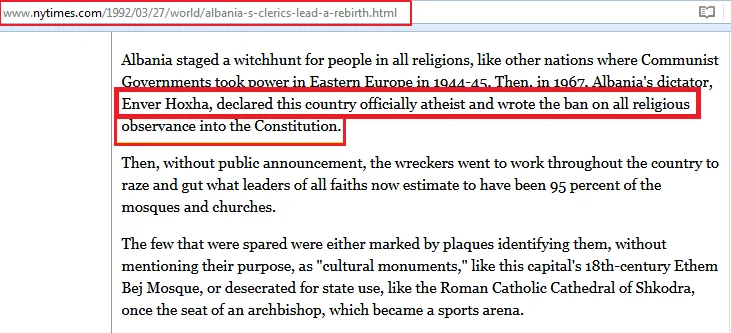
Hoxha declared Albania an officially atheist state and banned religion by a constitutional decree.39
Hoxha ruled Albanians with unimaginable cruelty for more than four decades, executing rivals within his own party—including those he had praised as war heroes only a few years earlier—and crushing all dissidents as he had the clergy and the aristocrats. By the time he died, Albania was officially the third-poorest country in the world.40

These horrors were the result of a single apostate coming to power. Tragically, Hoxha—the lunatic who took over the asylum—held an entire country hostage for forty years and faced no consequences. This clearly demonstrates that apostasy is among the gravest threats to both people’s religion and their welfare in this worldly life.
In a nutshell, atheistic systems do not object to the questioning of religion, which is only natural since secularism and materialism are their core values, and secularists seek to enforce penalties solely against those who violate secular laws. In contrast, the preservation of religion is one of al-maqāṣid aḍ-ḍarūriyyah (the essential objectives) of Islam. Accordingly, Islam does not permit the defamation of religion or the propagation of disbelief among people. It should be understood that, in an important sense, Muslim issues are truly global, human issues.41

Apostasy is a capital crime in Islamic law because it threatens the integrity and stability of the Muslim community and state. As discussed above, the penalty prescribed in the Islamic juristic tradition depends on the public interest of the community. Therefore, there is no harm in overlooking an individual’s apostasy as long as they do not endanger the community. Conversely, if an apostate jeopardizes the security and interests of the community, the Muslim ruler would regard them as a threat and impose the death penalty should they refuse to repent after being duly invited to do so.
Notes and References
- 1
Simon Cottee, The Apostates: When Muslims Leave Islam, (London, U.K.: Hurst Publishers, 2015), pp. 13–16 as cited in Jonathan Brown, “The Issue of Apostasy in Islam,” Yaqeen Institute, updated 21 Oct. 2020, https://yaqeeninstitute.org/read/paper/the-issue-of-apostasy-in-islam.
- 2
Jonathan Brown, “The Issue of Apostasy in Islam,” Yaqeen Institute, updated 21 Oct. 2020, https://yaqeeninstitute.org/read/paper/the-issue-of-apostasy-in-islam.
- 3
Abū al-Ḥasan al-Māwardī, Adab ad-Dunyā wa-ad-Dīn, (Cairo, Egypt: Dār al-Fārūq, 2008), pp. 183–4.
- 4
The ʿAhd Ardishīr was produced in the late Sassanid period; Beate Dignas and Engelbert Winter, Rome and Persia in Late Antiquity, (Cambridge, U.K.: Cambridge University Press, 2007), p. 211; Iḥsān ʿAbbās, ʿAhd Ardishīr, (Bayrut, Lebanon: Dār Ṣādir, 1967), p. 30 as cited in Jonathan Brown, “The Issue of Apostasy in Islam,” Yaqeen Institute, updated 21 Oct. 2020, https://yaqeeninstitute.org/read/paper/the-issue-of-apostasy-in-islam.
- 5
Jonathan Brown, “The Issue of Apostasy in Islam,” Yaqeen Institute, updated 21 Oct. 2020, https://yaqeeninstitute.org/read/paper/the-issue-of-apostasy-in-islam.
- 6
Wahbah az-Zuḥaylī, Mawsūʿat al-Fiqh al-Islāmī, (Damascus, Syria: Dār al-Fikr, 2010), vol. 5, pp. 714–15 as cited in ibid.
- 7
Shams ad-Dīn as-Sarakhsī, al-Mabsūṭ, (Bayrut, Lebanon: Dār al-Maʿrifah, n.d.), vol. 10, p. 110.
- 8
Jonathan Brown, “The Issue of Apostasy in Islam,” Yaqeen Institute, updated 21 Oct. 2020, https://yaqeeninstitute.org/read/paper/the-issue-of-apostasy-in-islam.
- 9
Ibid.
- 10
Muḥammad al-Bukhārī, Ṣaḥīḥ al-Bukhārī, (Cairo, Egypt: Dār as-Salām. 1999), book: 9, ḥadīth:1214, available at: https://sunnah.com/bulugh/9/46: On the authority of Ibn ʿAbbās [may Allah be pleased with them both], he said: The Messenger of Allah (peace and blessings be upon him) said, “Whoever changes his religion, put him to death.”
---., book: 93, ḥadīth:21, https://sunnah.com/bukhari:7157: On the authority of Abū Mūsá: A man embraced Islam and then adopted Judaism. Muʿāḏ ibn Jabal came while he was with Abū Mūsá and said, “What is wrong with this [man]?” He replied, “He embraced Islam and then adopted Judaism.” Muʿāḏ said, “I will not sit until I kill him—this is the judgment of Allah and His Messenger (peace and blessings be upon him).”
---., book: 87, ḥadīth: 17, https://sunnah.com/bukhari:6878: On the authority of ʿAbd Allāh, he said: The Messenger of Allah (peace and blessings be upon him) said, “The blood of a Muslim who bears witness that there is no god but Allah and that I am the Messenger of Allah is not permissible [to shed] except in one of three cases: a life for a life (retaliation for murder), a married person who commits adultery, or a person who apostatizes from the religion and abandons the community.”
- 11
Jonathan Brown, “The Issue of Apostasy in Islam,” Yaqeen Institute, updated 21 Oct. 2020, https://yaqeeninstitute.org/read/paper/the-issue-of-apostasy-in-islam.
- 12
Ibid.
- 13
Ibid.
- 14
Ibid.
- 15
Ibid
- 16
Ibid.
- 17
Maḥmūd Shaltūt, al-Islām ʿAqīdah wa-Sharīʿah, (Cairo, Egypt: Dār ash-Shurūq, 2019), p. 281.
- 18
Yūsuf al-Qaraḍāwī, al-Ḥurriyyah ad-Dīniyyah wa-at-Taʿaddudiyyah, (Bayrut, Lebanon: al-Maktab al-Islāmī, 2007), pp. 36–37, 46–53.
- 19
Ibid.
- 20
Al-Mawsūʿah al-Fiqhiyyah al-Kuwaytiyyah (Kuwaiti Encyclopedia of Islamic Jurisprudence), (Kuwait, Kuwait: Ministry of Endowments and Islamic Affairs, 1983), vol. 3, p. 175.
- 21
Mālik ibn Anas, al-Muwaṭṭaʾ, (Bayrūt, Lebanon: Dār al- Ġarb al-Islāmī, 1997), book: 36, ḥadīth: 1420, available at: https://sunnah.com/urn/514190.
Mālik narrated to me, on the authority of ʿAbd ar-Raḥmān ibn Muḥammad ibn ʿAbd Allāh ibn ʿAbd al-Qāriyy, from his father, that he said: A man came to ʿUmar ibn al-Khaṭṭāb from the side of abū Mūsá al-Ashʿarī. ʿUmar asked him about the people and he informed him. Then ʿUmar asked him, “Was there any unusual news among you?” He replied, “Yes, a man became an unbeliever after embracing Islam.” ʿUmar asked, “What did you do with him?” He said, “We brought him forward and struck off his neck.” ʿUmar said, “Why did you not confine him for three days, feed him a loaf of bread each day, and call him to repentance, so that perhaps he would repent and reconsider the matter of Allah?” Then ʿUmar said, “O Allah, I neither witnessed this, nor did I command it, nor was I pleased when it was reported to me.”
- 22
Abū Muḥammad ʿAlī ibn Aḥmad ibn Saʿīd ibn Ḥazm al-ʾAndalusī, Kitāb al-Muḥallá, (Bayrūt, Lebanon: Dār al-Kutub al-ʿIlmiyyah, 2003), vol. 11, p. 191; Abū Bakr Aḥmad ibn Ḥusayn al-Bayhaqī, as-Sunan al-Kubrá, (Bayrut, Lebanon: Dār al-Kutub al-ʿIlmiyyah, 2003), vol. 8, p. 343.
- 23
Muḥammad al-Bukhārī, Ṣaḥīḥ al-Bukhārī, (Cairo, Egypt: Dār as-Salām. 1999), book: 87, ḥadīth: 17, available at: https://sunnah.com/bukhari:6878.
On the authority of ʿAbd Allāh, he said: The Messenger of Allah (peace and blessings be upon him) said, “The blood of a Muslim who bears witness that there is no god but Allah and that I am the Messenger of Allah is not permissible [to shed] except in one of three cases: a life for a life (retaliation for murder), a married person who commits adultery, or a person who apostatizes from the religion and abandons the community.”
- 24
Aḥmad ibn ʿAbd al-Ḥalīm ibn Taymiyyah, aṣ-Ṣārim al-Maslūl, (Bayrūt, Lebanon: Dār al-Kutub al-ʿIlmiyyah, 1998), vol. 3, p. 598.
- 25
Ibid., vol. 3, p. 735.
- 26
Amnesty International, Yugoslavia: Prisoners of Conscience, (London, U.K.: Amnesty International Publications, 1985), pp. 9–10 as cited in Robert M. Hayden, “‘Genocide Denial’ Laws as Secular Heresy: A Critical Analysis with Reference to Bosnia,” Slavic Review, vol. 67, no. 2, 2008, pp. 384–407, JSTOR, http://www.jstor.org/stable/27652849.
- 27
Michael J. Bazyler, “Holocaust Denial Laws and Other Legislation Criminalizing Promotion of Nazism,” Yad Vashem, accessed 12 June 2023, https://www.yadvashem.org/holocaust/holocaust-antisemitism/holocaust-denial-laws.html.
- 28
“Germany’s ‘Nazi Grandma’ Given Jail Term for Holocaust Denial,” BBC News, 29 Nov. 2017, https://www.bbc.com/news/world-europe-42164853.
- 29
“Legality of Holocaust Denial,” Wikipedia: The Free Encyclopedia, last edited 21 May 2023, https://en.wikipedia.org/wiki/Legality_of_Holocaust_denial.
- 30
Ibid.
- 31
Tony Todd, “Ban on Full Islamic Veil Comes into Force,” France 24, updated on: 11 Apr. 2011, https://www.france24.com/en/20110411-france-ban-full-islamic-veil-sarkozy-ump-muslim-law-police-secularism-burqa.
- 32
Rim-Sarah Alouane, “Freedom of Religion and the Transformation of Public Order in France,” The Review of Faith & International Affairs, vol. 13, issue 1, 2015, p. 32.
- 33
Ryan Pickrell, “Christians Caught with a Bible in North Korea Have Faced Death and Had their Families, including Children, Thrown in Prison for Life, a New Report Says,” Insider, 26 May 2023, https://www.businessinsider.com/getting-caught-christian-north-korea-death-life-in-prison-report-2023-5.
- 34
“Lysenkoism,” Scholarly Community Encyclopedia, updated on: 02 Nov. 2022, https://encyclopedia.pub/entry/32380.
- 35
Sarah Zielinski, “When the Soviet Union Chose the Wrong Side on Genetics and Evolution,” Smithsonian Magazine, 1 Feb. 2010, https://www.smithsonianmag.com/science-nature/when-the-soviet-union-chose-the-wrong-side-on-genetics-and-evolution-23179035/.
For example, Lysenko claimed that he changed a species of spring wheat into a winter wheat in just a few years. Of course, this was impossible—particularly since the spring wheat species had two sets of chromosomes and the winter wheat had three—and more likely his experiment had been contaminated. But Lysenko held great power and his claims were rarely challenged.
- 36
“(2862) Vavilov,” in Lutz D. Schmadel, Dictionary of Minor Planet Names, (Berlin, Germany: Springer, 2003), p. 235. DOI: https://doi.org/10.1007/978-3-540-29925-7_2863.
- 37
Vadim J. Birstein, The Perversion of Knowledge: The True Story of Soviet Science, (Boulder, U.S. and Oxford, U.K.: Westview Press, 2001), available at: https://archive.org/details/B-001-003-864/page/n13/mode/2up.
- 38
“Enver Hoxha,” Wikipedia: The Free Encyclopedia, last edited 11 June 2023, https://en.wikipedia.org/wiki/Enver_Hoxha#:~:text=He%20was%20elected%20First%20Secretary,de%20facto%20head%20of%20state.
- 39
Henry Kamm, “Albania’s Clerics Lead a Rebirth,” The New York Times, 27 March 1992, https://www.nytimes.com/1992/03/27/world/albania-s-clerics-lead-a-rebirth.html.
- 40
Alex Sakalis, “Enver Hoxha: The Lunatic who Took over the Asylum,” Open Democracy, 15 March 2016, https://www.opendemocracy.net/en/can-europe-make-it/enver-hoxha-lunatic-who-took-over-asylum/.
- 41
Jonathan Brown, “The Issue of Apostasy in Islam,” Yaqeen Institute, updated 21 Oct. 2020, https://yaqeeninstitute.org/read/paper/the-issue-of-apostasy-in-islam.