How can we come to know Allāh?
There is no doubt that knowing Allāh is the greatest and most noble of all knowledge. There are numerous paths and means through which one may come to know Him. It may even be said that the ways of knowing Allāh are as many as the people themselves, given the differences in their intellects and capacities for understanding. However, in the following pages, we will explore the four principal ways by which Allāh may be known.
Knowing Allāh through the human fiṭrah (divinely endowed innate monotheistic disposition): Fiṭrah refers to the natural faculty of knowing Allāh that He has instilled within all human beings. Every person is born upon this state, in which tawḥīd—the affirmation of Allāh’s Oneness and uniqueness, without partner or peer in His Essence and Attributes—is intrinsic. In other words, fiṭrah is the instinctive and natural inclination of the human soul toward recognizing and submitting to its Creator. Deep within, every person knows that he has a Maker who fashioned him in a perfect and astonishing design—for the human body is truly a divine masterpiece in both its structure and function. Man also intuitively understands that his very purpose—his raison d’être—is to know, worship, and serve Allāh. The Qurʾān affirms that fiṭrah is a universal and unchanging element of human nature, and that it is Allāh’s will that mankind remain firm upon this original state, as indicated in the following verse: {So be steadfast in faith in all uprightness ˹O Prophet˺—the natural Way of Allāh which He has instilled in ˹all˺ people. Let there be no change in this creation of Allāh. That is the Straight Way, but most people do not know} (Qurʾān 30:30). Man’s natural disposition, or constitution, known as fiṭrah, is none other than his innate spiritual nature— the very nature alluded to in the verse concerning the Primordial Covenant: {And ˹remember˺ when your Lord brought forth from the loins of the children of Adam their descendants and had them testify regarding themselves. ˹Allāh asked,˺ “Am I not your Lord?” They replied, “Yes, You are! We testify.” ˹He cautioned,˺ “Now you have no right to say on Judgment Day, ‘We were not aware of this’} (Qurʾān 7:172). That is, Allāh took a covenant from the progeny of Adam in a prior existence—before they assumed their worldly forms. This covenant has not been erased from the memory of Adam’s descendants, and not a single soul has forgotten it. It is this fiṭrah, instilled deep within our hearts and souls, that compels us to believe in Allāh and yearn to know and worship Him. However, this fiṭrah can be altered by the way in which one is raised. The evidence for this lies in the well-known ḥadīth reported by al-Bukhārī and Muslim: “Every newborn is born in a state of fiṭrah (the divinely endowed innate monotheistic disposition i.e., Islām); it is only his parents who make him a Jew, a Christian, or a Magian.”1 Hence, Allāh has created human beings with the innate capacity to know their Creator through internal, instinctive knowledge. In other words, they do not require external means to recognize Allāh; if they turn inward and reflect deeply upon their own souls, they will come to understand that they are created and that they have a Lord. This inborn awareness is sufficient for any sincere seeker of truth to recognize it and submit to it once it becomes evident. Every individual, by virtue of this God-given instinct, possesses a natural inclination toward the pure religion and feels a connection to it. However, this fiṭrah can at times become dormant—particularly in corrupt and spiritually degraded environments that lack any form of reminder or call to the Lord. In such settings, people become absorbed in material life and give little or no thought to matters beyond the physical world, allowing this innate knowledge of Allāh to lie hidden. Yet, fiṭrah often resurfaces in moments of hardship and distress. In times of danger and helplessness, this deeply rooted awareness is stirred and reawakened. How many committed atheists have found themselves instinctively raising their hands toward the sky in supplication when afflicted by calamity! The following verse illustrates this reality: {When you are touched with hardship at sea, you ˹totally˺ forget all ˹the gods˺ you ˹normally˺ invoke, except Him. But when He delivers you ˹safely˺ to shore, you turn away. Humankind is ever ungrateful} (Qurʾān 17:67). This is clear proof that man’s innate nature recognizes no Lord but Allāh, and deep within his heart, he senses that Allāh alone holds true power over all benefit and harm. Were this not the case, a person would not instinctively call upon Allāh in moments when he knows no one else can relieve his hardship. The well-known saying, “There are no atheists in the trenches,” is particularly relevant here. Its earliest known use appears to be from The Western Times newspaper of Devon, England, dated November 6, 1914, which reported on a memorial service for a fallen soldier held at St. Matthias’ Church in Ilsham. During the service, a speaker read from a letter written by an unnamed chaplain serving at the Front, who stated: “Tell the Territorials and soldiers at home that they must know God before they come to the front if they would face what lies before them. We have no atheists in the trenches. Men are not ashamed to say that, though they never prayed before, they pray now with all their hearts.”2 This saying later made its way to the United States and became widespread during the Second World War, with the word “trenches” often replaced by “foxholes.” On February 7, 1954, it was quoted by President Dwight D. Eisenhower during a radio address from the White House, delivered as part of an American Legion initiative called “Back to God.” Eisenhower, who had served as the Supreme Commander of the U.S. armed forces in World War II, offered the following words of spiritual encouragement: “As a former soldier, I am delighted that our veterans are sponsoring a movement to increase our awareness of God in our daily lives. In battle, they learned a great truth-that there are no atheists in the foxholes. They know that in time of test and trial, we instinctively turn to God for new courage and peace of mind. All the history of America bears witness to this truth.3 Hence, turning to Allāh for protection in times of adversity and despair is an expression of the fiṭrah—the innate, God-knowing nature engraved upon the human soul. Every person is born in this state: a natural inclination to submit to Allāh’s will and to seek Him in moments of distress.
Knowing Allāh through al-ʿaql (reason/intellect): Al-ʿaql, the God-given faculty of understanding and discerning truth, holds an elevated status in Islam. It is through reason that one can arrive at the certainty that Allāh is the Creator of the world and the One who has subjected it to universal laws. The oneness of Allāh rests on sound logic and rational thought. The Qurʾān repeatedly encourages the use of intellect, as it enables human beings to think critically, distinguish right from wrong, and recognize truth from falsehood. The truths revealed by Allāh in the Qurʾān are entirely rational and accessible to anyone who reflects upon them. For instance, it is self-evident that human beings did not create themselves, for something that does not yet exist cannot bring itself into existence. Nor did they emerge without a creator, as nothing comes from nothing. It is also clear that this vast universe was not brought into being by human hands. Therefore, it follows logically that the Creator of both humanity and the universe is Allāh alone. Allāh appeals to human reason in the Qurʾān, saying: {Or were they created by nothing, or are they ˹their own˺ creators? Or did they create the heavens and the earth? In fact, they have no firm belief ˹in Allāh˺} (Qurʾān 52:35–36). This is such a pungent and piercing question that it shakes the very foundations of both atheism and polytheism. Al-Bukhārī and Muslim report that after the Battle of Badr, Jubayr ibn Muṭʿim came to al-Madīnah to negotiate the release of Quraysh prisoners of war on behalf of the people of Makkah. At that time, the Prophet (PBUH) was leading the maġrib (sunset) prayer and recited Chapter aṭ-Ṭūr. Jubayr, who was still a disbeliever then, later recounted that when the Prophet (PBUH) reached the verses (Qurʾān 52:35–36), “my heart almost flew (from the power of the reasoning in those verses). This was the first time that faith entered my heart.” Indeed, sound reason is always in harmony with the guidance of the Qurʾān and the authentic Sunnah.4 Indeed, sound reason is always in alignment with the guidance of the Qurʾān and the authentic Sunnah.
Knowing Allāh through the contemplation of His creation: Allāh has brought into existence an endless array of things to serve as subjects for reflection. Everything we see and perceive is, in truth, a manifestation and sign of Allāh. In the Qurʾān, Allāh calls upon people to come to know and recognize Him through reflecting on the marvels of His creation. He says: {Say, ˹O Prophet,˺ “Consider all that is in the heavens and the earth!”} (Qurʾān 10:101). And He says: {Indeed, in the creation of the heavens and the earth; the alternation of the day and the night; the ships that sail the sea for the benefit of humanity; the rain sent down by Allāh from the skies, reviving the earth after its death; the scattering of all kinds of creatures throughout; the shifting of the winds; and the clouds drifting between the heavens and the earth—˹in all of this˺ are surely signs for people of understanding} (Qurʾān 2:164). The entire universe is filled with signs that unmistakably testify to the existence, oneness, and attributes of Allāh—signs that are readily recognized by those who observe and reflect with open eyes and open hearts. In essence, the vast expanse of the universe laid out before us serves as a majestic introduction to Allāh.5
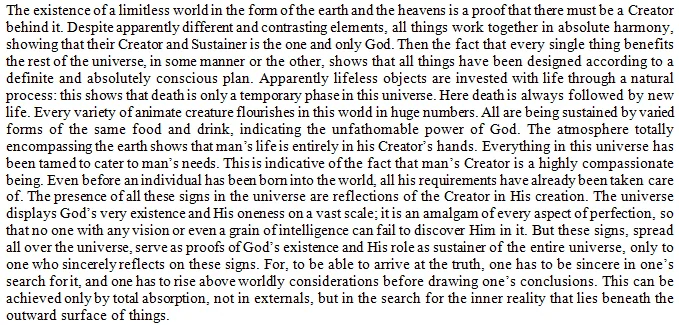
Indeed, for people of understanding, everything around them stands as a testimony to the greatness of Allāh.
Knowing Allāh through His Messengers and Prophets: Waḥy (Divine revelation) is the highest and most authoritative source of knowledge about Allāh. Alongside the other natural means of divine guidance—namely, man’s innate recognition of his Creator, the use of reason and intellect, and the observable signs in the universe— Allāh also sent Prophets and Messengers to mankind so that no one could excuse their misconduct by claiming ignorance of the divine plan for how human beings are meant to live their lives. All Prophets and Messengers brought the same religion, Islām, and upheld the same creed: belief in the Oneness of Allāh. As Maulana Wahiduddin Khan stated: “from start to finish, this divine plan necessitated all of the Prophets bringing the same message and the same mission to mankind. For, when all human beings without exception are to be weighed in the divine scale, how could their ‘test papers’ be different from one another?’’6 Moreover, they all taught that Allāh possesses all perfect attributes and bears no resemblance to any of His creation. They conveyed what Allāh commanded us to do and what He forbade us from in this life. They also taught about the Day of Judgment, when each person will be held accountable for whether or not they fulfilled their obligations. Not one of them preached anything that contradicted the belief in the Oneness of Allāh, and all of them instructed their followers to believe in every other Prophet sent by Allāh. In short, the essential mission of all the Prophets and Messengers was the same: to give glad tidings to those who obey Allāh and do what pleases Him, and to warn those who defy His commands of His punishment and retribution: {˹All were˺ messengers delivering good news and warnings so humanity should have no excuse before Allāh after ˹the coming of˺ the messengers. And Allāh is Almighty, All-Wise} (Qurʾān 4:165). That is, Allāh’s purpose in sending the Prophets and Messengers was to ensure that no one would have any excuse before Him.7

Hence, after Allāh has sent Prophets and Messengers accompanied by miracles, and after they have made clear the straight path of truth and explained what Allāh loves and is pleased with and what He dislikes and is displeased with, no one will have any excuse before Allāh.8

In short, human beings are all too prone, amid the comfort and ease of daily life, to forget their Lord. It is therefore in His mercy and wisdom that Allāh sent Prophets and Messengers to awaken and stir the fiṭrah, reminding people of their true religion and guiding them toward the fulfillment of their purpose: serving their Lord. Since tawḥīd (monotheism) is innate to the human being and rooted in his primordial nature, the Prophets and Messengers [peace be upon them] were sent to call him back to that which is already embedded in his original disposition.
Notes and References
- 1
Agreed upon ḥadīth, Muḥammad al-Bukhārī, Ṣaḥīḥ al-Bukhārī, (Cairo, Egypt: Dār as-Salām. 1999), book: 23, ḥadīth: 112, available at: https://sunnah.com/bukhari:1359; Muslim ibn al-Ḥajjāj, Ṣaḥīḥ Muslim, (Bayrūt, Lebanon: Dār al-Kutub ʿIlmiyyah, 2020), book: 46, ḥadīth: 37, available at: https://sunnah.com/muslim:2658e.
- 2
“Col. Burn’s Late Son: Torquay’s Expression of Sincere Sympathy,” The Western Times, 6 Nov. 1914, quote page 8, column 3 as cited in quoteresearch, “There Are No Atheists in Foxholes”, Quote Investigator®, 2 Nov. 2016, https://quoteinvestigator.com/2016/11/02/foxhole/.
- 3
Rick Chromey, ““Back to God”: The Spiritual Message and Power of Dwight D. Eisenhower,” Dr. Rick Chromey: History. Culture. Faith, 11 Nov. 2021, http://rickchromey.com/back-to-god-the-spiritual-message-and-power-of-dwight-d-eisenhower/.
- 4
Abū ʿAbd Allāh ibn Mājah, Sunan Ibn Mājah, (Cairo, Egypt: Dār at-Taʾṣīl. 2014), book 5, ḥadīth: 30, available at: https://sunnah.com/ibnmajah:832.
- 5
Maulana Wahiduddin Khan, Tazkirul Quran, (Noida, India: Goodword Books, 2012), Chapter al-Baqarah (Qurʾān 2:164), p. 63, footnote a, available at: https://archive.org/details/CPS-TQE/page/62/mode/2up?view=theater.
- 6
Maulana Wahiduddin Khan, Tazkirul Quran, (Noida, India: Goodword Books, 2012), Chapter an-Nisāʾ (Qurʾān 4:165), p. 266, footnote a, available at: https://archive.org/details/CPS-TQE/page/266/mode/2up?view=theater.
- 7
Sayyid abū al-Aʿlá al-Mawdūdī, Towards Understanding the Qurʾān (English version of Tafhīm al-Qurʾān), trans. and edit. Zafar Isḥāq ʾAnṣārī, (Markfield, U.K.: The Islamic foundation, 1988), Chapter an-Nisāʾ (Qurʾān 4:165), footnotes 207 and 208, available at: https://www.islamicstudies.info/tafheem.php?sura=4&verse=163&to=166.
- 8
Muḥammad Shafīʿ ibn Muḥammad Yāsīn ʿUsmānī Deobandī, Maʿārif-ul-Qurʾān: A Comprehensive Commentary of the Holy Qurʾān, trans. Muḥammad Hasan Askari and Muhammad Shamīm, (Karachi, Pakistan: Maktaba-e-Darul-ʿUloom, 2010), Chapter an-Nisāʾ (Qurʾān 4:165), pp. 633–634, available at: https://islamicstudies.info/quran/maarif/maarif.php?sura=4&verse=163.